PR051 - Syria UAP 2021- Apparent Instantaneous Acceleration

Interesting how the clouds are flowing through the frame constantly from right to left, until right when the "UFO" zips out of frame, when they slow right down. Almost as if the camera is following the UFO, then stops doing that so the UFO exits the right of the screen.

This is all consistent with the object flying along at a constant rate of speed (or a constant apparent speed produced by a moving camera and parallax for an essentially stationary object like a balloon). There is no observable evidence of acceleration in either case, instantaneous or otherwise!

Yet somebody in DoD is releasing this as an object flying in an anomalous fashion. This raises some ominous and unavoidable questions about the competence of some number of folks at DoD -- hopefully the number is small, and limited to either folks who Want To Believe or who Want To Mollify Congressional Members Who Want To Believe.
 
Last edited:
The segment in question


The video quality is quite a bit better than Corbell releases, you can actually see the interlacing artifacts, so it's much closer to the original, and you can see:

he clouds are flwoing through the frame constantly from right to left, until right when the "UFO" zips out of frame, when they slow right down. Almost as if the camera is following the UFO, then stops doing that so the UFO exits the right of the screen.
Which is also what the Sitrec analysis shows.
 
It seems that the official release has a few more seconds to it, with another change of mode and extended view.
Would be interesting to check if the object should be in the frame then (and if it can be found).
 
It seems that the official release has a few more seconds to it, with another change of mode and extended view.
Would be interesting to check if the object should be in the frame then (and if it can be found).
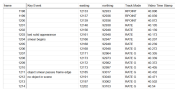
It (visually) traverses hald the most zoomed-in screen in 6 frames, so 12 frames for, let's call it an "1a" screen . leaving at 8562
30 frames later, without the view moving much, the view widens to 2a
70 frames after that it zooms out another 2a to 4a, over those 70 frames it pans maybe 1.5 of the 2a screen, or 3 1a screens
at 8841, we widen to 8a
at 8907, we go to what looks like 6x that, so 48a
8907-8562 = 345 frames, so it would have traversed 345/12, or about 28 1a screens, which is more than half of the wide 48a screen, so it would seems like it would be off screen.
 
It seems that the official release has a few more seconds to it
Some perhaps more interesting few seconds, are from frames 5784 (3:11.10) to 7352 (4:05.07), nearly a minute of video missing from Corbell's leak, in which the object appears to turn around, in much the same way as the windmill object does. The OSD here would, I strongly suspect, show that it matches the camera platform (the drone) turning around, and hence showing that the motion was parallax. I wonder if Corbell had this segment, and why it was not included in the release.
 
Yet somebody in DoD is releasing this as an object flying in an anomalous fashion. This raises some ominous and unavoidable questions about the competence of some number of folks at DoD
Unless I am mistaken, this was not collected because it was flying in an anomalous fashion, but because someone sent it to the collection office. They wouldn't analyze, they would just file it. Someone else will analyze, maybe, if they consider it worthwhile.

For example, consider the effort to collect phone calls. They just file every one that hits some keywords. Only later, if someone deems it interesting, does anyone go in and look.

So my feeling is that the people in question were doing exactly what they were hired to do, file it.
 
There appear to be some duplicate frames in the new video. E.g just before the zip off frame 634 is identical to frame 635. What might've caused that and what are the implications for the analysis of the rest of the video ?
 
There appear to be some duplicate frames in the new video. E.g just before the zip off frame 634 is identical to frame 635. What might've caused that and what are the implications for the analysis of the rest of the video ?
That appear to only happen in that intial clip, the full video at the end has the missing frame

Frame 635 (same as 634)

Frame 8553, different from. 8552, where 8552 = 634 and 635

This implication is that you shouldn't use the "original clip excerpt", as it loses data.

There are also a few pixel differences. Given the missing frames in the excerpt, then the "full original clip" is likely the closest to the actual original.
 
Last edited:
That appear to only happen in that intial clip, the full video at the end has the missing frame
It has that specific frame, which is good to know, but there are still duplicate frames in the full video at the end as well. 8559=8560, 8525=8526. I'm wondering if this means the video still suffers from some frame rate conversion issues, or something else and whether that might've created other artifacts in the frames that aren't duplicates as well.
 
Hmm, the "full original clip" ALSO has duplicates, just in different places.

8526, just as it rises above the ridge
Sitrec-Video_Viewer_frame_08526.jpg


8560, during the zip off
Sitrec-Video_Viewer_frame_08560.jpg


But, crucially, not during the transition to zip speed.


I think the bottom line here is that the background changes direction on the exact frame that the object zips off.
 
Isn't this also what you expect when the lock is lost, the background changes direction.
The lock was already lost (the object is not boxed). We are seeing a transition from RPOINT (attempting to hold a lost lock) to RATE-G (manual tracking). This appears to be something the operator did as the object was about to drift off-screen. They likely did not anticipate the parallax component, so they lost it.

@AverageChris has been researching this, and posted in the thread. I believe he posted on X about talking to an MQ-9 operator. Chris?
 
I think it's the original footage, just reencoded, so not filmed off a monitor. The various contrast issues are problems with the original IR camera.
That reminds me of something I've been meaning to ask:
Why exactly does Corbell do this "Recording-a-UAP-video-like-a-kid-from-the-early-2000s-taking-a-physical-picture-of-a-notable-moment-in-the-video-game-they-are-playing-on-the-CRT-TV" thing?

Has this been explained and I just missed it?
 
That reminds me of something I've been meaning to ask:
Why exactly does Corbell do this "Recording-a-UAP-video-like-a-kid-from-the-early-2000s-taking-a-physical-picture-of-a-notable-moment-in-the-video-game-they-are-playing-on-the-CRT-TV" thing?

Has this been explained and I just missed it?

That's how the "leaks" are giving to him. Presumably, the person providing the leak is concerned that if they actually downloaded the file from a government server, that might be traceable. And possibly illegal? So, they make a recording of whatever mysterious video they've seen with their likely personal phone and "smuggle" the file out that way.

Whether downloading is possible, traceable or illegal, I don't know. Seems like with the size of the federal government and all it's inner workings, I wouldn't be surprised if someone could download terabytes of stuff and nobody noticed, but I guess someone with actual government experience would have to weigh in.

There is also the possibility that the recorded screen trope gives the leaks a found footage vibe. Some secret that was recorded clandestinely in a secret government vault or SCIF by a courageous patriot fighting to get the truth out. Risking his career and life to provide Corbell with the evidence the public needs to see, the only way he can.

Personally, I think it's a combination of the 2. The leakers are recorded screens to avoid being found out, but the furtive nature of these screen recordings makes them more compelling as real secrets which also happens to be more entertaining.
 
That's how the "leaks" are giving to him. Presumably, the person providing the leak is concerned that if they actually downloaded the file from a government server, that might be traceable. And possibly illegal? So, they make a recording of whatever mysterious video they've seen with their likely personal phone and "smuggle" the file out that way.

Whether downloading is possible, traceable or illegal, I don't know. Seems like with the size of the federal government and all it's inner workings, I wouldn't be surprised if someone could download terabytes of stuff and nobody noticed, but I guess someone with actual government experience would have to weigh in.

There is also the possibility that the recorded screen trope gives the leaks a found footage vibe. Some secret that was recorded clandestinely in a secret government vault or SCIF by a courageous patriot fighting to get the truth out. Risking his career and life to provide Corbell with the evidence the public needs to see, the only way he can.

Personally, I think it's a combination of the 2. The leakers are recorded screens to avoid being found out, but the furtive nature of these screen recordings makes them more compelling as real secrets which also happens to be more entertaining.
As I understand it, to limit viruses from getting in and prevent protected data from getting out, the USB and other media ports on military and intelligence computer systems are apparently often disabled and facilities otherwise ban carrying thumbdrives and other portable media, leaving recording images from display screens with cell phones as the default method for leaking videos.
 
@AverageChris has been researching this, and posted in the thread. I believe he posted on X about talking to an MQ-9 operator. Chris?
Here's the article he wrote in which he spoke to a "retired USAF MQ-1/MQ-9 Sensor Operator".

Source: https://medium.com/@paranormalchris615/2021-syria-uap-video-proof-of-alien-technology-or-something-prosaic-8abe9cecac87

As the target moved farther away and image quality deteriorated, the tracking gate reportedly began blinking. This blinking indicates loss of confidence in the automated track. At that point, the system entered "Track Coast Mode," where it temporarily predicts target motion while maintaining previous azimuth and depression rates even though it no longer has a reliable lock.
...
Eventually, either the operator manually canceled the track (most likely) or the software's coast timer expired.
There's some evidence for it being the software's coast timer expiring.

The tracking gate first disappears on frame 578 at 00:19:08. Then you see the first hint that the zip off is starting or about to start on frame 636 at 00:21:06. That's at most two frames off of exactly 2 seconds. The time difference is the same in the full video later, frame 8496 at 04:43:06 - frame 8554 at 04:45:04.

If the software started the timer a frame earlier than what is displayed and if frame 636 is a compression artifact then you have exactly 2 seconds, a round number that someone might've programmed. Of course there's still a 1/30 chance of the operator randomly happening to switch modes right at that time.

I wonder if the same or some other drone operators could tell us whether some specific drone that might've taken this video has a coast mode timeout of exactly 2 seconds ? You can probably read it off some of the released reaper videos so it might not be classified ?
 
Speaking of missing frames, there's a segment of the video at 1:22, titled "5% Speed". It actually seems more like 10% speed, but it also seems to have all the frames (obviously duplicated). I think THIS is the real best footage of the zip-off. I'll extract the unique frames...
 

Okay, here's the unique frames from the 5% segment (I added a "unique frames only" option to Sitrec specifically for cases like this - well, specifically for THIS case, but I imagine there will be other usages).

Then there's longer segments derived from the 50% and 25% clips.


This is likely the best quality we will get. The 5% on will in theroy have the best pixels, but the 50% one should have the most frames. 25% somewhere in the middle. None of them should be missinge frames, they are just different lengths.
 
Last edited:
Looking over them again, I think the 25% one is the best one to use. It's longer than the 5% and it has the smallest redaction boxes, and is slightly better quality than the 50% one

 
There's some evidence for it being the software's coast timer expiring.
The blinking mentioned also happens here. From PR59


So it's blinking because it's losing confidence in the lock, and then it just transitions to the other mode and we get a zip-off.
 
And from PR077


Less dramatic here, but still visible. The white dot on left changes apparent direction at the end of blinking as the camera speeds up.


PR098, It gets a false lock, start blinking pretty quick, then when it ends, the tracking stops.
 
Last edited:
Some others for reference:
PR034 - less clear cut, but still blinking, then change direction
PR038 - (Chandelier) single blink before loss. [EDIT: 38, not 36]

The other ones seem to have a timeout of 3 seconds, but this one has a 2 second one !
I don't think it's a hard timeout. I think if the track quality is worse, it will end sooner.
 
Last edited:
View attachment 91130

PR098, It gets a false lock, start blinking pretty quick, then when it ends, the tracking stops.

Seems like this one is a great illustration of the whole phenomenon, but slower. There is an attempt to track the object resulting in the object and the camera being synced up in relation to the background. When the tracking stops, the background and the camera sync up and the object moves off. Easy to see, and one would think, easy to comprehend.
 
This video demonstrates an objection to the camera-motion hypothesis posited by Marik von Rennenkampff, on X.


He notes that the camera-relative trajectory of the object changes and suggests that this implies it is independent of the camera motion.

However, he seems to be missing that the background ALSO changes its apparent angular vertical velocity at the same time.

The background has a small componet of vertical (downward) motion while the object drifts out of the lock, after the mode change (causing the zip-off), the vertical componet increases, meaning the background moved downwards faster. The amount of this increase is the same as the increase in the downward motion of the object.

Which means it's all from camera motion.

Here I've added line makers roughly where the ridgeline is in each frame, starting about halfway through. The initial ones are offset so you can see them, as they are close together. Then, as the camera mode transition happens, we see the increase in vertical motion, just the same as the trajectory of the object changes.


I made some videos to help compare the background motion frame by frame before / after the zip off. I used the frames from the 25% slowed down portion as suggested above.

Here I've compared the frames just prior to the zip off to get a baseline for how fast the background was moving. We can see significant horizontal motion right->left, with only a slight vertical top->bottom component.


Here's the first frame of the zip off. This is the one most people have had trouble with, but if you look closely the left->right motion is about half as fast as before, and the top->down motion is about twice as fast. The background motion starts to change at exactly the same time as the zip off.


Here's the second frame of the zip off. We already see a very clear, very dramatic change in the background motion. By the second frame the right->left motion of the background has disappeared entirely, leaving only a significant top->down motion.


Notice that there is a rectangular feature at the top of the motion blur in the first frame of the zip off. The same rectangular feature appears at the same spot in the second frame. The motion blur of a circular object would not be rectangular of course, so this is clearly a compression artifact. I think the artifacts during the first frame make it a bit more difficult to see that the length of the motion blur is significantly longer during the second frame, up to twice as long. The zip off is not instant. It increases in speed gradually over two frames, and there is a corresponding gradual change in the background motion as the "right->left" component grinds to a halt over two frames.

This is all perfectly consistent with parallax due to the change in the camera tracking mode. But suppose someone still thinks the first frame of the zip off is ambiguous, and makes the objection that we should not prefer the parallax explanation simply because it is a priori much more likely than a sudden acceleration. Based on what we have learned above about how the camera tracking works we can make a much stronger case that essentially rules out an instant acceleration, arguing that If the object had suddenly accelerated it almost certainly would not look like the video that we have.

If the object had suddenly accelerated then we would not expect the background motion to change so dramatically within two frames. Some have argued that the object's acceleration causes a loss of lock. But we've seen that for this type of camera a loss of lock does not immediately change the background motion, coasting instead for a couple seconds. And more importantly we know, based on all the evidence discussed above, that the camera had already lost the lock 2 seconds prior to the zip off. The camera was not visually tracking the object at the time of the zip off, so there would be no automatic response whatsoever if the object had really suddenly accelerated at that time.

Some have argued that maybe the operator changed the tracking mode manually in response to the object zipping off. But this is not possible within two frames, up to 60ms. There is some delay in transmitting the image, possibly over long distances, to the operator, then transmitting any command back to the reaper. And more importantly the typical human reaction time is nowhere near that fast.
Article:
Elite athletes have reaction times of about 150 ms, and elite gamers are probably close to that, if perhaps slightly slower. Good gamers have reaction times of about 250 ms, and average gamers about 300 ms. Non-gamers have reaction times of about 350 ms.

I don't think anyone would reasonably argue that either the operator randomly, without prior knowledge, just happened to change the tracking mode within two frames of a never before seen instant acceleration, nor would they argue that the craft somehow knew the camera was about to change tracking modes and chose to zip off at the same time just to trick us.

So if an object's sudden acceleration coupled with a dramatic change in the background motion within two frames cannot be automatic, nor manual and almost certainly not a coincidence, then it is essentially ruled out. Parallax is not merely more likely. It is essentially the only thing that fits the data.
 
Last edited:
Hi there, I tried myself to analyse the relevant frames on this video. I don't know how to use more sophisticated tools so sorry it's not perfect work but enough to ask my question. I tried to find a suitable area to follow on the frames in the background and found the the cloud at the top right remains quite distinguishable on the 4 frames I was interested in. The first frame where the object shows an apparent change of velocity is at frame 8556. Compared to frame 8555, it is moving at a ~35°, e.g SW, and it is the only frame where one can see a motion both horizontally and vertically.


1780080466544.png


Imo, it could be explained by a change in the velocity of the object, or, maybe more plausibly, a rapid deceleration of the sensor during its transition to a vertical motion because it loses track. First question : what do you think ? Is the fact that one frame is not showing a vertical motion alone, where the object shows an apparent horizontal move does not disqualify the "no change in the object's move" hypothesis ?

Is there a way to sort of calculate what part of this apparent motion can be explained by the transition of the sensor from an horizontal motion to a vertical one ?

By the way, I'd like to thank @Mick West and Marik for their work, wish there would be more work and less conclusions on this topic, on both sides.
 
Last edited:
Here's the official release combined with the earlier leak's OSD, this actually give slightly more motion info, as you can see more of the background behind the redaction boxes - although the leaked version has some duplicated frames

 
Back
Top