Hah, I forgot I made this video talking about my balloon experiment.
Source: https://www.youtube.com/watch?v=snwqUpQ6oSE
Missed an opportunity to say, "Upon reflection, I recalled I made this video..."

Hah, I forgot I made this video talking about my balloon experiment.
Source: https://www.youtube.com/watch?v=snwqUpQ6oSE


Which is also what the Sitrec analysis shows.he clouds are flwoing through the frame constantly from right to left, until right when the "UFO" zips out of frame, when they slow right down. Almost as if the camera is following the UFO, then stops doing that so the UFO exits the right of the screen.
Do you think that this 'official' version has not been filmed off a monitor?The video quality is quite a bit better than Corbell releases
I think it's the original footage, just reencoded, so not filmed off a monitor. The various contrast issues are problems with the original IR camera.Do you think that this 'official' version has not been filmed off a monitor?
It (visually) traverses hald the most zoomed-in screen in 6 frames, so 12 frames for, let's call it an "1a" screen . leaving at 8562It seems that the official release has a few more seconds to it, with another change of mode and extended view.
Would be interesting to check if the object should be in the frame then (and if it can be found).
Some perhaps more interesting few seconds, are from frames 5784 (3:11.10) to 7352 (4:05.07), nearly a minute of video missing from Corbell's leak, in which the object appears to turn around, in much the same way as the windmill object does. The OSD here would, I strongly suspect, show that it matches the camera platform (the drone) turning around, and hence showing that the motion was parallax. I wonder if Corbell had this segment, and why it was not included in the release.It seems that the official release has a few more seconds to it

Unless I am mistaken, this was not collected because it was flying in an anomalous fashion, but because someone sent it to the collection office. They wouldn't analyze, they would just file it. Someone else will analyze, maybe, if they consider it worthwhile.Yet somebody in DoD is releasing this as an object flying in an anomalous fashion. This raises some ominous and unavoidable questions about the competence of some number of folks at DoD
That appear to only happen in that intial clip, the full video at the end has the missing frameThere appear to be some duplicate frames in the new video. E.g just before the zip off frame 634 is identical to frame 635. What might've caused that and what are the implications for the analysis of the rest of the video ?
It has that specific frame, which is good to know, but there are still duplicate frames in the full video at the end as well. 8559=8560, 8525=8526. I'm wondering if this means the video still suffers from some frame rate conversion issues, or something else and whether that might've created other artifacts in the frames that aren't duplicates as well.That appear to only happen in that intial clip, the full video at the end has the missing frame

Isn't this also what you expect when the lock is lost, the background changes direction.I think the bottom line here is that the background changes direction on the exact frame that the object zips off.
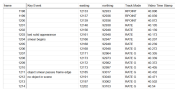
The lock was already lost (the object is not boxed). We are seeing a transition from RPOINT (attempting to hold a lost lock) to RATE-G (manual tracking). This appears to be something the operator did as the object was about to drift off-screen. They likely did not anticipate the parallax component, so they lost it.Isn't this also what you expect when the lock is lost, the background changes direction.
That reminds me of something I've been meaning to ask:I think it's the original footage, just reencoded, so not filmed off a monitor. The various contrast issues are problems with the original IR camera.

That reminds me of something I've been meaning to ask:
Why exactly does Corbell do this "Recording-a-UAP-video-like-a-kid-from-the-early-2000s-taking-a-physical-picture-of-a-notable-moment-in-the-video-game-they-are-playing-on-the-CRT-TV" thing?
Has this been explained and I just missed it?
As I understand it, to limit viruses from getting in and prevent protected data from getting out, the USB and other media ports on military and intelligence computer systems are apparently often disabled and facilities otherwise ban carrying thumbdrives and other portable media, leaving recording images from display screens with cell phones as the default method for leaking videos.That's how the "leaks" are giving to him. Presumably, the person providing the leak is concerned that if they actually downloaded the file from a government server, that might be traceable. And possibly illegal? So, they make a recording of whatever mysterious video they've seen with their likely personal phone and "smuggle" the file out that way.
Whether downloading is possible, traceable or illegal, I don't know. Seems like with the size of the federal government and all it's inner workings, I wouldn't be surprised if someone could download terabytes of stuff and nobody noticed, but I guess someone with actual government experience would have to weigh in.
There is also the possibility that the recorded screen trope gives the leaks a found footage vibe. Some secret that was recorded clandestinely in a secret government vault or SCIF by a courageous patriot fighting to get the truth out. Risking his career and life to provide Corbell with the evidence the public needs to see, the only way he can.
Personally, I think it's a combination of the 2. The leakers are recorded screens to avoid being found out, but the furtive nature of these screen recordings makes them more compelling as real secrets which also happens to be more entertaining.
Here's the article he wrote in which he spoke to a "retired USAF MQ-1/MQ-9 Sensor Operator".@AverageChris has been researching this, and posted in the thread. I believe he posted on X about talking to an MQ-9 operator. Chris?
There's some evidence for it being the software's coast timer expiring.As the target moved farther away and image quality deteriorated, the tracking gate reportedly began blinking. This blinking indicates loss of confidence in the automated track. At that point, the system entered "Track Coast Mode," where it temporarily predicts target motion while maintaining previous azimuth and depression rates even though it no longer has a reliable lock.
...
Eventually, either the operator manually canceled the track (most likely) or the software's coast timer expired.
The blinking mentioned also happens here. From PR59There's some evidence for it being the software's coast timer expiring.
The other ones seem to have a timeout of 3 seconds, but this one has a 2 second one !PR098, It gets a false lock, start blinking pretty quick, then when it ends, the trcking stops.
I don't think it's a hard timeout. I think if the track quality is worse, it will end sooner.The other ones seem to have a timeout of 3 seconds, but this one has a 2 second one !
Isn't handelier PR038?PR036 - (Chandelier) single blink before loss.
Yeah, my bad.Isn't handelier PR038?
View attachment 91130
PR098, It gets a false lock, start blinking pretty quick, then when it ends, the tracking stops.
Article: Elite athletes have reaction times of about 150 ms, and elite gamers are probably close to that, if perhaps slightly slower. Good gamers have reaction times of about 250 ms, and average gamers about 300 ms. Non-gamers have reaction times of about 350 ms.
Minor point, but there are no clouds in the video. The camera is looking down at the ground. The light area at the bottom is a ridge, but the upper area is ground beyond itthe cloud at the top right