A head injury leads to a higher priority than someone with controlled bleeding. I cannot say for certain but she may have other injuries in the chest (unclear) which would take a precedence. The wide open eyes is common with someone who is having repirations problems or head injury. I say this as head injuries cause confusion and respiratory problems and if it is a respiratory problem then the eyes lose oxygen flow and you start to lose vision like in passing out. In addition explosions are nortorious for causing tension pneumothoracies, which is an immediate concern and an immediate life threat.
Picture 4
This picture is used to point out that blood is not spraying. I cannot say if there is any sort of belt or restricting band on the injury slowing blood flow in this picture. What I can attest to is that in a complete amputation, the arteries and veins quiver and retract stopping blood flow. If a tourniquet is not applied then the arteries will relax and the patient will bleed out.
What to do
If you witness an amputation:
Call emergency services.
Stop the bleeding. A complete amputation may not bleed very much. The cut blood vessels may spasm, pull back into the injured part, and shrink. This slows or stops the bleeding. If there is bleeding, do the following:
source
Additionally the comment that his blood pressure would drop causing him to pass out is incorrect. BP (blood pressure) is the relationship of how much space available blood has to fill. Shock is the body pulling blood into the major organs. This man has lost blood from the tissue amputated, but with a tourniquet the size of the container the blood has to fill is decreased (body minus space of legs). The patients BP can maintain but saline is recommended to increase volume of blood.
I cannot say I have all the answers, if you have a question I will try to figure it out off of these pics or find others. If you see an error in my assesment let me know. I am hoping to dispell some misconceptions on the injured that are being continuously used in posts
will start this by describing my credentals on this subject
I spent 15 years as a Cavalry Scout in the Army. I have deployed to Bosnia, Kosovo, Iraq, and Afghanistan. I have seen numerous IED attacks, and mine strikes. I have been injured by an IED. I have been in charge of mas cas events, and treated patients in a mas cas event.
After I was forced into retirement from the Army, I became a EMT-Basic, and currently a Paramedic. I have 5 years in EMS (1 year EMT-Basic/ 4 years Paramedic). I have been in mas cas events since I joined EMS, and work in a 911 system as a crew chief. I work part time as a flight medic for a air evacuation service in vicinity of SC.
I am nationaly registered, and SC state certified. If you would like any proof of this I can find means without giving my cert numbers or my identity.
All my conclusions are based off of picture assesments, I cannot be 100% accurate as the only true way to be 100% positive would to be there doing patient assesments.
First you have to understand the method to the maddness of start triage. This is the system EMS uses to attempt to have as many people survive as possible without focusing on one individual. This is a good source to read for an explanation (PDF) Start Triage
After reading this, you will have a better understanding of why EMS did what they did.
I will label each picture, and refer to each with my info.
Picture 1 (pictures edited to meet ATS TOS U2U me if you want direct link)
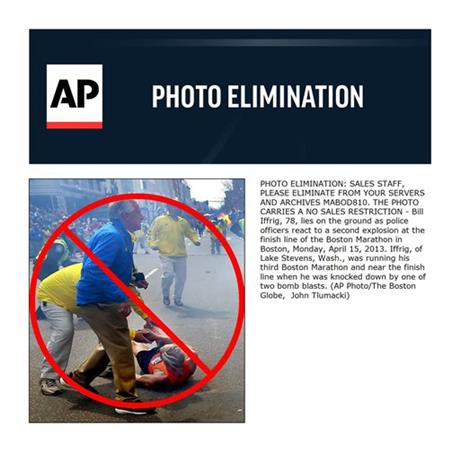
This picture is used as proof. It is stated that the errors commited are obvious making this a actor. Here is my assesment
#1 it is said that he is smiling and he has too much color. I have to disagree as he appears ashen, and unsure of lip color. It is a misconception that all patients lips turn blue when in shock. I cannot speak for his state of mind as a picture will not give you this answer, is that a smirk or is that confusion setting in? I wasnt there.
#2 #3 This is parts of the tourniquet on his limbs. #2 is the rod being used to constrict the tourniquet and #3 is the parts of the tourniquet. There are numerous ways to do one, but this appears to be effective. I cannot not speak for his right leg as I cannot get a clear view.
#4 It is stated that there is no spraying blood or dripping blood. A tourniquet effectively cuts off all blood flow to the limb below it and residual would be gone minus wetness dependant on time. This damage is consistant with a blast as that is a partial tibia protruding (not a turkey leg). No signs are observable of this person having a previous amputation. I believe he is on a wheel chair is because of triage. Triage, treat immediate life threats, transport are the order. Each ambulance has 1 stretcher, if there are more patients then ambulances then you move the patient as best you can.
The arguement that his legs should be elevated is irrelevant. That position is called the trendelumberg position and is not been taught in EMT- Paramedic classes anymore, as it has not shown to improve patient outcome. In addition elevating tourniqueted legs would have no change in blood pressure as the legs are already excluded from blood flow.
Here is an example of a bi lateral amputation with no bleeding and tourniquets
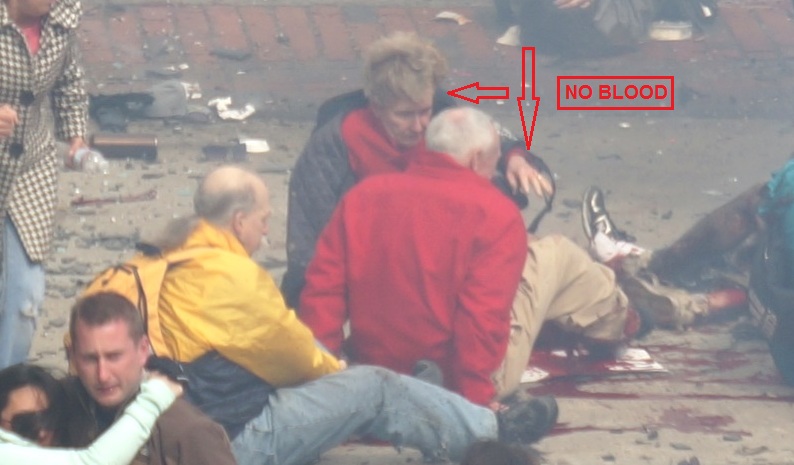
Picture 2
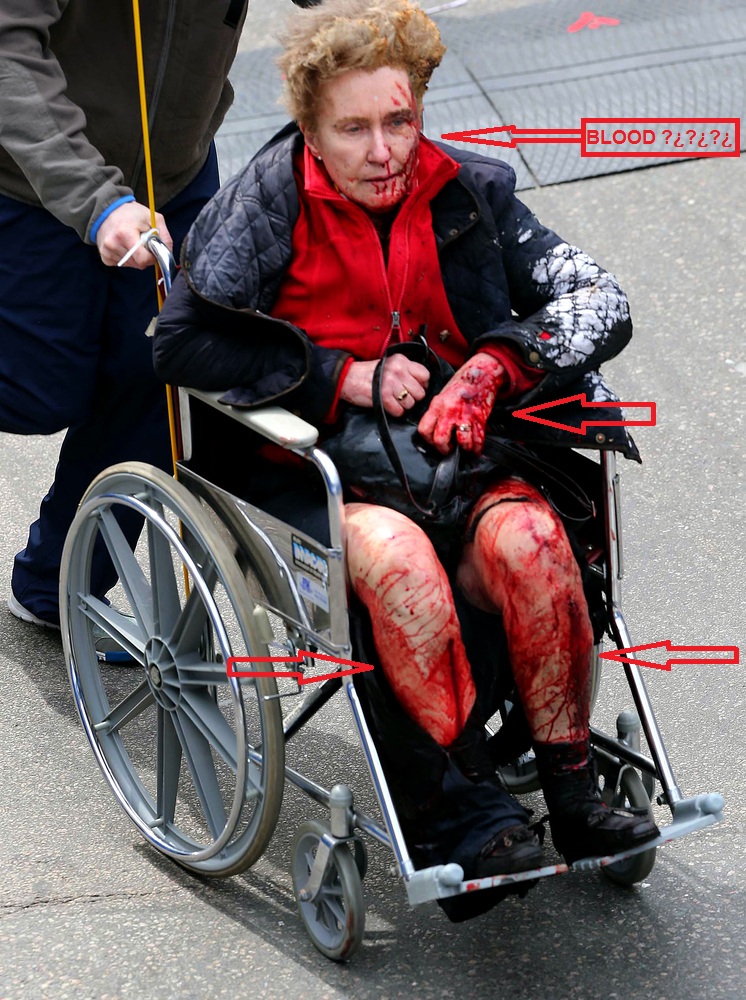
Picture 3
The woman in picture 2 is atributed to giving a hand signal that the cameras are rolling. To save space you can look at the series of pictures. Is this a signal, or someone that has been struck in the head and feeling her head. If you notice in other pics she has no blood on her hands before touching her head, and blood on her hands and head after touching. Is this her adding fake blood? You can see in picture 3, she has a towel with blood near her head, showing signs that she has a head injury.
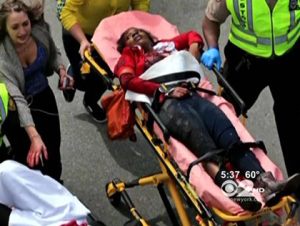
Picture 3 is used to say why is she spinal immobilzed and on a stretcher when picture 1 has a bi lateral amputation on a wheel chair. It also atributed that she is getting treatment before the amputations.
First she is not spinal immoblized, she is just on a stretcher. If you read the start triage you would see that respiration, pulse and memory play a role in transport decision (plus you cant see if amputation patient is still there). A head injury leads to a higher priority than someone with controlled bleeding. I cannot say for certain but she may have other injuries in the chest (unclear) which would take a precedence. The wide open eyes is common with someone who is having repirations problems or head injury. I say this as head injuries cause confusion and respiratory problems and if it is a respiratory problem then the eyes lose oxygen flow and you start to lose vision like in passing out. In addition explosions are nortorious for causing tension pneumothoracies, which is an immediate concern and an immediate life threat.
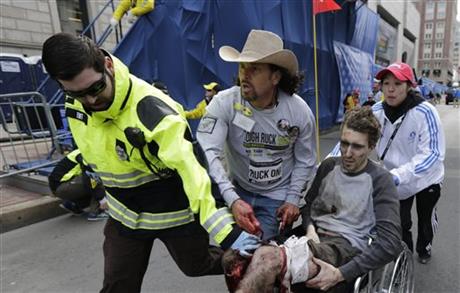
Picture 4
This picture is used to point out that blood is not spraying. I cannot say if there is any sort of belt or restricting band on the injury slowing blood flow in this picture. What I can attest to is that in a complete amputation, the arteries and veins quiver and retract stopping blood flow. If a tourniquet is not applied then the arteries will relax and the patient will bleed out.
What to do
If you witness an amputation:
Call emergency services.
Stop the bleeding. A complete amputation may not bleed very much. The cut blood vessels may spasm, pull back into the injured part, and shrink. This slows or stops the bleeding. If there is bleeding, do the following:
source
Additionally the comment that his blood pressure would drop causing him to pass out is incorrect. BP (blood pressure) is the relationship of how much space available blood has to fill. Shock is the body pulling blood into the major organs. This man has lost blood from the tissue amputated, but with a tourniquet the size of the container the blood has to fill is decreased (body minus space of legs). The patients BP can maintain but saline is recommended to increase volume of blood.
I cannot say I have all the answers, if you have a question I will try to figure it out off of these pics or find others. If you see an error in my assesment let me know. I am hoping to dispell some misconceptions on the injured that are being continuously used in posts
will start this by describing my credentals on this subject
I spent 15 years as a Cavalry Scout in the Army. I have deployed to Bosnia, Kosovo, Iraq, and Afghanistan. I have seen numerous IED attacks, and mine strikes. I have been injured by an IED. I have been in charge of mas cas events, and treated patients in a mas cas event.
After I was forced into retirement from the Army, I became a EMT-Basic, and currently a Paramedic. I have 5 years in EMS (1 year EMT-Basic/ 4 years Paramedic). I have been in mas cas events since I joined EMS, and work in a 911 system as a crew chief. I work part time as a flight medic for a air evacuation service in vicinity of SC.
I am nationaly registered, and SC state certified. If you would like any proof of this I can find means without giving my cert numbers or my identity.
All my conclusions are based off of picture assesments, I cannot be 100% accurate as the only true way to be 100% positive would to be there doing patient assesments.
First you have to understand the method to the maddness of start triage. This is the system EMS uses to attempt to have as many people survive as possible without focusing on one individual. This is a good source to read for an explanation (PDF)



 fficial&client=firefox-a