Transients in the Palomar Observatory Sky Survey

Extending this line of thought, Villarreal specifically suggests these were objects in geosynchronous orbits. That should constrain the potential change in position for a given "transient" between the times of the red and blue plates making a search for an alien artifact in both sets of plates quite feasible.
I think the current hypothesis is that the transients are very bright and very short in duration so unless the two plates were used for imaging at the same time then it would be very unlikely for a specific 'transients' to appear on both.
 
Did we/they ever do a minimum magnitude/second calculation to see the lower limit of the how bright and short they needed to be given the sensitivity/reciprocity of the film?

Is that even possible?
 
@eburacom 's post #229 had some musings about the brightness of the glints in comparison to stars...

It does this by saying that star images on a 50 minute exposure would be fuzzy, but a transient lasting a fraction of a second would be sharp. Yes, but so would a plate anomaly. So Handley and Blair's criticism is not refuted; it remains the case that these anomalies are overwhelmingly more likely to be flaws in the plate rather than alien satellites. To quote the PASP paper:

Note as well that any transient longer than a second or so would show a line, not a dot - and all these lines would be precisely aligned with the rotation of the telescope as it compensates for Earth's rotation. But there Is no evidence for such extended lines. So somehow all these NTA satellites are specifically configured to only glint for a fraction of a second. These satellites must be very strange shapes, too; they have tiny reflective surfaces that are only visible for a fraction of a second, but rarely rotate so that the glints are visible at regularly spaced intervals. One imagines a large black sphere with a tiny hand mirror glued to the side.

Any glint from a real object that lasted 0.5 seconds (the figure suggested in the paper) would be reduced in apparent brightness by a factor of 6000 (0.5 seconds over 50 minutes). This would result in a decrease in the apparent brightness on the plate by a factor of 10.4 magnitudes, not 9 magnitudes as stated in the paper.

As well as these incredibly dim anomalies that last a fraction of a second, we should also see a selection of longer transients, 1 or more seconds in length, which would show an easily recognisable signature of elongation parallel to the Earth's rotation. But we don't.

Not to mention glints from satellites in much closer orbits - if you want to observe events on the surface of a planet, a network of spy satellites in low Earth orbit would give a much clearer view than a grid thirty-five thousand kilometres away.
 
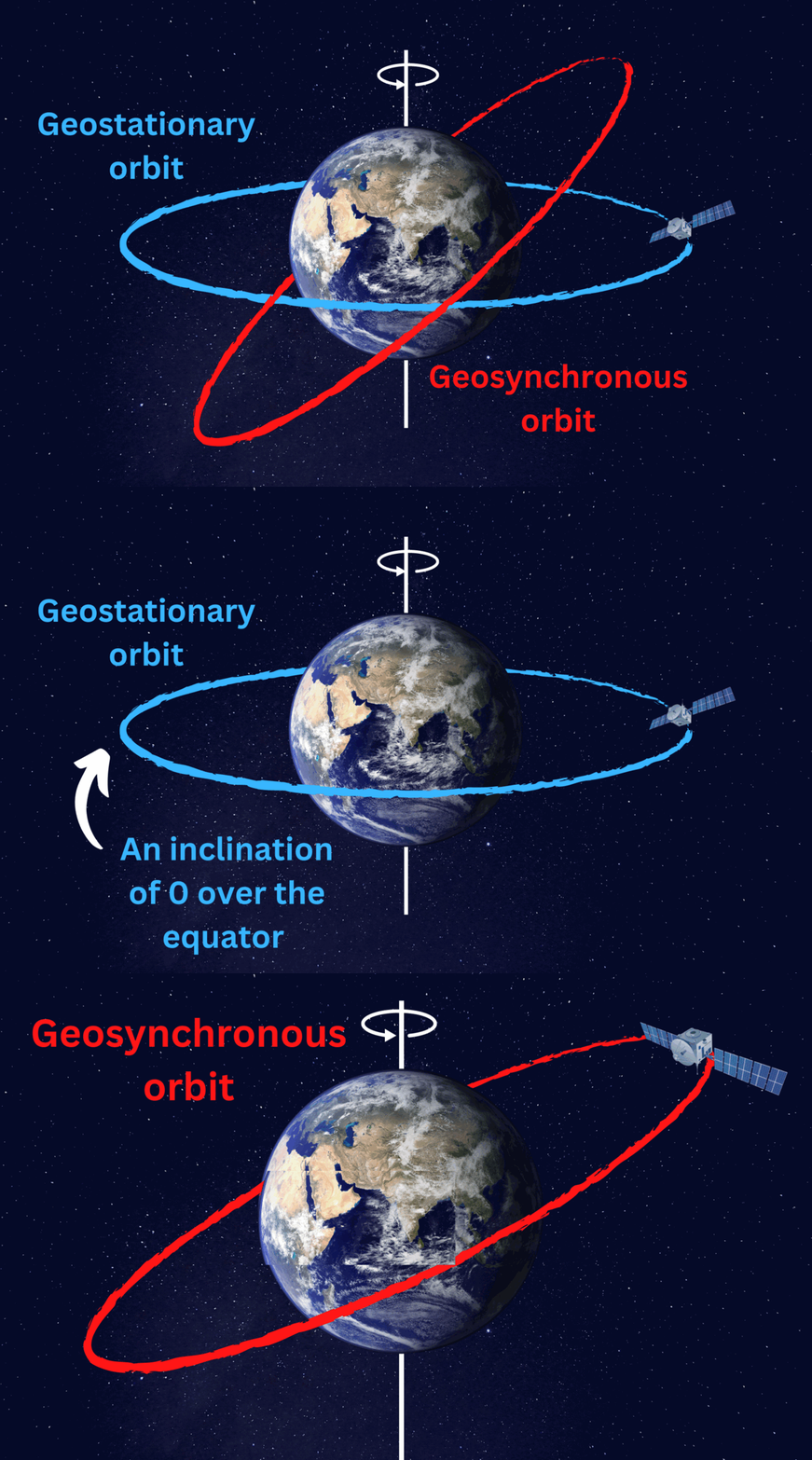
Extending this line of thought, Villarreal specifically suggests these were objects in geosynchronous orbits. That should constrain the potential change in position for a given "transient" between the times of the red and blue plates making a search for an alien artifact in both sets of plates quite feasible.
Not really. Geosynchronous satellites aren't just constrained to the Earth's equator; some range quite far north and south. A cloud of alien geosynchronous satellites might range all over the place, so it would be difficult to identify transients caused by the same object.

More uncertainty.

XT6g7XubC8bHjSvouqutKZ.gif
 
I've completed the Vasco60 pipeline.

Final release version #1 contains just a bunch of result files: https://github.com/jannefi/vasco60/tree/main/releases/final_release_v1/report

Survivors list (441 rows): https://github.com/jannefi/vasco60/blob/main/releases/final_release_v1/report/survivors.csv Using all veto-criteria, including the experimental ones inspired by the work of @Ivo Busko

So where are the hundred thousand or more survivors? Or 5,000? With this criteria, it's not possible to get that many survivors. But it's clear that even after extremely hard vetoes, a handful of survivors remain. They can be plate defects or other artefacts (e.g. aureoles, internal reflections, halation, ghost images). They can be transients. Note: I have not done any visual vetting.

Largest amount of survivor candidates from my pipeline is 15,303: https://github.com/jannefi/vasco60/blob/main/releases/final_release_v1/run/stage_S0.csv This is the so called Stage Zero file. It includes all candidates that survived the full pipeline. Rest of the survivors are reduced by post-pipeline steps in stages. All stage files are available here: https://github.com/jannefi/vasco60/tree/main/releases/final_release_v1/run/stages and everything is explained in README and some other docs available in the repository.

With the published criteria as I understand and implemented them, I do not see a path to a six‑figure survivor count. This suggests either (a) materially different selection/coverage/definitions, or (b) additional inputs/criteria not captured in the paper text. If the underlying list becomes available, I can run direct cross-checks and quantify the difference.

The related papers usually state: "Data will be shared on reasonable request to the corresponding author". But it seems this is not the case with this particular data. It looks like only handful of other persons have received this dataset while reproducing some statistical calculations. Please correct me if I'm wrong, but it looks like this dataset will not be shared on a reasonable request.

Maybe I should write some sort of final report/analysis, too.
 
Last edited:
Not really. Geosynchronous satellites aren't just constrained to the Earth's equator; some range quite far north and south. A cloud of alien geosynchronous satellites might range all over the place, so it would be difficult to identify transients caused by the same object. ...
[image removed]
More uncertainty.

Fair enough but a 'cloud' of alien satellites would indicate 24/7 coverage of the planet in which case the correlation with nuclear testing dates is irrelevant. The test sites would always be under observation. The papers authors really do seem to trying to have all things, all ways, circling back to NHI when an agnostic neutral observer would keep coming back to defects and artifacts of the human recording/transcribing technologies.
 
Back
Top