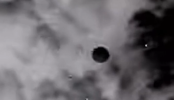
PR055: Corbell's "U.S. Military Films Huge Disc Hiding In The Clouds" new video 06/17/25

Maybe dumb question, but do things like flares, bokeh and the things we associate with regular light cameras occur in IR cameras? I know they may use lenses and sensors like regular cameras, but they're not recording light, right? They record heat and create a B&W image from the different levels of heat, right?
IR (heat) is a different part of the EM spectrum, and using the right optical materials (or mirror designs), it can be used to image and view. The IR of course differs from VIS or even UV, in that IR is radiated from objects as well as receiving radiation.
 
Maybe dumb question, but do things like flares, bokeh and the things we associate with regular light cameras occur in IR cameras? I know they may use lenses and sensors like regular cameras, but they're not recording light, right? They record heat and create a B&W image from the different levels of heat, right?

https://www.dvidshub.net/video/1007716/dow-uap-pr091-21-aug-callsign-observes-uap-persian-gulf

Look at the top left diffraction pattern between 1m44 and 1m52. I think you can see a lens flare behind it (it's more convincing in motion):
IR_lens_flare.png
 
Look at the top left diffraction pattern between 1m44 and 1m52. I think you can see a lens flare behind it (it's more convincing in motion):


Definitely, you can see it move so it stays lined up with the heat source (probably a gas flaring burn), and the center of the screen.
 
Could the flare be caused by light from the sun if the sun is not in frame?
Most often, such flares occur when the sun (or saturating source) is out of frame. They are generally the undesired reflections from the internals of the optical system. When the sun's in frame, it bleaches everything nearby.
 
Most often, such flares occur when the sun (or saturating source) is out of frame. They are generally the undesired reflections from the internals of the optical system. When the sun's in frame, it bleaches everything nearby.
Some thermal cameras (like mine) will shut down the instant the sun is in frame, dropping a shield in front of the sensor.
 
Is there a good explanation for this outside what's in this thread? I haven't read much that truly explains it.
 
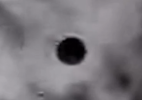
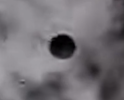
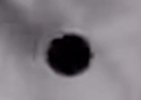
At another point, the UAP appears to pass beneath or behind a thin cloud veil. The partial fading does not look random or comparable to typical flare reproductions. It is gradual, localized, and follows the apparent trajectory of the UAP. Once again, it looks more like a coherent interaction of a real object with a cloud layer than an optical artifact changing shape.

~10 second of the DoW release (zoomed in)
 

Attachments

  • Capture d'écran 2026-05-31 213717.png
    Capture d'écran 2026-05-31 213717.png
    204.6 KB · Views: 5
  • Capture d'écran 2026-05-31 214455.png
    Capture d'écran 2026-05-31 214455.png
    52.7 KB · Views: 6
  • Capture d'écran 2026-05-31 214505.png
    Capture d'écran 2026-05-31 214505.png
    72.8 KB · Views: 8
At another point, the UAP appears to pass beneath or behind a thin cloud veil. The partial fading does not look random or comparable to typical flare reproductions. It is gradual, localized, and follows the apparent trajectory of the UAP. Once again, it looks more like a coherent interaction of a real object with a cloud layer than an optical artifact changing shape.

~10 second of the DoW release (zoomed in)
No offence, but what are you basing that judgment on?

I think the issue we're all having with this is a lack of priors .
 
No offence, but what are you basing that judgment on?

I think the issue we're all having with this is a lack of priors .
No offence taken, but I'm not sure what else I'm supposed to base my judgment on besides the video and the explanations being proposed here.
We all lack strong priors here, unless someone is an MQ-9 sensor operator or has access to the full metadata. So I don't really see why my lack of priors is a problem.
And honestly, this feels a bit like an ad hominem move to me. This is Metabunk, not a closed panel of experts. If my specific argument is wrong, then explain why or just ignore it.

I can't make a proper cut of the video on my PC, so I only shared a screenshot. But if you go to the timestamp I mentioned, there clearly seems to be a thin cloud veil above the object. The object appears to pass under it.
Based on what has been shown so far, I don't see how the artefact/flare hypothesis explains that convincingly. It already barely explains the first disappearance/reappearance, and this second partial occlusion looks even less like a flare behavior.

Everything looks like there is a real object being intermittently obscured by clouds.
 
And honestly, this feels a bit like an ad hominem move to me. This is Metabunk, not a closed panel of experts. If my specific argument is wrong, then explain why or just ignore it.
You made several rather specific claims in one post. It's quite reasonable to ask what you are basing those claims on. Are you comparing it to something? Is this entirely your personal opinion? Something in between?

For example:
this second partial occlusion looks even less like a flare behavior.
What flare behavior are you basing it on? If it looks "less like" something, then you need some kind of baseline. Or should you rephrase as "it looks less like what I imagine flare behavior would look like"?
 
You made several rather specific claims in one post. It's quite reasonable to ask what you are basing those claims on. Are you comparing it to something? Is this entirely your personal opinion? Something in between?

For example:

What flare behavior are you basing it on? If it looks "less like" something, then you need some kind of baseline. Or should you rephrase as "it looks less like what I imagine flare behavior would look like"?

It's the "lack of priors" part I was referring to, not the question about what I'm basing it on.

I actually managed to make a short clip with a phone app, so my point should be clearer. This is the section I'm talking about.
To answer your question, my opinion is mainly based on the visual behavior in this specific clip, not on strong technical priors about flares. I don't have any deep expertise regarding lens flares or IR sensor artifacts. My familiarity mostly comes from flares I've seen in various videos, in footage I've recorded myself with my samsung s4, and from the examples discussed in this thread (and others).
So yes, this is largely a visual impression rather than a technical conclusion.

That said, I think that clip illustrates the point I'm trying to make. The way the object appears to be partially obscured by what looks like a thin cloud layer seems visually different from the flare examples I've seen so far. The fading appears localized and follows the apparent trajectory of the object.

I'm simply saying that, based on what I can see in this clip, the cloud-occlusion interpretation feels more natural to me than the flare interpretation. If there's a flare mechanism that reproduces this specific behavior, I'd be interested in seeing it.
 
It's the "lack of priors" part I was referring to, not the question about what I'm basing it on.

I actually managed to make a short clip with a phone app, so my point should be clearer. This is the section I'm talking about.
To answer your question, my opinion is mainly based on the visual behavior in this specific clip, not on strong technical priors about flares. I don't have any deep expertise regarding lens flares or IR sensor artifacts. My familiarity mostly comes from flares I've seen in various videos, in footage I've recorded myself with my samsung s4, and from the examples discussed in this thread (and others).
So yes, this is largely a visual impression rather than a technical conclusion.

That said, I think that clip illustrates the point I'm trying to make. The way the object appears to be partially obscured by what looks like a thin cloud layer seems visually different from the flare examples I've seen so far. The fading appears localized and follows the apparent trajectory of the object.

I'm simply saying that, based on what I can see in this clip, the cloud-occlusion interpretation feels more natural to me than the flare interpretation. If there's a flare mechanism that reproduces this specific behavior, I'd be interested in seeing it.
View attachment 91232
Note sure what you wanted to highlight in your clip, can you tell me?
 
I'm simply saying that, based on what I can see in this clip, the cloud-occlusion interpretation feels more natural to me than the flare interpretation.
Sorry, with the best effort I can make, I don't see what you are referring to on this one.
 
Last edited:
the cloud-occlusion interpretation feels more natural to me than the flare interpretation
I think a big part of that is because it's in black hot mode, essentially inverted.

Lens flares are additive, you get the brightness of the flare plus the brighness of what is behind it. If that adds up to more than the clipping value of the camera's current gain setting, then you get a white disc (inverted to black). Reducing the gain will make this more transparent. When it's black, this does not seem to make sense.

Evidence for this would be the overall gain reducing as the object gets more transparent


Here, I've bumped the brightness just very slightly to 1.03, so we can see what areas are clipping (click the red triangle in the histogram)


Zoomed in in a bit, notice the disk become not clipped at the same time as it fades into the background. Not clipped means (if it's a reflection) that it's transparent.

Is this due to a change in gain? Watch the clouds directly to the right of it. Notice then become un-clipped exactly the same.


So, some aspects of this do seem consistent with a glare. To the extent that we must consider it as a possibility, along with a giant non-human intelligence-powered craft.
 
Note sure what you wanted to highlight in your clip, can you tell me?

Sorry, with the best effort I can make, I don;t see what you are referring to on this one.

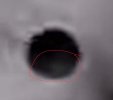
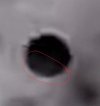
I circled it in red on the last two, the first one is the disk just before without the thin cloud.

See the attached screenshots (nothing in the first one, its for the comparison)
 

Attachments

  • Screenshot_20260601_002345_Gallery.jpg
    Screenshot_20260601_002345_Gallery.jpg
    23.7 KB · Views: 12
  • Screenshot_20260601_002354_Gallery.jpg
    Screenshot_20260601_002354_Gallery.jpg
    19.7 KB · Views: 5
  • Screenshot_20260601_002433_Gallery.jpg
    Screenshot_20260601_002433_Gallery.jpg
    23.6 KB · Views: 6
Zoomed in in a bit, notice the disk become not clipped at the same time as it fades into the background. Not clipped means (if it's a reflection) that it's transparent.

Is this due to a change in gain? Watch the clouds directly to the right of it. Notice then become un-clipped exactly the same.

I'm pointing to another section (At 0:10). A thin, wispy, discontinuous cloud-like filament appears to cross only a small part of the disk, while the disk itself remains round, coherent, and visible, unlike the broader fading sequence, where the disk gradually fades out and then fades back in. In the red overlay, you can see the brightness reducing in the affected area at the moment when this thin filament passes across part of the disk.


In this specific section, the effect is much more localized and subtle than the one that was previously discussed. I also do not see a surrounding brightness change here.
This is the kind of visual behavior I would expect from an object being partially veiled by a thin cloud layer. I'm not yet aware of an optical artifact that would produce that visual effect.

That said, I remain open to a technical explanation of course.
 
when this thin filament passes across part of the disk.
Does it, though? The clouds are moving left, the disk is moving right, but the "filament" seem to actually move right, with the disk.


The problem is that there's too much video compression to see what is really happening. Solid hot object moving through clouds? Internal reflection being internally occluded (and transparent). We are in the LIZ.
 
I've been analyzing PR055 and testing the main prosaic explanations (condensation/droplet on the dome and lens flare) against the observed kinematics and conditions, and wanted to share some points for discussion.

For the lens flare,

1. In the footage we see the target enter from the top of frame (Vertical Motion).
- This is inconsistent with known camera elevation changes. All demonstrations available show a lens flare would appear from the bottom of the screen.

2. The initial right to left motion of the target (Horizontal Motion).
- This would be consistent given the plane is in a left hand bank/ turn though out the video, increasing its rate of change during the video.

3. The left to right motion of the target (Horizontal Motion).
- This is inconsistent with known kinematics, and camera direction/ panning change occurring. All demonstrations available show a lens flare would, with the given parameters, should be moving right to left at a faster rate due to plane bank angle change.


Source: https://x.com/ZaineMichael1/status/2068950932814254375

top tweet - Reproducing the gps locations of the plane and the targeted spot on the earth, there is no point where the camera would be panning to the right. Red lines are the initial and end LOS.

bottom tweet - Plotting the onscreen values for the camera compass from the footage, JC release. Combined footage in the initial tweet.

For the water droplet theory,

At 21,000 ft the ISA temperature is approximately −27°C, a water droplet would
- be expected to freeze rapidly,
- demonstrate changing shape/ appearance/ streaking,
- and even being charitable, "aerodynamics around the pod can be complicated", I can't reconcile the motion, angle change to wind forces (for a water droplet to change directions) and or combined with gravity.

The only way I can put this, is a water droplet 220-240 knots winds would not adhere to the window of the pod and result in what we observe in the footage.

Does anyone have substantive examples of
- a lens flare changing direction due to the rate of same direction pan increasing?
- a lens flare, when the camera is panning up to a light source, of a flare entering from the top of the screen?
- comparable water interactions at high speeds for a partially shielded surface?

 
Last edited:
1. In the footage we see the target enter from the top of frame (Vertical Motion).
- This is inconsistent with known camera elevation changes. All demonstrations available show a lens flare would appear from the bottom of the screen.

2. The initial right to left motion of the target (Horizontal Motion).
- This would be consistent given the plane is in a left hand bank/ turn though out the video, increasing its rate of change during the video.

3. The left to right motion of the target (Horizontal Motion).
- This is inconsistent with known kinematics, and camera direction/ panning change occurring. All demonstrations available show a lens flare would, with the given parameters, should be moving right to left at a faster rate due to plane bank angle change.
Since we don't know the geometry of the camera, we can't really rule out an internal reflection that's different from other examples. And, no, I don't know what the geometry might be.

You don't seem to have addressed the correlation between the horizontal position of the disk, and the rotation of the camera.

https://www.metabunk.org/attachments/matching-curves-mp4.81730/

From post 74
https://www.metabunk.org/threads/pr...s-new-video-06-17-25.14289/page-2#post-347420
 
Back
Top