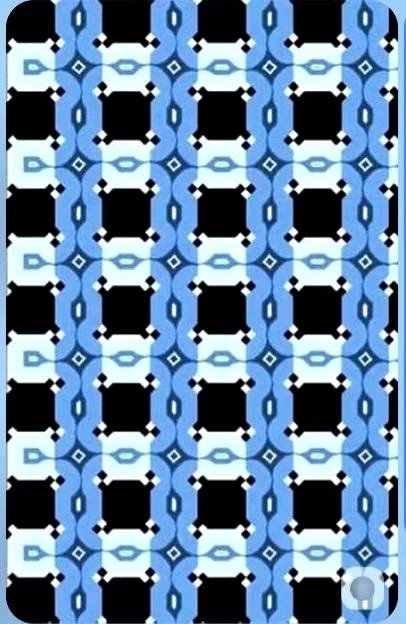
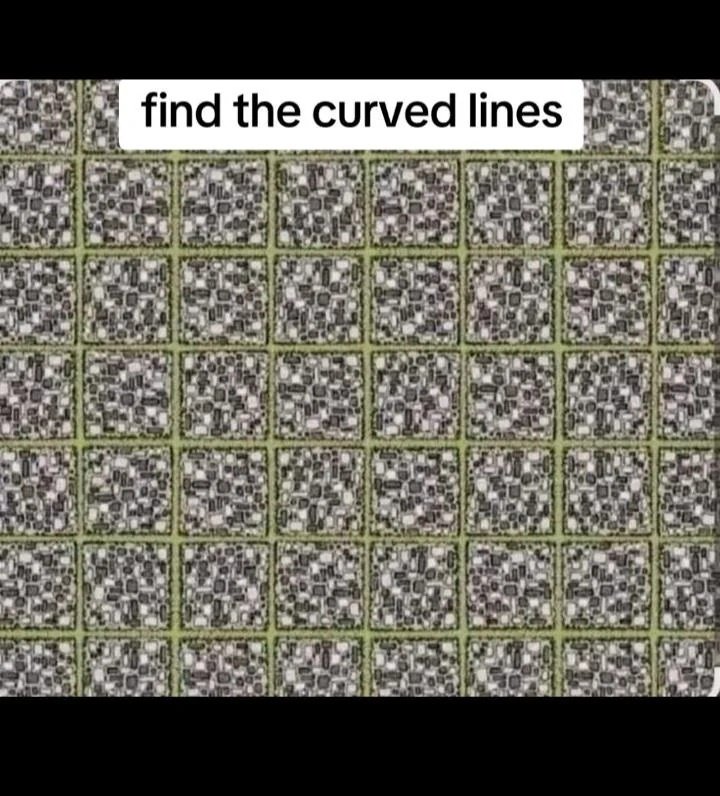
Optical illusions

Mendel

Senior Member.
Metabunk has a tag for optical illusions, https://www.metabunk.org/tags/optical-illusion/ , but all 4 threads in it are rather specific.

Optical illusions are interesting for us because they demonstrate how "normal people" (aka all of us) can be mistaken about what they're seeing; and that is a major reason why we can't rely on witness reports alone.

Source for these is
https://imgur.com/gallery/illusions-1VRl3k9
Imgur is currently blocked in the UK; I've put some of the files in the spoiler below. On the imgur embed, there's a right arrow that appears near the right edge that you can use to browse the image set; or click through to imgur to scroll.

This is from the comments:
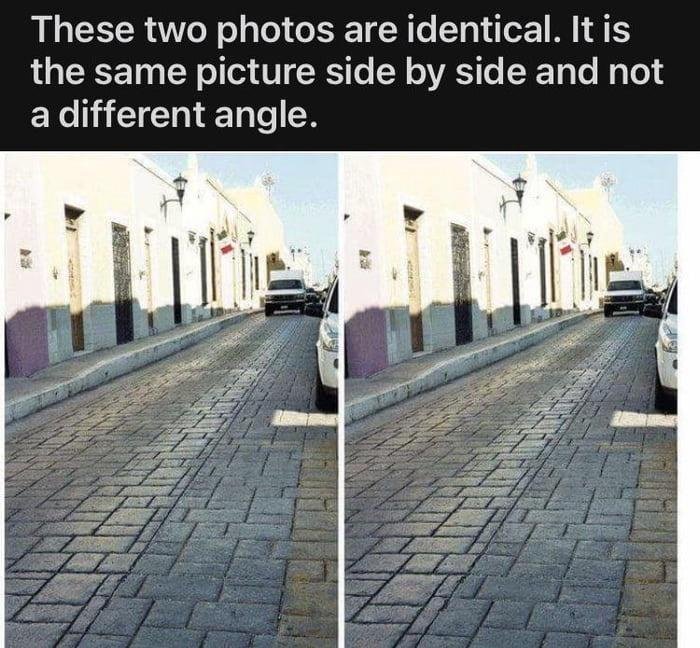
Q2Z0EVb.jpeg


YT5V707.jpeg
JOxG7WB.jpeg
 
I had never seen this one and it's amazing, I had to copy the image in an editor and play with it, it works also with multiple copies:
Interesting, to me it falls apart when I scan my eyes across it from side to side, as each pair that becomes the pair closest to the center of vision looks less extreme, and more like what the original "just two pictures" illusion. But that's maybe just me...
 
Interesting, to me it falls apart when I scan my eyes across it from side to side, as each pair that becomes the pair closest to the center of vision looks less extreme, and more like what the original "just two pictures" illusion. But that's maybe just me...
What I see is the road in the leftmost picure is a little inclined to the left, in the second picture it starts leaning to the right, and leans more to the right in each following picture. And I can't avoid seeing it that way,
 
What I see is the road in the leftmost picure is a little inclined to the left, in the second picture it starts leaning to the right, and leans more to the right in each following picture. And I can't avoid seeing it that way,
Same.

It's a very powerful illusion, but even when I look at it and understand why I am seeing it, I can't stop seeing it.

The source of the illusion, of course, is that our brain knows that the lines of the kerb and paving are meant to be parallel, even though on the screen the angle they make from vertical becomes smaller across the image from left to right. So we mentally compare the angled line on the left edge of the next photo to the perspective of the previous photo to the left. The perspective doesn't work, so we see that line as being out of parallel.

1792060935531.png


Applying a perspective transform to make the red lines parallel, this is what your brain's mental overhead map of the scene looks like:

1792061161767.png


Of course, we can see that it's the same street, so our intuition tells us that the viewpoint must have shifted in the second image, to make the line of paving appear with a steeper angle – even though it doesn't!

Interestingly the part of the image that looks most "wrong" to me is the broad stripe of worn paving in the middle of the road, rather than the kerb, even though the kerb has even more of a difference in angle.
 
The perspective doesn't work, so we see that line as being out of parallel.
The perspective does work, and that's the reason for the illusion.

In vanishing point perspective, any set of parallel lines converges on the same point on the horizon; conversely, any set of lines that converge on a point on the horizon are perceived as parallel. That means you can choose ANY horizon point as vanishing point, and how far off center that point is determines the angle at which we perceive the lines to be.

With the side-by-side photos, the vanishing point of the right photo has moved farther from the center, so that road is perceived to be at more of an angle than the left road with its vanishing point closer to the center.

It works because our brains have learned to process perspective.
 
The perspective does work, and that's the reason for the illusion.

In vanishing point perspective, any set of parallel lines converges on the same point on the horizon; conversely, any set of lines that converge on a point on the horizon are perceived as parallel. That means you can choose ANY horizon point as vanishing point, and how far off center that point is determines the angle at which we perceive the lines to be.
I think that's pretty much what I said, isn't it? It's certainly what I meant to say.
Our brains are comparing the lines in the right photo with the vanishing point in the left photo, which makes them appear to be angled. As I labelled here:

1792072090806.png


The purple line has a different vanishing point, because it's part of a different image. If your brain treats them as part of the same scene, then the lines cannot be parallel.

(There's a kind of additional layer to the illusion when the scenes are clearly identical like this, as the only explanation your brain can come up with to explain two views of the same street having non-parallel lines is that there must have been a shift in your perspective. So at first glance it appears that the second photo must have been taken from a vantage point further to the right.)
 
I was thinking about what level of perspective cues are needed to maintain the illusion.

Here I just traced two of the lines on the side by side images. With the background, the illusion is there - the purple line in the road looks more slanted that the red one.

1792073170884.png


Removing the background, the illusion disappears, at least for me. The brain doesn't recognise it as a perspective image, it's just two identical lines.
1792073297789.png


What if we add a third line to the image on the left, tracing the edge of the more yellowish paving stones, to hint at vanishing point perspective?
Does that main diagonal look more slanted on the purple side? To me, yes it does.

1792073495204.png


But wait! If you add the same line to both sides, the illusion disappears again!

1792073562872.png
 
The angle you marked is arbitrary; you could've chosen other lines (e.g. ones that are parallel). So that doesn't explain anything.
It's not arbitrary - it's the visual angle between that line and what that line would look like if it was subject to the same vanishing point as the equivalent lines on the left image. That is what is forcing it to look "too angled": it is pointing to the right relative to the vanishing point that our brain has already established from the image on the left.
And I don't understand your argument about the camera position ("vantage point").

As in the caption at the top of the illusion image: "It is the same picture side by side and not a different angle"
At first glance it does appear to be two photos of the same street taken from different angles – that's the whole illusion!

It looks like the street is more angled in the right-hand image, which would imply that the camera was further to the right - but then you look at the paving and the car, and so on, and realise that it can't be. That's the disconnect that makes the illusion more powerful than if it was just some straight lines.
 
It looks like the street is more angled in the right-hand image, which would imply that the camera was further to the right - but then you look at the paving and the car, and so on, and realise that it can't be.
If these were two streets that are angled, that's how it'd look, though. The street doesn't look different just because you need to turn your body a little bit to look down it. (There is some distortion because the image is projected on a flat plate, but it's minor here.) Because of this, smartphones can stitch a pan together to make a panoramic shot.
 

Trending content

Back
Top