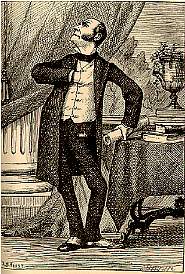
A transfer of meaning from antiquity to the eighteenth century can indeed be described for one such classically derived stance - the familiar male pose with a hand tucked in a waistcoat. This transformation of a postural into a portrait convention occurs at the critical juncture when England was emerging as a national power, engaging in the first of a long series of Continental wars that intensified Anglo-French enmity.(23) In response to France's challenge to her political and religious autonomy, England strengthened her self-image and forged her Augustan appearance. The following discussion tracks the curious route by which an ancient sculptural model was influential in visually defining English character.
It is useful to consider first a representative sample of the eighteenth-century "hand-in" type showing English sitters by English painters. A typical cross-section includes a Self-Portrait, 1710, by Godfrey Kneller (formerly at Lowther Castle); Horace Walpole, ca. 1734-35, by Jonathan Richardson, Sr.; William James, 1744, by William Hogarth (Worcester Art Museum, Mass.); Samuel Richardson, 1750, by Joseph Highmore ]; George Friderick Handel, 1756, by Thomas Hudson; Self-Portrait, ca. 1759, by Thomas Gainsborough; and Sir Hugh Molesworth, ca. 1760, by Reynolds (British private collection). A quick survey of these or any similar compendium of English eighteenth-century portraits immediately reveals that many artists made use of this same basic model.(24) The "hand-in" was one of the most popular of various stock poses portraitists offered their clients, and its prestige was buoyed by the commercial practices of London's major portrait studios.(25) The pose acquired its greatest cachet in the late 1740s and early 1750s as a staple of Thomas Hudson's fashionable studio, where it was considered eminently suited to the taste of "persons of quality and worth" who chose to be painted in a manner deemed "agreeable and without affectation."(26) Hudson, who used the pose so often that his ability to paint hands was called into question, apparently passed his market experience on to his students, supposedly counseling Reynolds that if he wanted to make a fortune, he must put hands in bosom or waistcoat pocket.(27) The type subsequently filtered down and became a staple of second-string painters of the squirearchy and middle classes such as Arthur Devis, whose "portraits in the small" offer numerous examples of the use of the gesture.(28) By mid-century one could call such works "commonplace" portraits,(29) for, as in the case of the formulaic entries in commonplace books, the authority of the type came from sanctioned usage.
In the full compass of its eighteenth-century usage, the hand-in-waistcoat portrait allowed for a number of formal variables: from a half to a full-length format, either seated or standing, the setting either landscape or interior, the figure oriented toward the left or right, and with either the left or the fight hand masked. Commonly, the right hand is inserted, although many examples show the left inserted instead. However, when the figure is depicted holding a hat, the image complies with prevailing social etiquette, which dictated that the hat be in the right hand. When the hat is shown placed under the left arm, either the right or the left hand might be inserted.(30) That these permutations of the form allowed ample latitude for individual characterization is readily seen by comparing Gainsborough's poetic self-portrait with Hudson's dour depiction of Handel. However, it should also be noted that in the broader context of eighteenth-century usage the pose was by no means exclusive to English painters, nor was it reserved for depicting English sitters. It was on occasion employed by the Lombard Ceruti, the Venetian provincial Manzini, the Swiss Liotard, the French pastelliste Perroneau, the Spaniard Goya, the Russian Leviatskii, and by many other Continental painters. But it is the ubiquitous success of the format in England that needs an explanation.
At this point an important distinction should be made between the "hand-in-waistcoat" attitude in portraiture and its use in social life, since the postural patterns of portraits are far more limited than conventions of deportment. Pictorial satire is perhaps the ideal benchmark of the gesture's widespread and immoderate social use, since the genre of satire is not an autonomous form but a response to real behavior. In particular, foreign travelers abroad, whose graceless social profile was a steady target in this heyday of the Grand Tour, were often burlesqued by means of a strained and uneasy version of the "hand-in" posture. It is seen in Thomas Patch's witty depictions of his fellow countrymen in Italy, typically in gatherings of virtuosi at the home of Sir Horace Mann, the English ambassador in Florence , (in the left foreground and in the portrait on the wall).(31) It is even more vigorously exaggerated by Pier Leoni Ghezzi, who apparently considered it the posture of choice for caricatures of visitors to Rome .(32)
The most incisive satirical depiction, however, is on English soil, by Hogarth in The Countess's Levee, the fourth scene from his Marriage a la Mode series .(33) Here Hogarth uses the "hand-in" gesture to portray two national types: one a dignified English magistrate (depicted in a portrait on the wall) and the other a foppish French dancing master. The pairing of a decorous painting above with a comic figure below ironically distinguishes between an attitude in a portrait and the notion of social posturing. This dual depiction highlights the ambivalence that the English often appear to have felt toward the French - admiring them, yet uncomfortable with their expressions of civility.(34)
It is perhaps ironic that while Hogarth distinguishes the portrait use of the gesture from its social use, it was the French who originally factored the exchange between portraiture and behavior - through the influential medium of engraving. Indeed, we find the earliest depictions of the "hand-in" pose in French prints dating from the early 1680s. It is significant, however, that it is not used in French painted portraits of the period,(35) but is instead confined to a medium meant essentially for reproduction and limited to subjects of a documentary nature. Reserved for concrete, factual descriptions presented without the rhetoric of art,(36) the pose is frequently seen in costume plates, such as those by Henri Bonnart, which announced and officially endorsed what was a la mode at court.(37) Similarly, it appears in engravings that give a candid glimpse of social etiquette at Versailles. In one such plate from the series Les Appartements by Antoine Trouvain, Monsieur, the king's brother, and several courtiers attend Louis XIV at a game of billiards, with their hands discreetly withdrawn ,(38) Clearly, the gesture is part of the language of social decorum; it belongs with the ritual of bows, honors, and formal courtesies set by the French court in the seventeenth century. This precedent suggests that English painters transformed a French social convention into an English portrait convention - and that they more readily absorbed elements from France's prosaic, factual engraving tradition than from her more flamboyant portrait-painting tradition. Nonetheless, this adaptation involved a substantive change. We can see that the process of transformation was already complete by 1738, the year Francois Nivelon published his Book of Genteel Behaviour,(39) a manual offering visual and verbal instruction on how to walk, stand, and present oneself for the minuet. Its engraved illustrations confirm that by that time graceful movements had become rigidly codified into prescriptive, static poses. One such pose was the "hand-in-waistcoat" - body language that Nivelon identified as signifying "manly boldness tempered with modesty" .