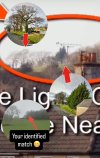
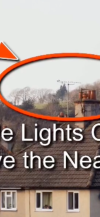
The Denbigh Lights UFO Analysis - Jan 2012 - [Likely sparking powerlines]

If I'm honest I'd think the crashed alien spaceship (crashed due to the weather, obviously!) is more likely than a groundskeeper being out in the storm at 3am. ;) Consider how this might be done with vehicles and how it might look, compared to what we can actually see in the video. One, maybe two vehicles driving up to a point to assess damage would not appear as bright lights continually moving (described as "mini explosions" by the witnesses) for half an hour, and then suddenly stopping.
(Woo) frame challenge: What if you believe more in cryptids than UFOs?

Cryptid hunters aren't going to let a little storm suppress the truth...
 
I've tried to highlight the part of the original video that best shows the electrical arcing. In this short clip you can see numerous blue flashes that are typical of an electrical power flash across an air gap.


Edit: I've taken this excerpt from the original video file on the SUFON page. I think it shows the electrical arcing and sparking quite well.

And here it is sync'd with a similar example for comparison.
 
Last edited:
So today I received a reply from SP Networks, the electricity supplier for the Denbigh area. They have confirmed that there was indeed an electrical fault reported at the location close to Denbigh Golf Club on the night in question. A fault was reported the following morning and it was repaired when the storm had eased.

1000157390.jpg

Edit: This is the area for Post Code LL16 5AA. I've annotated the location of the golf club, the known Powerlines within the Post Code Area (from inspection of the streetview imagery) and the calculated line of sight from the witness location, showing the likely location of the electrical fault. Source: https://postcodes.mapit.longair.net/area/814781.html

This image shows the route of the powerlines at the back of the property up towards the golf club & resevoir:

The UAP Files Podcast determined that the lights were above the top of the hill, however this analysis used the wrong house as a reference. @Trailblazer 's estimated position of the lights on the side of the hill is the best approximation we have.

So it looks like my hypothesis that the Denbigh lights were sparking overhead cables that had hit tree branches in a storm has been validated. I'll try and get in touch with the witnesses and let them know. ( @UAPF ..? )

Summary & Main Points:
Conclusion - the likely source of the "Denbigh lights" was electrical sparking and arcing caused by storm damage to overhead electrical cables close to Denbigh Golf Club.
 
Last edited:
Just had a quick attempt at putting The Denbigh Lights case into sitrec, with the building models created in GE. (This took about 10mins, what a great tool it is!) The grey line on the side of the hill represents the path of the overhead pylons there. I've also tried to give the wooded area on the top of the hill some physical presence. The buildings could obviously be a bit more accurate, particularly the roofs and chimneys. But as an initial model I'm quite pleased. It seems to further confirm that that the overhead wires going up the hill to the reservoir are a suitable match for the position of the UFO/lights.

Daytime
https://www.metabunk.org/sitrec/?cu...ws.com/15857/DenbighLights/20250905_051649.js

Night-time
https://www.metabunk.org/sitrec/?cu...ws.com/15857/DenbighLights/20250905_053158.js
 

Attachments

Last edited:
To start with the location needs to be identified and I believe I've identified the correct location viewed on the footage. Half the distance indicated by Flarkey. Which means the "likely sparking power lines" doesn't really fit. Nor does the DNOs fix for apparent 45m sparking/arching cable. That indicates an incredibly rare major catastrophic fault with the line that's very dangerous, but yet in Flarkey's letter they only replaced 2x insulated reels and a 160am fuse, not the cable. That's unheard of. Just wouldn't happen because of the indication of damage and loss of insulation/conductor fault. They'd absolutely change that line if that was the issue (multiple arching across a 45m point l). But they didn't change the line. Just left it. Indicates it probably wasn't major prolonged sparking, but rather a few sparks at the reel level.

Regardless that location is wrong in my opinion and i'm quite confident with the new location.

Oh and side note, I've been away for a bit, thanks for all the kind comments everyone
 

Attachments

  • IMG_6397.jpeg
    IMG_6397.jpeg
    395.1 KB · Views: 33
  • IMG_6396.jpeg
    IMG_6396.jpeg
    368.1 KB · Views: 26
  • IMG_6393.jpeg
    IMG_6393.jpeg
    367.5 KB · Views: 31
  • IMG_6394.jpeg
    IMG_6394.jpeg
    401.6 KB · Views: 28
  • IMG_6395.png
    IMG_6395.png
    1.1 MB · Views: 28
  • IMG_6360.jpeg
    IMG_6360.jpeg
    594.7 KB · Views: 24
the geolocation wasn't really mine, it was mostly done initially by @Mick West and then by @Trailblazer .

So basically @UAPF correct me if I'm wrong, but what I think you're saying is two things -

1) the electrical fault was at a different location than I suggested the letter was pointing at. ie not at the overhead cables and poles that lead up to the water tower. it was at Coppi Farm
and
2) The UFO was hovering above Coppi Farm

So basically you're still saying that the electrical fault was still at the same location that the "lights"were seen...?

is that correct....?

@UAPF - could you post an annotated map of 1) where you think the UAP was and 2) where you think the electical fault in the LV overhead wires was?
 
Last edited:
To start with the location needs to be identified and I believe I've identified the correct location viewed on the footage. Half the distance indicated by Flarkey. Which means the "likely sparking power lines" doesn't really fit. Nor does the DNOs fix for apparent 45m sparking/arching cable. That indicates an incredibly rare major catastrophic fault with the line that's very dangerous, but yet in Flarkey's letter they only replaced 2x insulated reels and a 160am fuse, not the cable. That's unheard of. Just wouldn't happen because of the indication of damage and loss of insulation/conductor fault. They'd absolutely change that line if that was the issue (multiple arching across a 45m point l). But they didn't change the line. Just left it. Indicates it probably wasn't major prolonged sparking, but rather a few sparks at the reel level.

Regardless that location is wrong in my opinion and i'm quite confident with the new location.

Oh and side note, I've been away for a bit, thanks for all the kind comments everyone

the geolocation wasn't really mine, it was mostly done initially by @Mick West and then by @Trailblazer .

So basically @UAPF correct me if I'm wrong, but what I think you're saying is two things -

1) the electrical fault was at a different location than I suggested the letter was pointing at. ie not at the overhead cables and poles that lead up to the water tower. it was at Coppi Farm
and
2) The UFO was hovering above Coppi Farm

So basically you're still saying that the electrical fault was still at the same location that the "lights"were seen...?

is that correct....?

@UAPF - could you post an annotated map of 1) where you think the UAP was and 2) where you think the electical fault in the LV overhead wires was?
That couldn't be further away from what I'm saying. I'm saying I've identified the spot observed in the footage (and captured by the investigators who conducted the initial interview and walked the "scene" at the time). And it isn't the spot you'd identified. It's quite clearly these trees near the road. The UFO could be right in front of the witnesses face, could be a hundred meters away from the trees, could be a thousand meters away from those trees as just a slightly higher incline. We don't know. No one has any data for distance.

And I'm not saying it's where the electrical fault is. I don't believe the electrical fault described by the DNO is even close to a large multi-arching power line that you'd maybe see with a high voltage anomaly once in a lifetime. The DNO identified a low voltage cable fault that required a change of insulator reels (x2) and a 160am fuse. As we've both identified in the current and past street view and area shots, none of the poles near your initial (water tank) site or my current (and correct) location have insulator reels on the poles. And they didn't even change the conductor/cable, surely if there was such a catastrophic failure and risk to life of massive firework-like arching electricity they'd put a safe line up. But no. Just a couple little reels and a fuse. Really?

I work with armoured cable almost daily and the suggestion of arching along a 45m expanse visible from 1.4km away lighting up like fireworks on a low voltage line, several meters below a thick treeline is perverse.

The electrical fault theory doesn't seem to have any positive data points to resolve this as an electrical fault. No more than the golf cart theory. Your email from the DNO identified 6 properties which services a 100+ acre postcode. Including the massive golf course. Essentially someone reported a fault during bad weather 7hrs after the UFO sighting and it wasn't important enough to attend until later that afternoon. Danger of death faults get an immediate call out, regardless of weather.

An object cannot be meaningfully identified when the framework of identification precludes the very possibility that it is genuinely unidentified.
 
So today I received a reply from SP Networks, the electricity supplier for the Denbigh area. They have confirmed that there was indeed an electrical fault reported at the location close to Denbigh Golf Club on the night in question. A fault was reported the following morning and it was repaired when the storm had eased.


Edit: This is the area for Post Code LL16 5AA. I've annotated the location of the golf club, the known Powerlines within the Post Code Area (from inspection of the streetview imagery) and the calculated line of sight from the witness location, showing the likely location of the electrical fault. Source: https://postcodes.mapit.longair.net/area/814781.html


This image shows the route of the powerlines at the back of the property up towards the golf club & resevoir:


The UAP Files Podcast determined that the lights were above the top of the hill, however this analysis used the wrong house as a reference. @Trailblazer 's estimated position of the lights on the side of the hill is the best approximation we have.


So it looks like my hypothesis that the Denbigh lights were sparking overhead cables that had hit tree branches in a storm has been validated. I'll try and get in touch with the witnesses and let them know. ( @UAPF ..? )

Summary & Main Points:
Conclusion - the likely source of the "Denbigh lights" was electrical sparking and arcing caused by storm damage to overhead electrical cables close to Denbigh Golf Club.
Electrical arcing is driven by voltage potential, air breakdown, and the electrical path of least resistance, not by wind direction.
 
Electrical arcing is driven by voltage potential, air breakdown, and the electrical path of least resistance, not by wind direction.

I don't think it's controversial to say there's a correlation between visible electrical discharges from electricity infrastructure and very high wind.
Stormy conditions damage electricity infrastructure.
I'd guess electricity grid repair crews get far more call-outs during and immediately after storms. Nothing wrong with @flarkey's conclusion.
 
Electrical arcing is driven by voltage potential, air breakdown, and the electrical path of least resistance, not by wind direction.
If moments when the cables come particularly close to each other are caused by an oscillation pattern created by the wind, perhaps these points tend to travel in the direction most aligned with the wind vector.

Diagram attempting to illustrate:
Screenshot 2025-11-14 at 8.29.50 PM.png
 
If moments when the cables come particularly close to each other are caused by an oscillation pattern created by the wind, perhaps these points tend to travel in the direction most aligned with the wind vector.

Diagram attempting to illustrate:
View attachment 85903
The cables being close generates the first arc; it ionizes the air, creating a path that can bridge longer distances. These ions then get driven by the wind.
This is the reason why the arc travels upward in this demonstration: the hot air rises.

Source: https://www.youtube.com/watch?v=a-oqRBuw-hM&t=8

If you "fix" the place where the spark originates by widening the gap, there's no arcing.
 
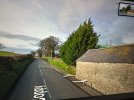
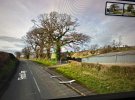
To start with the location needs to be identified and I believe I've identified the correct location viewed on the footage. Half the distance indicated by Flarkey.
You're not really clear how you've come by your identification; from your images, it looks like it was from a daytime photo that doesn't match the nighttime view?
I'm not convinced that the daytime reference image is taken from the same angle as the night video.
In post #26 and following, @Trailblazer and @flarkey develop the location. Please point out where they went wrong, in your opinion.
 
I don't think it's controversial to say there's a correlation between visible electrical discharges from electricity infrastructure and very high wind.
Stormy conditions damage electricity infrastructure.
I'd guess electricity grid repair crews get far more call-outs during and immediately after storms. Nothing wrong with @flarkey's conclusion.

To reply to you both. You seem to be mixing up correlation with causation "wind-induced motion" with "wind direction causing the arc."

The wind only changes physical position, not electrical preference.

When an arc forms, it jumps along the direction of the electric field, not the direction of the wind.

The arc doesn't "follow the wind."
It follows the electric potential gradient.
 
Electrical arcing is driven by voltage potential, air breakdown, and the electrical path of least resistance, not by wind direction.

I haven't suggesed that electrical arcing is driven or caused by wind direction. I suggested that storm damage to the overhead cables causes arcing and sparking , and the resultant sparks were blown by the wind as they fell to the ground. I think that's what we see in this video.

 
You're not really clear how you've come by your identification; from your images, it looks like it was from a daytime photo that doesn't match the nighttime view?

In post #26 and following, @Trailblazer and @flarkey develop the location. Please point out where they went wrong, in your opinion.
It's the image used in Mick's analysis from 6 years ago, as well as the image used by this thread and identified by Flarkey, albeit from a slightly lower vantage point. And the image created by the investigators who interviewed Nathan at the time. If you have a better image I'll happily consider it. This seems like the best data we have to identify the trees in question, though.
 
You're not really clear how you've come by your identification; from your images, it looks like it was from a daytime photo that doesn't match the nighttime view?

In post #26 and following, @Trailblazer and @flarkey develop the location. Please point out where they went wrong, in your opinion.
Mine is a clear visual match via the identified LOS that everyone seems to agree on. @flarkey isn't a clear visual match. Flarkey seems to have identified his location not based on a clear visual match on the LOS that was identified, but by there being a stretch of cable there and a DNO report that doesn't identify that stretch of cable. Happy to consider other locations if you have any?
 
To start with the location needs to be identified and I believe I've identified the correct location viewed on the footage. Half the distance indicated by Flarkey. Which means the "likely sparking power lines" doesn't really fit. Nor does the DNOs fix for apparent 45m sparking/arching cable. That indicates an incredibly rare major catastrophic fault with the line that's very dangerous, but yet in Flarkey's letter they only replaced 2x insulated reels and a 160am fuse, not the cable. That's unheard of. Just wouldn't happen because of the indication of damage and loss of insulation/conductor fault. They'd absolutely change that line if that was the issue (multiple arching across a 45m point l). But they didn't change the line. Just left it. Indicates it probably wasn't major prolonged sparking, but rather a few sparks at the reel level.

Regardless that location is wrong in my opinion and i'm quite confident with the new location.

Oh and side note, I've been away for a bit, thanks for all the kind comments everyone
The location you are pointing out here seems to be based on this image, which has already been established to be taken from a lower elevation than the night-time video. Look at the position of the chimney relative to the treeline - the chimney pots are only just below the trees.

1763195229085.png


From the bedroom window, the chimney is lower relative to the treeline and the closer trees are also visually lower:

1763195459126.png


It's a shame there isn't a good-quality photo like there is from the lower vantage point, only the video grab. But overlaying shows the difference - with the position of the house aligned between the two images you can see how the treeline on the hill appears to rise from the bedroom window. That's why the zoomed-in photo is misleading. (Where was that taken from, exactly?)

(Tried to do this as a GIF but it wouldn't play, so embedded as a MOV file instead)

 
and mine was a reply to you.
Your theory requires that the fault that magically "moves" 45 m along the line, or sparks that stay bright for a long time and are spaced out neatly as they fall. Neither matches real LV fault behaviour, in my experience of through modelling on AI. Check yourself, don't take my word for it. Podcasting isn't my job. I work with EV/solar and armoured cable most days. What you're seeing in that video isn't from an LV line 1.4km away. I'm sure if that. And I hope the DNO replies to us both and provides some clarity to put that to bed. Their report doesn't even match the pole/connection, or cable set up in the street view photos of the water tank location (in any of the archived/backdated images).
 
The location you are pointing out here seems to be based on this image, which has already been established to be taken from a lower elevation than the night-time video. Look at the position of the chimney relative to the treeline - the chimney pots are only just below the trees.

View attachment 85904


From the bedroom window, the chimney is lower relative to the treeline and the closer trees are also visually lower:

View attachment 85905

It's a shame there isn't a good-quality photo like there is from the lower vantage point, only the video grab. But overlaying shows the difference - with the position of the house aligned between the two images you can see how the treeline on the hill appears to rise from the bedroom window. That's why the zoomed-in photo is misleading. (Where was that taken from, exactly?)

(Tried to do this as a GIF but it wouldn't play, so embedded as a MOV file instead)

View attachment 85909
Yes I'm going based on the first image which seems the closest match with the overlays of the night time footage and is the same image identified by Mick and in Flarkey's modelling and LOS/direction arrow.
 
Mine is a clear visual match via the identified LOS that everyone seems to agree on. @flarkey isn't a clear visual match. Flarkey seems to have identified his location not based on a clear visual match on the LOS that was identified, but by there being a stretch of cable there and a DNO report that doesn't identify that stretch of cable. Happy to consider other locations if you have any?
The stretch of cable seems to be a match the line of sight, as I showed in post 35:

1763196873844.png


And you included a grab in your post showing that same line of sight.

Edit: the tree ID below is incorrect, as shown by @flarkey in post 89 in this thread.

The prominent trees visible just behind the TV aerial here:

1763197003269.png


are visible near the 0.50km mark on the Google Maps view:
1763196983217.png


It's this row of conifer trees, viewed almost end-on:
View attachment 85913

1763197193719.png


So exactly where that line of sight was drawn in my post.

Looking at the view from the bedroom window and aligning it with the still photo, those conifers are here. They are less obvious because the treeline behind is relatively higher so they don't stick up as much as they do from the lower point of view.

1763197503221.png


The lights themselves, in my overlaid image, were almost exactly aligned with this, but slightly left of it.
1763197584809.png


You can see the other bare trees in the still photo, which are to the left of the conifers as you look up the hill. This gap is pretty much where you are looking through to see the lights, at a similar angle as the view from the house:

1763198327522.png


The direction is clearly correct. But the question of whether you can see over the intervening ridgeline to see those power lines from the upstairs window could only really be solved by taking a decent zoom photo from the same window. And even then the tree growth could be substantially different by now.

 
Last edited:
Mine is a clear visual match via the identified LOS that everyone seems to agree on. @flarkey isn't a clear visual match. Flarkey seems to have identified his location not based on a clear visual match on the LOS that was identified, but by there being a stretch of cable there and a DNO report that doesn't identify that stretch of cable. Happy to consider other locations if you have any?

Just for clarification, this is my rationale....

  • I've taken the geolocation of the witness location and lights from the work done by others in the thread.
  • That location has a line of overhead power cables running up a hill to a small wood and reservoir/ water tank.
  • The lights in the video looks (to me anyway) to be similar to blue flashes from electrical arcing and sparking from storm damage - but that raises the question ... was there an electrical fault at that location?
  • I asked the electricity supplier if there was a fault at the area on that date & time and they replied confirming that there was. Their description of the location matches, but I accept that it doesn't specifically confirm the address of the fault.
  • I have since requested clarification of the location of the fault in the DNO letter.

@UAPF The foundation of this investigation is the geolocation of the witness's house and the lights on the hill. If you think these are wrong or imprecise then it would be great to see your thoughts on where you think they are. Graphics are usually better than text, such as an annotated map.
 
Last edited:
The stretch of cable seems to be a match the line of sight, as I showed in post 35:

View attachment 85910

And you included a grab in your post showing that same line of sight.

The prominent trees visible just behind the TV aerial here:

View attachment 85912

are visible near the 0.50km mark on the Google Maps view:
View attachment 85911

It's this row of conifer trees, viewed almost end-on:
View attachment 85913

View attachment 85914

So exactly where that line of sight was drawn in my post.

Looking at the view from the bedroom window and aligning it with the still photo, those conifers are here. They are less obvious because the treeline behind is relatively higher so they don't stick up as much as they do from the lower point of view.

View attachment 85915

The lights themselves, in my overlaid image, were almost exactly aligned with this, but slightly left of it.View attachment 85916

You can see the other bare trees in the still photo, which are to the left of the conifers as you look up the hill. This gap is pretty much where you are looking through to see the lights, at a similar angle as the view from the house:

View attachment 85918

The direction is clearly correct. But the question of whether you can see over the intervening ridgeline to see those power lines from the upstairs window could only really be solved by taking a decent zoom photo from the same window. And even then the tree growth could be substantially different by now.
Yes I agree that seems to be the line of sight and they seem to be the trees we're seeing in the daytime photo. I don't think a one meter (roughly) difference in elevation is going to detract from that angle and I think we're all making pretty wild guesses that the ground would level out enough to see a treeline a further (roughly) 1km away.
 
Sparking and discharges are of very, very short duration. Unless something burns out and starts to melt etc, I don't see the match with the video. I wonder if what we see are powerlines "sparking". I would assume if this is a real thing happening with powerlines, we should see it very often (as there are so many powerlines everywhere)?

Edit: I just read it is not even a HV line. LV is not able to spark in any possible way.
 
Just for clarification, this is my rationale....

I've taken the geolocation of the witness location and lights from the work done by others in the thread.
That location has a line of overhead power cables running up a hill to a small wood and reservoir/ water tank.
The lights in the video looks (to me anyway) to be similar to blue flashes from electrical arcing and sparking from storm damage - but that raises the question ... was there an electrical fault at that location?
I asked the electricity supplier if there was a fault at the area on that date & time and they replied confirming that there was. Their description of the location matches, but I accept that it doesn't specifically confirm the address of the fault.
I have since requested clarification of the location of the fault in the DNO letter.

@UAPF The foundation of this investigation is the geolocation of the witness's house and the lights on the hill. If you think these are wrong or imprecise then it would be great to see your thoughts on where you think they are. Graphics are usually better than text, such as an annotated map.
I disagree. The foundation of this investigation is the connection that you've made with the lights and electricity. It's highly probable that (if we get further data) the electrical fault is nowhere near that LOS either closer or further away. A flash of blue is just a colour. Providing too much credence to that isn't helpful imo. Electric arching can be white, violet, blue, green. Much like reports of UFOs in the sky.

Equally putting too much emphasis on electricity is a mistake imo because there are LV cables everywhere you look. Every home has a connection and that connection needs to connect in a giant grid across the country. Based on your suggestion that this is multi-point arching along a 45 meter expanse on a low voltage cable doesn't fit. If we were talking about a HV cable in that area, and the DNO said they fitted a part associated with that cable (again we have no insulator reels on these LV poles)…then that would be worth considering.

Can I ask if the fact that none of the poles in any of your images on your chosen LV cable have insulator reels in place in photos before and after the event, is a significant problem or not?
 
Sparking and discharges are of very, very short duration. Unless something burns out and starts to melt etc, I don't see the match with the video. I wonder if what we see are powerlines "sparking". I would assume if this is a real thing happening with powerlines, we should see it very often (as there are so many powerlines everywhere)?
Absolutely. That would make far more sense. High voltage voltage lines make higher voltage arcs and are at a higher elevation. But we have even less data for that as a resolution.
 
Electrical arcing is driven by voltage potential, air breakdown, and the electrical path of least resistance, not by wind direction.
Would you expect the air downwind of a lightning conductor to be identical to the air upwind of a lightning conductor?
 
I am not sure, but was there not a theory that it could be a string of people with torches walking down the hill? I think that matches, but if geo-locationally it cannot be, we have to look further.
 
Sparking and discharges are of very, very short duration. Unless something burns out and starts to melt etc, I don't see the match with the video. I wonder if what we see are powerlines "sparking". I would assume if this is a real thing happening with powerlines, we should see it very often (as there are so many powerlines everywhere)?

Edit: I just read it is not even a HV line. LV is not able to spark in any possible way.

According to their website it is a 3-phase 230V and I think a 50A Overhead line:

https://www.spenergynetworks.co.uk/pages/connectmore_interactive_map.aspx

Can I ask if the fact that none of the poles in any of your images on your chosen LV cable have insulator reels in place in photos before and after the event, is a significant problem or not?

I suppose it depends on the extent of the works (the letter says the reels and fuse were replaced as 'part of the required works') and where they were replaced (perhaps at the HV supply? But that is entirely speculation). The DNO letter isn't clear about the full extent of the works either.
 
According to their website it is a 3-phase 230V and I think a 50A Overhead line:

https://www.spenergynetworks.co.uk/pages/connectmore_interactive_map.aspx


I suppose it depends on the extent of the works (the letter says the reels and fuse were replaced as 'part of the required works') and where they were replaced (perhaps at the HV supply? But that is entirely speculation). The DNO letter isn't clear about the full extent of the works either.

According to their website it is a 3-phase 230V and I think a 50A Overhead line:

https://www.spenergynetworks.co.uk/pages/connectmore_interactive_map.aspx


I suppose it depends on the extent of the works (the letter says the reels and fuse were replaced as 'part of the required works') and where they were replaced (perhaps at the HV supply? But that is entirely speculation). The DNO letter isn't clear about the full extent of the works either.
No indication from the DNO that it's related to any HV lines. Data suggesting otherwise in fact. And 230v is basically common household stuff, kettles and toasters. My electric shower is on an 40amp RCBO. The website says it doesn't even qualify for EV installation. Not sure if it's even functioning. Says insistent for an EV installation. Even a basic household DB could take an EV charge point in stall.
 
Would you expect the air downwind of a lightning conductor to be identical to the air upwind of a lightning conductor?
The electrical field controls the arc, not the wind, because the tiny differences between upwind and downwind air are irrelevant compared to the enormous voltages involved. A lightning leader propagates at tens to hundreds of thousands of meters per second. Wind only moves at around 5 to maybe 20 m/s waaaay to slow to influence the arc's path.
 
Of possible interest... powerlines arcing, on a windy day (note the bush to the right of center, the arc traveling along the lines in the direction of the wind. (Cued up a bit before the arc for a chance to see the wind blowing the bush!) Whether the direction the arc travels is influenced by the wind, or coincidental, I don't know.


Source: https://youtu.be/BNaIChPiiww?t=11


Another case, where the video quality is terrible but the arcing appears to move upwind.


Source: https://youtu.be/jnnJp-XAZdU?t=9


And a nice one of "bouncing" power lines creating moving arcs as the wave of the "bounce" goes down the lines, moving the point where the lines approach each other down the line...


Source: https://www.youtube.com/shorts/iYupPFZjuJw?feature=share
 
I think those are HV lines, not the same as we have here and 3 phase LV. I'll bow down to @UAPF 's expert status with regards to the possibility of sparking being generated from such a supply, but I still stand by my assertion that the original video "looks" like an electrical fault. Of course, it is possible that it's from the electro-gravatic propulsion system of an NHI craft, but we'd have to get confirmation of the likeness from an appropriate subject matter expert such as Bob Lazar.

In the meantime I've made this comparison video showing how the original video compares with sparking caused by a tree on a power line...

Source - youtube.com/shorts/3kPX1RSDQEQ?si=OCit843o63KJxi4y
 
Last edited:
The arc doesn't "follow the wind."

No-one is claiming the wind directly blows electrical discharges off or along power lines! (I think).

High winds can damage electrical infrastructure by damaging insulators, sometimes because of wind-driven debris, and by loosening/ breaking connections/ cables. Cables- not always held taut between pylons- are blown around, and the distance between them and other structures can be reduced and insulation damaged through flexing. Warping/ damage to pylons and support struts can also alter the position of cables relative to each other. Precipitation increases the risk of arcing. Precipitation is blown by the wind, and moisture settled on cables etc. (which might contain dust, which can also increase the risk of arcing) might be.
External Quote:

Reduced Insulation Integrity: Moisture can condense on insulating materials, especially during temperature fluctuations. This condensation creates a conductive film, reducing the surface and dielectric strength of insulators. Lowered insulation resistance makes it easier for leakage currents to occur, potentially escalating into a fault and an arc flash.
LK Power website, The Impact of Humidity and Temperature on Arc Flash Events, https://lkpower.com.au/the-impact-of-humidity-and-temperature-on-arc-flash-events/.

Arcing might be more likely (and certainly more spectacular) with HV lines, but is perfectly possible with domestic range supplies, see "What causes Electrical Arcing. Why electricity Arcs", Electrical Faults Fixed website https://www.electricalfaultsfixed.com/blog/what-causes-electrical-arcing-why-electricity-arcs.

There is the obvious real-world correlation of high winds, damage to electrical infrastructure, and unwanted (visible) electrical discharges from elements of that infrastructure.

No indication from the DNO that it's related to any HV lines. Data suggesting otherwise in fact.

SP Energy Networks letter to @flarkey as per post #46,
External Quote:

...regarding faults in the Denbigh Golf Club area of LL165AA on 3rd January 2012.
...I can confirm there were severe storm weather conditions in the area on this date... There were reports of sparking overhead lines in the field at the rear of a property. Our resource attended site at 12.45pm to... complete the necessary repairs to the low voltage overhead lines. ...A linesteam attended at 2.18pm and replaced two insulator reels and 160-amp fuse as part of the required works.
(my emphasis).

The electricity company for the relevant area doesn't seem to be surprised that low voltage lines might cause visible sparking.
 
Back
Top