
You are using an out of date browser. It may not display this or other websites correctly.
You should upgrade or use an alternative browser.
You should upgrade or use an alternative browser.
The Denbigh Lights UFO Analysis - Jan 2012 - [Likely sparking powerlines]


John J.
Senior Member.
"A Short History of Low Voltage Power Lines and Local Flora of Denbigh".Holy cow, you guys are still at it! Let's bundle everything in a big book.
Sounds like a winner.
U
UAPF
Guest
Thanks all. I appreciate the effort and the visualisation. That's cleared it up.
My confusion was around this orange line posted by @Trailblazer in post #231 below with the orange line depicting and I think you're saying the pink is the poles and the orange is the ground where the poles meet the ground and the length of the 45m.

And watching other peoples overlays it seemed like you're all agreeing that the lights are on those poles.
I recreated my own overlay which matched this.
My overlay is pretty good and it's here: Taken from this video
But what doesn't make any sense is the distances of your poles. We should only see one pole in Flarkey's 45m expanse of orange (cable) at your selected row of trees up by Denbigh Golf Club.
As we see here (both 45m), right?

I'm fairly sure we should only be able to see one pole, not three and also be able to see that row of trees at the very end (christmas tree and the friends to the left).
The next problem that I am scratching my head with is that we shouldn't be able to see over the second hill 158m elevation at 940m (along the line of sight) between Nathan's bedroom window (perfectly in the centre of our line of sight). As seen in this image 158m @ exactly 940m distance from us towards our target of Flarkey/Mick and Trailblazers christmas conifer tree at the golf club, but not yet reaching it. I'll come to that final expanse of trees shortly.
Our LOS at that point is at 155.6m elevation, but the hill there is 158m elevation. The hill at 158m elevation acts like a horizon (extended to 1.4km) that line sits at 178.6 m. So at 1.4km away you only see things above 178.6m and we should lose about 3.6m of that final golf club Christmas tree for starters. But even if we don't, because we don't know exactly what the height is (i'm gonna remove tree heights entirely from this, to save the debates).

That means the hill is about 2.4m higher than your line of sight, so it blocks the view of anything behind it that's shorter than 175m. So the poles are standard 7-9m in height (lets go with the generous 9m). Pole 1 is at 170m elevation, pole 2 is at 165m and pole 3 is at 161m. We shouldn't see two of them, not in the images you guys have shared, not in the original footage from Nathan's vantage point.
So if we're seeing three poles in the LOS (as seen from @Trailblazer image) then we're seeing 90 meters of low voltage cable (attached to those three poles. Not the 45m of cable identified by @flarkey within our line of sight.
Lastly, I said I wouldn't mention trees because they're down to interpretation, but at the above image 138m elevation hill right in the middle of our LOS, it does have trees there. If the tree was, say 5 meters tall, 713 meters from our vantage point looking out towards the golf course Christmas tree (as per the relevant place mark), then our hill tree touches the base of the one LV pole that is visible and above the horizon. but you see various trees above that horizon line in @Trailblazer image, many are at far lower elevation, from the roadside near Coppy Farm. So maybe you have slightly off angles in your modelling?

My confusion was around this orange line posted by @Trailblazer in post #231 below with the orange line depicting and I think you're saying the pink is the poles and the orange is the ground where the poles meet the ground and the length of the 45m.
And watching other peoples overlays it seemed like you're all agreeing that the lights are on those poles.
I recreated my own overlay which matched this.
My overlay is pretty good and it's here: Taken from this video
But what doesn't make any sense is the distances of your poles. We should only see one pole in Flarkey's 45m expanse of orange (cable) at your selected row of trees up by Denbigh Golf Club.
As we see here (both 45m), right?
I'm fairly sure we should only be able to see one pole, not three and also be able to see that row of trees at the very end (christmas tree and the friends to the left).
The next problem that I am scratching my head with is that we shouldn't be able to see over the second hill 158m elevation at 940m (along the line of sight) between Nathan's bedroom window (perfectly in the centre of our line of sight). As seen in this image 158m @ exactly 940m distance from us towards our target of Flarkey/Mick and Trailblazers christmas conifer tree at the golf club, but not yet reaching it. I'll come to that final expanse of trees shortly.
Our LOS at that point is at 155.6m elevation, but the hill there is 158m elevation. The hill at 158m elevation acts like a horizon (extended to 1.4km) that line sits at 178.6 m. So at 1.4km away you only see things above 178.6m and we should lose about 3.6m of that final golf club Christmas tree for starters. But even if we don't, because we don't know exactly what the height is (i'm gonna remove tree heights entirely from this, to save the debates).
That means the hill is about 2.4m higher than your line of sight, so it blocks the view of anything behind it that's shorter than 175m. So the poles are standard 7-9m in height (lets go with the generous 9m). Pole 1 is at 170m elevation, pole 2 is at 165m and pole 3 is at 161m. We shouldn't see two of them, not in the images you guys have shared, not in the original footage from Nathan's vantage point.
So if we're seeing three poles in the LOS (as seen from @Trailblazer image) then we're seeing 90 meters of low voltage cable (attached to those three poles. Not the 45m of cable identified by @flarkey within our line of sight.
Lastly, I said I wouldn't mention trees because they're down to interpretation, but at the above image 138m elevation hill right in the middle of our LOS, it does have trees there. If the tree was, say 5 meters tall, 713 meters from our vantage point looking out towards the golf course Christmas tree (as per the relevant place mark), then our hill tree touches the base of the one LV pole that is visible and above the horizon. but you see various trees above that horizon line in @Trailblazer image, many are at far lower elevation, from the roadside near Coppy Farm. So maybe you have slightly off angles in your modelling?
Last edited by a moderator:

I added some polys 3m, 6m, and 9m highThat means the hill is about 2.4m higher than your line of sight, so it blocks the view of anything behind it that's shorter than 175m. So the poles are standard 7-9m in height (lets go with the generous 9m). Pole 1 is at 170m elevation, pole 2 is at 165m and pole 3 is at 161m. We shouldn't see two of them, not in the images you guys have shared, not in the original footage from Nathan's vantage point.
They all seem fully visible in Google Earth from the bedroom window (same camera position)
Zoomed in
And this uses the same elevation data.
U
UAPF
Guest
Help me understand what part of my math you disagree with? This is your software so I don't understand how that works, but I understand how maths works, so I can work with that. My maths tells me you shouldn't be able to see the first two poles. So something is wrong.I added some polys 3m, 6m, and 9m high
View attachment 86301
They all seem fully visible in Google Earth from the bedroom window (same camera position)
View attachment 86303
Zoomed in
View attachment 86302
And this uses the same elevation data.
As my good friend G. Polya often said: "Draw a diagram."Help me understand what part of my math you disagree with? This is your software so I don't understand how that works, but I understand how maths works, so I can work with that. My maths tells me you shouldn't be able to see the first two poles. So something is wrong.
Here is the elevation profile from the house to the base of the pole.
There's nothing obstructing it. Same thing for the tree.
(and this is conservative, as the viewpoint is actually 4-5m above the ground)
If you think otherwise, draw a diagram of the side view with the line of sight

You are quite possibly right on that point at least. I didn't compare pole locations and note how many poles would be visible, I was just going by a fairly fuzzy screenshot. As I said, I wasn't at all sure about two of the three possible poles I marked and they could well just be tree trunks. I do think the middle one is a pole though - but I haven't modelled its location relative to the LOS.I'm fairly sure we should only be able to see one pole, not three and also be able to see that row of trees at the very end (christmas tree and the friends to the left).
John J.
Senior Member.
The next problem that I am scratching my head with is that we shouldn't be able to see over the second hill 158m elevation at 940m (along the line of sight)
This is a bit rough-and-ready, but I don't think there's an issue with landscape contours obscuring the LOS between a second floor location in Brin Garth and the proposed location of the lights.
The tree with an estimated height of 5 metres at 138 metres elevation (green cross on the graph) almost reaches the direct line of sight as marked above. But even if it was taller than 5 metres, sparking on cables some metres to the west of the pole might have been visible from a house in Brin Garth.
Topographical Map .com provides slightly higher values (171-173m) for the elevation of ground at the eastern end of the LV cable before it is hidden (from a vantage point in Brin Garth) by the trees of Crest Mawr Wood,
https://en-gb.topographic-map.com/map-1fgf3/Denbigh/?center=53.1926,-3.43028&zoom=16&popup=53.19509,-3.43439
...and we'd probably have to add a minimum of 5 metres for the height of the cables above ground,
"Safe working near overhead power lines – what you need to know", National Farmer's Union https://www.nfuonline.com/updates-and-information/safe-working-near-overhead-powerlines/ (although I don't know if that standard is met by older infrastructure in all locations);External Quote:Low voltage, 11kV and 33kV lines have a minimum height requirement of 5.2 metres
so the cables might be at an elevation of 176+ metres in that area.

Thanks all. I appreciate the effort and the visualisation. That's cleared it up.
My confusion was around this orange line posted by @Trailblazer in post #231 below with the orange line depicting and I think you're saying the pink is the poles and the orange is the ground where the poles meet the ground and the length of the 45m.
And watching other peoples overlays it seemed like you're all agreeing that the lights are on those poles.
But what doesn't make any sense is the distances of your poles. We should only see one pole in Flarkey's 45m expanse of orange (cable) at your selected row of trees up by Denbigh Golf Club.
View attachment 86291
I think we can only see one pole in @Trailblazer 's annotated image - the middle purple line - and here's why...
We can line up the chimneys like we did previously and extend them to the pole line.
The blue line pretty much aligns with one pole but the left pink and right yellow lines do not.
Comparing the lines with the annotated photo shows that the left and right poles would be outside of the view. However in the high quality photo we can maybe see a second pole further down the hill. It is in the correct location, but is hard to be sure with the tree branches in the way.
Attachments
Last edited:
Thanks, yes as I said at the timeI think we can only see one pole in @Trailblazer 's annotated image - the middle purple line - and here's why...
I hadn't actually looked at where the poles are located, I was just going by what might be poles on that overzoomed image. Only the middle one being a pole makes sense.External Quote:(I think the middle one is a pole, but I am less sure about the others)
U
UAPF
Guest
OK superb. Thanks guys. I wanted to be super confident that we were looking at the one (and only one) pole indicated by @flarkey in this image below, which he has shown with a blue line. The only one visible on the 45m expanse. The reason I think this is so important is because there isn't a single tree around. Literally the only conceivable reason we could see multiple-point arching on a 45m expanse of LV cable (for at least 6 mins) would be trees/vegetation because 230v cannot create free-air arcs mid-span, faults only arc at direct contact points, such as damaged insulation or branches touching the line. Yet there are no trees, or vegetation near the identified cable span, meaning there's no source of intermittent contact that could create multiple fault points. For six separate illuminated points to appear, the cable would need multiple simultaneous defects along the span. That's several locations with insulation damage or conductor contact all producing intermittent arcing without burning clear.
You'd also need a combination of multi-point damage, sustained fault current, non-operation (or perfectly tuned partial operation) of 160 A protection...And yet no trees.
Of course you could say one of those trees furthest to the yellow line has taken out a pole (the yellow one maybe?) or one of the trees has been blown over in the storm and damaged the cable at multiple points causing damage at multiple points - hence the arching seen?
OK, so the cable has been damaged and trees down? Or a pole has been taken out.
But the DNO has confirmed that the only thing replaced to resolve the "sparking" reported (8 hours after the footage was captured at the horizon point that everyone in Denbigh could see) is two insulator reels and a 160a fuse. They didn't replace the cable that was damaged in multiple points, or the pole taken down? Or the trees laying over the line?
Can you imagine a situation where the insulation on a cable that long has been damaged in multiple locations (risk to life stuff) and they don't replace the cable? That would be Health and Safety Executive action, huge fines and potential lawsuits/danger of death to customers on something like that.
And the DNO confirmed, very categorically, that the works took just 1hr and 52 minutes to fix it and restore the supply to the customers effected. It takes me that long to find the right tools and faff about with the SWA glanding and termination.

Seems highly improbable.


Flarkey's email from the DNO, post-event, shows the only changes were two insulator reels and a single 160 A fuse – exactly what you'd expect from one localised fault at or near an insulator (that the reporting person has seen sparking (probably 8hrs later) not from six independent arcing sites spread across 45 m of cable.
Again, how would the witness know the it was sparking if they didn't see it at the time sparking along a 45m expanse? Or is it still sparking 8hrs later? No chance.
Which means you have identified the line of sigh (the horizon) and a cable in that area. That's pretty confident stuff. But then, there is cable in every single direction on earth, layers and layers of it. So that's not difficult to do.
Then we have the problem that there is no insulator reels before or after the "fault" on the identified line/pole (in image above in blue). So the DNO is wrong, or we are shelving this data to help us fit the hypothesis?
(insulator reels reminder)

In order for it to be this LV line as a confirmed resolution to this case, the DNO would need to have replaced the damaged cable and there would be insulator reels identified in place before and/or after the event. And it would need to be surrounded by trees. Unless some other object at 7-9 meters high has damaged 6 different points across the line?
We have a line of sight and a probability that there is LV or HV cable across any line of sight anywhere in the world (where people are living) and you have 1.4km in which to find one. You had 100 acres (roughly as a location from the DNO). There are not other factors that make this the resolution.
The science/probability from an electrical perspective is near impossible without these factors on an LV line, not only the damage issue, but also the breakers/fuse failing, arching/sparking for 6 mins minimum.
I don't think the LV line is the cause of the "Denbigh Lights" and I think if you're honest you'll agree that the data doesn't fit that as a resolution either.
What we have confirmed is that the lights are coming from just above the horizon.
What the DNO email/letter tells us is that they fixed a single point fault at an insulator reel, near to a transformer with a 160a fuse. 11 kV/400 V transformer. Something like this:

Coincidentally this pole is an example of a pole with a relevant transformer/160a fuse and insulator reels from google street view outside of Coppy Farm (within the DNOs postcode). There isn't one anywhere near the LOS or the elevation of your target location.
You'd also need a combination of multi-point damage, sustained fault current, non-operation (or perfectly tuned partial operation) of 160 A protection...And yet no trees.
Of course you could say one of those trees furthest to the yellow line has taken out a pole (the yellow one maybe?) or one of the trees has been blown over in the storm and damaged the cable at multiple points causing damage at multiple points - hence the arching seen?
OK, so the cable has been damaged and trees down? Or a pole has been taken out.
But the DNO has confirmed that the only thing replaced to resolve the "sparking" reported (8 hours after the footage was captured at the horizon point that everyone in Denbigh could see) is two insulator reels and a 160a fuse. They didn't replace the cable that was damaged in multiple points, or the pole taken down? Or the trees laying over the line?
Can you imagine a situation where the insulation on a cable that long has been damaged in multiple locations (risk to life stuff) and they don't replace the cable? That would be Health and Safety Executive action, huge fines and potential lawsuits/danger of death to customers on something like that.
And the DNO confirmed, very categorically, that the works took just 1hr and 52 minutes to fix it and restore the supply to the customers effected. It takes me that long to find the right tools and faff about with the SWA glanding and termination.
Seems highly improbable.
Flarkey's email from the DNO, post-event, shows the only changes were two insulator reels and a single 160 A fuse – exactly what you'd expect from one localised fault at or near an insulator (that the reporting person has seen sparking (probably 8hrs later) not from six independent arcing sites spread across 45 m of cable.
Again, how would the witness know the it was sparking if they didn't see it at the time sparking along a 45m expanse? Or is it still sparking 8hrs later? No chance.
Which means you have identified the line of sigh (the horizon) and a cable in that area. That's pretty confident stuff. But then, there is cable in every single direction on earth, layers and layers of it. So that's not difficult to do.
Then we have the problem that there is no insulator reels before or after the "fault" on the identified line/pole (in image above in blue). So the DNO is wrong, or we are shelving this data to help us fit the hypothesis?
(insulator reels reminder)
In order for it to be this LV line as a confirmed resolution to this case, the DNO would need to have replaced the damaged cable and there would be insulator reels identified in place before and/or after the event. And it would need to be surrounded by trees. Unless some other object at 7-9 meters high has damaged 6 different points across the line?
We have a line of sight and a probability that there is LV or HV cable across any line of sight anywhere in the world (where people are living) and you have 1.4km in which to find one. You had 100 acres (roughly as a location from the DNO). There are not other factors that make this the resolution.
The science/probability from an electrical perspective is near impossible without these factors on an LV line, not only the damage issue, but also the breakers/fuse failing, arching/sparking for 6 mins minimum.
I don't think the LV line is the cause of the "Denbigh Lights" and I think if you're honest you'll agree that the data doesn't fit that as a resolution either.
What we have confirmed is that the lights are coming from just above the horizon.
What the DNO email/letter tells us is that they fixed a single point fault at an insulator reel, near to a transformer with a 160a fuse. 11 kV/400 V transformer. Something like this:
Coincidentally this pole is an example of a pole with a relevant transformer/160a fuse and insulator reels from google street view outside of Coppy Farm (within the DNOs postcode). There isn't one anywhere near the LOS or the elevation of your target location.

JMartJr
Senior Member.
Perhaps you could have saved some time and effort by stipulating that up front, then...Which means you have identified the line of sigh (the horizon) and a cable in that area. That's pretty confident stuff. But then, there is cable in every single direction on earth, layers and layers of it
U
UAPF
Guest
Well I needed to be absolutely sure you weren't going to identify my cables down at Coppy Farm as the UFO, first.Perhaps you could have saved some time and effort by stipulating that up front, then...

The cables at Coppi Farm aren't visible from the witness location. They can't be the source of the lights. I think we both agree on that, right?Well I needed to be absolutely sure you weren't going to identify my cables down at Coppy Farm as the UFO, first.
John J.
Senior Member.
We have a line of sight and a probability that there is LV or HV cable across any line of sight anywhere in the world (where people are living)
I think that might be overstating the case a little. Even in many cities and large towns, I'm sure there are many locations where you can't see a power cable, and the claim that there is LV or HV cable across any line of sight- i.e. wherever you look- must be questionable.
We have sort of gone from "The cable couldn't be seen in that direction from Bryn Garth" to "Cables can be seen in any direction you look"
The Denbigh footage appears to show lights in the direction, and at the same elevation, of a visible stretch of electricity line.
We know there were reports of sparking from electricity lines in that postcode area, LL165AA, and the relevant company made some repairs. (We don't know when sparking was seen, reports were received 8 hours after Nathan's sighting). We don't know if SP's account of repairs, performed over 13 years earlier, is fully comprehensive.
LL165AA is a relatively large postcode area due to its low population density, but SP Energy Network's letter suggests repairs in the area of Denbigh Golf Club, which is the other side of a field from the estimated location of the lights (approx. 260 metres away).
The issues with electricity cables/ infrastructure in the area could be coincidental, and might not have been at the location of the lights, but at the moment there doesn't seem to be a better hypothesis. I guess people using torches/ vehicle spotlights to check the cables might be a possibility, but that requires them to be in the same location as the observed lights, i.e. very near the cable at the proposed location and presumably in response to something that had been seen there.

Mauro
Senior Member.
Your case now rests on this single argument.The science/probability from an electrical perspective is near impossible without these factors on an LV line, not only the damage issue, but also the breakers/fuse failing, arching/sparking for 6 mins minimum.
Were the wires bare (with air as the insulator), or were they coated with an additional insulating layer, say of PVC, as domestic wires are? A lot of overhead lines use bare wires (this being cheaper). I don't know, of course, if the Denbigh line used insulated or bare wires.
If the cables were air-insulated, your theory is in trouble. Enough wind, water, and maybe ice build-up can surely affect them enough to give flashovers under nominal voltage. And fuses can take a long time to melt (or breakers to trip) under intermittent short-circuits (and we know fuses, in the end, indeed blew and were replaced). While the cable will not be damaged enough by some sparks to require replacement.
If the cables were insulated, instead, then your theory is more probable. It's harder for the cables to flashover (an overvoltage surge would be needed) and the cable would probably need to be replaced, due to the damage to the insulation.
So you better find this out: bare or insulated cables? My bet is...
We cant definitively see if the lines running up the hill to the water tank are insulated, but (as already mentioned by @jarlrmai) the StreetView images from 2009 and 2011 show 3 lines running up the hill - so possibly air-gapped, uninsulated wires , but by 2021 they had been replaced by a twisted, and therefore insulated, line.
2009

2011

2021

The DNO website has this to say about LV overhead lines:
2009
2011
2021
The DNO website has this to say about LV overhead lines:
Article: Most high-voltage overhead lines, ie greater than 1000 V (1000 V = 1 kV) have wires that are bare and uninsulated but some have wires with a light plastic covering or coating. All high-voltage lines should be treated as though they are uninsulated. While many low-voltage overhead lines (ie less than 1 kV) have bare uninsulated wires, some have wires covered with insulating material. However, this insulation can sometimes be in poor condition or, with some older lines, it may not act as effective insulation; in these cases you should treat the line in the same way as an uninsulated line. If in any doubt, you should take a precautionary approach and consult the owner of the line
I think we're in danger of losing sight of the wood for the trees (as it were).Your case now rests on this single argument.
It's worth remembering how much the original argument presented for this case has changed. We've gone from "they're lights in the sky over the woods, way above the tree line, the debunkers are wrong!" to "ok so yes they're close to the ground exactly where this line of power lines is but are you sure they're the right type of power lines?"
Then we have the problem that there is no insulator reels before or after the "fault" on the identified line/pole (in image above in blue). So the DNO is wrong, or we are shelving this data to help us fit the hypothesis?
(insulator reels reminder)
View attachment 86356
No insulator reels on the line? Lets check.
First of all, lets see where inulstor reels are used and what they look like.
Reel Insulators (sometimes called spool insulators) are used at overhead poles, usually where there is a change in direction of the line so that the strain in the uninsulated cable can be set to the correct tension to enusre the lines don't come into ontact with the other conductors on the line. A splice sometimes is used to carry the current across the gap between two insulator on either side of the pole.
http://waterheatertimer.org/Names-of-parts-on-electric-pole.html
Here's an in-focus and closeup example from StreetView that shows how they look in the UK...
The streetview imagery near Denbigh from 2009 and 2011 shows that there are at multiple points along the route. The insulator reels are also used at points where the diretcion. By 2021 the reel insulators had been removed.
Unfortunately the line is Too Far Away and Out Of Focus to confirm where there are Insulator Reels all the way up to the Water Tank. But we can see from the 2016 Google Earth Imagery that the line changes direction at the point where it enters the woods, so maybe there were insulator reels there too, like in the other location where the line changes direction....?
So what was the exact fault? The DNO letter says that two insulator reels were replaced - presumably they were damaged, possibly physically broken. So what would happen if two insulator reels on a three-phase uninsulated line were broken in stormy weather? Well the tension would be removed from the line, which then could sag and when buffeted by the wind they could touch each other and cause a Phase to Phase short circuit. (ok - I accept there's lots of 'coulds' in those sentences, it is of course hypothetical but not outside the realms of possibility)
Edit- I've just been out in my village in England to see how straight overhead lines are supported at the poles. This image shows what I saw and it demonstrates that Reel Insulators are also used to support unsheilded conductors when there isnt a change in direction too.
Edit 2- and this is from another 3-phase line in the Denbigh area...
So it seems that @UAPF 's claim that "there is no insulator reels before or after the "fault" on the identified line/pole" is likely not true.
So that information lets us add detail to the line running up the hill to the watertank. Knowing that it is a 3-phase 230V line, and seeing that it is split across 3 lines lets us concludethat there are 3 insulation reels on each pole, and that each line is on an uninsulated conductor.
The question then becomes, could a 400V potential difference (230V phase to phase) cause sparking like I think we see in the video?
(edits: typos)
Attachments
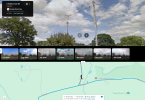

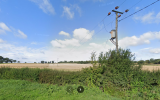
Last edited:
John J.
Senior Member.
There was an error in my diagram in post #248, an elevation of 123 metres was put at 133 metres on the graph.
It doesn't affect the outcome; there is no topographical obstruction of line-of-sight from Bryn Garth to the proposed location of the lights (electricity cables near the easternmost corner of the field immediately to the south of the Denbigh Golf Club buildings).
Click to enlarge to see revision (if interested!)
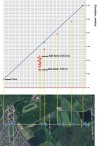
It doesn't affect the outcome; there is no topographical obstruction of line-of-sight from Bryn Garth to the proposed location of the lights (electricity cables near the easternmost corner of the field immediately to the south of the Denbigh Golf Club buildings).
Click to enlarge to see revision (if interested!)
I finally found a video showing what the water tank looks like up close, including the electrical control cabin that the 3-phase line terminates at . Not much additional info to help our investigation though.
Source: https://youtu.be/BnRg42R1Eug?t=577
Source: https://youtu.be/BnRg42R1Eug?t=577
Last edited:
I've just received a reply from the DNO regarding my request for a more accurate location of the fault from their records. Unfortunately it doesn't provide any useful additional info...
I assume that when they say "overhead lines at the rear of Coppi Road Denbigh LL16 5AA" they mean "at the rear of (a property on) Coppi Road Denbigh LL16 5AA" as per the original letter.
---------- Forwarded message ---------
From: Complaints SPM <spencomplaintssouth@spenergynetworks.co.uk>
Date: Fri, 5 Dec 2025, 09:15
Subject: Re: Case 01423350
To: flarkey@email.com
Dear Mr Larkey,
Thank you for your patience whilst I have reviewed this incident further.
As this incident dates back to 2012 I can only access limited information. However, I can confirm we became aware of the fault on 3rd January 2012 when we receive a call reporting sparking from the overhead lines at the rear of Coppi Road Denbigh LL16 5AA
As detailed in my previous correspondence, our resources attended site and replaced two insulator reels and 160-amp fuse as part of the required repair works. Supply was then restored to all customer at 4.10 pm that same day.
I trust this information will be sufficient for your needs and I am sorry I am unable to provide a more precise location, due to system and network changes since this incident.
I assume that when they say "overhead lines at the rear of Coppi Road Denbigh LL16 5AA" they mean "at the rear of (a property on) Coppi Road Denbigh LL16 5AA" as per the original letter.
Last edited:

maharadzor
New Member
The question then becomes, could a 400V potential difference (230V phase to phase) cause sparking like I think we see in the video? .
230V with a current limit.
Source: https://youtu.be/duk44mL3P-M?t=2m8s
Source: https://youtu.be/l2IzHkZo4xE
Source: https://youtu.be/CQo31GL3fls
Current limiting seems crucial, otherwise it is more like an explosion
Source: https://youtu.be/-iClXrd50Z8
Source: https://youtu.be/6vR-_idhF60
Source: https://youtu.be/bXmX6OuWeDA
AI check:
https://g.co/gemini/share/1014331e5331
Loosly tangled wires and/or voltage fluctuation could possibly create a series of bright longer arcs.
BUT, I would expect they would be chaotic, short lived and sparky - possibly quickly moving in either direction depending how wiggling wire waves propagate.
Source: https://youtu.be/Bu174a_TzkE?t=3m36s
On the contrary, slowly moving relativly stable lights would imply wind pushing the hot plasma/air, just like in Jacob ladder experientes. But, again, for that stable arc we would need continous higher voltage (since we dont have a current limit).
Last edited:
This has been bothering me for a while - we had no conclusive evidence that Low Voltage Overhead power lines could produce sparks, as was the theory for the lights seen in the Denbigh UFO video.
I've found a video of what appears to be LV cables sparking. Although the day looks nice the OP says that there were high winds at the time.
Source: https://www.youtube.com/watch?v=929b1dK11GE
I've geolocated the Video to a field just north of Abridge, Kent, Uk. The view of the treeline in the distance matches in Streetview.
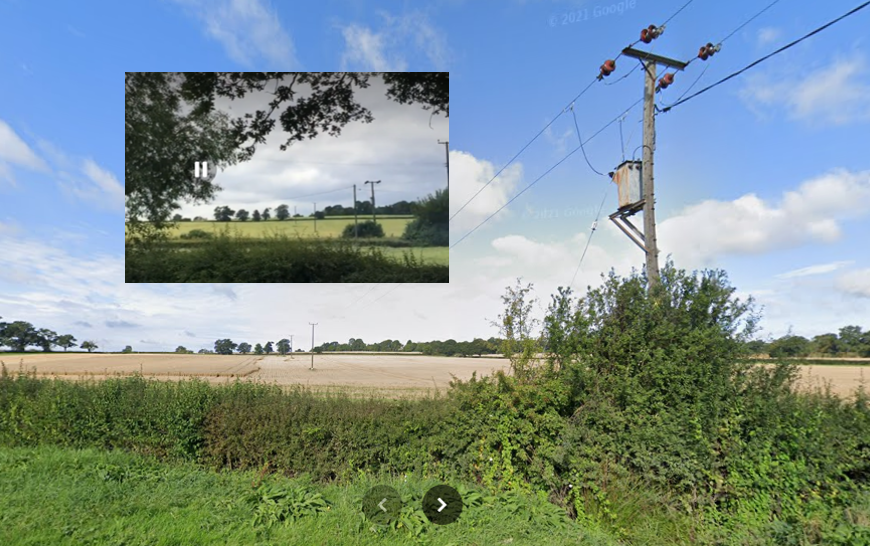
https://www.google.com/maps/place/Abridge/@51.6645356,0.1350374,29a,73.9y,274.96h,88.37t/data=!3m11!1e1!3m9!1saBkik4O8xW9wEy_oVWhlIA!2e0!5s20200801T000000!6shttps://streetviewpixels-pa.googleapis.com/v1/thumbnail?cb_client=maps_sv.tactile&w=900&h=600&pitch=1.627168726823001&panoid=aBkik4O8xW9wEy_oVWhlIA&yaw=274.95778258821815!7i16384!8i8192!9m2!1b1!2i39!4m6!3m5!1s0x47d8a23174b37231:0x4063d705b5dc348e!8m2!3d51.650306!4d0.1178471!16zL20vMDdxbXAy?entry=ttu&g_ep=EgoyMDI2MDkxMy4wIKXMDSoASAFQAw==
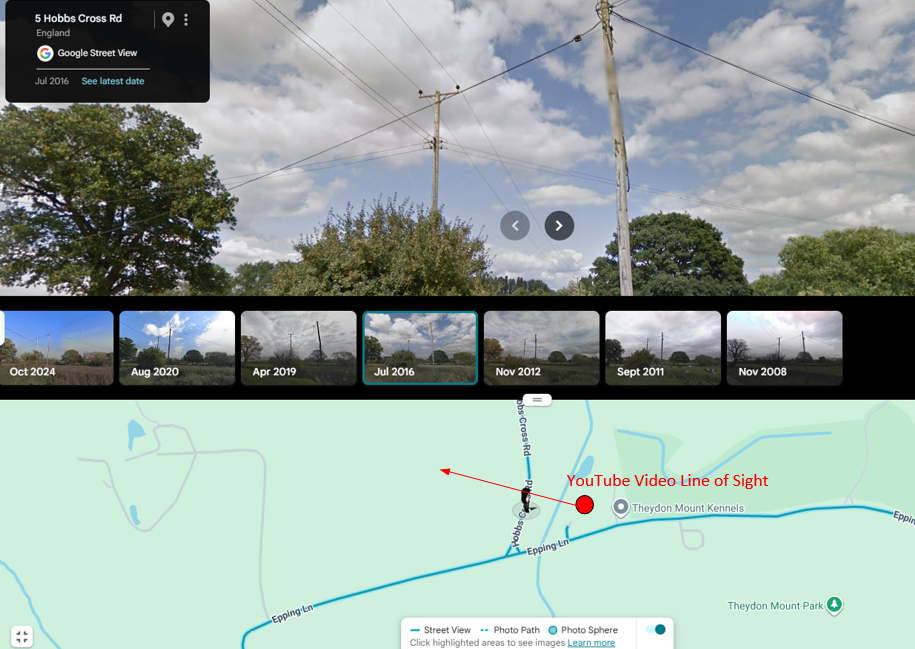
The video above is recorded from close to the river, between where the StreetView-man is and the Kennels. It is looking west toward the pole with the two-wire 3-way junction. The streetview image below looks back NE towards the pole.
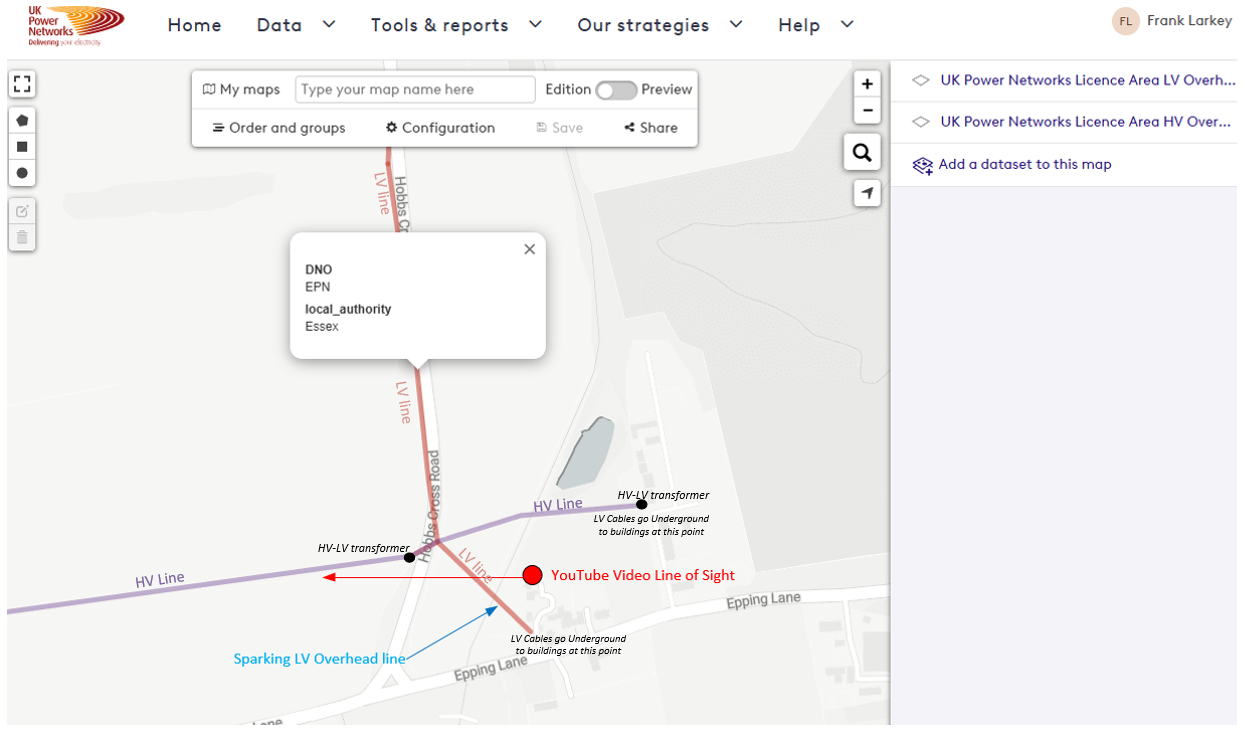
The ODN network map confirms the pole with the 3-way junction is supporting LV cables. (red line LV, purple line HV). The pair of wires routes from the transformer on the pole to two residences nearby - the transformer changes the supply from HV to LV. The fact that the lines are going direct to residential properties suggests that these are UK Mains 230V lines.
https://ukpowernetworks.opendatasoft.com/map/+d72afbee776145d5/edit/ (red line = LV, purple line = HV)
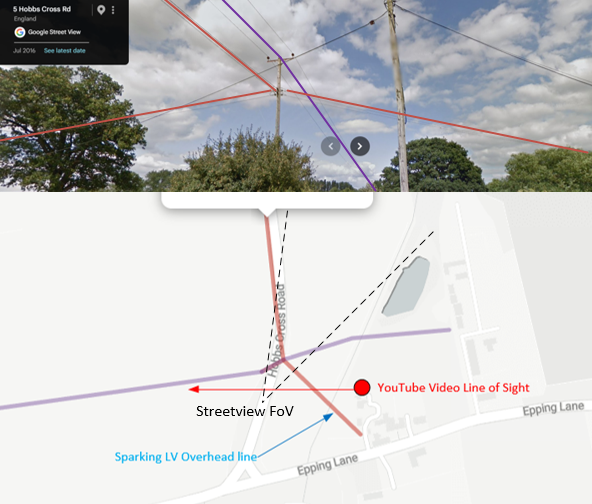
Relating the map to the StreetView image:
So this confirms that sparking from Low Voltage Overhead Cables is indeed a possible phenomenon that could fully explain the 'UFO Sighting' in Denbigh that night. The cables sparking in the video from Abridge shows 230V Mains cables running to residential properties, but the cables in Denbigh were 230V 3-phase cables running up the the reservoir, so they would have been even more likely to create bright sparks (the phase to phase difference in 3-phase cables is close to 400V).
This is a reminder of what the video shows - a phenomenon that visually matches sparking LV cables, in a location that we know that Low Voltage Overhead cables were present, during a storm that caused damage to electricity infrastructure in the area.
Perhaps "Likely sparking powerlines" should be revised to "almost certainly sparking powerlines".
The question then becomes, could a 400V potential difference (230V phase to phase) cause sparking like I think we see in the video?
I've found a video of what appears to be LV cables sparking. Although the day looks nice the OP says that there were high winds at the time.
Electricity Pole wires sparking and banging in the wind near Abridge Village, Essex. Wires from electric poles blown about in wind and shorting out causing loud banging noises and massive sparks.
Source: https://www.youtube.com/watch?v=929b1dK11GE
I've geolocated the Video to a field just north of Abridge, Kent, Uk. The view of the treeline in the distance matches in Streetview.
https://www.google.com/maps/place/Abridge/@51.6645356,0.1350374,29a,73.9y,274.96h,88.37t/data=!3m11!1e1!3m9!1saBkik4O8xW9wEy_oVWhlIA!2e0!5s20200801T000000!6shttps://streetviewpixels-pa.googleapis.com/v1/thumbnail?cb_client=maps_sv.tactile&w=900&h=600&pitch=1.627168726823001&panoid=aBkik4O8xW9wEy_oVWhlIA&yaw=274.95778258821815!7i16384!8i8192!9m2!1b1!2i39!4m6!3m5!1s0x47d8a23174b37231:0x4063d705b5dc348e!8m2!3d51.650306!4d0.1178471!16zL20vMDdxbXAy?entry=ttu&g_ep=EgoyMDI2MDkxMy4wIKXMDSoASAFQAw==
The video above is recorded from close to the river, between where the StreetView-man is and the Kennels. It is looking west toward the pole with the two-wire 3-way junction. The streetview image below looks back NE towards the pole.
The ODN network map confirms the pole with the 3-way junction is supporting LV cables. (red line LV, purple line HV). The pair of wires routes from the transformer on the pole to two residences nearby - the transformer changes the supply from HV to LV. The fact that the lines are going direct to residential properties suggests that these are UK Mains 230V lines.
https://ukpowernetworks.opendatasoft.com/map/+d72afbee776145d5/edit/ (red line = LV, purple line = HV)
Relating the map to the StreetView image:
So this confirms that sparking from Low Voltage Overhead Cables is indeed a possible phenomenon that could fully explain the 'UFO Sighting' in Denbigh that night. The cables sparking in the video from Abridge shows 230V Mains cables running to residential properties, but the cables in Denbigh were 230V 3-phase cables running up the the reservoir, so they would have been even more likely to create bright sparks (the phase to phase difference in 3-phase cables is close to 400V).
This is a reminder of what the video shows - a phenomenon that visually matches sparking LV cables, in a location that we know that Low Voltage Overhead cables were present, during a storm that caused damage to electricity infrastructure in the area.
Perhaps "Likely sparking powerlines" should be revised to "almost certainly sparking powerlines".
Last edited:
Similar threads


- Replies
- 24
- Views
- 9K
- Replies
- 46
- Views
- 8K


- Replies
- 63
- Views
- 15K


Trending content
-
 Thread 'David Grusch Makes Wild Claims in Oct 2026 Appearance on Joe Rogan Podcast'
- MeowingMuon
Replies: 44 -
-
