
White noise and the illusion of interactivity: A curious paper on vision

jdog

Senior Member.
I came across "Magnetic sand": Illusions of interactivity, a May paper in Journal of Vision that catalogs a new variety of visual perception issue, in which the participant perceives an actually inert system is responding to them, which struck me as interesting in relation to some UAP sightings, particularly those where observers think lights in the sky are reacting to them. If nothing else it highlights how things can differ between what is actually happening and what an observer perceives is happening.
External Quote:

We discovered a series of new illusions in which hand or finger movements near a random white noise display lead to the perception that the display is interactively altered contingent upon the observer's actions.
External Quote:

In all demonstrations, the observer is expected to hold their finger(s) or palm very close to the dynamic random noise display, but not touch it. They should then execute the following movements, each of which leads to a visual illusion. All these illusions make the visual noise appear interactive with the finger movements. [emphasis added]
...
Eight participants (7 male, 1 female), all students or researchers affiliated with the California Institute of Technology, took part in the study. All participants reported normal or corrected-to-normal vision and provided written informed consent prior to their involvement. They were compensated $50.00 for their participation in a 120-minute session, which included a short break after approximately 50 minutes. In addition to these laboratory participants, all reported effects were tested, refined, and confirmed through demonstrations—both onsite and via the project website—with 50 to 70 audience members each year at the Demo Night, held at the Vision Science Society Annual Meetings in 2019, 2022, 2023, 2024, and 2025. All participants were explicitly instructed to ensure clear perception of each illusion, from illusion 1 to illusion 4.
External Quote:
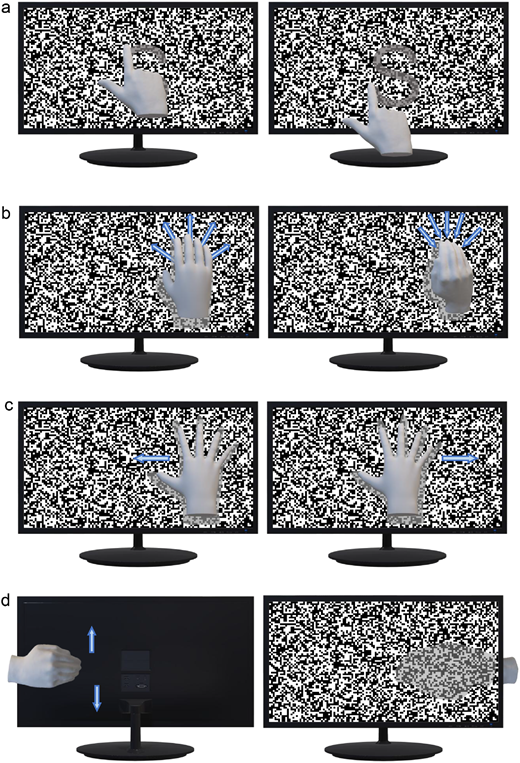
m_i1534-7362-26-5-3-f1_1778575627.64592.png


New illusions. (a) Illusion 1. Iconic trace of trajectory. When the observer draws an "S" letter (or any other letter/pattern) on the dynamic noise display, they see a trace that fades away quickly. (b) Illusion 2. Magnetic repulsion/attraction. Open a palm as it approaches the display, then close the fingers (as though grabbing) as you pull away from it, and repeat. The nearby dots are perceived as though magnetic, moving away while the palm opens and gets close, and being attracted to the fingers when they grab and move away from the display. (c) Illusion 3. Action capture (with visible hand). The palm should be wide open, held very close and parallel to the noise display, then slowly moved left and right (or up and down), within a very small spatial range (a slow shudder). It perceptually captures the nearby dots, as though they were being captured and coming together with the palm. (d) Illusion 4. Action capture (with invisible hand). While observing the dynamic noise, the observer moves their hand up and down behind the display, so that the hand itself is invisible. The dynamic noise nearby (although often in the spreading area) may appear to be captured by the invisible hand.
 
I came across "Magnetic sand": Illusions of interactivity, a May paper in Journal of Vision that catalogs a new variety of visual perception issue, in which the participant perceives an actually inert system is responding to them, which struck me as interesting in relation to some UAP sightings, particularly those where observers think lights in the sky are reacting to them. If nothing else it highlights how things can differ between what is actually happening and what an observer perceives is happening.

Your post reminded me of a couple of studies briefly mentioned in the "Major UFO experiences are specific to the observer" thread, post #15.
In one, believers in paranormal phenomena were more likely to ascribe intentionality to randomly moving dots,
in the other, believers in the paranormal were more likely to report seeing a walking figure in a pattern of lights when none was present:

External Quote:
Riekki recently asked sceptics and believers to view simple animations of moving shapes, while lying in a brain scanner. He found paranormal believers were more likely to see some kind of intention behind the movements – as if the shapes were playing a game of "tag", say – and this was reflected in greater brain activity in the regions normally associated with "theory of mind" and understanding others' motives. Riekki has also found that people who believe in the supernatural are more likely to see hidden faces in everyday photos – a finding confirmed by another team at the University of Amsterdam, who showed that paranormal believers are more likely to imagine that they had seen a walking figure in random light displays.
External Quote:
Added to this, Riekki has found that believers may have weaker cognitive "inhibition", compared to sceptics. That's the skill that allows you to quash unwanted thoughts, so perhaps we are all spooked by strange coincidences and patterns from time to time, but sceptics are better at pushing them aside. Riekki gives the example of someone who is thinking about their mother, only for her to call two minutes later. "Is it just that sceptics can laugh and say it is just coincidence, and then think of something else?" he wonders. Significantly, another paper reported that paranormal believers also tend to have greater confidence in their decisions, even when they are based on ambiguous information.
BBC Future, "Psychology: The truth about the paranormal", David Robson, 31/10/2014
here https://www.bbc.com/future/article/20141030-the-truth-about-the-paranormal
It's quite a light but interesting read IMHO.

The abstract and introduction of the University of Amsterdam study [mentioned in the BBC article] - seeing if there was a difference between believers and sceptics in the perception of a walking human figure in a pattern of moving dots- can be seen here,
https://www.sciencedirect.com/science/article/abs/pii/S1053810013000974
"Paranormal believers are more prone to illusory agency detection than skeptics", Michiel van Elk, Consciousness and Cognition Vol. 22, 3, September 2013.
External Quote:
...paranormal beliefs (i.e. Psi, spiritualism, precognition, superstition) were strongly related to illusory agency detection.

NB, van Elk wrote
External Quote:
...it was found that illusory agency detection was unrelated to traditional religious belief and belief in witchcraft, whereas paranormal beliefs (i.e. Psi, spiritualism, precognition, superstition) were strongly related to illusory agency detection.
It's not clear if any "believer" subjects, who were recruited at a paranormal fair hosted by Netherlands group Paraview (website https://www.paraview.nl/) were recruited/ identified because of their beliefs about UFOs, probably not.
 
Eight participants (7 male, 1 female), all students or researchers affiliated with the California Institute of Technology, took part in the study.
I think it takes a lot of hubris to write a paper when your study only included eight participants.
 
I think it takes a lot of hubris to write a paper when your study only included eight participants.
External Quote:
[Eight participants (7 male, 1 female), all students or researchers affiliated with the California Institute of Technology, took part in the study./EX]

Ooh, good point. Looks like an opportunistic sample too.
 
Back
Top