I'm interested in psychology, history and astronomy. The subject at hand is an intersection of all three. I've done so much reading over the decades... and I have no logbook. As a start, I'll to point to anything by John Romer. You have to
grok the Egyptians first, because it's a completely different mindset. Although they mapped the sky in great detail, and had good predictive models, their cosmology was almost entirely religious in nature. Pre-scientific people were intuitive thinkers, and felt that everything was alive. The Egyptians felt that the earth and sky are alive and full of alive things.
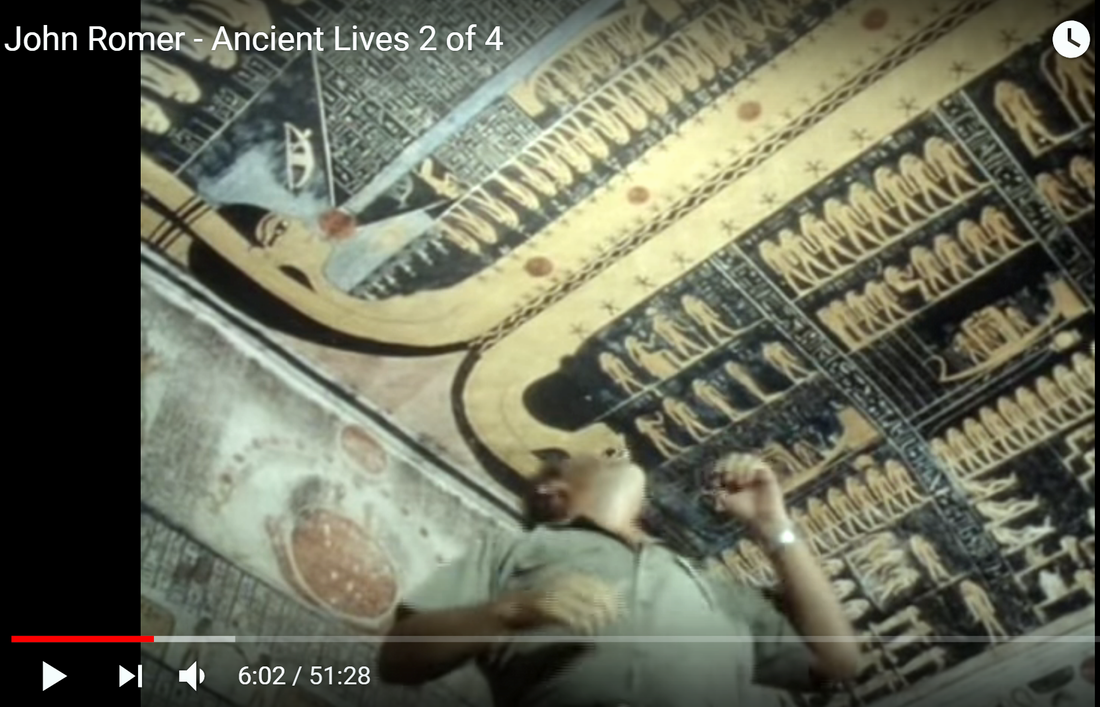
Here, on the ceiling of a tomb, is a bit of Egyptian cosmology. The two female figures are goddesses. Mut, the Earth Goddess, was considered a primal deity, associated with the waters of life from which everything was born. You can see the Sun Disk passing through her body. The figure with the stars in her body is Nut, the Sky Goddess.
Before going any further... These paintings are not meant to be representational. Nut is associated with the dome of the sky, but the dome doesn't literally look like a woman. The sky is alive with her goddess spirit and will. The Sun and stars are alive things, inside her. The Underworld is a physical place, but infused with the
aliveness of Mut. It's a vast place with the waters of life flowing through
it Her.
They seem to be back to back, but this is not meant to be their actual physical arrangement. We would think that the sky would be over the earth. We're running into an artistic practice. You'll see the same kind of thing on the ceiling of the tomb of Seti I. There you can see paintings of recognizable constellations, but it's confusing because they don't have the same physical relationship to one another you see in the sky.
The Sun, or Amun-Ra the Sun God, or the Dead Pharaoh who has become Amun-Ra, journeys during the night on a boat on one of the Underworld rivers of the Waters of Life. There was no definite separation between the physical sun we see in the sky, the Sun God Amun-Ra (who himself is a fusion between two gods), and the Pharaoh(s) who become(s) Amun-Ra.
If you're looking for a cosmology the way we think of it in analytical terms you might find yourself lost or even frustrated. (But in all of this, I'm working from memory and over-simplifying. It is best to really rely on your own education.)
Most apropos to the subject of this thread, I'll reiterate: The cosmology of the Egyptians made intuitive sense based on what we see. The sun looks as if it is rising above an edge, passing over us, and dropping below an edge. It doesn't look as if it's traveling in a circle above the flat surface of earth.
The night sky looks like a fixed dome with independent stars moving through it on fixed courses, some of which also dip below a physical edge and rise above a physical edge. It doesn't look like a rotating dome with fixed stars on its surface. That model doesn't make intuitive sense even to a person who doesn't travel. E.g. stars on the horizon would be moving sideways and parallel to the horizon.
In both cases these modern FE models were invented because no one can now deny times zones.
In both cases Modern FE Believers are not trusting their eyes; they have concocted pseudo-analytical rationalizations to explain away what we see.
I can point to a book I read not too long ago.
The History and Practice of Ancient Astronomy
by
James Evans
External Quote:
The History and Practice of Ancient Astronomy combines new scholarship with hands-on science to bring readers into direct contact with the work of ancient astronomers. While tracing ideas from ancient Babylon to sixteenth-century Europe, the book places its greatest emphasis on the Greek period, when astronomers developed the geometric and philosophical ideas that have determined the subsequent character of Western astronomy. The author approaches this history through the concrete details of ancient astronomical practice.
A bit more about John Romer. He's a very good start because his love for these people is evident, and he explains how they lived... and thought... and felt. Just as different people/deities/things could fuse into one, each person had parts of himself, that would separate and go to different places after death.
External Quote:
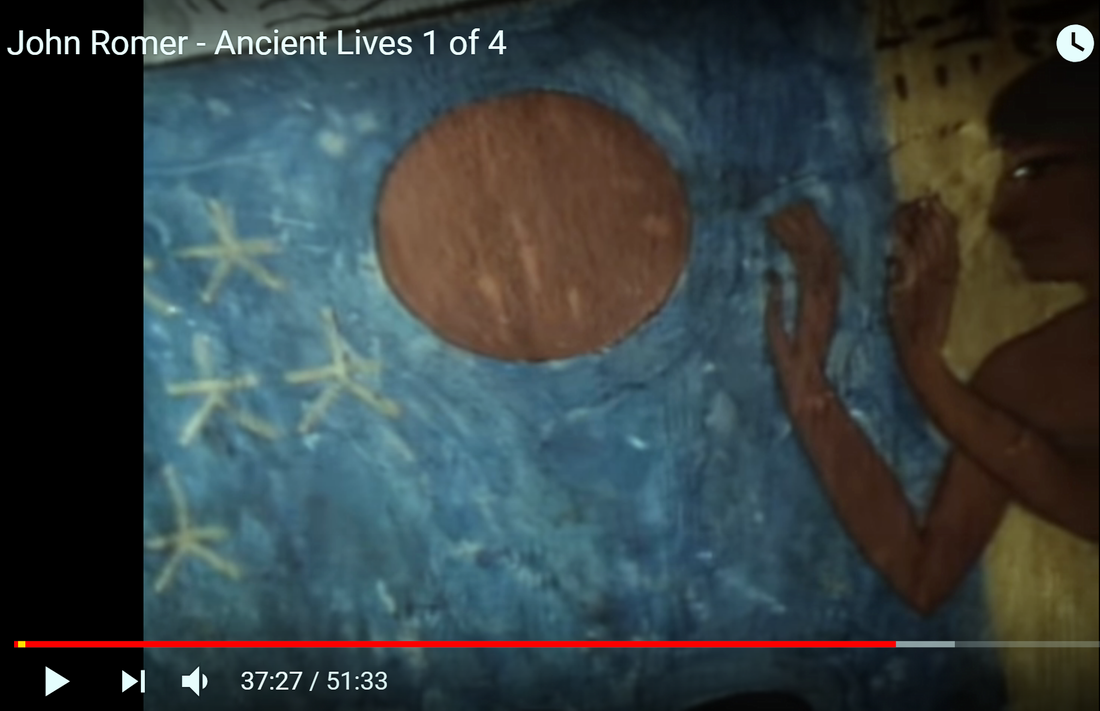
There are other heavens for different parts of the person. And one of those is the person's soul. Now that goes up to heaven. And these are the souls of our villagers, these stars up here. Here's Sennedjem worshipping older villagers, so that he too would be a star and shine in the night sky.
I've gone on here at Metabunk about the difference between analytical thinking and intuitive thinking. I don't want to give the impression that I hate intuitive thinking. It's the place where you feel, and
grok what other people are all about. But when you use nothing but intuitive thought (especially if you are a suspicious person full of negative emotions) you can get into trouble.
"Love with your heart, use your head for everything else."