
You are using an out of date browser. It may not display this or other websites correctly.
You should upgrade or use an alternative browser.
You should upgrade or use an alternative browser.
The Denbigh Lights UFO Analysis - Jan 2012 - [Likely sparking powerlines]


in 2011 we can see a 3 cable setup running up the hill
View attachment 86045
By 2021 it's been replaced by a single cable
View attachment 86046
If you look closely at some of the other imagery you'll see the single cable is 3 wires (carrying each of the 3 phases) twisted together. The lower wires are telephone wires.
The stretch along the road seems to have been replaced first, before the line running through the fields at the back of the property.
Last edited:

Well based on that photo, this is the line of sight:This is a photo from inside his bedroom.
https://www.metabunk.org/sitrec/?cu...ebnigh bedroom photo match/20251117_195914.js

JMartJr
Senior Member.
Thanks for clarifying that!I think the confusion is that you think I'm arguing a different point. You think I'm denying that arcs can travel along power lines. I'm not.
OK, I understand your position better now, again, thank you....
Aside from that, the videos you've posted appear to be medium, to high voltage distribution, almost certainly 7.2 kV – 34.5 kV. This is not relevant to 230V domestic lines, which absolutely cannot do this. They just don't have enough voltage to sustain an air arc or visible discharge like the ones in the video (or allegedly seen in the original Denbigh UFO video).
...
So that's the real problem that has to be overcome to blame/resolve the UFO on the "likely sparking power lines" argument as listed in the thread title.
It does, and I'll continue to follow the conversation as those of you with more expertise than the "almost none" that I have thrash it out! ^_^Again it's definitely not likely..if a subject matter expert means anything to you?
I remain darkly suspicious of AI as a research tool, so won't put any weight on that. I would be interested in seeing a "real world example," though I am hampered in searching for one as they all just look like power lines to me! (And of course, if, as you say, there are none, that would hamper the search even more!^_^)Confirmed by any of the AI you can ask and the lack of a single real-world example?
Ain't up to me! But if you demonstrate that it is wrong to the satisfaction of those whom it IS up to, I would guess they'll update it.Add to that there aren't any HV lines in your current LOS…why are we keeping that title?
JMartJr
Senior Member.
Looking at the wires that come to my house, there are three wires/cables/strands. Two appear to be involved in the whole bringing-me-electrisity" business, the third appears to be uninsulated and seems to be there just to help support the weight of the other two -- it is attached too the house structure directly via an insulated fitting, and to what appears to be a ground wire that IS insualted...If you look closely at some of the other imagery you'll see the single cable is 3 wires (carrying each of the 3 phases) twisted together. The lower wires are telephone wires.
Is that the sprt of thing we are seeing in the picture, or are the three wires part of the three-phase system discussed above, or am I totally wrong and it is something else entirely?
U
UAPF
Guest
Great spot. Another reason why it's probably not this location as per Flarkeys letter stating the only thing changed was 2x insulator reels (which aren't on these poles before or after the event from the street view images). And they've even changed it from there phase in to single phase and no mention of that either. Good work good sir. I think I remember reading they'd changed a few things in the area around 2016 for some modernisation. I'll see if I can dig it up.in 2011 we can see a 3 cable setup running up the hill
View attachment 86045
By 2021 it's been replaced by a single cable
View attachment 86046
U
UAPF
Guest
I only see the telephone cable twisted which is common. And they're insulated anyway. The LV looks solid.If you look closely at some of the other imagery you'll see the single cable is 3 wires (carrying each of the 3 phases) twisted together. The lower wires are telephone wires.
View attachment 86048
View attachment 86049
The stretch along the road seems to have been replaced first, before the line running through the fields at the back of the property.
U
UAPF
Guest
Yes, that's close to the line of sight I have, but the most important data point is the furthest (right) flash/light from Nathan's footage which is over number 12 Bryn Garth to theWell based on that photo, this is the line of sight:
https://www.metabunk.org/sitrec/?custom=https://sitrec.s3.us-west-2.amazonaws.com/1/Debnigh bedroom photo match/20251117_195914.js
View attachment 86051
Last edited by a moderator:
U
UAPF
Guest
Thanks man. Appreciate that.Thanks for clarifying that!
OK, I understand your position better now, again, thank you.
It does, and I'll continue to follow the conversation as those of you with more expertise than the "almost none" that I have thrash it out! ^_^
I remain darkly suspicious of AI as a research tool, so won't put any weight on that. I would be interested in seeing a "real world example," though I am hampered in searching for one as they all just look like power lines to me! (And of course, if, as you say, there are none, that would hamper the search even more!^_^)
Ain't up to me! But if you demonstrate that it is wrong to the satisfaction of those whom it IS up to, I would guess they'll update it.
Yes, that's close to the line of sight I have, but the most important data point is the furthest (left) flash/light from Nathan's footage which is over number 12 Bryn Garth to the left of their roof pitch in fact. Which I'm sure you agree the angle of which would put the furthest right UFO light smack bang in the middle of the woods. Nowhere near Flarkey water tank location. @flarkey what do you think.
@UAPF You've drawn the line of sight over the wrong house.
It goes over 9/10, not 11/12 as per your diagrams.
Last edited:
It goes over 9/10, not 11/12 as per your diagrams.
Yeah, 100% it goes over 9/10. Towards the power lines area (and the edge of the woods), not the woods.
U
UAPF
Guest
As I said early on, I'm happy the LOS is accurate. Though I do think the furthest light source on the right comes over the number 11 (I can see the hedge) and the angle pushes it a degrees more right.@UAPF You've drawn the line of sight over the wrong house.
View attachment 86061
It goes over 9/10, not 11/12 as per your diagrams.
View attachment 86062
Either way, even if that's the correct location, we still haven't established why there are no matching power lines, assuming that's still considered a reasonable explanation.
There still are no insulator reels visible on the cables (before or after the event), and the probability of arcing occurring on a low-voltage cable is extremely low. The DNO hasn't provided any location details that actually tie this to the specific event or this exact spot. The postcode alone covers more than 100 acres.
On top of that, we're assuming we can confidently match the elevation and tree lines, but the area is full of overlapping tree lines, bushes, varied farmland, and lots of small elevation change, even within a single field. It's simply too blurry to know which tree line corresponds to what, and Street View isn't much help because all the sightlines are taken from road level at unhelpful angles.
But the big problem is LV lines don't arch like this, ever. And absolutely not for 6-10 minutes, even if by some stroke of luck they did. Tis highly improbable.
There's still a significant amount of guesswork because of all the missing data.
Last edited by a moderator:

John J.
Senior Member.
But non-zero?the probability of arcing occurring on a low-voltage cable is extremely low.
After all, small arc flashes can occur with domestic electricity circuits/ household appliances.

Mendel
Senior Member.
[citation required]But non-zero?
After all, small arc flashes can occur with domestic electricity circuits/ household appliances.
Microwave ovens include a transformer.
Other electrical faults involve a medium other than air combusting.
You gave two images, one with some some lights at the area where the power line are and one with a red arrow pointing at the wrong house. They are nowhere near each other.As I said early on, I'm happy the LOS is accurate. Though I do think the furthest light source on the right comes over the number 11 (I can see the hedge) and the angle pushes it a degrees more right.

FatPhil
Senior Member.
Why are you reintroducing a concept I've told you is irrelevant?The propagation speed of an electrical arc is tens to hundreds of thousands of metres per second, while wind moves at only 5–20 m/s.
No-one's talking about steering the arc.Because the leader forms orders of magnitude faster than the air can be displaced, wind simply cannot steer the arc, the path is determined almost entirely by the local electric-field gradient.
Where do your "microseconds" and "collapses almost instantly" come from. Again, you seem to be straw-manning, as no-one's talking about influencing the lightning's path once a strike has begun.Ionised air does have lower resistance, but the ionisation channel exists for "microseconds" and collapses almost instantly. It does not drift far enough or persist long enough for wind to influence the lightning path. And if we use our case in question, that doesn't make sense does it?
The trees are visible in 2018 Google Earth imagery, but have been removed by 2022. If this was "Presumably to lay underground LV cable" then it was well after our event.Also looks like these trees have been cleared since 2011 to create that gap you're seeing in the original "UFO daytime pic". Presumably to lay underground LV cable
U
UAPF
Guest
The street view images are better as the provide some hight of the trees. You have to cut trees down to stumps before you can then dig up the stumps. And as your images show that's been proper dug up. We're making presumptions that it was done al at the same time and not left for weeks/months/years to complete the final stages. Which makes sense on a golf course. You can trim a tree down in a couple of hours with a bloke and a harness. Pulling up stumps means closing off part of the golf course and driving an excavator up there. Maybe off season stuff for the golf course? Why do you think they removed all those trees?The trees are visible in 2018 Google Earth imagery, but have been removed by 2022. If this was "Presumably to lay underground LV cable" then it was well after our event.
View attachment 86086
View attachment 86087

What do you mean by "you can see the hedge"? The images you attached don't seem to indicate that at all. (BTW it would be helpful if you inserted the images inline as well as just attaching them - click the "Insert" button after uploading.)Though I do think the furthest light source on the right comes over the number 11 (I can see the hedge) and the angle pushes it a degrees more right.
Although this image is dark you can see that all of the light flashes are to the left of the front door of number 10. The front door is dark and provides a good contrast against the pale house so it shows up nicely in the video. I've aligned them here with the purple vertical line.
Until we clear up that fundamental misunderstanding about the line of sight, which pins down the location of the lights, then we'll keep going round in circles. All the lights are well to the left of the front door of number 10. In fact the furthest right they go appears to be approximately in between the windows of number 10. Which, by comparing to the daytime pic from the bedroom window, is right where the prominent trees on the golf course are.
It's also interesting to see that there appears to be a very similar car parked in exactly the same spot as the night video. When was this daytime shot taken?
The Streetview Images are from:The street view images are better as the provide some hight of the trees.
- Mar 2009 (trees visible)
- April 2011 (trees visible)
- Sept 2021 (trees removed)
- Mar 2023 (trees removed)
- April 2009 (trees visible)
- April 2015 (trees visible)
- May 2016 (trees visible)
- July 2019 (Obscured By Clouds)
- Jan 2020 (trees removed)
- April 2025 (trees removed)
The presumption being made is that they were cut to lay an LV cable when no evidence for an LV cables in that specific area exists (other than trees being cut down) - You're doing the same thing that you are accusing us of doing - guessing. Suggesting hypotheses is absolutely fine, but they should be tested or validated through investigation or analysis and presentation of evidence. (maybe you have access to https://lsbud.co.uk/ through your work?)You have to cut trees down to stumps before you can then dig up the stumps. And as your images show that's been proper dug up. We're making presumptions that it was done al at the same time and not left for weeks/months/years to complete the final stages. Which makes sense on a golf course. You can trim a tree down in a couple of hours with a bloke and a harness. Pulling up stumps means closing off part of the golf course and driving an excavator up there. Maybe off season stuff for the golf course?
I don't know why, and to be honest I'm fine not knowing why. Some things are just in the realm of the unknown.Why do you think they removed all those trees?
Last edited:
U
UAPF
Guest
Lets not forget that the hypothesised Overhead Lines are 230V three-phase not 230V domestic lines , assumed to supply power to the reservoir machinery and pumps. My 3-phase experience is limited to what I studied at university and some electrical supplies on aircraft, and only then in fully functioning states and not fault conditions such as this. But I do understand the difference between single and multi-phase supplies and the increased hazards associated with them.
https://www.businessenergydeals.co.uk/blog/three-phase-power/
This is what Google has to say about the dangers associated with 3-phase supplies....
So they can create "more severe arc flash events and damage, posing a greater risk of burns, explosions, and injury."
As I've said I think the LOS is pretty much spot on. Perhaps seeming slightly over the front garden hedge of number 11, but I accept it's difficult with night shots and daytime overlays. But that only creates further problems with this location and the DNO's letter.
3 phase is common in rural locations. We've done the science on a 230v arc chance for a prolonged period over a 45m expanse being near zero probability. It's still a 230v line regardless with all the associated problems with multiple-point arching over 45m expanse. That's a big hurdle to get over. BUT...we have the big problem and that is confirming it's this the same fault as is recorded in your letter from SP Energy Networks who state 2 insulator reels and a 160a fuse were replaced.
They have yet to provide a location other than a postcode. For those in this thread not in the UK a postcode covers multiple areas and in this specific case covers 6 properties all with large bodies of land with hills and tree lines and hedges and various elevations across fields. Even trenches and cave areas I can see.
None of the images in street view before or very near or after the incident show insulator reels on your poles at your identified location. Why isn't that being focussed on here? The DNO gave us that valuable important data point.
There are overhead LV lines in virtually every direction and if we go further back you'll find probably another 5 lines that would work, but of course the distance would be probability of actually zero due to the arching and visibility issues. The power line that is at that much closer point I identified would make far more sense from a scientific perspective because of distance, visibility, size of the arching. But then that would mean that it's not at the rear of a property but across a road.
My location fits better, is in line of sight (that we all seem to agree on), does have overhead LV power lines overhead and importantly does have insulator reels, is within the DNOs postcode provided.So why not my location?
Last edited by a moderator:
U
UAPF
Guest
I don't use that website. Never heard of it, but then I don't dig ditches. I work in various Kw EV and solar installations. Small commercial and residential at the moment. But over time have dealt with a fair bit of cable, as you can imagine. Let's talk about the insulator reels, eh?The Streetview Images are from:
The Google Earth imagery is from:
- Mar 2009 (trees visible)
- April 2011 (trees visible)
- Sept 2021 (trees removed)
- Mar 2023 (trees removed)
So better coverage in GoogleEarth to deduce when the trees were cut down. (Although TBH I'm still not sure what your point with these trees is. Was it back when you thought we had the wrong line of sight? I think that has been conclusively put to bed now though so this point is moot)
- April 2009 (trees visible)
- April 2015 (trees visible)
- May 2016 (trees visible)
- July 2019 (Obscured By Clouds)
- Jan 2020 (trees removed)
- April 2025 (trees removed)
The presumption being made is that they were cut to lay an LV cable when no evidence for an LV cables in that specific area exists (other than trees being cut down) - You're doing the same thing that you are accusing us of doing - guessing. Suggesting hypotheses is absolutely fine, but they should be tested or validated through investigation or analysis and presentation of evidence. (maybe you have access to https://lsbud.co.uk/ through your work?)
I don't know why, and to be honest I'm fine not knowing why. Some things are just in the realm of the unknown.
Last edited by a moderator:
Yeah, the insulator reels that you identified at Coppi Farm are on the associated HV line that supplies the Pole Mounted transformer that converts the 11kV to 230V single phase, which then crosses the road to supply the farmhouse. I agree that it has insulator reels on the HV line in the field across the road at the front of the property. (but not at the rear of the property like in the DNO letter).
Source and DNO HV and LV Lines
So lets check the pole that mounts the associated HV-LV Transformer for the 3-phase line near the golf club to see if there wereinsulator reels on it ... and the imagery from 2011 shows is that there are, but they don't appear in later imagery.
Source and DNO HV and LV Lines
In later imagery it looks like they have been replaced with a different style. (source )
Like you said previously - we don't have the exact details of the location of the fault only a description saying in was "in the fields at the rear of a property", nor the extent of the work, and I accept and agree with this. However, both locations have reels on their associated HV line, but only one of the locations has LV lines in a spot that matches the location of the lights (on the ridgeline at the top of the hill near the golf club).
So like @Trailblazer said, unless we can agree on the location of the lights we'll just go round in circles.
Source and DNO HV and LV Lines
So lets check the pole that mounts the associated HV-LV Transformer for the 3-phase line near the golf club to see if there wereinsulator reels on it ... and the imagery from 2011 shows is that there are, but they don't appear in later imagery.
Source and DNO HV and LV Lines
In later imagery it looks like they have been replaced with a different style. (source )
Like you said previously - we don't have the exact details of the location of the fault only a description saying in was "in the fields at the rear of a property", nor the extent of the work, and I accept and agree with this. However, both locations have reels on their associated HV line, but only one of the locations has LV lines in a spot that matches the location of the lights (on the ridgeline at the top of the hill near the golf club).
So like @Trailblazer said, unless we can agree on the location of the lights we'll just go round in circles.
Last edited:
U
UAPF
Guest
Yes, like I said, it's a pole with LV and insulator reel on. The pole has both LV & HV. With a transformer to step down HV to LV. And the cable goes right across the road through the LOSYeah, the insulator reels that you identified at Coppi Farm are on the associated HV line that supplies the Pole Mounted transformer that converts the 11kV to 230V single phase, which then crosses the road to supply the farmhouse. I agree that it has insulator reels on the HV line in the field across the road at the front of the property. (but not at the rear of the property like in the DNO letter).
Source and DNO HV and LV Lines
So lets check the pole that mounts the associated HV-LV Transformer for the 3-phase line near the golf club to see if there wereinsulator reels on it ... and the imagery from 2011 shows is that there are, but they don't appear in later imagery.
Source and DNO HV and LV Lines
Like you said previously - we don't have the exact details of the location of the fault only a description saying in was "in the fields at the rear of a property", nor the extent of the work, and I accept and agree with this. However, both locations have reels on their associated HV line, but only one of the locations has LV lines in a spot that matches the location of the lights (on the ridgeline at the top of the hill near the golf club).
So like @Trailblazer said, unless we can agree on the location of the lights we'll just go round in circles.
.
Last edited by a moderator:
But that's not within the LOS. It's in the right direction, but that road is way below the roofs of the houses as viewed from the bedroom window, as show by @flarkey in post 89.Yes, like I said, it's a pole with LV and insulator reel on. The pole has both LV & HV. With a transformer to step down HV to LV. And the cable goes right across the road through the LOS.
That cable is by Coppi Farm...
... which is entirely blocked by the houses as viewed from the video location:
Yes, like I said, it's a pole with LV and insulator reel on. The pole has both LV & HV. With a transformer to step down HV to LV. And the cable goes right across the road through the LOS
@Trailblazer - I think @UAPF 's argument is that the direct Line Of Sight to Coppi Farm doesn't matter, because he thinks the witness didn't see the 'sparking LV cables' there (although which he thinks they are actually there), he saw the UFO somewhere else on a line of sight that goes directly over Coppi Farm. It just so happens that if you extend that line of sight to its full extents (1.5km) it intersects with the ground at the overhead lines near the Golf club (which is where most of us think the lights and the electrical fault were). This is why @UAPF mentions distance to the UAP in some earlier posts - the distance to the lights cannot be determined form a 2d image and therefore we must accept the possibility that the UAP can be anywhere on that 1.5km long line of sight.
OK so why mention the cables crossing the road there?I think @UAPF 's argument is that the direct Line Of Sight to Coppi Farm doesn't matter, because he thinks the witness didn't see the 'sparking LV cables' there (which he thinks are there), he saw the UFO somewhere else on a line of sight that goes directly over Coppi Farm.
Here I have overlaid the position of Coppi Farm onto the view from the bedroom window, so you can see that the farm is entirely hidden behind the house at number 10. Any cables there cannot be anything to do with the lights visible.
The horizontal p[osition won't be entirely accurate, because that image is taken from Street View which is somewhat to the right (east) of the bedroom, so it will displace the farm buildings somewhat to the left relative to the distant trees, but that will be very slight. The vertical position should be very close to reality.
This can be confirmed by the line of the green field and hedge to the left of the tall white chimney visible from the bedroom window. That runs down from left to right and aligns with the farm buildings.
Last edited:
John J.
Senior Member.
But non-zero?
After all, small arc flashes can occur with domestic electricity circuits/ household appliances.
[citation required]
"Signs Your Home Could Have Electrical Problems", Home Alliance website, Michael Foster 04 Nov. 2025
https://homealliance.com/blogs/signs-your-home-could-have-electrical-problems
External Quote:
Witnessing sparks or small electrical arcs while plugging or unplugging devices from outlets is a concerning sign...
Loose connections disrupt the flow of electricity, creating arcing when contact is made or broken. Similarly, damaged wiring can expose live wires, leading to sparks upon contact.
"Understanding Arc Flash: What Homeowners Need to Know", Gardner Electrical website, 25 Nov. 2024
https://www.gardner-electrical.com/...rstanding-arc-flash-what-homeowners-need-to-/
External Quote:
Arc Flash – Have you ever noticed flickering lights or a strange burning smell near an outlet? These might be more than minor annoyances—they could signal a potential arc flash hazard in your home.
While arc flash is often associated with industrial sites, it can also occur in residential areas, posing serious risks.
"Arcing: An Electrical Shock or Fire Hazard", The Home Inspector's Handbook, Matthew Steger 2014
https://thehomeinspectorsnotebook.com/arcing-an-electrical-shock-or-fire-hazard/
External Quote:
As part of a home inspection, your inspector should inspect for signs of electrical arcing at receptacles, where wiring connects to circuit breakers or fuses, etc. ...The photo to the right shows the result of arcing where a conductor came loose at a receptacle's terminals hidden within a wall. Notice the one conductor's melted insulation.
"What causes Electrical Arcing. Why electricity Arcs", Electrical Faults Fixed website 25 Oct. 2024
https://www.electricalfaultsfixed.com/blog/what-causes-electrical-arcing-why-electricity-arcs
External Quote:
Electrical Arcing in Different Settings
The risk and nature of electrical arcing can vary depending on the setting:
Residential: In homes, especially older homes, common areas of concern include electrical outlets, light switches, and electrical panels. Arc fault circuit interrupters are now required in many areas of new construction, including bedrooms, family rooms, and dining rooms.
I'd guess many if not all of these arcs will be of very limited size and over very short distances. But they're not directly from a 3 phase power cable.
Arcing is often visible though ventilation grills/ holes in the motor housing of electric drills (with brushed motors) running on domestic supply.
"Cordless Drill Sparking: Are They Meant To Do That?" Sidev website, April 15 2025 https://sidev.org/are-cordless-drills-meant-to-spark-p1137/; the same applies to plug-in drills, "Why Is My Corded Drill Sparking?", Woodworking Street https://www.woodworkingstreet.com/why-is-my-corded-drill-sparking/External Quote:
Sparks... are typically small, brief flashes of light that occur within the motor housing. These sparks are a result of electrical arcing, a phenomenon where electricity jumps across a gap between two conductors. ...this arcing primarily happens at the commutator and brushes of the motor.
Last edited:
U
UAPF
Guest
To confirm my point: The LOS you/Mick and seemingly everyone believes is directly over that fam (as per @Trailblazer latest post with red and green pen - trees and green barn roof). There is only one LV cable that passes thorough your direction analysis that is attached to any pole with insulator reels on. Only one. Coppi Farm. And the cable stretches from the field on the left, across the road and in to the farm. The cable is LV, but it is attached to a HV pole on a step-down transformer (with insulator reels).@Trailblazer - I think @UAPF 's argument is that the direct Line Of Sight to Coppi Farm doesn't matter, because he thinks the witness didn't see the 'sparking LV cables' there (although which he thinks they are actually there), he saw the UFO somewhere else on a line of sight that goes directly over Coppi Farm. It just so happens that if you extend that line of sight to its full extents (1.5km) it intersects with the ground at the overhead lines near the Golf club (which is where most of us think the lights and the electrical fault were). This is why @UAPF mentions distance to the UAP in some earlier posts - the distance to the lights cannot be determined form a 2d image and therefore we must accept the possibility that the UAP can be anywhere on that 1.5km long line of sight.
I appreciate that is not helpful for your identification of the LV cable near your Denbigh Golf Course/water tank location, but there is no insulator reel on that pole, or any of the cable attached to the house, or in the road, in fact. None. Not now and not in archived street view images. The DNO stated specifically that they had to replace x2 insulator reels. Suggesting they either already had insulator reels there in the first place to replace, or added them after when they had none in the first place. Either way, there would/should be insulator reels on poles related to the fault recorded by the DNO - Which is what we are basing this entire conversation and discussion on. So if that's the cause of your lights, as indicated by Flakey and edited in to the thread title...where are the reels?
Last edited by a moderator:
U
UAPF
Guest
I agree entirely with all of these links. Not sure why you think I wouldn't. Our scenario is entirely different. Please see my post #82"Signs Your Home Could Have Electrical Problems", Home Alliance website, Michael Foster 04 Nov. 2025
https://homealliance.com/blogs/signs-your-home-could-have-electrical-problems
"Understanding Arc Flash: What Homeowners Need to Know", Gardner Electrical website, 25 Nov. 2024External Quote:
Witnessing sparks or small electrical arcs while plugging or unplugging devices from outlets is a concerning sign...
Loose connections disrupt the flow of electricity, creating arcing when contact is made or broken. Similarly, damaged wiring can expose live wires, leading to sparks upon contact.
https://www.gardner-electrical.com/...rstanding-arc-flash-what-homeowners-need-to-/
"Arcing: An Electrical Shock or Fire Hazard", The Home Inspector's Handbook, Matthew Steger 2014External Quote:
Arc Flash – Have you ever noticed flickering lights or a strange burning smell near an outlet? These might be more than minor annoyances—they could signal a potential arc flash hazard in your home.
While arc flash is often associated with industrial sites, it can also occur in residential areas, posing serious risks.
https://thehomeinspectorsnotebook.com/arcing-an-electrical-shock-or-fire-hazard/
"What causes Electrical Arcing. Why electricity Arcs", Electrical Faults Fixed website 25 Oct. 2024External Quote:
As part of a home inspection, your inspector should inspect for signs of electrical arcing at receptacles, where wiring connects to circuit breakers or fuses, etc. ...The photo to the right shows the result of arcing where a conductor came loose at a receptacle's terminals hidden within a wall. Notice the one conductor's melted insulation.
https://www.electricalfaultsfixed.com/blog/what-causes-electrical-arcing-why-electricity-arcs
I'd guess many if not all of these arcs will be of very limited size and over very short distances. But they're not directly from a 3 phase power cable.External Quote:
Electrical Arcing in Different Settings
The risk and nature of electrical arcing can vary depending on the setting:
Residential: In homes, especially older homes, common areas of concern include electrical outlets, light switches, and electrical panels. Arc fault circuit interrupters are now required in many areas of new construction, including bedrooms, family rooms, and dining rooms.

Mauro
Senior Member.
Some data about overvoltages on power lines.

https://www.renesas.cn/zh/document/...etic-and-lightning-induced-voltage-transients
Notice how 220V~ power lines can be subject to voltage surges up to 20kV (coincidentally, on a 'farmhouse supplied by overhead transmission lines').
Extrapolating the graph, I'm pretty sure the voltage transients could even be higher than 20kV. Indeed, there's no practical limit to the magnitude of an overvoltage surge a lightning can create (hundreds of kV, I guess), what actually limits the overvoltage is the presence of surge arresters in the distribution system, or, if there are no surge arresters (or they are far, or simply if the lightning overwhelms the protections) it's the wires arcing which actually limit the surge:
https://www.renesas.cn/zh/document/...etic-and-lightning-induced-voltage-transients
Notice how 220V~ power lines can be subject to voltage surges up to 20kV (coincidentally, on a 'farmhouse supplied by overhead transmission lines').
Extrapolating the graph, I'm pretty sure the voltage transients could even be higher than 20kV. Indeed, there's no practical limit to the magnitude of an overvoltage surge a lightning can create (hundreds of kV, I guess), what actually limits the overvoltage is the presence of surge arresters in the distribution system, or, if there are no surge arresters (or they are far, or simply if the lightning overwhelms the protections) it's the wires arcing which actually limit the surge:
An unlucky lightning strikes the lines (somewhere, not necessarily near the arcing wires) and the voltage rises until something yields: the voltage rating of the transmission line has little importance, except that the higher the voltage rating the more the wires will be spaced and thus the higher the voltage surge will be before arcing ensues.External Quote:
For 120V AC lines, flashover of the typical wiring spacing produces an upper limit between 6kV and 8kV.
Last edited:
the reels are shown in post #143.by the DNO - Which is what we are basing this entire conversation and discussion on. So if that's the cause of your lights, as indicated by Flakey and edited in to the thread title...where are the reels?
Last edited:
FatPhil
Senior Member.
[citation required]
The whole internet? I'm aghast you've never witnessed it. It's simple inductance - the current doesn't want to stop flowing.
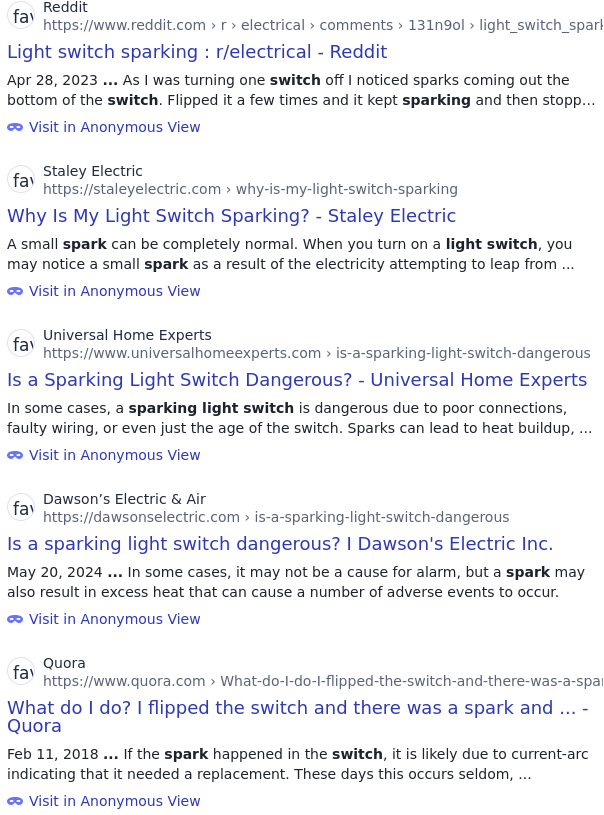
And it's not even necessarily a sign of a problem:
-- https://staleyelectric.com/why-is-my-light-switch-sparking/External Quote:Believe It or Not, Sparking Can Be Normal
If you want to know what causes a light switch to spark, it's important to start by saying that this occurrence isn't always something that you should be worried about. In fact, a small spark can be completely normal.
When you turn on a light switch, you may notice a small spark as a result of the electricity attempting to leap from one contact to another. This is known as a "load arc."
John J.
Senior Member.
I was responding to Mendel's (reasonable) request for citations for the claim that arcs can occur from domestic supplies.I agree entirely with all of these links. Not sure why you think I wouldn't.
My thinking being, if arcing happens in domestic settings, more visible sparking/ arcing might originate from damaged 3-phase lines.
No criticism of anything you've posted was intended.
U
UAPF
Guest
Not sure what you're suggesting here? Can you clarify. Can be subjected to voltage surges, sure. But from where? Lightning? Sparks are milliseconds. the fault path would burn open, not continue sparking for several minutes. In order for this to happen along a 45 meter expanse it would have to have a breakdown of air at a dozen points. Independently sustained faults at all those points. No fuse/breaker clearing the fault. Near identical timing over a long length.Some data about overvoltages on power lines.
View attachment 86107
https://www.renesas.cn/zh/document/...etic-and-lightning-induced-voltage-transients
Notice how 220V~ power lines can be subject to voltage surges up to 20kV (coincidentally, on a 'farmhouse supplied by overhead transmission lines').
Extrapolating the graph, I'm pretty sure the voltage transients could even be higher than 20kV. Indeed, there's no practical limit to the magnitude of an overvoltage surge a lightning can create (hundreds of kV, I guess), what actually limits the overvoltage is the presence of surge arresters in the distribution system, or, if there are no surge arresters (or they are far, or simply if the lightning overwhelms the protections) it's the wires arcing which actually limit the surge:
An unlucky lightning strikes the lines (somewhere, not necessarily near the arcing wires) and the voltage rises until something yields: the voltage rating of the transmission line has little importance, except that the higher the voltage rating the more the wires will be spaced and thus the higher the voltage surge will be before arcing ensues.External Quote:
Air requires requires several thousand volts per millimetre to break down and 230v cannot bridge even small gaps. Long duration multi-point sparks or arks....visible across a 1.4km distance, going on for, what 8-10 mins? Probability of that is not even worth calculating. 0.1%? Run it through every model, AI, GPT/Grok, Gemini etc., cant happen, which is why no one is going to be able to find a single video from anywhere on earth throughout video capture history of it happening.
Plus, that LV line identified by Flakey isn't the one the DNO is referring to as having the fault recorded that morning (7-8 ours after our incident was filmed BTW). Isn't that also an interesting point of note? No one reported massive lightning type arcs running 45 meters across a field until 8 hours after the event. If the answer is how did they know to look at 2am, then id argue how did they know it was sparking 8hrs later? Or are we saying it was arching not for 6 mins-10 mins, but in fact for 8hrs? Lots of things that don't make sense. But we have a line of sight, so that's cool.
Mauro
Senior Member.
The point was to show that low-voltage lines can arc, due to surges, as well as high-voltage ones. They actually do arc more, because their wire-to-wire insulation (distance) is lower.Not sure what you're suggesting here? Can you clarify.
Yes, lightning is the most frequent cause of overvoltages. The second cause is the sudden switch-off of a load.Can be subjected to voltage surges, sure. But from where? Lightning?
I would not understimate what a thunderstorm can do to an electrical distribution systems. And lightnings can strike multiple times.Sparks are milliseconds. the fault path would burn open, not continue sparking for several minutes.
Yet again, I wouldn't underestimate what a lightning can do, expecially in a low-voltage distribution system.In order for this to happen along a 45 meter expanse it would have to have a breakdown of air at a dozen points. Independently sustained faults at all those points.
A fuse/breaker will isolate a section of a line. Not useful if the lightning strikes downwards of the breaker (which, in this case, would only protect the line upwards).No fuse/breaker clearing the fault.
If wires are oscillating there may be many points where the distance between them is low enough for a flashover. Electrical discharges are fiendishly complicated things., I wouldn't dare say 'it cannot happen'.Near identical timing over a long length.
U
UAPF
Guest
Interesting. Well if you think it might be that one, then we have some new problems to solve. That's Foxhall Farm (LL16 5AB) and not in the line of sight. The insulator reels would be quite some distance away from the water tank location and certainly not attached to the same pole, but rather jumping across multiple poles in order to get across to your water tank location. Is this your new location from the DNO do you think @flarkey ?the reels are shown in post #143.
View attachment 86109

Ravi
Senior Member.
It reminds me of an incident which happened two years ago in Flevoland, the Netherlands. A friend of mine works at Tennet, so I got all the juice inside info.. A surge of over 8,000 amps, thinks get hot and melt.
It is interesting and possibly relevant. For sure an exiting story, the translation is below.
It is interesting and possibly relevant. For sure an exiting story, the translation is below.
External Quote:
A large fireball, smoking high-voltage power lines, multiple fires, and chaos on the roads and railways. A year ago, a major power outage occurred in Flevoland. The outage also affected people's homes. This week, Omroep Flevoland looks back at the outage with eyewitnesses and those involved. This first part focuses on what exactly happened that day.
It's still early in the morning of September 2nd as TenneT employees begin finishing work at a substation on Olsterpad in Dronten. The substation is integrated into the high-voltage grid between Lelystad and Hattem, and construction began in mid-2021. Once completed, the substation will feed the energy from the municipality's new wind turbines back into the electricity grid.
The switch."Three things went wrong that day, which is really exceptional."
— Eefje van Gorp, spokesperson for TenneT
On the day in question in September, three things went wrong simultaneously. "Which is really quite unusual," says Eefje van Gorp of TenneT. "First of all, there was a human error." At 3:05 PM, just as the employees were finishing work, one of them mistakenly flipped a switch, according to her, and power was transferred. "Normally, that's stopped at the other end of the line, so that's at the (sub)station in Lelystad. They have a switch there too, and that stops it."
But on that day in September, there were also people working at the distribution station in Lelystad. Employees were testing that particular switch, which caused it to malfunction. "That was mistake number two," says Van Gorp.

The conscious 'switch'
Result: short circuit
When the earthing switch in Dronten is switched on, current flows through the cables of the high-voltage connection and a short circuit occurs.
According to Van Gorp, there's always a backup, but it turned out to be a technical error. As a result, the short circuit wasn't stopped within a fraction of a second, as it normally would be. "So those three factors combined meant the power wasn't shut off in half a second, but took over four minutes." With all the consequences that entailed.

Explosions at Dronten substation
Boiling high-voltage wires sag.
The power cables of the high-voltage connection run from Lelystad to Dronten. Because the protection system is not working, a short-circuit current of approximately 8,500 amps flows through the high-voltage cables for a prolonged period. As a result, the cables reach a temperature of 300 degrees Celsius, where 80 degrees Celsius is permitted. The heat causes the cables to expand and sag.
It's becoming too dangerous to drive under the cables. Flevoland was closed right down the middle. "The North-South connection was completely out of service," says Ruud Walters of the Safety Region. "Those cables were practically on the road in some places. They had to be secured first so we could allow traffic to pass safely again, so that traffic was simply at a standstill.""We've experienced power outages before, but I've never seen slack cables."
— Ruud Walters, Safety Region

Never before seen.
It was a unique event. "We've experienced power outages before," says Walters. "But slack cables, I've never seen that before. And I've been around for a few years, so that's quite unusual." According to the firefighter, the event was a complex problem.
A fire also broke out at the high-voltage substation in Lelystad. The workers there were caught off guard by the fire. "They were really scared," says Eefje van Gorp of TenneT. "So they really had to run to get away from the fire. And luckily, they were completely safe. They escaped unscathed, but they had to sprint to keep the fire from getting to them. So it's actually a miracle that it happened the way it did.""The employees had to run to get away from the fire"
— Eefje van Gorp, spokesperson for TenneT
No injuries were reported, but the damage to the high-voltage line was extensive. The heat caused the lines to burn, and smoke billowed from them. Parts of the substation in Dronten also burned. "You saw some fire, and you could actually see the lines smoking all the way to Lelystad," says Van Gorp. "Because there's grease on those lines, and yes, because of the tension and the heat, you could see the grease smoking."

Distribution station next to the A6
Power jumps to the Hanzelijn.
But it didn't stop there. The cables expanded due to the heat and hung so low that sparks jumped to the overhead lines. "All the train wiring received a huge electrical surge," says Ruud Wolters of the fire department. "And they overheated, so all the meter boxes started smoldering."
Hot cables buried in the ground caused small roadside fires. The intercity train from Zwolle to Lelystad was also halted. The damage proved extensive . Trains were unable to run on the tracks for months. "Yes, that was a major setback, of course," says Irma Winkenius, regional director of NS (Dutch Railways). "We're a train company, so you just want to get everything back on track as quickly as possible."

Who's footing the bill?
That's why trains were rerouted to other tracks, and buses were deployed between Lelystad and Dronten. "An average intercity train seats about a thousand people," says Winkenius. "And a bus holds 50 people. Those numbers compared to each other are, of course, a huge undertaking."
The Dutch Railways (NS) also suffered significant damage, which entailed significant costs. But the reputational damage to public transport was the greatest. "You also don't want to lose passengers who then say, 'The detour is also busy, you know what, I'll buy a used car.' That's the very last thing we want, of course." Buses also had to be hired. "And that's also a question of who is responsible for the damage? So, discussions are now taking place with all sorts of lawyers about 'who will pay the bus bill?'"
Grid operator Liander reports that it has suffered several million euros in damages from the outage, as has rail infrastructure manager ProRail. TenneT also faces substantial damages: around 10 million euros. "Considerable damage," says Eefje van Gorp of TenneT.
Not all damage to the high-voltage connection between Dronten and Lelystad has been repaired. New cables will need to be installed in several locations along the high-voltage pylons. TenneT hopes to have this completed by early 2024.
The fireball above the track.
At the moment the current crossed over on the Hanzelijn, driver Richard Saedt was driving a train towards Lelystad. He saw a lot of smoke and took pictures of a fireball on the track. You can read his story on Thursday in the second part of the series "The Switch."
Last edited:
Interesting. Well if you think it might be that one, then we have some new problems to solve. That's Foxhall Farm (LL16 5AB) and not in the line of sight. The insulator reels would be quite some distance away from the water tank location and certainly not attached to the same pole, but rather jumping across multiple poles in order to get across to your water tank location. Is this your new location from the DNO do you think @flarkey ?
No Jimmy, That is the same location that I have been saying all along. The Streetview location is between the Golf Club and Tyddyn-Uchaf. The LV line is the 3-phase line that goes up to the watertank. It is fed by the HV line and the pole mounted transformer.
I took the time to annotate the maps and pictures with arrows so there can be no confusion of what I'm trying to convey, so please look at it closely. This is the Google StreetView link .
It would be helpful if we could get on the same page regarding LOS. You still seem to be suggesting it's "over the woods" when it seems very clear that it's not (see @Trailblazer's several posts).The LOS you/Mick and seemingly everyone believes
I stacked several frames from the original video.
The semi in the middle is nos 9 and 10, with the dark door being #10. The lights in the video, where we can see their positions, are always between the #9 and #10 doors (and a bit to the right of #9, more like the window)
So, would you agree that all the light events with position context are in this red rectangle?
Similar threads


- Replies
- 24
- Views
- 10K
- Replies
- 46
- Views
- 8K


- Replies
- 63
- Views
- 15K


