Europe has been rocked for months by reports of drones at airports, ports and military installations. This led to unrest, temporary closures and speculation about Russian involvement. But an analysis of more than sixty incidents by
Trouw and
Dronewatch paints a different picture. In most cases, it has never been confirmed that drones were flying and evidence for a foreign actor is almost completely lacking.
For this study, dozens of news items and reports on drone sightings from the period 9 September to 27 November were analysed. In total, there were 61 separate observations, in 11 countries. For each incident, it was checked what eventually became known. The outcome shows that most reports do not provide a clear picture.
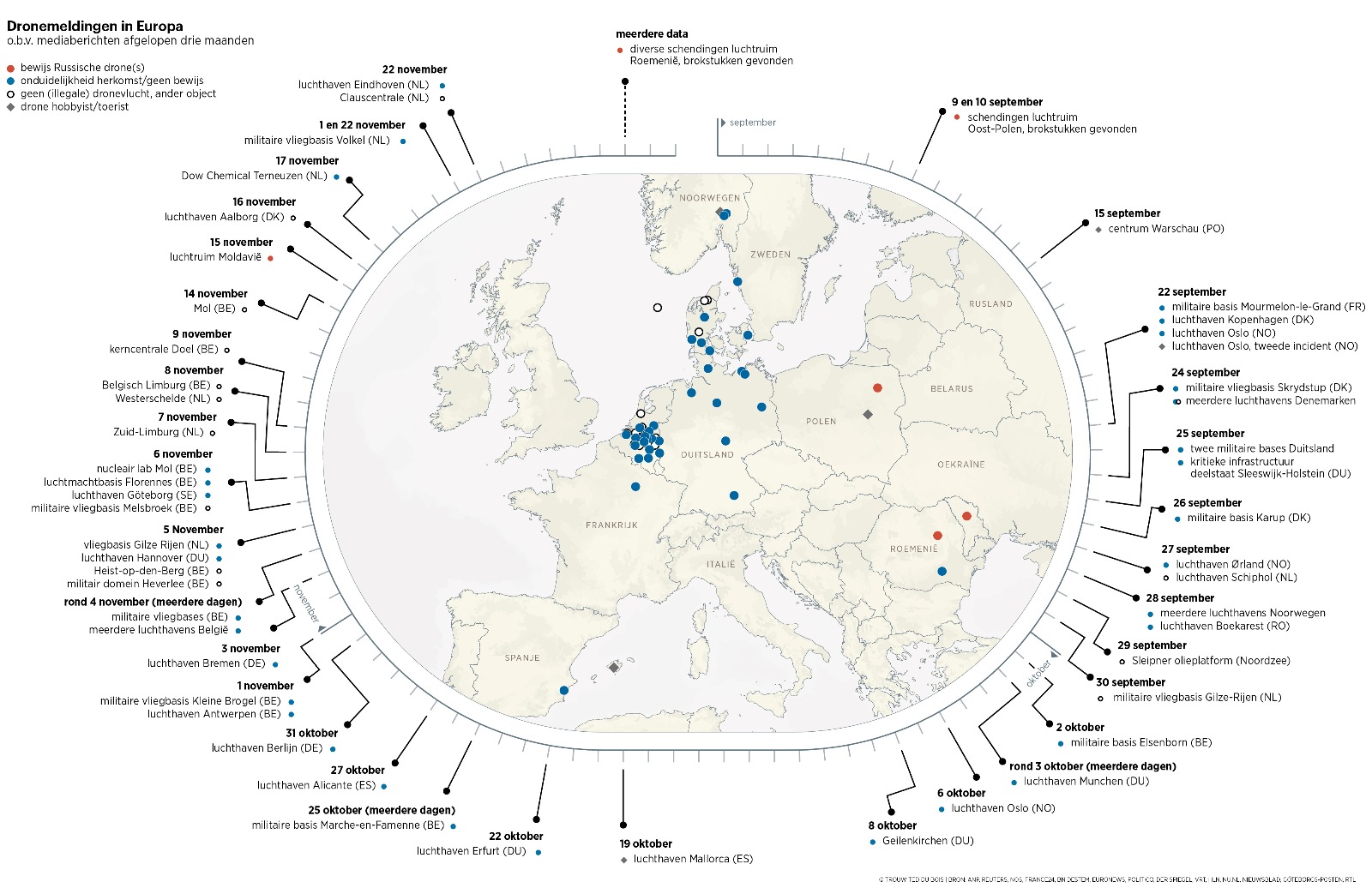
The map below shows all the analyzed cases:
 Distribution
No drone, other object: 14
No evidence / origin unknown: 41
Proven Russian drone: 3
Proven hobby or tourist drone: 3
This means that in 55 of the 61 cases, no confirmation has been found for hostile or illegal drones at this time. This is closely linked to an
earlier Dronewatch analysis in which, for example, the alleged hybrid drone attack on Denmark in September has so far remained unproven.
The high concentration of reports in Belgium is striking. The extensive media attention seems to have played a role there, making people more alert to points of light in the night sky and more likely to think they saw a drone. In addition, it is striking that there have been hardly any updates from Germany about how previous reports have ended.
There are several cases where video footage or notifications initially pointed to drones, but later turned out to show something completely different. The incidents in Belgium at the beginning of November are well known, where video images of an alleged large drone over Zaventem eventually turned out to be a
police helicopter. Other Belgian reports also turned out to be traced back to a helicopter or a landing cargo plane.
Elsewhere in Europe, things went wrong due to visual misinterpretation of points of light or bright stars at night. In
Billund and
South Limburg, stars were mistaken for drones, and off the coast of Norway, an alleged flying object near an oil platform turned out to be a ship, according to police. Such mistakes are not exceptional, especially now that authorities and media are paying a lot of attention to drone incidents.
Although authorities in Denmark, Germany and Belgium repeatedly suggested that Russia was behind the sightings, the data points to something else. In only three cases was physical evidence of Russian drones actually found, all of which concerned countries that border directly with Ukraine: Poland, Romania and Moldova.
This means that the often-heard link with Russian hybrid warfare in Western Europe cannot yet be substantiated. As Dronewatch previously reported in its analysis of the alleged attack on various European countries, verifiable evidence is missing almost everywhere. But even if at some point there were actually drones flying in formation, as the Belgian defense minister stated several times, that does not automatically mean that a state actor was behind it.
It is striking that research teams in almost all countries face the same challenge. Most reports are based on human observations without technical confirmation. That makes it difficult to determine what has actually been seen. In Denmark, after a
reconstruction by a Danish TV channel, it turned out that a large part of the observations around Copenhagen airport concerned regular air traffic.
No drone detection equipment was installed.
Also in Norway and Sweden, where the airports of Oslo and Gothenburg were temporarily closed, police and aviation authorities were later unable to trace a drone. There was a detector in Oslo, but it was
not in use. The lack of structural drone detection leads to incidents being overestimated, misinterpreted or not properly reconstructable afterwards.
In Belgium, the installation of additional detection systems from various countries seems to have had a recent effect. Remarkably, the number of reports decreased
immediately after additional detection equipment was installed. This may mean that malicious parties have been deterred, but just as well that previous reports were mainly the result of misinterpretations.
In the Netherlands, the Ministry of Defense emphasizes after the recent reports at Volkel and Eindhoven that there is no reason to panic. According to the Marechaussee, '
hobby drones' have been seen, but the origin is unclear and, according to a spokesperson, it does not seem to be a state threat.
Although it is still too early to draw definitive conclusions, because the investigation is still ongoing in several countries, the situation is very similar to the drone panic that gripped the US state of New Jersey last year. There, the FBI investigated thousands of reports, but ultimately
concluded that there was no hostile activity.
Panic or not, the recent drone sightings in Europe are causing several countries to accelerate the expansion of their detection and response capacity. In Belgium, new drone detection systems from Senhive have now been purchased, supplemented by jammers from DroneShield for disrupting suspicious flights. The Netherlands is also accelerating its investments. The Ministry
of Defence orders a hundred IRIS drone radars and uses SkyRanger rapid-fire guns to disable small unmanned aircraft. The Ministry of Defence is also organising a counter-strike drone challenge.