The Denbigh Lights UFO Analysis - Jan 2012 - [Likely sparking powerlines]

Sparking and discharges are of very, very short duration. Unless something burns out and starts to melt etc, I don't see the match with the video. I wonder if what we see are powerlines "sparking". I would assume if this is a real thing happening with powerlines, we should see it very often (as there are so many powerlines everywhere)?

Edit: I just read it is not even a HV line. LV is not able to spark in any possible way.
I had a very similar reaction when I saw it was LV. Seemingly near impossible in real world terms. I've never seen it, or ever seen a video of it.
 
No-one is claiming the wind directly blows electrical discharges off or along power lines! (I think).

High winds can damage electrical infrastructure by damaging insulators, sometimes because of wind-driven debris, and by loosening/ breaking connections/ cables. Cables- not always held taut between pylons- are blown around, and the distance between them and other structures can be reduced and insulation damaged through flexing. Warping/ damage to pylons and support struts can also alter the position of cables relative to each other. Precipitation increases the risk of arcing. Precipitation is blown by the wind, and moisture settled on cables etc. (which might contain dust, which can also increase the risk of arcing) might be.
External Quote:

Reduced Insulation Integrity: Moisture can condense on insulating materials, especially during temperature fluctuations. This condensation creates a conductive film, reducing the surface and dielectric strength of insulators. Lowered insulation resistance makes it easier for leakage currents to occur, potentially escalating into a fault and an arc flash.
LK Power website, The Impact of Humidity and Temperature on Arc Flash Events, https://lkpower.com.au/the-impact-of-humidity-and-temperature-on-arc-flash-events/.

Arcing might be more likely (and certainly more spectacular) with HV lines, but is perfectly possible with domestic range supplies, see "What causes Electrical Arcing. Why electricity Arcs", Electrical Faults Fixed website https://www.electricalfaultsfixed.com/blog/what-causes-electrical-arcing-why-electricity-arcs.

There is the obvious real-world correlation of high winds, damage to electrical infrastructure, and unwanted (visible) electrical discharges from elements of that infrastructure.


SP Energy Networks letter to @flarkey as per post #46,
External Quote:

...regarding faults in the Denbigh Golf Club area of LL165AA on 3rd January 2012.
...I can confirm there were severe storm weather conditions in the area on this date... There were reports of sparking overhead lines in the field at the rear of a property. Our resource attended site at 12.45pm to... complete the necessary repairs to the low voltage overhead lines. ...A linesteam attended at 2.18pm and replaced two insulator reels and 160-amp fuse as part of the required works.
(my emphasis).

The electricity company for the relevant area doesn't seem to be surprised that low voltage lines might cause visible sparking.

Anything electrical can spark, of course. I took a vape in to a hot tub by mistake once and it blew up in my pocket and I saw the spark from under the water. Was most embarrassing considering I'd had a few shandy's. But we're talking about LV cable in a 160a fuse that has a sustained multiple minute powerful arch across multiple points up to 45 meters, seen from 1.4 km away. The chances of which are lower than 1% imo.
 
I had a very similar reaction when I saw it was LV. Seemingly near impossible in real world terms. I've never seen it, or ever seen a video of it.
Nevertheless SP Energy Networks think it's possible, and fixed the problem. They were alerted by reports of sparking power lines.

The chances of which are lower than 1% imo.
Based on what? How have you assessed the visibility of any sparking? The power company documented reports of sparking low voltage power lines. I doubt they're involved in a cover-up :)
 
Last edited:
Doing a bit of an experiment with the new buildings in Sitrec (I added a "ridgeline inset", just for this):

https://www.metabunk.org/sitrec/?cu...zonaws.com/1/Denbigh Redux/20251115_163736.js
2025-11-15_08-37-45.jpg


Pretty much where we had it before, I think. Top of the path with the powerline, and right by the golf course. It's hard to be perfect, as there's imperfect elevation data, and estimates of building heights, and the camera position
 
The electrical field controls the arc, not the wind, because the tiny differences between upwind and downwind air are irrelevant compared to the enormous voltages involved. A lightning leader propagates at tens to hundreds of thousands of meters per second. Wind only moves at around 5 to maybe 20 m/s waaaay to slow to influence the arc's path.
The arc travels through the dielectric - air. Ionised air has a lower resistance than non-ionised air (I seem to remember from ESD training that the effect can be many orders of magnitude, but of course the outside isn't a lab), and lightning conductors ionise air.
And the speed of the arc through the medium is not relevant.
 
Ok low voltage and very high current is of course a problem for connections along the line that are too resistive (old, etc), causing heating and melting.
 
Nevertheless SP Energy Networks think it's possible, and fixed the problem. They were alerted by reports of sparking power lines.


Based on what? How have you assessed the visibility of any sparking? The power company documented reports of sparking low voltage power lines. I doubt they're involved in a cover-up :)
Yes, Flarkey and I did this to death yesterday and the day before over on X. Several models all indicating near zero chance.

Happy to stand corrected if you can find a single case in history and in any country where a low voltage line arches in multiple spots for a prolonged time as seen in this footage.

The energy company didn't think it was possible, or not think it was possible, they didn't comment on it. They just confirming they had a report some 7hrs after our event, somewhere within a 100 acre radius of some sparking and told us what they did to fix it. The rest is us all guessing.
 
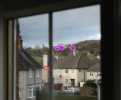
The prominent trees visible just behind the TV aerial here:

View attachment 85912

are visible near the 0.50km mark on the Google Maps view:
View attachment 85911

It's this row of conifer trees, viewed almost end-on:
View attachment 85913

View attachment 85914

So exactly where that line of sight was drawn in my post.

The direction is clearly correct. But the question of whether you can see over the intervening ridgeline to see those power lines from the upstairs window could only really be solved by taking a decent zoom photo from the same window. And even then the tree growth could be substantially different by now.

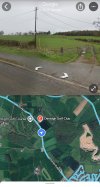
Hey @Trailblazer - I don't agree with your arboreal-location here. Yes, the line of sight is correct but the prominent tree beside the tv aerial arent the ones at Coppi Farm. There is a better Streetview of the landscape not far from the witness location at a slightly higher elevation. <linky> - that lets us see that the prominent tree is beyond the line of scrub and bushes close to Coppi Farm. The farmbuildings (green roof) and the trees can be seen on the streetviews and confirm the relative positions.

1763299379383.png

Edit,. ^^^^^ typo, image top right should say 15th tee.

The prominent tree is on top of the ridgeline beside the 15th Tee of Denbigh Golf club. (Source).
1763299238807.png


The tree can be seen here, just in front of the 15th teebox.... (Source):
1763307714816.png
 
Last edited:
I don't agree with your arboreal-location here. Yes, the line of sight is correct but the prominent tree beside the tv aerial arent the ones at Coppi Farm. There is a better Streetview of the landscape not far from the witness location at a slightly higher elevation. <linky> - that lets us see that the prominent tree is beyond the line of scrub and bushes close to Coppi Farm.
You are quite correct. I didn't look far enough up the hill. I was confused as the tree looked much more than 500 metres away, so that explains it.
 
Doing a bit of an experiment with the new buildings in Sitrec (I added a "ridgeline inset", just for this):

https://www.metabunk.org/sitrec/?custom=https://sitrec.s3.us-west-2.amazonaws.com/1/Denbigh Redux/20251115_163736.js
View attachment 85927

Pretty much where we had it before, I think. Top of the path with the powerline, and right by the golf course. It's hard to be perfect, as there's imperfect elevation data, and estimates of building heights, and

Hey @Trailblazer - I don't agree with your arboreal-location here. Yes, the line of sight is correct but the prominent tree beside the tv aerial arent the ones at Coppi Farm. There is a better Streetview of the landscape not far from the witness location at a slightly higher elevation. <linky> - that lets us see that the prominent tree is beyond the line of scrub and bushes close to Coppi Farm. The farmbuildings (green roof) and the trees can be seen on the streetviews and confirm the relative positions.

View attachment 85946
Edit,. ^^^^^ typo, image top right should say 15th tee.

The prominent tree is on top of the ridgeline beside the 15th Tee of Denbigh Golf club. (Source).
View attachment 85945

The tree can be seen here, just in front of the 15th teebox.... (Source):
View attachment 85948
Totally different angle. My street view data relevant and looking up the hill, closest fit visually and your image is from 2023 and a different angle entirely.

IMG_6557.jpeg
IMG_6553.jpeg

IMG_6552.jpeg
 
Last edited by a moderator:
Also looks like these trees have been cleared since 2011 to create that gap you're seeing in the original "UFO daytime pic". Presumably to lay underground LV cable

IMG_6562.jpeg


IMG_6552.jpeg
 
Last edited by a moderator:
I had a very similar reaction when I saw it was LV. Seemingly near impossible in real world terms. I've never seen it, or ever seen a video of it.

So you're dismissing this unidentified electrical phenomenon because you've never seen good evidence of it before? That's kind of ironic, coming from the host of a UFO Podcast ;)

Equally putting too much emphasis on electricity is a mistake imo because there are LV cables everywhere you look. Every home has a connection and that connection needs to connect in a giant grid across the country.

The LV overhead cables are quite sparsely located in that area:
Source: https://www.spenergynetworks.co.uk/pages/connectmore_interactive_map.aspx

No indication from the DNO that it's related to any HV lines. Data suggesting otherwise in fact. And 230v is basically common household stuff, kettles and toasters. My electric shower is on an 40amp RCBO. The website says it doesn't even qualify for EV installation. Not sure if it's even functioning. Says insistent for an EV installation. Even a basic household DB could take an EV charge point in stall.


The DNO website says it is 3-phase 230V. I would be rather miffed if you connected my kettle or toaster to a 3-phase supply. o_O

The potential difference between 2 phases of 3-phase electrical supply can reach almost 400V - which is enough to cause bright sparking. Here's a video showing 400v sparking...


Source: https://youtube.com/shorts/l_pTWOyMGQg?si=4jL3dKHb6q-EMa_O
 
Totally different angle. My street view data relevant and looking up the hill, closest fit visually and your image is from 2023 and a different angle entirely.

The angles all fit. Even the Street view up the hill intersects with the witness LOS at the location of the tree on the ridge line.

20251117_124746.jpg


20251117_124857.jpg
 
Totally different angle. My street view data relevant and looking up the hill, closest fit visually and your image is from 2023 and a different angle entirely.
The trees are not at Coppi Farm. I've had another look and @flarkey is definitely right here. The trees are up on the skyline. Coppi Farm is hidden behind the houses from the video vantage point, much lower down.

1763383947158.png


The full view shows that the lights were nowhere near the farm, but up on the ridgeline near the golf course, another 1km or so beyond the farm, as we thought originally.

1763384744347.png


These are the trees, at the left, with the fields crossed by the power lines visible to the left and in front as viewed from the house.

1763384953000.png
 
Last edited:
The arc travels through the dielectric - air. Ionised air has a lower resistance than non-ionised air (I seem to remember from ESD training that the effect can be many orders of magnitude, but of course the outside isn't a lab), and lightning conductors ionise air.
And the speed of the arc through the medium is not relevant.
The propagation speed of an electrical arc is tens to hundreds of thousands of metres per second, while wind moves at only 5–20 m/s.

Because the leader forms orders of magnitude faster than the air can be displaced, wind simply cannot steer the arc, the path is determined almost entirely by the local electric-field gradient.

Ionised air does have lower resistance, but the ionisation channel exists for "microseconds" and collapses almost instantly. It does not drift far enough or persist long enough for wind to influence the lightning path. And if we use our case in question, that doesn't make sense does it?
 
So you're dismissing this unidentified electrical phenomenon because you've never seen good evidence of it before? That's kind of ironic, coming from the host of a UFO Podcast ;)
Yes, because I'm an expert with electrical installation and armoured cable lol. But like you, I'm a layman with UFO identification.
The LV overhead cables are quite sparsely located in that area:

Source: https://www.spenergynetworks.co.uk/pages/connectmore_interactive_map.aspx


The DNO website says it is 3-phase 230V. I would be rather miffed if you connected my kettle or toaster to a 3-phase supply. o_O
I'm saying my house and your house run of 230v. Standard stuff, kettles and TVs are connected.

What you've missed is 3 phase tend to have less current in each conductor than a single-phase system. You know, for longer cables than run out to a barn or workshop or somet.


The potential difference between 2 phases of 3-phase electrical supply can reach almost 400V - which is enough to cause bright sparking. Here's a video showing 400v sparking...


Source: https://youtube.com/shorts/l_pTWOyMGQg?si=4jL3dKHb6q-EMa_O

My
The angles all fit. Even the Street view up the hill intersects with the witness LOS at the location of the tree on the ridge line.

View attachment 85999

View attachment 86000These are totally different rooftops
IMG_6566.jpeg
 
Last edited by a moderator:
The propagation speed of an electrical arc is tens to hundreds of thousands of metres per second, while wind moves at only 5–20 m/s.

Because the leader forms orders of magnitude faster than the air can be displaced, wind simply cannot steer the arc, the path is determined almost entirely by the local electric-field gradient.

Ionised air does have lower resistance, but the ionisation channel exists for "microseconds" and collapses almost instantly. It does not drift far enough or persist long enough for wind to influence the lightning path. And if we use our case in question, that doesn't make sense does it?
Please rewatch this video, explain why the arc starts at the bottom, and then moves upward at a "leisurely" speed, and vanishes.

Source: https://www.youtube.com/watch?v=a-oqRBuw-hM&t=8
 
These are totally different rooftops.
Yes, I said that in post #89 above - and in the annotated images. The view is not for lining up with the rooftops, it is from a position 130m SE of the Witness location (assuming we have that right) and 15ft higher. It gives a better view of the landscape and Coppi Farm becuse it is slightly elevated.


Streetview link

This is the difference in the Lines of Sight from the witness video and the images above. (assuming we have the witness location right?)
1763386326393.png
 
Last edited:
Please rewatch this video, explain why the arc starts at the bottom, and then moves upward at a "leisurely" speed, and vanishes.

Source: https://www.youtube.com/watch?v=a-oqRBuw-hM&t=8

The video you posted is a Jacob's ladder and the physics of that device does not apply to lightning leaders or flashover arcs.

A Jacob's ladder arc rises because the arc heats the air, the hot air becomes buoyant and convection lifts the arc slowly upward at about 1–3 m/s. The arc follows the rising "plume" because the electrodes are shaped so that the gap widens as it rises, causing the arc to extinguish at the top.

This is a thermal buoyancy effect, not an electric-field-driven propagation effect…what we're discussing here.

A lightning leader is veeeery different. Leader propagation occurs at tens to hundreds of thousands of metres per second and is driven entirely by the local electric-field gradients, not by "airflow". The ionisation channel in a leader lasts microseconds, collapses almost instantly, and does not drift with the wind.

So the Jacob's ladder arc in the video is not relevant as a counterexampl, it's a different phenomenon with completely different physics/timescales.
 
The propagation speed of an electrical arc is tens to hundreds of thousands of metres per second, while wind moves at only 5–20 m/s.

Because the leader forms orders of magnitude faster than the air can be displaced, wind simply cannot steer the arc, the path is determined almost entirely by the local electric-field gradient.
Ionised air does have lower resistance, but the ionisation channel exists for "microseconds" and collapses almost instantly. It does not drift far enough or persist long enough for wind to influence the lightning path. And if we use our case in question, that doesn't make sense does it?

Yes, but we're talking of two different things. One thing is the propagation of the arc, between the wires which is as you say, very fast and barely influenced by the wind, if at all. But what matters here is how the position of the arc moves along the wire, which happens on a totally different timescale. It was already said that the wind can make wires oscillate, which means that the distance between the wires varies: the arc position moves along the wires, following the path where the minimum distance lies and where the discharge is more probable to happen.


230V~ is a rather mild voltage which is unlikely to arc in normal conditions, but during a thunderstorm there will be voltage surges on the lines (due to lightnings), which can easily reach thousands of volts even on low-voltage lines (ie. 230V~ insulation devices are commonly rated for pulse surges of 6kV). Add in air saturated with humidity and the wind swinging the cables, changing their distance, and arcing becomes quite possible.
 
Yes, I said that in post #89 above - and in the annotated images. The view is not for lining up with the rooftops, it is from a position 130m SE of the Witness location (assuming we have that right) and 15ft higher. It gives a better view of the landscape and Coppi Farm becuse it is slightly elevated.


Streetview link

This is the difference in the Lines of Sight from the witness video and the images above. (assuming we have the witness location right?)
View attachment 86005
Oh ok, so as it stands, the images you initially shared and agreed on and from the investigators at the time (that I agree on) are showing a likeness to "my" trees. And the images of rooftops 2 roads away from a different angle are identifying "your" trees are these new different angles?
 
Oh ok, so as it stands, the images you initially shared and agreed on and from the investigators at the time (that I agree on) are showing a likeness to "my" trees. And the images of rooftops 2 roads away from a different angle are identifying "your" trees are these new different angles?

No, not a likeness. A match. They are showing the same landscape, hills, buildings and trees in the distance around 1.5km away. Although they from slightly different positions (one street away) and elevations (15ft higher) they are looking towards the same direction at the same hill, wood and ridgeline near Denbigh. Do you not agree?

1763387790074.png
 
The video you posted is a Jacob's ladder and the physics of that device does not apply to lightning leaders or flashover arcs.
I agree we are not talking about lightning leaders.
It does seem similar to a flashover arc.
A Jacob's ladder arc rises because the arc heats the air, the hot air becomes buoyant and convection lifts the arc slowly upward at about 1–3 m/s. The arc follows the rising "plume" because the electrodes are shaped so that the gap widens as it rises, causing the arc to extinguish at the top.
The arc moves with the air; the air is moved by convection. It would also move with the air if the air was moved by wind, as long as the length of the path remains short enough to be sustainable.
This is a thermal buoyancy effect, not an electric-field-driven propagation effect…what we're discussing here.
I don't think anyone discussed "electric-field-driven propagation".


230V~ is a rather mild voltage which is unlikely to arc in normal conditions,
Well...
Article:
For example, in air, at a pressure of one atmosphere, the distance for minimal breakdown voltage is about 7.5 μm. The voltage required to arc this distance is 327 V, which is insufficient to ignite the arcs for gaps that are either wider or narrower.

A 230V RMS power supply has a peak voltage of 230V × sqrt(2)=325V.

This would not normally spark, unless there were fluctuations, or two separate phases touched, or e.g. a tree branch touches from a slightly different neutral potential. Ignition also depends on air pressure and humidity. I also don't know what happens when two wet wires touch, i.e. the initial current goes through water which ionizes—that could immediately ignite if I understand the phenomenon correctly.
 
Yes, but we're talking of two different things. One thing is the propagation of the arc, between the wires which is as you say, very fast and barely influenced by the wind, if at all. But what matters here is how the position of the arc moves along the wire, which happens on a totally different timescale. It was already said that the wind can make wires oscillate, which means that the distance between the wires varies: the arc position moves along the wires, following the path where the minimum distance lies and where the discharge is more probable to happen.


230V~ is a rather mild voltage which is unlikely to arc in normal conditions, but during a thunderstorm there will be voltage surges on the lines (due to lightnings), which can easily reach thousands of volts even on low-voltage lines (ie. 230V~ insulation devices are commonly rated for pulse surges of 6kV). Add in air saturated with humidity and the wind swinging the cables, changing their distance, and arcing becomes quite possible.
Mauro, you're mixing two very different processes.

Where along a wire an arc might start (due to wind shifting the cable spacing) is not the same as how an arc propagates.

The electrical discharge itself propagates at tens to hundreds of thousands of metres per second and is governed by electric-field gradients, not by cable sway or wind... Changing the mechanical spacing of wires only changes where a fault might occur, it does not produce a slow moving or wind guided arc. Also 230v lines simply cannot create visible arcing in open air.

Air breakdown is ~3 million volts per metre. Even with surge conditions, LV lines only reach a few kV, which is why they do not arc in normal operation, storms, or otherwise. The 6kV surge rating of LV insulators is exactly because surges remain below that level.

The behaviour in the Jacob's ladder video is caused by buoyant hot air and requires 10–20 kV continuous supply. It is not comparable to LV distribution wiring, lightning, or arc leaders.
 
Electrical arcing is driven by voltage potential, air breakdown, and the electrical path of least resistance, not by wind direction.
The plasma in the arc, which creates a path of least resistance, is made up of ions, which are moved by the wind. So, in this sense, arcing is driven by wind direction.
 
No, not a likeness. A match. They are showing the same landscape, hills, buildings and trees in the distance around 1.5km away. Although they from slightly different positions (one street away) and elevations (15ft higher) they are looking towards the same direction at the same hill, wood and ridgeline near Denbigh. Do you not agree?
If @UAPF isn't convinced, perhaps this visualisation in Google Earth will help.

The Coppi Farm conifers are down in a dip and not visible from the bedroom window. The golf course trees appear on the skyline from both the bedroom video location and from the Street View location a short distance away.

 
The plasma in the arc, which creates a path of least resistance, is made up of ions, which are moved by the wind. So, in this sense, arcing is driven by wind direction.
Gaspa, the plasma in an arc only exists for microseconds before it collapses and reforms.

In microseconds, air moved by wind travels only a few microns, far too small to shift the ionised channel.

That's why I'm so confident that those lights aren't from a LV cable 1.4km away. Just goes against everything I know. We can debate the location till we're blue in the face (not you, others) but that ain't no LV cable. Nagative, nada, nope.
 
We can debate the location till we're blue in the face (not you, others) but that ain't no LV cable. Nagative, nada, nope.
Well whatever it is, it appears to follow the track at the top of the hill. If it's not sparking cables then it could be lights from pedestrians or vehicles following that track (perhaps to inspect damage).

Either way, there appears to be absolutely no reason to believe it is either (a) something up in the sky or (b) something unusual. Which makes the original description ("UFO") rather inaccurate.
 
The plasma in the arc, which creates a path of least resistance, is made up of ions, which are moved by the wind. So, in this sense, arcing is driven by wind direction.
Gaspa, the plasma in an arc only exists for microseconds before it collapses and reforms.

In microseconds, air moved by wind travels only a few microns, far too small to shift the ionised channel.
If @UAPF isn't convinced, perhaps this visualisation in Google Earth will help.

The Coppi Farm conifers are down in a dip and not visible from the bedroom window. The golf course trees appear on the skyline from both the bedroom video location and from the Street View location a short distance away.

View attachment 86009
I appreciate you making your position clear, but I actually think we've all got the angles wrong.

I can't draw an accurate line on my phone at present due to limitations of mobile google earth, but I think this is actually the LOS. He describes it as "over the woods" which would match. And specifically in his interview with me (he's lived there all his life) "not over the golf club".

This is a photo from inside his bedroom.

IMG_6582.jpeg


IMG_6578.jpeg
 
Last edited by a moderator:
Where along a wire an arc might start (due to wind shifting the cable spacing) is not the same as how an arc propagates.

The electrical discharge itself propagates at tens to hundreds of thousands of metres per second and is governed by electric-field gradients, not by cable sway or wind... Changing the mechanical spacing of wires only changes where a fault might occur, it does not produce a slow moving or wind guided arc.
I call your attention you videos I posted in Post 78 above, clearly showing electric arcs on power lines moving ar relatively sedate speeds along the lines.

I am not sure I am following your argument, but IF you are maintaining that this cannot happen, you are in error. If instead you agree that it happens but are arguing CAUSE, I'm not blessed with lots of electricity knowing so probably can't contribute to that.
 
I call your attention you videos I posted in Post 78 above, clearly showing electric arcs on power lines moving ar relatively sedate speeds along the lines.

I am not sure I am following your argument, but IF you are maintaining that this cannot happen, you are in error. If instead you agree that it happens but are arguing CAUSE, I'm not blessed with lots of electricity knowing so probably can't contribute to that.
I think the confusion is that you think I'm arguing a different point. You think I'm denying that arcs can travel along power lines. I'm not.

The cause of that movement is electrical geometry + wire spacing + faults in the hardware — NOT the arc "propagating through the air like a slow-moving lightning bolt. We were discussing environmental impact factors.

Aside from that, the videos you've posted appear to be medium, to high voltage distribution, almost certainly 7.2 kV – 34.5 kV. This is not relevant to 230V domestic lines, which absolutely cannot do this. They just don't have enough voltage to sustain an air arc or visible discharge like the ones in the video (or allegedly seen in the original Denbigh UFO video).

I'll give you an example LV power lines basically
230/400 V AC. HV power lines usually 11 kV. Extra HV (things like distribution and transmission more like 66kV-132kV

These lager-end ones will be what you're seeing in the crazy videos that look like lightning.

So that's the real problem that has to be overcome to blame/resolve the UFO on the "likely sparking power lines" argument as listed in the thread title.

Again it's definitely not likely..if a subject matter expert means anything to you? Confirmed by any of the AI you can ask and the lack of a single real-world example? Add to that there aren't any HV lines in your current LOS…why are we keeping that title?
 
Gaspa, the plasma in an arc only exists for microseconds before it collapses and reforms.

In microseconds, air moved by wind travels only a few microns, far too small to shift the ionised channel.

I appreciate you making your position clear, but I actually think we've all got the angles wrong.

I can't draw an accurate line on my phone at present due to limitations of mobile google earth, but I think this is actually the LOS. He describes it as "over the woods" which would match. And specifically in his interview with me (he's lived there all his life) "not over the golf club".

This is a photo from inside his bedroom.

The lights aren't "over the woods", we have already established that. They are to the left of the woods.

I already overlaid the video with the photo from his bedroom and showed that the lights were just to the left of that "golf club tree", in post 31:

1763401529022.png


That screengrab just shows one of the lights, which happens to be about as far right as they go.

Here I have done it with another frame of the video which shows a whole string of lights. Lining up using the street light and the house corner and door:


This is the result, overlaid on the photo from the bedroom window. The lights aren't "over the woods", they run in a line that follows the track and/or field in front of the golf course. Which (coincidentally or not) is also the line of the power lines.
 

Attachments

  • 1763401185877.png
    1763401185877.png
    806.6 KB · Views: 32
The lights aren't "over the woods", we have already established that. They are to the left of the woods.

I already overlaid the video with the photo from his bedroom and showed that the lights were just to the left of that "golf club tree", in post 31:

View attachment 86026

That screengrab just shows one of the lights, which happens to be about as far right as they go.

Here I have done it with another frame of the video which shows a whole string of lights. Lining up using the street light and the house corner and door:


View attachment 86024


This is the result, overlaid on the photo from the bedroom window. The lights aren't "over the woods", they run in a line that follows the track and/or field in front of the golf course. Which (coincidentally or not) is also the line of the power lines.
They're definitely over the woods. Check the location of the furthest light to the right.
C1240F7F-74BC-4F69-85E1-59E814827AB8.jpeg

81EC3B4D-AFDE-40D5-90F9-F06AA1D3A3F5.jpeg

IMG_6594.jpeg

IMG_6598.jpeg
 
Last edited by a moderator:
They're definitely over the woods. Check the location of the furthest light to the right.

Your images are not remotely lined up there, so your red arrows are meaningless.


1763404030226.png


When you overlay them correctly you can see that the lights are to the left of the woods.

Incidentally it also looks like the video was taken from a slightly lower vantage point than the bedroom window photo. You can see the mismatch in this short comparison:


Initially I thought it was a problem with the aspect ratio that stopped the vertical alignment being correct when the features were aligned horizontally. There may be a small part of that but also the nearer house on the right appears higher in the video. At the end of the above clip I circled a window with the cursor. In the photo it is above the roof of the nearer house, but in the video it is cut off by the slope of the roof.
 
Last edited:
They're definitely over the woods. Check the location of the furthest light to the right.
@UAPF You've lined them up with the wrong chimney on the wrong house....

1763404239628.png


When you draw a line of sight from the bedroom window over the correct chimney it points to the tree beside the 15th tee at Denbigh Golf club.

1763404421060.png


1763404440243.png

1763405913733.png
 
Last edited:
The lights aren't "over the woods", we have already established that. They are to the left of the woods.

I already overlaid the video with the photo from his bedroom and showed that the lights were just to the left of that "golf club tree", in post 31:

That screengrab just shows one of the lights, which happens to be about as far right as they go.

Here I have done it with another frame of the video which shows a whole string of lights. Lining up using the street light and the house corner and door:

This is the result, overlaid on the photo from the bedroom window. The lights aren't "over the woods", they run in a line that follows the track and/or field in front of the golf course. Which (coincidentally or not) is also the line of the power lines.

@Trailblazer I like your overlay. It suggests the lights were in a line running left to right, slightly below the top of the ridge and on this side of the hill.
1763404724393.png


It really allows us to narrow in on the possible UAP landing zone and see what could be there.....

1763405051044.png
 
I also wonder if @UAPF could elaborate on some points I raised earlier, namely:

1) What is the red horizontal line meant to indicate at 4:25 in the video? The horizon is not remotely level here so which part is this supposed to approximate?

1763404979870.png


2) AT 4:54, why is the arrow on the photograph pointing to the telegraph pole while the arrow on the video inset (supposedly showing the same object) is pointing at the street light?

1763405074458.png


I think the second point stems from the same confusion over which house is which, and which chimney is which. The same mix-up between the street light and the telegraph pole makes you think the lights are further right than they actually are, i.e. over the woods rather than to the left of them.
 
I think the confusion is that you think I'm arguing a different point. You think I'm denying that arcs can travel along power lines. I'm not.

The cause of that movement is electrical geometry + wire spacing + faults in the hardware — NOT the arc "propagating through the air like a slow-moving lightning bolt. We were discussing environmental impact factors.

Aside from that, the videos you've posted appear to be medium, to high voltage distribution, almost certainly 7.2 kV – 34.5 kV. This is not relevant to 230V domestic lines, which absolutely cannot do this. They just don't have enough voltage to sustain an air arc or visible discharge like the ones in the video (or allegedly seen in the original Denbigh UFO video).

Lets not forget that the hypothesised Overhead Lines are 230V three-phase not 230V domestic lines , assumed to supply power to the reservoir machinery and pumps. My 3-phase experience is limited to what I studied at university and some electrical supplies on aircraft, and only then in fully functioning states and not fault conditions such as this. But I do understand the difference between single and multi-phase supplies and the increased hazards associated with them.

https://www.businessenergydeals.co.uk/blog/three-phase-power/

This is what Google has to say about the dangers associated with 3-phase supplies....

So they can create "more severe arc flash events and damage, posing a greater risk of burns, explosions, and injury."
 
Last edited:
Back
Top