Rico
Senior Member
Check out forums like http://www.pprune.org/ too.



No, many times people simply don't get involved for several reasons:George, does it not seem odd to you that if it is so obviously impossible for the hijackers to have piloted the planes on 9/11, that only four or six pilots, out of approximately 600,000 licensed pilots, are speaking out about it. You'd think if it WAS impossible, as those four have said and they are quite sure of themselves, that hundreds, if not thousands, of others would have come forward. On the other hand, the vast majority of pilots probably feel that the comments from that very small percentage on the lunatic fringe are so ridiculous, that they are not worthy of the effort of a reply.
I think it is rather (historically) obvious that two major areas where Bunk has been identified to Debunked on MetaBunk are the 911 and Chemtrail conspiracies . . . take it for what it is . . .Maybe I am not understanding you, but you seem to be complaining that it is mostly conspiracy theories that are being debunked here.
If a conspiracy cannot hold up to reason and science and facts, shouldn't that be a reason for it to be debunked? Personally, I debunk a lot of things I read. Recently a friend had shared a story about the military cutting out hot breakfasts and snacks for the troops in Afghanistan, in order to save money. Before I hit that 'share' button, I took the time to check out the story. It turns out that 2 hot meals ARE being cut in some forward operating bases, but it is in preparation for the troops being withdrawn. It had nothing to do with a budget cut. Of course the person that shared it didn't like that, she wanted to insist that it was a budget cut, even thought the military says it isn't. I KNOW better, I can tell others better.

 Your questions are just broad catch-alls, or overly specific, forcing a misleading answer. Everyone feels there are holes in the official story - even if it's just "why didn't Bush leave the classroom immediately". That's a ridiculous poll question. And a large number of people are in the "essentially let it happen a bit via incompetence" camp.
Budget cuts to the American military? Now there's a ludicrous theory.If a conspiracy cannot hold up to reason and science and facts, shouldn't that be a reason for it to be debunked? Personally, I debunk a lot of things I read. Recently a friend had shared a story about the military cutting out hot breakfasts and snacks for the troops in Afghanistan, in order to save money. Before I hit that 'share' button, I took the time to check out the story. It turns out that 2 hot meals ARE being cut in some forward operating bases, but it is in preparation for the troops being withdrawn. It had nothing to do with a budget cut. Of course the person that shared it didn't like that, she wanted to insist that it was a budget cut, even thought the military says it isn't. I KNOW better, I can tell others better.

No, I'm just saying that from hundreds if not thousands of feet, the pentagon wouldn't be that easy a target, especially considering it's not particularly tall. I'd think the most logical way to try and hit a structure like that would be to nose-dive it, as from a downward angle it's a far more obvious target.. there's just a risk that a 'bulls-eye' will result in a collision with the central courtyard and minimal damage to the building. As if anticipating this, a rather skilled spiral descent and low-approach was used, to collide with the building from the side.You are assuming they wanted to hit it in exactly that way. Seem far more likely that they just wanted to hit it, and that's how it ended up.
Well thanks Mick for sparing my feelings . . . my intention was to get something from MetaBunk that would be acceptable . . . does the rest of the group agree with the above options and wording???You need some poll-writing lesson George
They are pilots, ask them about how hard it is to hit a building at the speeds indicated.
Q) Could pilots with only a single engine commercial licence have flown the planes into the World Trade Center like they appeared to do on 9/11?
1) Yes, it would be fairly straightforward
2) Yes, but it would have needed a lot of concentration
3) Yes, but it would have been very difficult
4) Probably, but they were pretty lucky
5) Probably not, it would be very hard to do
6) No, the plane would be impossible to control at that speed
7) No, the plane would have fallen apart at that speed
8) No, the plane could never even reach that speed.
Budget cuts to the American military? Now there's a ludicrous theory.
Mick, you need to slip an 'and the pentagon' in there. The Pentagon collision is what most 'Truthers' describe as the unbelievable feat of piloting, not the tower-collisions. It might, in fact, taint the results of the survey to give the Towers prominence.
No, I'm just saying that from hundreds if not thousands of feet, the pentagon wouldn't be that easy a target, especially considering it's not particularly tall. I'd think the most logical way to try and hit a structure like that would be to nose-dive it, as from a downward angle it's a far more obvious target.. there's just a risk that a 'bulls-eye' will result in a collision with the central courtyard and minimal damage to the building. As if anticipating this, a rather skilled spiral descent and low-approach was used, to collide with the building from the side.
...I don't see what difference that makes where including an 'and the pentagon' in the survey is concerned...!
Including only the towers will lead to the obvious answer of 'Durr, of course it wouldn't be hard, they're massive towers.', which is hardly a productive or meaningful result, and doesn't really address the issue at hand appropriately.
I think there needs to be a qualification of . . . relatively inexperienced . . . as inSure, add it. I just wanted to avoid any misunderstanding about needing to duplicate the flight path.
Maybe then, with clarification:
Q) Could pilots with only a commercial licence have hit the the World Trade Center and the Pentagon with a 767 or 757 at the speeds observed on 9/11? (Without needing to duplicate the impact location, just hit the building).
(I removed the "single engine" qualification, as Hajour, who hit the Pentagon, had multi-engine certification, some jet training, and about ten years of flying.)
I think there needs to be a qualification of . . . relatively inexperienced . . . as in
Q) Could relatively inexperienced pilots with only a commercial license have hit (dead center or not) the World Trade Center and the Pentagon with a 767 or 757 at the speeds and situations observed on 9/11?
No, because "and situations" implies the need to duplicate exactly what happened. That's not what the hijackers were trying to do, they were just trying to hit the buildings. What "situation" are you referring to? There was no situation - they were in a plane, in the air.
And what does "relatively inexperienced" mean?

Just "commercial license" could mean significant long term flight experience thus "relatively inexperienced" . . . I don't think much experience was the case . . . "situation" is not necessary I was referring to the stress of martyrdom, killing or injuring the flight crews, etc. . . .
Just "commercial license" could mean significant long term flight experience thus "relatively inexperienced" . . . I don't think much experience was the case . . . "situation" is not necessary I was referring to the stress of martyrdom, killing or injuring the flight crews, etc. . . .
Then find out how many hours of flying experience each pilot had, and list that. Find their jet experience, list that. Find their Boeing simulator experience, list that. Be more precise, not less precise.
And since you have zero idea how an individual jihadist reacts to the stress of martyrdom, then it's not relevant. Simply trying to hit the building is stressful enough.
I indicated the "situation" was not necessary .. . for brevity . . . I think we need an agreed upon modifier for "licensed" pilot . . . I think "commercial" is misleading as well . . .
More specifically:External Quote:A commercial pilot license (CPL), is a qualification that permits the holder to act as the pilot-in-command of an aircraft and be paid for his/her work.
The basic requirements to obtain the license and the privileges it confers are agreed internationally by International Civil Aviation Organization (ICAO), however the actual implementation varies quite widely from country to country. According to ICAO, to be eligible for a commercial pilot license, the applicant must be able to read, speak, write, and understand English: already hold a private pilot license, have received training in the areas of a commercial pilot, and successfully complete the relevant written exams. To proceed in obtaining a commercial pilot license, the applicant must first obtain second-class medical certification. The JAA has several approved courses leading to the issue of a JAA commercial pilot's license with an instrument rating without first obtaining a private pilot's license. Upon completing those prerequisites the applicant will then receive an exam from the governing aviation body that consists of an oral and practical flight test from an examiner. Applicants for a CPL (aeroplanes) must also have completed a solo cross-country flight of at least 300 nm with full-stop landings at two airfields other than the pilot's airfield of origin.
External Quote:Sec. 61.129
Aeronautical experience.
(a) For an airplane single-engine rating. Except as provided in paragraph (i) of this section, a person who applies for a commercial pilot certificate with an airplane category and single-engine class rating must log at least 250 hours of flight time as a pilot that consists of at least:
(1) 100 hours in powered aircraft, of which 50 hours must be in airplanes.
(2) 100 hours of pilot-in-command flight time, which includes at least--
(i) 50 hours in airplanes; and
(ii) 50 hours in cross-country flight of which at least 10 hours must be in airplanes.
(3) 20 hours of training on the areas of operation listed in Sec. 61.127(b)(1) of this part that includes at least--
[(i) Ten hours of instrument training using a view-limiting device including attitude instrument flying, partial panel skills, recovery from unusual flight attitudes, and intercepting and tracking navigational systems. Five hours of the 10 hours required on instrument training must be in a single engine airplane;]
(ii) 10 hours of training in an airplane that has a retractable landing gear, flaps, and a controllable pitch propeller, or is turbine-powered, or for an applicant seeking a single-engine seaplane rating, 10 hours of training in a seaplane that has flaps and a controllable pitch propeller;
[(iii) One 2-hour cross country flight in a single engine airplane in daytime conditions that consists of a total straight-line distance of more than 100 nautical miles from the original point of departure;
(iv) One 2-hour cross country flight in a single engine airplane in nighttime conditions that consists of a total straight-line distance of more than 100 nautical miles from the original point of departure; and
(v) Three hours in a single-engine airplane with an authorized instructor in preparation for the practical test within the preceding 2 calendar months from the month of the test.
(4) Ten hours of solo flight time in a single engine airplane or 10 hours of flight time performing the duties of pilot in command in a single engine airplane with an authorized instructor on board (either of which may be credited towards the flight time requirement under paragraph (a)(2) of this section), on the areas of operation listed under Sec. 61.127(b)(1) that include--]
(i) One cross-country flight of not less than 300 nautical miles total distance, with landings at a minimum of three points, one of which is a straight-line distance of at least 250 nautical miles from the original departure point. However, if this requirement is being met in Hawaii, the longest segment need only have a straight-line distance of at least 150 nautical miles; and
(ii) 5 hours in night VFR conditions with 10 takeoffs and 10 landings (with each landing involving a flight in the traffic pattern) at an airport with an operating control tower.
No it's not, commercial has a very specific meaning. It's a type of pilot license certification, which they had. Any pilot will understand what this is:
http://en.wikipedia.org/wiki/Commercial_pilot_license
More specifically:External Quote:A commercial pilot license (CPL), is a qualification that permits the holder to act as the pilot-in-command of an aircraft and be paid for his/her work.
The basic requirements to obtain the license and the privileges it confers are agreed internationally by International Civil Aviation Organization (ICAO), however the actual implementation varies quite widely from country to country. According to ICAO, to be eligible for a commercial pilot license, the applicant must be able to read, speak, write, and understand English: already hold a private pilot license, have received training in the areas of a commercial pilot, and successfully complete the relevant written exams. To proceed in obtaining a commercial pilot license, the applicant must first obtain second-class medical certification. The JAA has several approved courses leading to the issue of a JAA commercial pilot's license with an instrument rating without first obtaining a private pilot's license. Upon completing those prerequisites the applicant will then receive an exam from the governing aviation body that consists of an oral and practical flight test from an examiner. Applicants for a CPL (aeroplanes) must also have completed a solo cross-country flight of at least 300 nm with full-stop landings at two airfields other than the pilot's airfield of origin.
http://rgl.faa.gov/Regulatory_and_G...ctLookup/61.129!OpenDocument&ExpandSection=-3
External Quote:Sec. 61.129
Aeronautical experience.
(a) For an airplane single-engine rating. Except as provided in paragraph (i) of this section, a person who applies for a commercial pilot certificate with an airplane category and single-engine class rating must log at least 250 hours of flight time as a pilot that consists of at least:(1) 100 hours in powered aircraft, of which 50 hours must be in airplanes.
(2) 100 hours of pilot-in-command flight time, which includes at least--
(i) 50 hours in airplanes; and
(ii) 50 hours in cross-country flight of which at least 10 hours must be in airplanes.
(3) 20 hours of training on the areas of operation listed in Sec. 61.127(b)(1) of this part that includes at least--
[(i) Ten hours of instrument training using a view-limiting device including attitude instrument flying, partial panel skills, recovery from unusual flight attitudes, and intercepting and tracking navigational systems. Five hours of the 10 hours required on instrument training must be in a single engine airplane;]
(ii) 10 hours of training in an airplane that has a retractable landing gear, flaps, and a controllable pitch propeller, or is turbine-powered, or for an applicant seeking a single-engine seaplane rating, 10 hours of training in a seaplane that has flaps and a controllable pitch propeller;
[(iii) One 2-hour cross country flight in a single engine airplane in daytime conditions that consists of a total straight-line distance of more than 100 nautical miles from the original point of departure;
(iv) One 2-hour cross country flight in a single engine airplane in nighttime conditions that consists of a total straight-line distance of more than 100 nautical miles from the original point of departure; and
(v) Three hours in a single-engine airplane with an authorized instructor in preparation for the practical test within the preceding 2 calendar months from the month of the test.
(4) Ten hours of solo flight time in a single engine airplane or 10 hours of flight time performing the duties of pilot in command in a single engine airplane with an authorized instructor on board (either of which may be credited towards the flight time requirement under paragraph (a)(2) of this section), on the areas of operation listed under Sec. 61.127(b)(1) that include--]
(i) One cross-country flight of not less than 300 nautical miles total distance, with landings at a minimum of three points, one of which is a straight-line distance of at least 250 nautical miles from the original departure point. However, if this requirement is being met in Hawaii, the longest segment need only have a straight-line distance of at least 150 nautical miles; and
(ii) 5 hours in night VFR conditions with 10 takeoffs and 10 landings (with each landing involving a flight in the traffic pattern) at an airport with an operating control tower.
http://www.911myths.com/index.php/Flight_School_Dropouts
Seems all the hijackers had minimal time no matter what type license they held . . .
You mean only 250 hours of flight time?
Read the full article you just linked.
I am talking about real time as a commercial pilot or any pilot in solo situations . . . you are telling me these were experienced pilots . . . any of them . . . to me that is what a commercial licensed pilot implies to the public and to other pilots?
Seems we are not absolutely sure who was piloting the aircraft and unless I am not reading it correctly not all the supposed pilots had commercial licenses . . . so why don't we just call them "Hijackers" and link to the discussion above if voters wish to view more info about their experience . . .Pilots know what "commercial pilot" means. You are planning on asking pilots. If you want more precision as to their experience, then list their actual experience in terms of hours. Or just list the FAA requirements as what their experience is. Don't be subjective, be objective.
Seems we are not absolutely sure who was piloting the aircraft and unless I am not reading it correctly not all the supposed pilots had commercial licenses . . . so why don't we just call them "Hijackers" and link to the discussion above if voters wish to view more info about their experience . . .
Could the Hijackers have hit the World Trade Center and the Pentagon with a 767 or 757 at the speeds observed on 9/11?
I don't get your take here . . . the voters are capable of researching their own understanding . . . However, I would go with (the pilots were assumed to have earned a commercial license within the previous year) . . .No. It makes the most sense that the most experience hijacker would pilot the plane. And in each case that was a pilot with a commercial license. We are trying to determine if what happened is actually possible here. You wanted to add "relatively inexperienced", so let's be precise about the experience available.
I don't get your take here . . . the voters are capable of researching their own understanding . . . However, I would go with (the pilots were assumed to have earned a commercial license within the previous year) . . .
And how are you going to do that embedded on the face of the poll and expect anyone to respond to it????? As a hot link OK . . .My take is that you should supply as much objective context as possible, and you should not add subjective assessments.
Why not say when they go their commercial licenses? Why not say how much experience they had in hours? Why not list their jet and simulator experience?
And how are you going to do that embedded on the face of the poll and expect anyone to respond to it????? As a hot link OK . . .
Okay, if it's a problem then I'd be fine with "(the pilots were assumed to have earned a commercial license within the previous year)"
Q) Could pilots with only a commercial licencse have hit the the World Trade Center and the Pentagon with a 767 or 757 at the speeds observed on 9/11? (the pilots were assumed to have earned a commercial license within the previous year)
1) Yes, it would be fairly straightforward
2) Yes, but it would have needed a lot of concentration
3) Yes, but it would have been very difficult
4) Probably, but they were pretty lucky
5) Probably not, it would be very hard to do
6) No, the plane would be impossible to control at that speed
7) No, the plane would have fallen apart at that speed
8) No, the plane could never even reach that speed.
I would remove "only" from the question. Again, that sets up a bias in the question that could lead to bad results. Just my opinion.
IMO there should also be generic "no" answer "for other reasons", since having such prescriptive criteria may result in some people not being able to honestly anser "no" because you haven't listed the reason THEY think applies.
External Quote:Flight 77, flying at 530 mph (853 km/h, 237 m/s, or 460 knots) over the Navy Annex Building adjacent to Arlington National Cemetery,[36] crashed into the western side of the Pentagon in Arlington County, Virginia, just south of Washington, http://en.wikipedia.org/wiki/American_Airlines_Flight_77
External Quote:
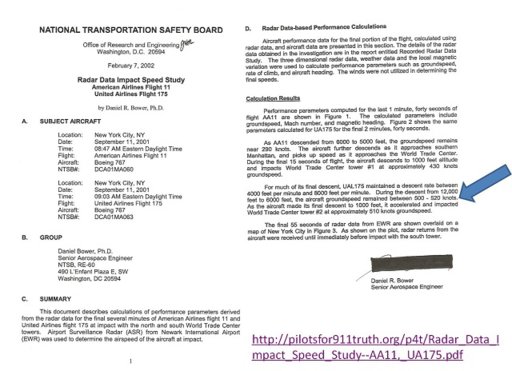
Cite the speeds, in knots groundspeed, for each corresponding flight as per the official report
Edit: If it lists indicated airspeed, or true airspeed, you can list those as well. Just make sure you differentiate Indicated Airspeed, True Airspeed, and Groundspeed, as they are all different airspeeds under different contexts.
George B. said:Q) Could pilots with a commercial licencse have hit the the World Trade Center and the Pentagon with a 767 or 757 at the speeds observed on 9/11? (the pilots were assumed to have earned a commercial license within the previous year) (Tower #1 = 473 - 510 Knots Groundspeed, Tower#2 = 430 Knots Groundspeed, Pentagon = 460 Knots Groundspeed)
1) Yes
2) Yes, it would be fairly straightforward
3) Yes, but it would have needed a lot of concentration
4) Yes, but it would have been very difficult
5) Probably, but they were pretty lucky
6) Probably not, it would be very hard to do
7) No
8) No, the plane would be impossible to control at that speed
9) No, the plane would have fallen apart at that speed
10) No, the plane could never even reach that speed.
11) I don't know
That I don't know or can confirm . . . we could publish both if you have an authoritative source . . .So the NTSB estimate I found, with a groundspeed much leSs than 510 knots is being discounted?