
Jazzy
Closed Account
Them pesky bicycle sheds...Um, no..300 parts per million is 0.03%...33% would be 333,000 parts per millions (PPM)..

Them pesky bicycle sheds...Um, no..300 parts per million is 0.03%...33% would be 333,000 parts per millions (PPM)..

That's not how percentage of change math works. A 0.01% increase from 0.03% is 0.030003%. A 33% increase is 0.04%.Um, no..300 parts per million is 0.03%...33% would be 333,000 parts per millions (PPM)..
So intelligence has always been, yet never directs its hand. This also fails by Occam for several reasons. Whoops, sorry, Mick. You made me jump, there… (scuttles off.)Indeed, (my mistake). I think it is logical to deduce that an origin of time inherently eludes any sort of explanation, and therefore (as well as for other reasons), the simplest assumption (or 'explanation') is that time did not ever begin; it simply has always been, just as the intelligence (consciousness) which likely lent itself to all that we know has and will.

Really? You haven't heard of the anthropogenic global warming hypothesis?
Basically, human activity due to our use of fossil fuels in industrialisation and technology has increased carbon dioxide levels in the atmosphere enough to trap more of the sun's heat. That's what's changed.
How much explanation is needed? Most of those 250 parts don't affect temperature because they are transparent to infrared radiation.
Inverse square law. If increased solar output is heating the entire solar system, particularly if the sun has increased output enough to cause outlying balls of ice to warm up then it would back inner planets to a crisp.
Again. Please stick to the topic. Any more off-topic posts will be deleted and the poster will be tread-banned.

Well, stick around for a few trillion more years, then we'll see....doubt it.

Any posts not about the level of warming observed in other planets as a representative indicator for the level of solar forcing of the Earth's climate.What exactly are you referring to, Mick?
So intelligence has always been, yet never directs its hand. This also fails by Occam for several reasons. Whoops, sorry, Mick. You made me jump, there… (scuttles off.)
Any posts not about the level of warming observed in other planets as a representative indicator for the level of solar forcing of the Earth's climate.
This is not a general discussion forum. Threads should not expand to discuss other aspects of a general topic, they should focus on specific claims of evidence. If you want to discuss the broader topic, there are many other forums that will allow that.
So, if the entire solar system is heating up, is there any evidence of a heating up of all planets and orbiting objects that do not have an atmosphere? That would remove the confounding factor of changing constituents of various planetary atmospheres. Gas giants are out, but you could include larger asteroids, comets, Kuiper belt and our moon.

(and can't imagine how) anyone could deduce what actual solar output was half a billion years ago..
In a word: physics.
Principles of Stellar Evolution and Nucleosynthesis
Main sequence stars get more luminous with age. The sun is a main sequence star.
The following document seems to indicate a gradual linear increase in lunar temperatures in the 70s:
http://www.earth.lsa.umich.edu/~shaopeng/Huang08ASR.pdf
Could you quote the bit that indicates that?
View attachment 8779
On page 1858, there is a graph which indicates an increase in average low temperature and another showing a very clear and steady increase in average temperature on the lunar surface over a 4 year period.

Yes, this idea was thrown around by the "Planet X" people too. I always wondered if it was based on anything real. Apparently not or just based on cherry-picked info, as usual.Yes. Roughly five or six years ago. Yet another "Urban Legend" concocted out of scientific illiteracy and (perhaps) some tongue-in-cheek jesting that was, unfortunately, taken seriously (though not properly vetted as to scientific accuracy).
But that's explained in the paper. It's a function of "orbit eccentricities and rotations axis inclinations of the Earth and Moon, as well as other astrometry factors". The red line was calculated using constant solar output. There's no solar variation there.
Note the troughs go down, it's not actually heating.
View attachment 8781

Yup, and when I averaged the peaks and troughs in those data (estimated roughtly from the graph, I couldn't find the source data), I found that the overall annual trend in daytime max temps was slightly negative.But that's explained in the paper. It's a function of "orbit eccentricities and rotations axis inclinations of the Earth and Moon, as well as other astrometry factors". The red line was calculated using constant solar output. There's no solar variation there.
Note the troughs go down, it's not actually heating.
View attachment 8781
D3FC0NZ3R0 said:Also what about the linear uptick in low temperatures (with no corresponding offset) over the period?
External Quote:To a great extent, the nighttime temperature variation is independent of daytime temperature. This is evidence that daytime and nighttime temperatures are governed by two different radiation processes, namely the solar radiation and terrestrial radiation.
The observed lunar nighttime warning from mid 1972 to the end of 1975 appears to be consistent with the global dimming of earth prior to the late 1980s (Stanhill and Cohen, 2001; Pinker et al., 2005; Wild et al., 2005).[...] Given a constant solar irradiance, the less sunlight reaches the Earth's ground surface, the more solar radiation is reflected to the deep space, and the higher lunar nighttime temperature would be.
I doesn't say that it is a function orbit eccentricities and rotation axis inclinations of the Moon and Earth
as well as other astrometry factors...it says the mission "takes into accounts orbit eccentricities and rotation axis inclinations of the Moon and Earth as well as other astrometry factors."
Yup, and when I averaged the peaks and troughs in those data (estimated roughtly from the graph, I couldn't find the source data), I found that the overall annual trend in daytime max temps was slightly negative.
This is explained in the text:
External Quote:To a great extent, the nighttime temperature variation is independent of daytime temperature. This is evidence that daytime and nighttime temperatures are governed by two different radiation processes, namely the solar radiation and terrestrial radiation.
The observed lunar nighttime warning from mid 1972 to the end of 1975 appears to be consistent with the global dimming of earth prior to the late 1980s (Stanhill and Cohen, 2001; Pinker et al., 2005; Wild et al., 2005).[...] Given a constant solar irradiance, the less sunlight reaches the Earth's ground surface, the more solar radiation is refleccted to the deep space, and the higher nighttime temperature would be.

Are you arguing the same Mars receives similar irradiance to earth?Okay, so then how does Mars reach nearly 100 F when it is nearly 3 times the distance from the Sun than Earth?
What about the troughs? Looks like variation increased but average stayed the same.View attachment 8779
On page 1858, there is a graph which indicates an increase in average low temperature and another showing a very clear and steady increase in average temperature on the lunar surface over a 4 year period.
But the red line is a computed temperature, not an observed temperature. So it's only varying based on those factors.
And it matches the actual observations.
But wasn't anthropomorphic global warming supposed to have been in full swing (no pun intended) by the groovy 70s...shouldn't that mean that the earth was 'hogging' more of that solar radiation, thereby starving the nocturnal Luna of precious heat?
If you can point to some record or method of estimating (with hypothesized margin of error) solar output 1/2 billion years ago, I would be happy to consider it.
It says right in the material that you quoted that the earth atmosphere was more reflective. Moon was being heated at night by solar radiation bouncing off the atmosphere not by infrared radiating from earth.by the groovy 70s...shouldn't that mean that the earth was 'hogging' more of that solar radiation,
Are you arguing the same Mars receives similar irradiance to earth?
What about the troughs? Looks like variation increased but average stayed the same.
It says right in the material that you quoted that the earth atmosphere was more reflective. Moon was being heated at night by solar radiation bouncing off the atmosphere not by infrared radiating from earth.
This thread is about whether or not "The Whole Solar System is Undergoing Global Warming" as per the title of the ATS thread linked in the opening post. I think that the claim is conclusively debunked.

Skeptical Science actually did another article that dictates the sun is actually cooling since the 70's based on individual measurements. http://www.skepticalscience.com/acrim-pmod-sun-getting-hotter.htmhttp://www.skepticalscience.com/global-warming-other-planets-solar-system-intermediate.htm
Rundown:
Mercury: Not warming
Venus: Not warming
Mars: The warming "trend" is based on information from 1977 and 1999, not continuous data. The 1977 data came right after a global dust storm, and the 1999 data right before one. Based on data since 1999 (which is close to continuous), Mars is not undergoing any long term warming.
Jupiter: Jupiter underwent a temperature change due to the merging of several storms temporarily shifting how heat moved through the atmosphere. The poles became colder, the equator warmer, but overall temperature stayed the same. The effect was temporary.
Saturn: Not warming
Uranus: Actually getting colder, due to its wacky seasonal cycle.
Neptune (and its moon Triton): Both are moving into the first southern hemisphere summer we've observed - it's actually been spring (and fall in the north) there since we discovered the planet. Some seasonal warming is expected.
Pluto: Warming, and we don't know why. Pluto's axial tilt and orbital eccentricity should give it even wackier seasons than Uranus, but a full season hasn't passed since we discovered it, and we're not even sure what its surface or atmosphere is like yet, so we're really banking on the New Horizons probe to help us figure this one out.
However, if Pluto's warming is due to increased solar output and not a local effect like seasonal warming, then Eath's temperature should have risen several hundred degrees, not several degrees, and Mercury should be literally burning away to nothing.
Lastly, it's not like solar output is hard to measure, and we do know it's actually declined over the last 35 years, separate from the solar cycle - there's a slight but measurable decline max-to-max and min-to-min in the last few decades. Not enough to have a measurable impact on any of the planets' temperatures, but it is opposite of the trends on Earth and Pluto.
External Quote:Climate Myth...
The sun is getting hotter
There is no single continuous satellite measurement of Total Solar Irradiance (TSI). Instead, the data is composited from various satellite measurements. The two most cited composites are PMOD and ACRIM. According to Nicola Scafetta, ACRIM more faithfully reproduces the observations whereas PMOD assumes the published TSI satellite data are wrong and need additional corrections. In particular, PMOD alters the data from the Nimbus7/ERB record from 1989 to 1991. Nimbus7/ERB data during such a short period show a clear upward trend while PMOD during the same period is almost constant. The alteration of the Nimbus7/ERB data is responsible for the different shape between theACRIM and PMOD TSI composites (Shining More Light on the Solar Factor).
We must also take into consideration that the sun (our star) like any star goes through cycles and variations. They are able to determine the Sun's activity in the past through several means, from drilling ice cores to investigating the rings of a tree. They look for several isotopes but the most famous of them to the public is C14. Someone asked how they were able to determine the sun's "strength" half a billion years ago, while that might be a difficult task, astronomers often look to the Universe for these answers by finding similar stars to our sun at varying levels of age to determine their output and stage in the life cycle. Agreeably, there is still much to learn about our Sun and it's effect on earth and the solar system, but there is a great deal they understand..External Quote:The ACRIM composite shows a slight increase in TSI - the PMOD composite shows a slight decrease. Regardless of which dataset you use, the trend is so slight, solar variations can at most have contributed only a fraction of the current global warming. Scafetta 2006 uses the ACRIM composite and finds 50% of warming since 1900 is due to solar variations. However, the warming from solar influence occured primarily in the early 20th century when the sun showed significant warming. As for the global warming trend that began around 1975, Scafetta concludes "since 1975 global warming has occurred much faster than could be reasonably expected from the sun alone.
http://en.wikipedia.org/wiki/Solar_variationExternal Quote:Carbon-14 production[edit]
Sunspot record (blue) with 14C (inverted).
The production of carbon-14 (radiocarbon: 14C) also is related to solar activity. Carbon-14 is produced in the upper atmosphere when cosmic ray bombardment of atmospheric nitrogen (14N) induces the Nitrogen to undergo β+ decay, thus transforming into an unusual isotope of carbon with an atomic weight of 14 rather than the more common 12. Because cosmic rays are partially excluded from the Solar System by the outward sweep of magnetic fields in the solar wind, increased solar activity results in a reduction of cosmic rays reaching the Earth's atmosphere and thus reduces 14C production. Thus the cosmic ray intensity and carbon-14 production vary inversely to the general level of solar activity.[53]
Therefore, the atmospheric 14C concentration is lower during sunspot maxima and higher during sunspot minima. By measuring the captured 14C in wood and counting tree rings, production of radiocarbon relative to recent wood can be measured and dated. A reconstruction of the past 10,000 years shows that the 14C production was much higher during the mid-Holocene 7,000 years ago and decreased until 1,000 years ago. In addition to variations in solar activity, the long term trends in carbon-14 production are influenced by changes in the Earth's geomagnetic field and by changes in carbon cycling within the biosphere (particularly those associated with changes in the extent of vegetation since the last ice age)[citation needed]
The theory is that as main sequence stars convert their hydrogen to helium, and burn more helium, they become hotter with age. A rough method for the calculating the change in luminosity is L(t)=[1+0.4(1-t/to)e-1 Lo]
Is it good enough that these are accepted theories of stellar evolution, or are you going to go so far as to require a detailed explanation of nuclear physics before you'll be happy to consider it?
We covered that, I got schooled by Mick West on that one. Uh, yes, I arm arguing the radical hypothesis that the same source of (just about) all of our energy and primary driver of climate fluctuations for the first 4,529,999,900 years has not retired, and continues to lead the league (our solar system) in on base percentage (average global temperature).
Okay, so then how does Mars reach nearly 100 F when it is nearly 3 times the distance from the Sun than Earth?
Bouncing?...at night?...from where?....No radiating Solar energy received during the day....
External Quote:The observed lunar nighttime warning from mid 1972 to the end of 1975 appears to be consistent with the global dimming of earth prior to the late 1980s (Stanhill and Cohen, 2001; Pinker et al., 2005; Wild et al., 2005).[...] Given a constant solar irradiance, the less sunlight reaches the Earth's ground surface, the more solar radiation is refleccted to the deep space, and the higher nighttime temperature would be.
Because CO2 isn't always an indicator for temperature rises and decreases on the surface of the earth.Ok, "rough method"...well so is this, but I think it pretty conclusively shows the 'experts' (at wikipedia) feel that overall solar output was about 1% less then (400 MYA; when CO2 was 4400 PPM and temps were 72 degrees fahrenheit)...if the sun is so insignificant to climate now, how was only a 1% lesser output enough to equal temperatures on par with the present when, at that time, the (so very significant) CO2 concentrations were at least 10 fold what they are now?
View attachment 8786
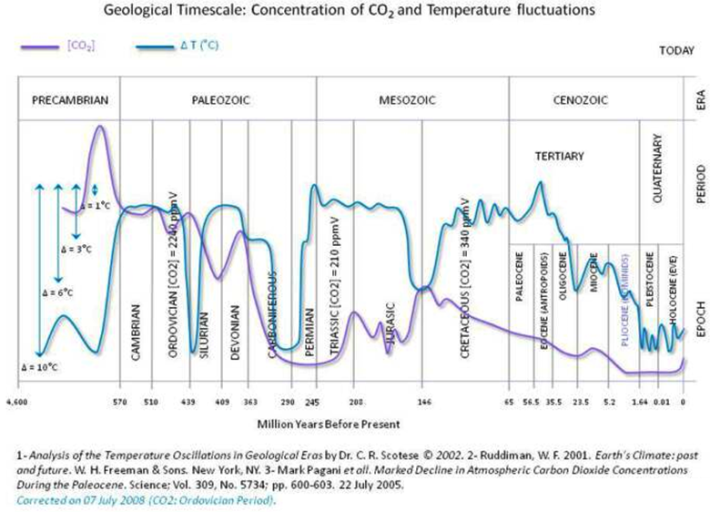
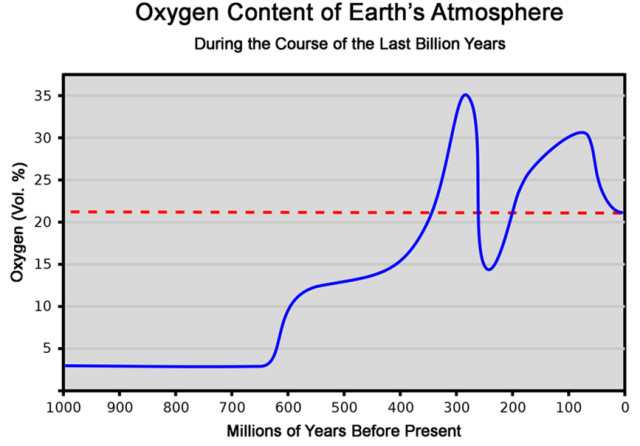
D3FC0NZ3R0, in case it's not clear, the "global dimming" referred to here is from particulate pollution in the atmosphere. http://en.wikipedia.org/wiki/Global_dimmingYou quoted it already but I can quote it back to you:
External Quote:The observed lunar nighttime warning from mid 1972 to the end of 1975 appears to be consistent with the global dimming of earth prior to the late 1980s (Stanhill and Cohen, 2001; Pinker et al., 2005; Wild et al., 2005).[...] Given a constant solar irradiance, the less sunlight reaches the Earth's ground surface, the more solar radiation is refleccted to the deep space, and the higher nighttime temperature would be.
The sun obviously is not insignificant to climate. But again, solar irradiance has not been increasing in recent decades. So, it can't explain the recent warming trend.if the sun is so insignificant to climate now


