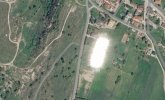
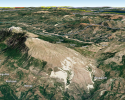
We need OSINT specialists to identify the location of a UFO sighting filmed from a Tripoli-Kyiv flight in March 2007.

Igor K.

New Member

The objects can be seen in the following time intervals: 02:37-03:07 and 03:11-03:18
Over the Ionian Sea, the object was exactly on the cockpit monitor at 11:15. The distance to central Greece, including the mountains, is approximately 12 hours, when I was able to observe it. Some of the bodies of water in the video before the sighting, bordering the land, were two large lakes, which, like the Ionian Sea, did not produce glare. The original tape and video camera are available. In 2010, this video was featured in a documentary. The documentary also states that the pilots of the flight were interviewed by telephone and did not notice anything unusual. An object filmed by a video camera in March 2007 during the Tripoli-Kyiv flight.
photo_2024-06-24_09-27-53-225x300.jpg
photo_2024-06-24_09-27-54-225x300.jpg
photo_2024-08-11_22-15-11-225x300.jpg

Recorded on March 15, 2007, on a MiniDV ME DVM60 tape with a Panasonic NV-GS27.
photo_2024-08-16_13-48-18-768x536.jpg

photo_2024-08-16_13-48-19-768x524.jpg

After checking the camera, we saw that the first UFO appeared at 11:45 AM, and the second one a minute and a half later, at 11:46 AM.
We need to more accurately identify the area, looking for shallow water, large greenhouses, or other structures that could reflect light. We also need to test the hypothesis of a mirrored Mylar balloon in a hurricane wind, a weather balloon, etc.
The entire tape has been digitized, but it's 01:18 AM, 3.44 GB, and the relevant fragment is attached.
There is also a questionnaire filled out by an eyewitness - but unfortunately it is not in English. http://ufology-news.com/wp-content/uploads/2025/02/2007.03.15.pdf
 
It's not the motor its the iris blades

Looks like a plane in the sky, I am not sure how geo-locating it solves anything given how long ago it is there are no ADSB etc records.

Looks like at the time the plane was beginning descent presumably to Kiev
 
If we take into account the reflection hypothesis, it is difficult to say the exact location right away, if we focus on the airport and the river, and then on Bucharest, then the trajectory is this place, it was not there yet in the 2007 images, but it appeared in 2008. But, perhaps the 2007 images were taken in January-February, this is not indicated. In any case, solar panels can be added to the possible lakes and greenhouses. Here is another fragment
 

Attachments

  • нове.jpg
    нове.jpg
    102.6 KB · Views: 36
  • ось ще один фрагмент.mp4
    941.7 KB
If we consider the hypothesis that the object was another aircraft reflecting sunlight and located outside the camera's focus, there is an important optical question concerning the Panasonic NV-GS27.

Could the use of zoom on the Panasonic NV-GS27 affect the focus position or change how a foreground/background out-of-focus object appears?

The use of zoom can affect depth of field and how prominent an out-of-focus object becomes, although focus and depth of field should be distinguished.

Focus determines which distance is rendered sharply. Optical zoom itself does not necessarily change the focus distance, although with autofocus enabled the camera may refocus during zooming.
As the focal length increases toward the telephoto end, depth of field generally becomes shallower. Close objects in front of the camera — insects, dust, leaves, droplets, etc. — can therefore become strongly blurred while the distant background remains relatively sharp.
At the wide-angle end, depth of field is considerably greater, so objects at different distances may appear relatively sharp simultaneously.
Digital zoom is particularly important. It does not add optical detail; it simply enlarges the image. Consequently, a blurred or out-of-focus object may appear even more unusual in shape.

For the identification of a UFO/UAP, this is important: a zoomed-in frame containing a bright, blurred object is not evidence by itself that the object was large or at a great distance. Without knowing the focal length, focus position, and preferably examining a sequence of frames recorded at different zoom/focus settings, it may be difficult to determine whether the object was close to the camera, at an intermediate distance, or in the distant background.

What happens if the object is a bright reflection outside the focus?

If a highly reflective object is outside the plane of focus, several things can happen when the operator zooms toward it:

Autofocus enabled: the camera may begin refocusing on the bright object or on another high-contrast element in the scene. The object may gradually become sharper while another part of the image becomes less sharp.
Focus locked/manual: changing the zoom does not necessarily change the established focus distance. The object can remain out of focus, although its apparent size and the characteristics of its blur will change.
At high magnification, a small bright out-of-focus object can appear as a characteristic blurred spot, disk, ring, or other geometric shape. This is particularly relevant when dealing with strong reflections of sunlight.

Therefore, if the object in this case was another aircraft producing a strong solar reflection, it is quite possible to obtain a sequence in which an initially diffuse bright spot changes its apparent size, shape, and sharpness as the operator zooms and the autofocus responds. This does not necessarily mean that the physical object itself changed shape or position.

For forensic analysis, the sequence of focusing and zooming is therefore potentially very informative. If the apparent sharpness of the bright spot changes in synchronization with autofocus activity during zooming, this could provide evidence for an out-of-focus optical source rather than an anomalous object.

Would anyone here be interested in helping analyze this aspect of the footage, particularly the Panasonic NV-GS27 focusing/zoom behavior and whether the observed changes are consistent with an out-of-focus aircraft reflecting sunlight?
 
Back
Top