
NoParty
Senior Member.
A bit off topic, but have you ever explained why "Three-Dollar Kit"?We have one witness Terry...

A bit off topic, but have you ever explained why "Three-Dollar Kit"?We have one witness Terry...

I've got to say, you're not the only one who's been curious about that. Thought about that on and off for the last few years, since coming across the site in relation to the Travis Walton "abduction".A bit off topic, but have you ever explained why "Three-Dollar Kit"?

Her blog says the Travis Walton case inspired the name, though I can't figure out how.I've got to say, you're not the only one who's been curious about that. Thought about that on and off for the last few years, since coming across the site in relation to the Travis Walton "abduction".
Ah, I didn't know that. I came across the site and read the sections about the Travis Walton and the Hill's "abduction" and read those. Then, only later, did I see the the blog section and read that, but for some reason didn't read the early parts of it.Her blog says the Travis Walton case inspired the name, though I can't figure out how.

A bit off topic, but have you ever explained why "Three-Dollar Kit"?

We have one witness Terry who says she saw the landed craft in the Grange and got close enough to feel its heat. (Again I'm ignoring Victor who claims he along with many other witnesses saw two craft for two hours alongside the school - nobody else corroborates this and his timing doesn't work.)
Terry's testimony in terms of what she saw, what she did, what the UFO did, and who else was there, has changed drastically over the years in ways that bad memory can't account for. And there's no evidence she told any other students at the time. Nobody corroborates it, including another student Tanya whom Terry claims was present at the Grange in varying states of hysteria or consciousness.
I don't think it's worth going into detail for discussion here, but (at the risk of self-promotion) I've collected her stories over the years and compared them here (scroll down to "Case study: Feeling the heat") with quotes and linked sources. As an example of how her story got more and more amazing, she initially told Shane Ryan (reported in Yahoo Groups in 2007, and in his doco 2010) that the UFO was rising up in the air and overhead when she arrived at the Grange, but by 2016 the UFO was landed in front of her for a few minutes before taking off (so she had time to approach and feel its heat).

And there's a certain level of double standards with regard to later testimony....for example the Rendlesham case where later evidence by Halt and other witnesses is 'embellished'.....yet base Commander Conrad makes a statement 11 years later and nobody seems to question whether his memory is working fine or he is changing the story.
Also, you can't just invent which bits of testimony are reliable and which aren't.
A point you made in post #662 of that thread. Respondents pointed out that Conrad hadn't changed his story or added new highly dramatic claims.
"...nobody seems to question whether... he is changing the story", because he hasn't.

Well you can't add new dramatic claims to 'nothing happened'...without obvious inventing of material. But why do we assume that Conrad's statement after 11 years is factually correct ? Why do we take his word for it that nothing happened, yet cast doubt on Halt's claim that something did ? Is it not just as possible that someone could do the reverse of embellishing the story...and relate 'nothing to see here, folks' when they know stuff did actually happen ?
No, I am quite certain I have seen a documentary in which one of the boys ( who is interviewed for the documentary ) clearly states that there was a purple glow around the edge of the object, and that he actually got onto the object briefly. I suppose I'm gonna have to find it.
Also, you can't just invent which bits of testimony are reliable and which aren't. There are numerous court cases where people have added to testimony and their later testimony turns out to be more accurate than an initial one. Even in my own UFO report ( 1977 ) I failed to initially add that the UFO changed shape...because that just seemed a little too crazy. You can't just automatically assume that later evidence is 'embellished'. And there's a certain level of double standards with regard to later testimony....for example the Rendlesham case where later evidence by Halt and other witnesses is 'embellished'.....yet base Commander Conrad makes a statement 11 years later and nobody seems to question whether his memory is working fine or he is changing the story.
Source: Secrets of the UFOs, Ross Coulthart, 2021 (timestamped)External Quote:Tanya: They didn't want me to speak of the incident to absolutely anybody. And because it was "in the interest of national security, so we want you to keep this under your belt and not discuss it with anybody."
Host: Did they try and explain to you what it was?
Tanya: Yes, they did. One of them actually told me that it was a very special weather balloon.
Coutlhart: Did you believe it?
Tanya: No, not even - not at the age of 12. I knew better. I know what I saw and it was definitely not a balloon.
I understand, a verbal report is always subject to question: is it true, is it a misinterpretation, is it a deliberate falsification? But we were discussing the additional factors of the fallibility of memory and the tendency of humans to embellish. Telling a different story after a long period of time opens up the possibility of either or both of those confounding factors to be in play. Telling the same story does not.
then write down now what you think you wrote then, so you have committed to something you can compareOne of the reasons I want to get hold of my own 1977 UFO report is precisely to see how my memory of it 49 years later matches what is in the report made on the day of the event.


Neat video showing a launch from MilduraProject Hibal. - he is a technician who worked on the Hibal project at Mildura during this timeframe and wrote a memoir] This field is visible from the offices to the southeast of the school/Grange, and Shane Ryan has witnesses who saw activity there.
This aired last night as the event was 60 years ago
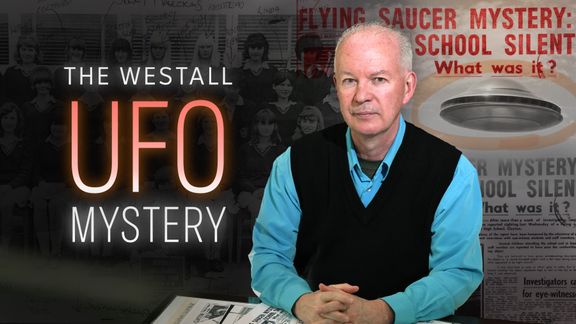
The Westall UFO Mystery
Duration: 30 minutes 32 seconds30m
In 1966, a Melbourne high school was thrown into chaos when strange objects appeared in the sky. Sixty years on from Australia's biggest UFO sighting, witnesses are still looking for answers about what they saw at Westall.
https://iview.abc.net.au/video/NC2602Q009S00
Later the number of witnesses is given as 300, but even if we take the ~10 witnesses interviewed here (as adults), only 3 of them said anything on record in 1966 (two girls Joy and Marilyn, and science teacher Andrew Greenwood), so how can we possibly know there's a "sheer volume" of 10 or 300 or whatever saying the same thing 60 years ago as today?External Quote:The significance of the Westall case is the sheer volume of eyewitnesses saying the same thing that they did 60 years ago.
Would not be surprised if this was misinterpreted as a flying saucer while it slowly came down above the ground
The only contemporaneous illustrations:External Quote:"it seemed to have two parts (like it was two-storied), with a flat saucer-like bottom, on top of which was something like a dome." (Tanya)
"somebody's got some way of projecting a film of something into the sky" (Paul S)
"silver space blankets"... "Everyone knew it was rubbish blowing around until someone yelled, flying saucer. Then mass hysteria took over." (Rob N)
"I could see that it was just a large deflated balloon" (Peter A)
"I'm convinced it was a half flat weather balloon." (Jack T)
"It appeared to be floating as if being carried through the air by the breeze [like] a shoal of fish swimming very slowly through the ocean." (Jelte H)
1. Westall '66 (2010) documentaryExternal Quote:I looked up and I was facing the object in the sky and I just thought, "Oh, somebody's got some way of projecting a film of something into the sky. I didn't believe that it was really happening... [1]
It was just sitting there about 20 feet above the ground... it was just glowing. It was a sort of whitish silver... It was a solid object to start with but went from translucent, transparent, ... and then there it went - like there was just this resonance left like a gas or fumes or something... and it went into the pine trees... I've always felt uncomfortable because my description is so totally different from what the school kids saw. [2]
First, I've said before that I'm really impressed by the detail you've supplied to this story. It's remarkable.It's plausible that the "dome" on Joy's drawing is an artifact of her style, given she clearly went over the shape a few times with the pen. The description on the report she filed in 1966 describes 2 UFOs as "circular... round on top, flat on bottom" with no mention of a dome.
First, I've said before that I'm really impressed by the detail you've supplied to this story. It's remarkable.
This particular passage, though, puzzles me (to be fair, I haven't recently reviewed all 30,000 posts in this thread, so I may be overlooking something obvious): But aren't most domes roundish on top, & flat on the bottom?
External Quote:
The Grange Reserve commemorates a momentous day in local, and universe, history.
The UFO themed park was designed in honour of an event that took place on the morning of April 6, 1966 when at least 90 students and teachers witnessed three 'flying saucers' hovering over their school oval.

I actually spoke with Terry for a while right before she made her way to be interviewed with Ross
Thanks. Ah, the typical flying saucer!I meant: no mention of a small dome on top of the upper "saucer", as in a typical flying saucer.
View attachment 89483

Search for "flying saucer" on google images, and the majority of results have the Adamski dome.Thanks. Ah, the typical flying saucer!

It would be interesting to know whether the cultural idea of UFO =disc-with-dome led to all those fake discs with domes dangling from strings or tossed in the air, or did all the hoax pics create the cultural meme...Search for "flying saucer" on google images, and the majority of results have the Adamski dome.
View attachment 89499
We're talking about a cultural archetype here, not actual UFOs.
It would be interesting to know whether the cultural idea of UFO =disc-with-dome led to all those fake discs with domes dangling from strings or tossed in the air, or did all the hoax pics create the cultural meme...
I guess most likely they just reinforced one another, with Hollywood and comic books and such fanning the flame.
Wikipedia, https://en.wikipedia.org/wiki/Roswell_incident, quote from Associated Press, "Flying Disc Found; In Army Possession", The Bakersfield Californian 08 July 1947.External Quote:The many rumors regarding the flying disc became a reality...
In terms of "real" flying saucers- or flying saucers claimed, and believed by some, to be real- George Adamski's December 1952 photo of a Venusian Scout Ship was enormously influential. But it lacks the futuristic blended surfaces of Klaatu's 1951 machine; maybe the Venusian engineers didn't have access to Frank Lloyd Wright. Or a wind tunnel. (Less charitably, perhaps Adamski didn't have the resources of 20th Century Fox's modelmakers).External Quote:Laffoley quotes Wright and his attempt in designing the exterior: "... to imitate an experimental substance that I have heard about which acts like living tissue. If cut, the rift would appear to heal like a wound, leaving a continuous surface with no scar."
A thing that makes some sort of sense for our hypothetical interstellar travelers is the idea of a round shape, which can rotate to give a "gravity" sensation to the occupants by centrifugal force. That, of course, requires a 90° reorientation so that the perimeter and the center correspond to "down" and "up".The 1951 film The Day the Earth Stood Still was perhaps the first non-"B" movie with a wide distribution to portray a flying saucer, and it conforms to the saucer-with-a-dome trope: A cabin with reasonable headroom for crew on a long trip.
It also would make the "dome" experience very little weight, defying the purpose.A thing that makes some sort of sense for our hypothetical interstellar travelers is the idea of a round shape, which can rotate to give a "gravity" sensation to the occupants by centrifugal force. That, of course, requires a 90° reorientation so that the perimeter and the center correspond to "down" and "up".
A thing that makes some sort of sense for our hypothetical interstellar travelers is the idea of a round shape, which can rotate to give a "gravity" sensation to the occupants by centrifugal force. That, of course, requires a 90° reorientation so that the perimeter and the center correspond to "down" and "up".
...obviously there is no good way to fly the same furniture near the planet.


