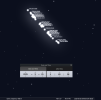
Feature Request Starlink Flares TLE Sources for Trains (vs. Stellarium)

Should I expect to see at the time newly deployed Starlink trains in historical Sitrecs when loading LEO sats for that date?

For instance in this case
...


I might have missed it, or the date/time might be wrong..

I was assuming the date/time were wrong because I couldn't find it. But then I tried to look up an older sighting in sitrec and couldn't find it either even though I found it in Stellarium at the time.


Source: https://www.reddit.com/r/UFOs/comments/1nqqeqm/unknown_object_cheyenne_wy/
 

Attachments

  • cheyenne_starlink_train.png
    cheyenne_starlink_train.png
    308.8 KB · Views: 69
Not exactly sure what Sitrec will do, but to find TLE for shortly after the launch you need to find the pre-Launch Placeholder, which is the predicted TLE.

So for Sep 19 2025 at 1910 UTC, I'd goto https://en.wikipedia.org/wiki/List_of_Starlink_and_Starshield_launches and find the closest launch and group...

To find Starlink Group 17-12 I use this url and just edit the ID nos....

https://celestrak.org/NORAD/elements/supplemental/table.php?FILE=starlink-g17-12&FORMAT=tle
1762164098506.png


Click the Latest SupGP (TLE format) Data at the top. That should give you the following Text. And just to check the validity "25262.73207176" = 2025 day 262 = 19 Sep . The fact that the data is flagged as "SupGP Age (days) = 44.69" is RED is good becasue we want the TLE that was valid on that day, not today.

STARLINK-G17-12 STACK
1 72000C 25211A 25262.73207176 .00015198 00000+0 23377-4 0 02
2 72000 97.6074 302.3553 0010748 248.6174 129.0303 16.04173648 16
STARLINK-G17-12 SINGLE
1 72001C 25211B 25262.73207176 .00993480 00000+0 14977-2 0 06
2 72001 97.6073 302.3553 0010729 248.6150 129.0327 16.04174501 14
 
So the answer is for post launch trains you need supplemental TLEs, cool thanks for that detailed guide @flarkey

So is stack for the entire stack and single, for one sat? Or is there some other difference?
 
Should I expect to see at the time newly deployed Starlink trains in historical Sitrecs when loading LEO sats for that date?
It;s eems they are often not in the space-data data. I see them sometimes if you use the "Current Starlink".

Not exactly sure what Sitrec will do, but to find TLE for shortly after the launch you need to find the pre-Launch Placeholder, which is the predicted TLE.
It won't currently do that. But I might be able to automate it.
 
It looks like the Stellarium source has a track for each sat which would make the train apparent, rather than the single/stack object from the TLE above.
 
Were you at the date/time of the sighting in Stellarium when you hit that button?

It seems odd i'd expect Stellarium to just go and get the current TLEs which would probably not show this train, as per Sitrec.

But perhaps it's cleverer than that..
 
Does Sitrec's Satellite stuff need work? (outside of deployed Starlinks)

Launch trains not showing individual sats
Labels for sats looking like this

1762771783149.png


This thread seems to show stellarium providing the position of 2 NOSS sata near Saturn matching a video, but Sitrec doesnt seem to recreate, the debate is which is accurate? Is Stellarium using old inaccurate TLEs or is Sitrec just not loading these sats?

https://www.metabunk.org/sitrec/?cu...m/11433/Reddit Basingstoke/20251110_105232.js


Source: https://old.reddit.com/r/UFOs/comments/1os54ya/lights_in_the_sky_at_work/


1762771924273.png
 
This thread seems to show stellarium providing the position of 2 NOSS sata near Saturn matching a video, but Sitrec doesnt seem to recreate, the debate is which is accurate? Is Stellarium using old inaccurate TLEs or is Sitrec just not loading these sats?
Stellarium uses the newest TLEs, which makes them inaccurate for historical predictions, but should be fine for within a few days (although going backwards with calculations is harder than going forwards)

NOSS satellites are classified and not published as part of the USG space-data feed I use. However you can add them to Stellarium by adding https://mmccants.org/tles/classfd.zip as a source.
2025-11-10_05-47-10.jpg


I need to add better support for multiple TLE sources. Right now, you can only have one.
You can manually combine the TLEs, but obviously this is not ideal.
https://www.metabunk.org/sitrec/?cu...naws.com/1/Sat Labels TEST/20251110_140159.js

2025-11-10_06-06-46.jpg
 
The TLEs are not loaded as standard because they are recently launched. you need to use the Celestrak supplemental placeholder data

https://celestrak.org/NORAD/elements/supplemental/


This was the Starlink G17-35 launch that went up at 03.50am UTC on April 7 -

TLEs are available here: https://celestrak.org/NORAD/elements/supplemental/sup-gp.php?FILE=starlink-g17-35&FORMAT=tle

STARLINK-G17-35 STACK
1 72000C 26073A 26097.16129306 .00026806 00000+0 33114-4 0 09
2 72000 97.2902 293.9531 0011543 283.5004 90.9223 16.07717854 10
STARLINK-G17-35 SINGLE
1 72001C 26073B 26097.16129306 .01277900 00000+0 15368-2 0 03
2 72001 97.2900 293.9531 0011513 284.1265 90.2961 16.07716370 16

Here it is over London in Sitrec...

https://www.metabunk.org/sitrec/?custom=15857/Starlink G17-35/20260409_094622.js

Here's a slightly less sensational post from my local astronomical society...
 

Attachments

Hmm, @jarlrmai - thats an interesting anomaly, but I think I've worked it out (maybe)....

The actual time for launch was 3.50am BST = 2.50UTC

https://en.wikipedia.org/wiki/List_of_Starlink_and_Starshield_launches

Confirmed by the SpaceX YouTube channel banner...

The TLE from Celestrak - https://celestrak.org/NORAD/elements/supplemental/sup-gp.php?FILE=starlink-g17-35&FORMAT=tle
STARLINK-G17-35 SINGLE
1 72001C 26073B 26097.16129306 .01277900 00000+0 15368-2 0 03
2 72001 97.2900 293.9531 0011513 284.1265 90.2961 16.07716370 16

... can be decoded here: https://satellitemap.space/tle-calculator .... but gives the Epoch date/time as 03:52Z , which is one hour out. I'd expect it to be a few minutes out due to the time taken from launch to starting orbit, but not ~1 hr out.
An offset of 1hr for the satellites in Sitrec would result in a wrong Sitrec'd position compared to the actual observations. That's why they appeared on the other side of the globe. If you fast forward 1hr they appear over the UK, which is in line with the observations.

I need to dig a little deeper into this. Its quite a claim for me to say "I'm right and the Celestrak/NORAD TLEs are wrong".
 
20:15 UTC is when they were over the UK but the TLE file is back one hour so 19:15 is what you set in Sitrec
 
Last edited:
... can be decoded here: https://satellitemap.space/tle-calculator .... but gives the Epoch date/time as 03:52Z , which is one hour out. I'd expect it to be a few minutes out due to the time taken from launch to starting orbit, but not ~1 hr out.

An offset of 1hr for the satellites in Sitrec would result in a wrong Sitrec'd position compared to the actual observations. That's why they appeared on the other side of the globe. If you fast forward 1hr they appear over the UK, which is in line with the observations.

I need to dig a little deeper into this. Its quite a claim for me to say "I'm right and the Celestrak/NORAD TLEs are wrong".

Ah , I've looked at the Celestrak prediction for the upcoming G17-21 launch and it has the Launch
Launch time as 2026-04-11 02:39:00 UTC and the Deploy time as 2026-04-11 03:40:58.960 UTC, which is approximately 1hr later.


That matches the decoded Epoch time in the TLE...

So that would account for the difference in times from Launch to Epoch in the G17-35 TLE data, but does not account for the differences we're seeing between orbital calculations and observations.
 

Trending content

Back
Top