
Sir Francis Chichester's "Flying Saucer" 1931

Giddierone

Senior Member.
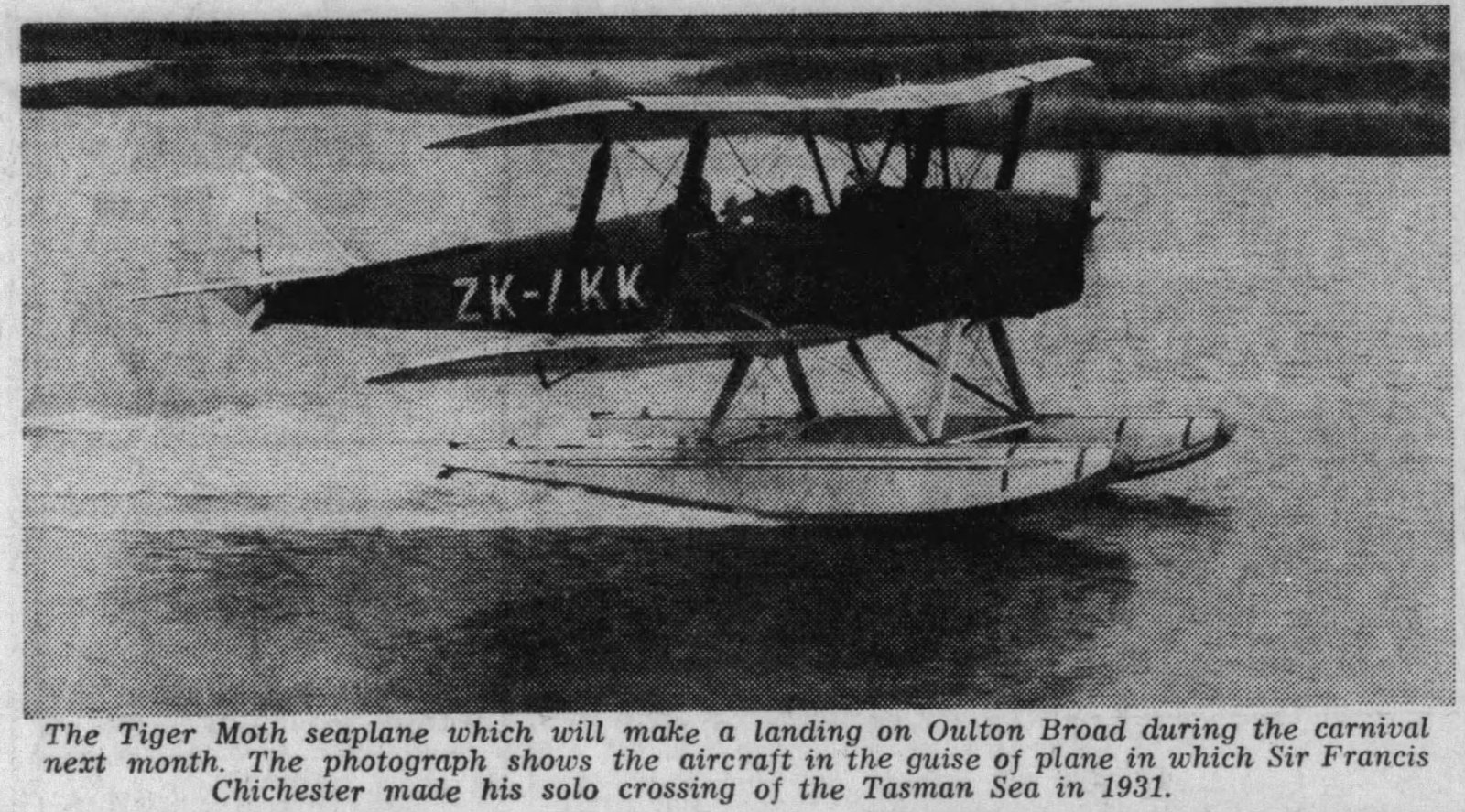
Aviator (and sailor) Sir Francis Chichester described seeing a "flying saucer" while flying from New Zealand to Australia over the Tasman Sea in 1931.

The main part of his sighting is described in his book The Lonely Sea and the Sky, 1964. (it's not mentioned again and doesn't seem to have been a big part of his memoirs).
External Quote:
Suddenly, ahead and thirty degrees to the left, there were bright
flashes in several places, like the dazzle of a heliograph. I saw a dull
grey-white airship coming towards me. It seemed impossible, but I
could have sworn that it was an airship, nosing towards me like an
oblong pearl.
Except for a cloud or two, there was nothing else in the
sky. I looked around, sometimes catching a flash or a glint, and turn-
ing again to look at the airship I found that it had disappeared. I
screwed up my eyes, unable to believe them, and twisted the seaplane
this way and that, thinking that the airship must be hidden by a blind
spot. Dazzling flashes continued in four or five different places, but I
still could not pick out any planes. Then, out of some clouds to my
right front, I saw another, or the same, airship advancing. I watched
it intently, determined not to look away for a fraction of a second: I'd
see what happened to this one, if I had to chase it. It drew steadily
closer, until perhaps a mile away, when suddenly it vanished. Then
it reappeared, close to where it had vanished:
I watched with angry
intentness. It drew closer, and I could see the dull gleam of light on its
nose and back. It came on, but instead of increasing in size, it
diminished as it approached
. When quite near, it suddenly became its
own ghost-one second I could see through it, and the next it had
vanished. I decided that it could only be a diminutive cloud, per-
fectly shaped like an airship and then dissolving, but it was uncanny
that it should exactly resume the same shape after it had once
vanished.
I turned towards the flashes, but those too, had vanished.
All this was many years before anyone spoke of flying saucers. What-
ever it was I saw, it seems to have been very much like what people
have since claimed to be flying saucers.

However, in the paragraphs immediately before is a long descriptive passage about the rapidly changing conditions he faced in his seaplane (an adapted Gypsy Moth).
Norwich_Evening_News_1971_07_29_8.jpg


External Quote:

By the end of the second hour the wind had backed still more to the north, but still was driving the plane onwards. I had covered 217 miles, nearly half-way, in two hours. Again through the change of wind I had not corrected enough for drift, and was now twenty-five miles off course to the south. Every mile to the south added length to the flight, but it did not seem to make much odds in such perfect condi-tions. I changed course another ten degrees to northward.
Then came clouds, and I could see that I might be unable to get a sextant shot. I did not worry much at first-there did not seem much to worry about with a target 2,000 miles wide ahead. But the wind was increasing, and backing persistently. At 250 miles out the sky was completely shut off by dull grey, threatening cloud. I spurred myself to make some hurried drift observations; the wind had increased to fifty m.p.h. from the north-east, and the seaplane was forty-three miles off course to the south. With the drift, we were heading obliquely for the receding part of Australia. Forty-three miles off course seemed a lot, and I wished that I had not allowed it to build up so much. I changed course another ten degrees northwards.
At three hours out heavy rain stung my face. The drift to the south was becoming alarming; the wind had backed till it was now right in the north. I changed course another ten degrees to the north, which put the wind dead abeam. I dared not correct the drift more than that, or I should have made a head wind of the gale, which I sensed would destroy my chance of reaching the mainland. The seaplane was drifting forty degrees to the south, and moving half sideways over the water, like a crab. The rain became a downpour-I had forgotten that it could rain so heavily. I kept my head down as much as possible, but the water caught the top of my helmet, streamed down my face and poured down my neck. We seemed to strike a solid wall of water with a crash. I ducked my head, and from the corner of my eye I could see water leaving the trailing edge of the wings in a sheet, to be shattered instantly by the air blast. On either side of my head the water poured into the cockpit in two streams, which were scattered like windblown waterfalls and blew into my face. I was flying blind, as if in a dense cloud of smoke. I throttled back, and began a slanting dive for the water. Panic clutched me: if I got out of control, I would be too low to recover. But panic meant dying like a paralysed rabbit. I remember saying out loud, "Keep cool! Keep cool! K-e-e-p c-o-o-l!" The seaplane passed through small sudden bumps, which shook it violently. I looked over at the air speed indicator on the strut, but I could not see either the pointer or the figures in the smother of water. I had to make do with the rev indicator; if the revs increased, the dive
to find the surface of the sea, for I dared not try to climb blind. If I lost control and tried to spin out, the sea would not show up quickly enough to level off. I sat dead still, moving only my eyes from compass to rev indicator to vertically downwards over the cockpit edge. When the engine speed increased, I used the control-stick lightly with finger and thumb to ease up the plane's nose. There was more chance of the seaplane's flying itself level than of my keeping it level, flying blind. Thank God it was rigged true.
At last I saw a dull patch of water below the lower wing rushing up at me. I pushed the throttle, the engine misfired, and failed to pick up. I thrust the lever wide open as I flattened the seaplane out above the water; the engine spluttered, broke into an uneven rattle and back-fired intermittently; its roughness shaking the whole plane. But the plane kept up, and lumbered on. I concentrated on flying. The engine continued with an uneven tearing noise. The sea was only visible a plane's length ahead, where it merged in the grey wall of rainwater. I was flying in the centre of a hollow grey globe, with nothing to help me to keep level except the small patch where the globe rested on the sea.
I hugged every wave, rising or falling with it, and the seaplane jerked its way along. The water poured over my goggles, distorting my sight; it ran down my face and neck, and streams of it trickled down my chest, stomach and back. I dared not take my eyes off the water to look at the compass or the rev indicator. One thing helped me-the violence of the gale itself. Although the seaplane headed in one direc-tion, it was being blown sideways, so that it crabbed along half left, and I could see the next wave between the wings instead of its being hidden by the fuselage. I steered by the drift, keeping the angle of it constant. Otherwise I should have wandered aimlessly about the sea. There was a furious cross sea. Waves shot upward, to lick at the machine, but were slashed away bodily southwards by the wind. The tails of spume streaking south across the wave troughs enabled me to steer a straight course. I knew that I was flying as I had never flown before, but I also knew that I could not last long at that pace. At any moment I expected a muscle to lag, and the seaplane to strike a wave-crest. Suddenly I found myself flying straight into the water, and snatched back the stick to jump the seaplane's nose up, thinking my eye and hand had at last failed me. Then I realized that the rainfall had eased while I was in the trough between two rollers, and that the crest of the swell ahead had unshrouded above me. Next instant the seaplane shot into the open air. I rose 30 feet, and snatched the goggles up to my forehead. It seemed like 3,000 feet.
104
The compass showed that I was fifty-five degrees off course, headed to miss even Tasmania. That seemed strange, for I thought that I could fly accurately by the drift. I soon saw what had happened-the wind had backed another forty-five degrees, and was now north-west.
I had to think hard. I picked up the chart case on which my chart was rolled, but the soaked chart was useless. Before the storm I had been drifted so far south that I was right on the edge of the chart; during the storm I was blown farther south at the rate of a mile a minute, and was now far off it. I had a small map of Australia torn from a school atlas on the island. There was not enough sea area on it to show Lord Howe Island's position, but it was the only thing to use. Where was I before the storm? The position on the school map came right in the middle of a city plan of Sydney in the corner.
I flew up to another line squall ahead, parallel to the previous storm, and stretching from horizon to horizon, but I could see the water on the other side, as through a gauzy curtain. The rain was heavy, but the engine still carried on. We flew through the curtain of rain into an immense cavern of space between the illimitable vault of dull sky above, and the immeasurable floor of dull water below. It was solitary in that great space. Some slanting pillars of rain leaned against the wind, trailing across the dull floor of water like spirits of the dead drifting from the infernal regions. The vastness lent it all a nightmare air. In one place the vaulted ceiling bulged downwards with two black-cored squall clouds, each linked to the sea by a column of waterspout. Between the two columns another waterspout, a slender grey-white pillar was rising from the sea's surface. At a good height it burst at the top, like smoke expanding after an explosion. I flew straight towards it, fascinated. Suddenly the engine burst into a rough clatter again, and I realized that I must not fly near that thing; the disturbance capable of twisting it from the sea must be terrific.
I thought I saw land away to the north-west, purple foothills with a mountain range behind, but when I looked for it again later it had disappeared; land was still 160 miles away. At the foot of a great storm-cloud I saw smoke-a ship. It offered me a new lease of life, and I immediately turned towards it. It lay at the edge of the storm like a duck at the foot of a black cliff. I swooped down and read the name Kurow on the stern. It was an awesome sight. The bows slid out of one comber, and crashed into the next, to churn up a huge patch of seething water. When a cross swell struck her, she lurched heavily, slid into a trough and sank, decks awash, as if waterlogged; but wallowed out, rolling first on one beam and then the other, discharging water from her decks as though over a weir. There was no sign of life on
board, and I could not imagine anything less capable of helping me. I felt as if a door had been slammed in my face, turned and made off north-west to round the storm. I felt that I would rather go fifty miles out of my way than face another storm. I had been only four hours thirty-five minutes in the air: it seemed a lifetime.
Round the storm we flew into calm air under a weak hazy sun. I took out the sextant and got two shots. It took me thirty minutes to work them out, for the engine kept backfiring, and my attention wandered every time it did so. The sight in the end was not much use; the sun was too far west, but I got some self-respect from doing the job.
It's not clear what his altitude was (maybe around 3,000ft). I wonder if he saw a sub sun, similar to that photographed in this thread:
https://www.metabunk.org/threads/in...zon-halos-sub-sun-sub-sundog.3253/#post-93892
The fact that he describes it vanishing and reappearing as the same shape makes me think could have been.
 
Last edited:
There are other UFO cases where someone reported objects getting bigger or smaller and disappearing.
Regardless, he described a grey white elongated object, I wonder if he actually saw an actual airship glinting in the sun?
I don't know who would describe the sub sun as elongated, it's actually more "disk" shaped.
If he described a flying "disk" then it would be possibly more likely.
Unless of course he just embellished his sighting of whatever it was.
It's strikingly similar to many other reports of the so called "cigars".
Some airships are kinda like cigars.
 
It immediately struck me that this seems like an atmospheric optical phenomenon. But I think there's a better candidate than a subsun.

First, which way was he heading? And where was the Sun?
Wikipedia
https://en.wikipedia.org/wiki/Francis_Chichester
...went on to make the first solo flight across the Tasman Sea from East to West (New Zealand to Australia).

He couldn't make it in one go so there was more than one leg to the journey. He ran into the storm on the final leg: Lord Howe Island to Australia.
https://jervisbaymaritimemuseum.blogspot.com/2018/06/francis-charles-chinchester-lands-in.html
Leaving Lord Howe he flew into a torrential storm, in an open cockpit he was soon saturated, the storm was so bad he flew completely blind, unable to make out the surface of the ocean and ruining his only chart.


Chichester speaking
...the wind had increased to fifty m.p.h. from the north-east, and the seaplane was forty-three miles off course to the south. With the drift, we were heading obliquely for the receding part of Australia. Forty-three miles off course seemed a lot, and I wished that I had not allowed it to build up so much. I changed course another ten degrees northwards.

Seems he was heading north of west, but the exact heading is unknown.

Generally northwest, it seems.

Where was the Sun?

The sight in the end was not much use; the sun was too far west...
The Sun was westering... No idea, so far, how many degrees above the horizon.


More info
https://jervisbaymaritimemuseum.blogspot.com/2018/06/francis-charles-chinchester-lands-in.html
At 3.30 pm Chichester landed in Jervis Bay...
...the steamer Kurow had sighted him at 1.30 pm 80 miles due east of Sydney.
Jervis Bay is south of Sidney. Note that the nose of the plane would have been pointing generally northwest, while the wind was pushing it south.

The Sun, near Sydney Australia, on June 7th, 1931 at approximately 2:30, let's say, was about 22 degrees above the horizon and a few degrees north of northwest. (Near the winter solstice, it's going to be a short day with the Sun low on the northern horizon. Southern hemisphere, you know.)
Sun 102.png


In other words he was flying into the afternoon Sun. A good match for seeing some type of atmospheric optical phenomenon ahead.


Chichester's description of the sighting...
I saw a dull grey-white airship coming towards me. It seemed impossible, but I could have sworn that it was an airship, nosing towards me like an oblong pearl.
Not an ad hoc poetic description. An oblong pearl is a recognized type of pearl.
oblong.png

mabe-pearl-polished (1).jpg
il_340x270.2895118087_tmfd.png


Then, out of some clouds to my right front, I saw another, or the same, airship advancing.
Looking in the direction of the low afternoon Sun.

I watched it intently, determined not to look away for a fraction of a second: I'd see what happened to this one, if I had to chase it. It drew steadily closer, until perhaps a mile away, when suddenly it vanished. Then it reappeared, close to where it had vanished: I watched with angry intentness. It drew closer, and I could see the dull gleam of light on its nose and back. It came on, but instead of increasing in size, it diminished as it approached. When quite near, it suddenly became its own ghost-one second I could see through it, and the next it had
vanished.
It seemed to him that he was looking at it nose on, and it was somewhat below his altitude so that he could see the nose and the top.


It seems to have been acting much like the circumzenithal arc in this time lapse video.

What's happening? It's a refraction effect in column-shaped hexagonal crystals. The crystals have to be sufficiently numerous and uniform in orientation, which is with their long axes horizontal. The arc is more or less complete, and more or less bright, depending on the conditions. And the conditions were changing.

This seems very much like Chichester's description of this mysterious evanescent object.

He describes other flashes of light...
....ahead and thirty degrees to the left, there were bright flashes in several places, like the dazzle of a heliograph.
I'm betting this was a partial sun dog to the left of the Sun. Or maybe a partial 22 degree halo.
I turned towards the flashes, but those too, had vanished.
These flashes were also mysteriously evanescent for the same reason. Changing conditions. He had to turn [his gaze] to search for them because they were to the left of the Sun.


But what is the best candidate for the airship? I think a lower tangent arc is best.

The shape of a lower tangent arc changes with the altitude of the Sun.

There's simulator here
https://www.atoptics.org.uk/halo/colsolat.htm#
The lower tangent arc narrows and then broadens again as the sun ascends. Of course, the lower arc is below the horizon when the sun is less than 22º high.

A lower tangent arc with the Sun at 20 degrees above the horizon.
Arc 103.png

An oblong pearl
il_340x270.2895118087_tmfd.png
(Chichester's words) with the brightest part on the top. Like a specular reflection of the Sun on the top surface of a dirigible.


It might be an even better shape with the Sun at 22 degrees above the horizon, but the simulator only moves in multiples of 5.
 
Last edited:
A lower tangent arc has a much larger apparent size than a subsun. Why? Because a subsun is a specular reflection of the sunlight off the flat outer surface of ice crystals. A reflection off a flat surface can only have the apparent size of the original source. So a subsun can only be approximately half a degree across. A bit more, perhaps, because the ice crystals are wobbling as they fall, so the reflection can spread out a bit.

But a lower tangent arc is going to be maybe 10 to 20 degrees wide... I think. Anyway, a lot bigger. Much more noticeable.

Also, I don't think a layer of suitable ice crystals lying below a biplane is likely. That's a high altitude kind of thing. Even less likely in rain and high wind, I'd think.


So, I'm going to stick with the lower tangent arc.
 
Last edited:
My layman's take-away to this point...

Therer seem to be several possible mundane-if-unusual things that Chichester might have seen. It may be possible to identify which particular one it was, or it may not. However, several ordinary explanations being possible, an extra-ordinary hypothesis is not needed.
 
Here's the earliest version of the story from Chichester's book Seaplane Solo, published in 1934.

He described his route from NZ to AUS as a "rainbow curve" with stops at Norfolk and Lord Howe Islands.

External Quote:
...Always, I flew on west; I had always been flying west, and I always should be. I sighted land ahead and somewhat to the right. Purple-coloured lowland on two sides of a great estuary. The water of the estuary gleamed in the sunlight. Ahead in a roll of white weak clouds a bright light flashed. What was that? Nothing could glitter and flash in a cloud but an aeroplane. I watched the spot intently for a time.
More flashes occurred, but I could see no plane. Turning to the land, I found that had disappeared: in its place, a long purple-hued cloud lay on the sea at a great distance. Another illusion! It thrust me down into the deepest depths of depression. When I looked back at the flashing light, that too had dis-appeared. There was not a sign of it. Yes, suddenly it caught my eye 30° to the left front. Then vivid flashes in several places like the dazzle of a helio-graph. That, it could not be; it must be a flight of planes. They could hardly be connected with me? Then I saw advancing-great heavens!-the dull grey-white shape of an airship Airship Impossible! However, there was no doubt about it, and indeed how should I be mistaken in an airship? It nosed towards me like an oblong pearl. Nothing but a cloud or two was visible in the sky for miles. I looked left, sometimes catching a flash or a glint there. Turning again to the airship. I found it had completely vanished. I screwed up my eyes, unable to believe them, and twisted the plane this way and that thinking the airship must be hidden by a blind spot. There was scarcely a wisp of a cloud any-where near. "Heavens!" I thought, "am I seeing things?" Or was I just being tantalized? Dazzling flashes continued in four or five different places to the left, but still I could pick out no planes.
Then out of some clouds to my right front I saw another, or the same, airship advancing. I fixed my gaze on it, determined not to look away for the fraction of a second. I'd see what happened to this one if I had to chase it.
It drew steadily closer until perhaps a mile away when, right under my gaze as it were, it suddenly vanished. I was astonished.
But it reappeared close to where it had vanished. I watched it angrily with fixed intentness. It drew closer. I could see the dull gleam of light on nose and back. It came on, but instead of increasing in size, it diminished as it approached! When quite near, it suddenly became its own ghost. For one second I could see clear through it and the next, so quickly as a flame can vanish, it had vanished. A diminutive cloud formed perfectly to the shape of an airship and then dissolving. I turned to the flashes: those too had now vanished.
Curiously, he doesn't return to speculate about what he saw. If fact he seems to consider it an illusion and doesn't bring it up again.

A few years later in 1953, after "Flying Saucers" had been coined, people started to speculate about his sighting. They wrote to Chichester who wrote back to confirm that what he saw might be considered a flying saucer.

His story is given a more dramatic (and embellished - flashes of light have now become things "moving erratically... at amazing speed") retelling in Flying Saucers on the Attack 1954

External Quote:
At this moment, I will go no farther back than to the year 1931, which will be within the memory of the present generation. In that year, Francis Chichester, well known as an air-man and navigator, took off from New South Wales, alone, in a little Moth airplane which had an open cockpit. He attemp-ted what was then a very dangerous flight of 1,650 miles across the lonely Tasman Sea to New Zealand. All alone, over this waste of waters, with not a sign of smoke from any steamer, right across to the horizon, with nothing below his cockpit but the rolling waves, and nothing in the sky save his own airplane, he was startled by sudden flashes, moving mysteriously in the sky. They moved erratically, and came and went at amazing speed. Then, an object which he afterwards des-cribed as "like a silver pearl", ranged up to his 'plane. It came in front of the nacelle, and then it suddenly and inexplicably seemed to fade out!
To say he was astonished is to put the matter mildly. He did not suppose that what he was witnessing, over the lonely Tasman Sea, was a vanishing trick denoting, perhaps, command of some cosmic, or unknown ray, rendering an object invisible to terrestrial vision, or the existence of an order of beings whose wave-length, or frequency of "etheric vibration" is very different from that of our own world. Nor did he know that this phenomenon had been seen from the ground, and not in the air, by many sane people, long before the year 1931. Mr. Chichester could offer no explanation of the mysterious affair, but he clearly did not think he had been "seeing things". No doubt, he did not suppose that anyone would believe his story, or regard it as any more than a hallucination induced, perhaps, by mental and physical strain in a very dangerous solo flight of that time, 23 years ago.
He said the mysterious object flashed with the brilliance of a powerful searchlight, or a heliograph. It moved with astonishing velocity, then it slowed down, and again accelerated, to vanish with the speed of lightning, or like the phantasm of a haunted house.
 
Last edited:
It moved with astonishing velocity, then it slowed down, and again accelerated, to vanish with the speed of lightning...
The classic cause and effect error. Disappearance equals tremendous acceleration.
 
https://atoptics.co.uk/blog/perfect-lower-tangent-arc-opod/

perfect-lower-tangent-arc-opod-1.png


Captured by the talented photographer Dario Labella in Italy, the images showcase the sheer beauty of the Perfect Lower Tangent Arc. While the upper tangent arc is frequently witnessed, the lower tangent arc is a much rarer spectacle. What sets these images apart is the extraordinary completeness and perfection of the lower tangent arc, a sight that is seldom encountered.

The shape of the tangent arcs undergoes dramatic transformations with the changing altitude of the sun. When the sun is at an elevation of 29 degrees, the lower and upper tangent arcs merge to form what is known as the circumscribed halo. However, what distinguishes Dario's images is the absence of the common 22-degree circular halo, making the perfect lower tangent arc even more prominent and captivating.

The Flexibility of Column Crystals
A closer look at a singly oriented column crystal reveals its remarkable ability to rotate around its horizontal long axis. This rotation allows the crystal to assume various positions, enhancing the diversity of optical phenomena it can produce. The intricate interplay between the orientation and rotation of these crystals contributes to the mesmerizing patterns we observe in the atmosphere.

Unveiling the Wonders of Atmospheric Optics
The Perfect Lower Tangent Arc exemplifies the enchanting nature of atmospheric optics and the intricate mechanisms at play. By unraveling the science behind this phenomenon, we gain a deeper appreciation for the complexity of our atmosphere and its ability to create stunning displays of light.

To summarize the key points:

The Perfect Lower Tangent Arc is a rare and rarely observed atmospheric phenomenon.
Hexagonal column crystals, formed by low-level diamond dust, play a crucial role in its formation.
Aerodynamic drag aligns these crystals horizontally, allowing light to enter and exit through inclined side faces.
The shape of the tangent arcs changes with the sun's altitude, with a merging point at 29 degrees to form the circumscribed halo.
The absence of the common 22-degree circular halo in Dario's images emphasizes the prominence of the perfect lower tangent arc.
Column crystals possess the ability to rotate around their horizontal long axis, adding to the diversity of optical effects they can create.
In conclusion, the Perfect Lower Tangent Arc is a testament to the awe-inspiring beauty and complexity of atmospheric optics. Through the lens of talented photographers like Dario Labella, we are granted a glimpse into the remarkable phenomena that occur in our skies. Let us continue to marvel at these wonders and explore the mysteries that lie within our ever-changing atmosphere.


Another example. But this time it's a video.
The explanation from the physicist is wrong. This is not caused by reflection off the exterior surface of flat hexagonal crystals. It's a refraction effect involving column-shaped hexagonal crystals. A lower tangent arc.


He really should know better. As I noted above, the apparent size of a reflection in a flat surface can't be greater than the apparent size of the source. The wobbly nature of crystals can add to the apparent size... a bit.

As noted the camera is within the layer of ice crystals instead of the usual situation of looking up at a distant layer.


More complete version
 
Last edited:
Lower tangent arc and 22 degree halo,
images (2).jpg


Lower tangent arc and subsun (over exposed)
2343700702_7ac2bb2f4c_z.jpg


Another really good lower tangent arc in the Alps
Tangent_arc_John_Callender_Grindelwald_Switzerland.jpg


Wider lower tangent arc with Sun higher above horizon. Sun dog to our right.
Tangent_arc_dmalpas_Summit_Camp_Ostgronland_Greenland.jpg


Chichester's 1934 description
I sighted land ahead and somewhat to the right. Purple-coloured lowland on two sides of a great estuary. The water of the estuary gleamed in the sunlight. Ahead in a roll of white weak clouds a bright light flashed. What was that? Nothing could glitter and flash in a cloud but an aeroplane. I watched the spot intently for a time.
More flashes occurred, but I could see no plane. Turning to the land, I found that had disappeared: in its place, a long purple-hued cloud lay on the sea at a great distance.
Could this "long purple-hued cloud" which he evidently had mistaken for land be a wider lower tangent arc, and 22 degree halo? Wider because it was earlier and the Sun was higher.
 
Back
Top