

Giddierone
Senior Member.
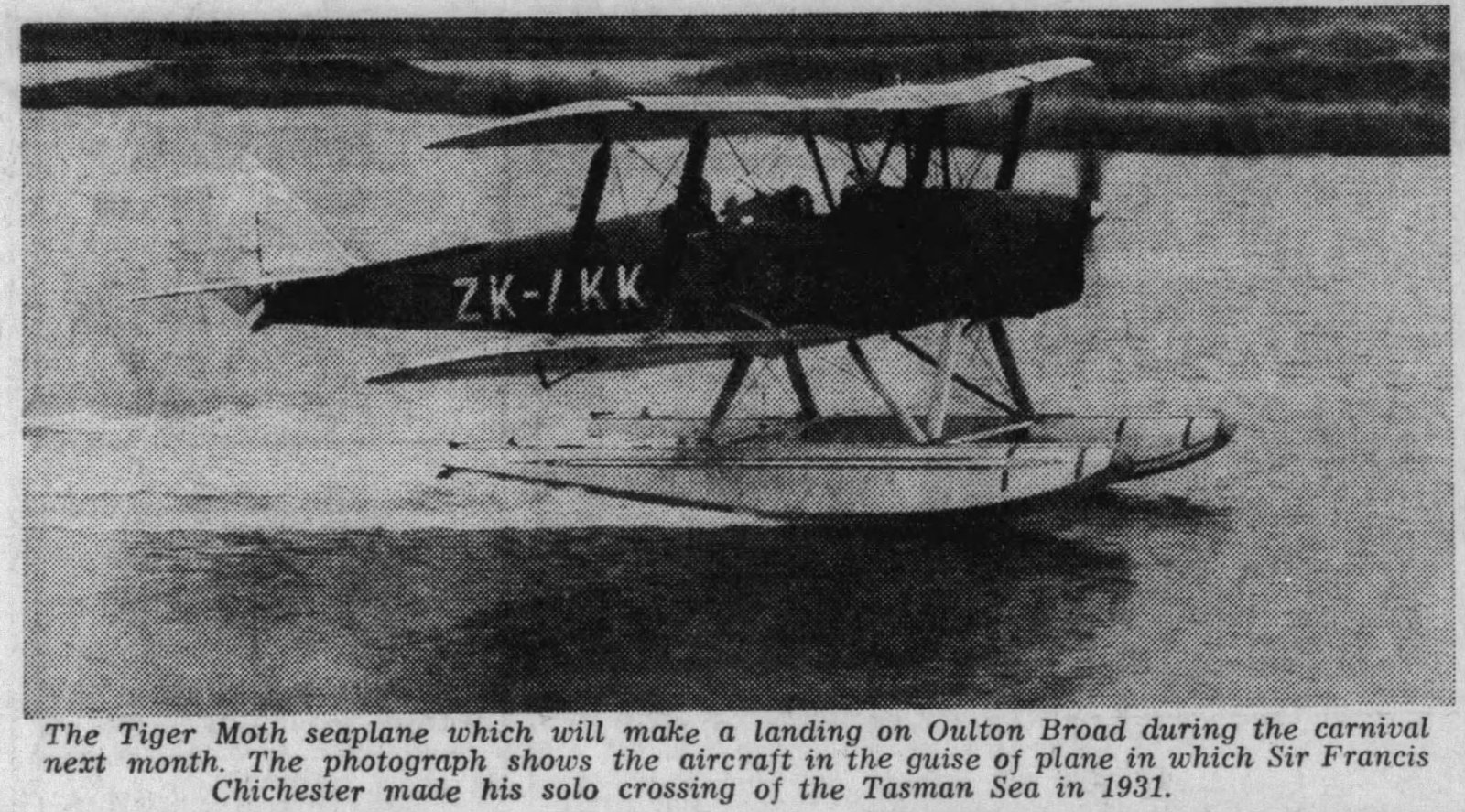
Aviator (and sailor) Sir Francis Chichester described seeing a "flying saucer" while flying from New Zealand to Australia over the Tasman Sea in 1931.
The main part of his sighting is described in his book The Lonely Sea and the Sky, 1964. (it's not mentioned again and doesn't seem to have been a big part of his memoirs).
https://www.metabunk.org/threads/in...zon-halos-sub-sun-sub-sundog.3253/#post-93892
The fact that he describes it vanishing and reappearing as the same shape makes me think could have been.
The main part of his sighting is described in his book The Lonely Sea and the Sky, 1964. (it's not mentioned again and doesn't seem to have been a big part of his memoirs).
However, in the paragraphs immediately before is a long descriptive passage about the rapidly changing conditions he faced in his seaplane (an adapted Gypsy Moth).External Quote:Suddenly, ahead and thirty degrees to the left, there were bright
flashes in several places, like the dazzle of a heliograph. I saw a dull
grey-white airship coming towards me. It seemed impossible, but I
could have sworn that it was an airship, nosing towards me like an
oblong pearl. Except for a cloud or two, there was nothing else in the
sky. I looked around, sometimes catching a flash or a glint, and turn-
ing again to look at the airship I found that it had disappeared. I
screwed up my eyes, unable to believe them, and twisted the seaplane
this way and that, thinking that the airship must be hidden by a blind
spot. Dazzling flashes continued in four or five different places, but I
still could not pick out any planes. Then, out of some clouds to my
right front, I saw another, or the same, airship advancing. I watched
it intently, determined not to look away for a fraction of a second: I'd
see what happened to this one, if I had to chase it. It drew steadily
closer, until perhaps a mile away, when suddenly it vanished. Then
it reappeared, close to where it had vanished: I watched with angry
intentness. It drew closer, and I could see the dull gleam of light on its
nose and back. It came on, but instead of increasing in size, it
diminished as it approached. When quite near, it suddenly became its
own ghost-one second I could see through it, and the next it had
vanished. I decided that it could only be a diminutive cloud, per-
fectly shaped like an airship and then dissolving, but it was uncanny
that it should exactly resume the same shape after it had once
vanished. I turned towards the flashes, but those too, had vanished.
All this was many years before anyone spoke of flying saucers. What-
ever it was I saw, it seems to have been very much like what people
have since claimed to be flying saucers.
It's not clear what his altitude was (maybe around 3,000ft). I wonder if he saw a sub sun, similar to that photographed in this thread:External Quote:
By the end of the second hour the wind had backed still more to the north, but still was driving the plane onwards. I had covered 217 miles, nearly half-way, in two hours. Again through the change of wind I had not corrected enough for drift, and was now twenty-five miles off course to the south. Every mile to the south added length to the flight, but it did not seem to make much odds in such perfect condi-tions. I changed course another ten degrees to northward.
Then came clouds, and I could see that I might be unable to get a sextant shot. I did not worry much at first-there did not seem much to worry about with a target 2,000 miles wide ahead. But the wind was increasing, and backing persistently. At 250 miles out the sky was completely shut off by dull grey, threatening cloud. I spurred myself to make some hurried drift observations; the wind had increased to fifty m.p.h. from the north-east, and the seaplane was forty-three miles off course to the south. With the drift, we were heading obliquely for the receding part of Australia. Forty-three miles off course seemed a lot, and I wished that I had not allowed it to build up so much. I changed course another ten degrees northwards.
At three hours out heavy rain stung my face. The drift to the south was becoming alarming; the wind had backed till it was now right in the north. I changed course another ten degrees to the north, which put the wind dead abeam. I dared not correct the drift more than that, or I should have made a head wind of the gale, which I sensed would destroy my chance of reaching the mainland. The seaplane was drifting forty degrees to the south, and moving half sideways over the water, like a crab. The rain became a downpour-I had forgotten that it could rain so heavily. I kept my head down as much as possible, but the water caught the top of my helmet, streamed down my face and poured down my neck. We seemed to strike a solid wall of water with a crash. I ducked my head, and from the corner of my eye I could see water leaving the trailing edge of the wings in a sheet, to be shattered instantly by the air blast. On either side of my head the water poured into the cockpit in two streams, which were scattered like windblown waterfalls and blew into my face. I was flying blind, as if in a dense cloud of smoke. I throttled back, and began a slanting dive for the water. Panic clutched me: if I got out of control, I would be too low to recover. But panic meant dying like a paralysed rabbit. I remember saying out loud, "Keep cool! Keep cool! K-e-e-p c-o-o-l!" The seaplane passed through small sudden bumps, which shook it violently. I looked over at the air speed indicator on the strut, but I could not see either the pointer or the figures in the smother of water. I had to make do with the rev indicator; if the revs increased, the dive
to find the surface of the sea, for I dared not try to climb blind. If I lost control and tried to spin out, the sea would not show up quickly enough to level off. I sat dead still, moving only my eyes from compass to rev indicator to vertically downwards over the cockpit edge. When the engine speed increased, I used the control-stick lightly with finger and thumb to ease up the plane's nose. There was more chance of the seaplane's flying itself level than of my keeping it level, flying blind. Thank God it was rigged true.
At last I saw a dull patch of water below the lower wing rushing up at me. I pushed the throttle, the engine misfired, and failed to pick up. I thrust the lever wide open as I flattened the seaplane out above the water; the engine spluttered, broke into an uneven rattle and back-fired intermittently; its roughness shaking the whole plane. But the plane kept up, and lumbered on. I concentrated on flying. The engine continued with an uneven tearing noise. The sea was only visible a plane's length ahead, where it merged in the grey wall of rainwater. I was flying in the centre of a hollow grey globe, with nothing to help me to keep level except the small patch where the globe rested on the sea.
I hugged every wave, rising or falling with it, and the seaplane jerked its way along. The water poured over my goggles, distorting my sight; it ran down my face and neck, and streams of it trickled down my chest, stomach and back. I dared not take my eyes off the water to look at the compass or the rev indicator. One thing helped me-the violence of the gale itself. Although the seaplane headed in one direc-tion, it was being blown sideways, so that it crabbed along half left, and I could see the next wave between the wings instead of its being hidden by the fuselage. I steered by the drift, keeping the angle of it constant. Otherwise I should have wandered aimlessly about the sea. There was a furious cross sea. Waves shot upward, to lick at the machine, but were slashed away bodily southwards by the wind. The tails of spume streaking south across the wave troughs enabled me to steer a straight course. I knew that I was flying as I had never flown before, but I also knew that I could not last long at that pace. At any moment I expected a muscle to lag, and the seaplane to strike a wave-crest. Suddenly I found myself flying straight into the water, and snatched back the stick to jump the seaplane's nose up, thinking my eye and hand had at last failed me. Then I realized that the rainfall had eased while I was in the trough between two rollers, and that the crest of the swell ahead had unshrouded above me. Next instant the seaplane shot into the open air. I rose 30 feet, and snatched the goggles up to my forehead. It seemed like 3,000 feet.
104
The compass showed that I was fifty-five degrees off course, headed to miss even Tasmania. That seemed strange, for I thought that I could fly accurately by the drift. I soon saw what had happened-the wind had backed another forty-five degrees, and was now north-west.
I had to think hard. I picked up the chart case on which my chart was rolled, but the soaked chart was useless. Before the storm I had been drifted so far south that I was right on the edge of the chart; during the storm I was blown farther south at the rate of a mile a minute, and was now far off it. I had a small map of Australia torn from a school atlas on the island. There was not enough sea area on it to show Lord Howe Island's position, but it was the only thing to use. Where was I before the storm? The position on the school map came right in the middle of a city plan of Sydney in the corner.
I flew up to another line squall ahead, parallel to the previous storm, and stretching from horizon to horizon, but I could see the water on the other side, as through a gauzy curtain. The rain was heavy, but the engine still carried on. We flew through the curtain of rain into an immense cavern of space between the illimitable vault of dull sky above, and the immeasurable floor of dull water below. It was solitary in that great space. Some slanting pillars of rain leaned against the wind, trailing across the dull floor of water like spirits of the dead drifting from the infernal regions. The vastness lent it all a nightmare air. In one place the vaulted ceiling bulged downwards with two black-cored squall clouds, each linked to the sea by a column of waterspout. Between the two columns another waterspout, a slender grey-white pillar was rising from the sea's surface. At a good height it burst at the top, like smoke expanding after an explosion. I flew straight towards it, fascinated. Suddenly the engine burst into a rough clatter again, and I realized that I must not fly near that thing; the disturbance capable of twisting it from the sea must be terrific.
I thought I saw land away to the north-west, purple foothills with a mountain range behind, but when I looked for it again later it had disappeared; land was still 160 miles away. At the foot of a great storm-cloud I saw smoke-a ship. It offered me a new lease of life, and I immediately turned towards it. It lay at the edge of the storm like a duck at the foot of a black cliff. I swooped down and read the name Kurow on the stern. It was an awesome sight. The bows slid out of one comber, and crashed into the next, to churn up a huge patch of seething water. When a cross swell struck her, she lurched heavily, slid into a trough and sank, decks awash, as if waterlogged; but wallowed out, rolling first on one beam and then the other, discharging water from her decks as though over a weir. There was no sign of life on
board, and I could not imagine anything less capable of helping me. I felt as if a door had been slammed in my face, turned and made off north-west to round the storm. I felt that I would rather go fifty miles out of my way than face another storm. I had been only four hours thirty-five minutes in the air: it seemed a lifetime.
Round the storm we flew into calm air under a weak hazy sun. I took out the sextant and got two shots. It took me thirty minutes to work them out, for the engine kept backfiring, and my attention wandered every time it did so. The sight in the end was not much use; the sun was too far west, but I got some self-respect from doing the job.
https://www.metabunk.org/threads/in...zon-halos-sub-sun-sub-sundog.3253/#post-93892
The fact that he describes it vanishing and reappearing as the same shape makes me think could have been.
Last edited:


