
Pfizer Building Buckled Columns

Mick West

Administrator
Staff member
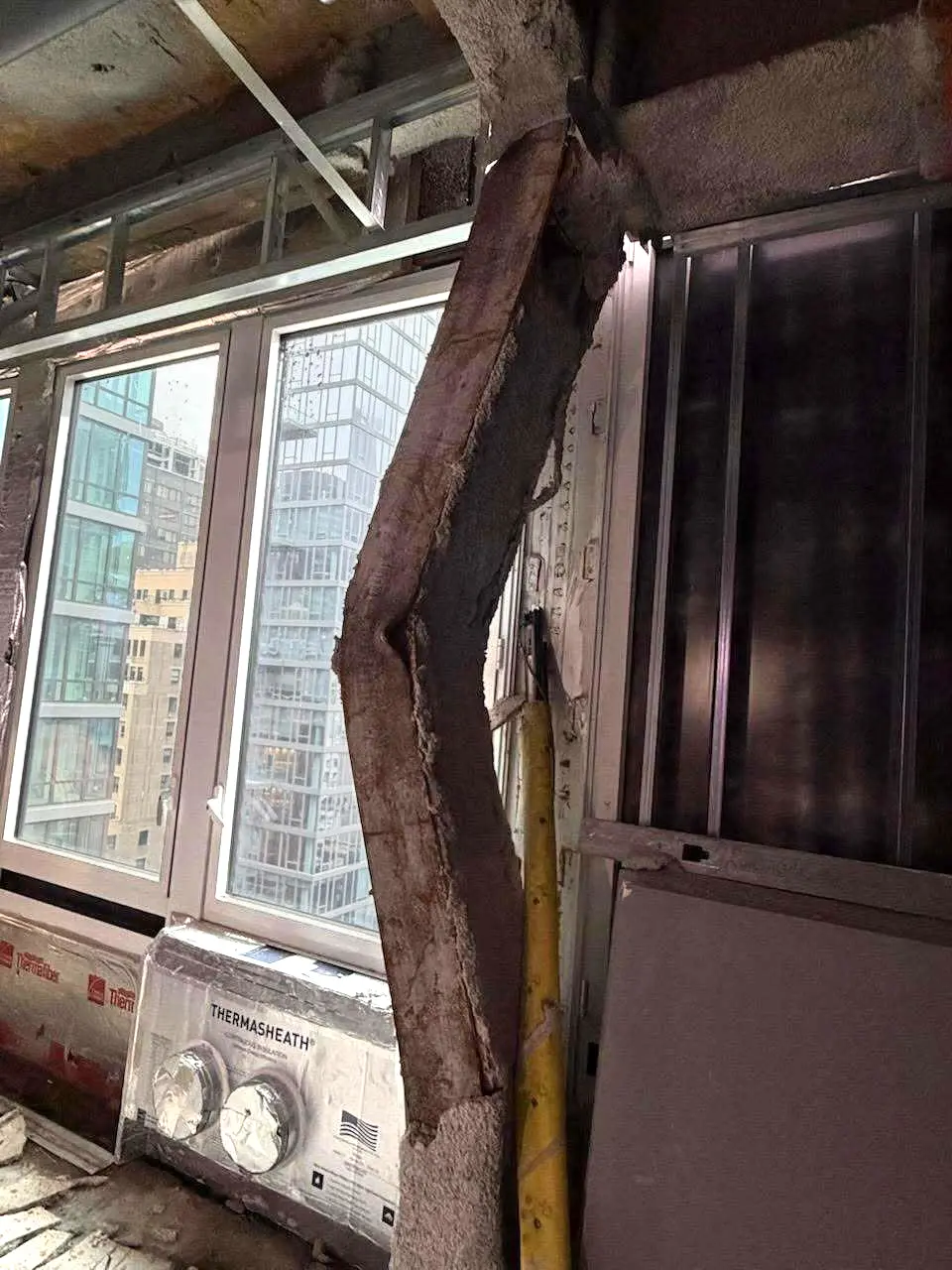
The old Pfizer building in New York is at risk of collapse after at least two structural columns buckled under the load of a building addition.
1783540595520.png


This is Metabunky for a couple of reasons, both grounded in 9/11 lore.

Firstly, if it does not collapse, or partially collapse, then it will be taken as a counterexample the WTC collapses, particulalry with statment like:

Article:
The Fire Department shared photos from the building on social media that showed missing paneling on the building facade and a vertical beam bent like an elbow. Fire officials said there was no risk of a full building collapse because of its steel-frame construction


So that's going to be interpreted as a statement that the WTC building should not have collapsed, as they were also "steel-frame construction". Of course, the towers suffered significantly more damage from the plane impacts, and, as designed, do not collapse from that damage.


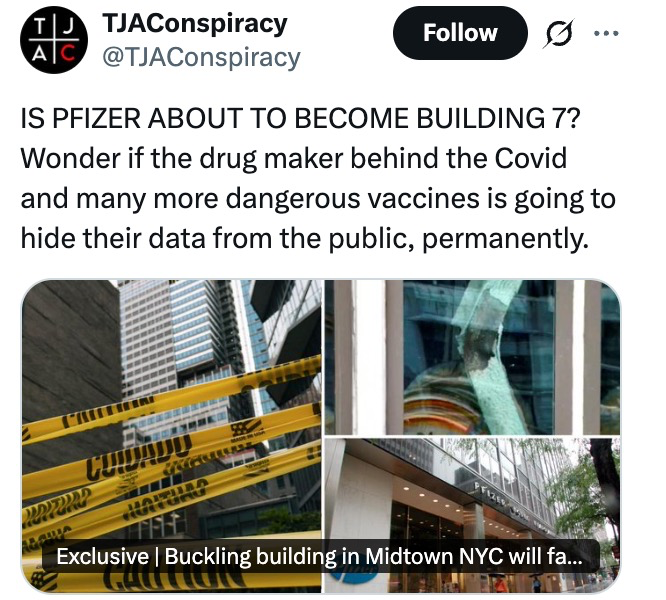
Secondly, but less likely to get traction, a few people are suggesting that the building is being deliberately destroyed to bury Pfizer's secrets, possibly regarding their COVID-19 vaccine. This reflects the belief that the destruction of WTC7 was to hide something. It's not at all clear how this would work.
1783540756767.png


The real reason is likely to be mundane, human error. But perhaps not without conspiracy, as there are already allegations that insufficient steel was used to support the new structure.

Article:
"The beams started bending," said Cliff Johnsen, the business agent for the Local 638 steamfitters union, which had workers on site. Several floors were sagging.

The building seemed to be crumbling fast, he said.

[Johnsen] said the incident was highly unusual, and he claimed that the builders had not used enough steel to support the weight of the additional floors. His claim could not be verified.

"That's not something you see," he said, noting the union's role in building Hudson Yards, the World Trade Center, Yankee Stadium, Madison Square Garden and Barclays Center.

Abi Aghayere, a professor of structural engineering at Drexel University, likened office-to-residential renovations to "structural gymnastics." During those intermediate stages, a lot of work would be happening in the building that could give rise to potential problems.

For example, beams that support columns that bear vertical loads might be moved. Those types of problems could emerge because of a faulty design or because of an error by the construction workers.


Looking at the top image, it seems like this is old steel. It's near the top floor of the old structure, so it seems weird that it would be expected to support a whole other building. Even if the load distribution calculations were correct, they assume specific values for the integrity of the old column. Those assumptions might not have been valid.
 
Only that beam knows the true sinister secrets of messenger ribonucleic acid.

Okay, wacky conspiracy theories aside, I was a little surprised at how casual the early reports on this were:
I mean, they made it sound like an easier fix that I'd have ever imagined.
[Not an argument from incredulity: The experts understand this 1,000% better than I ever will, and I respect
their expertise. It's just mind-blowing to me that severe structural failures 21 stories up a 37 story building, is repairable.]
 
The Pfizer Building has a wiki of course - https://en.wikipedia.org/wiki/Pfizer_Building

External Quote:
The Pfizer Building is a skyscraper on 42nd Street in the East Midtown neighborhood of Manhattan, New York City, New York, U.S. The structure consists of two formerly separate buildings at 219 and 235 East 42nd Street, which housed the pharmaceutical company Pfizer. The older building at 219 East 42nd Street, completed in 1905, was originally a 10-story building. The building at 235 East 42nd Street, designed by Emery Roth & Sons in the International Style, was constructed in 1960 and has 33 stories.
It's older than I thought.
 
I agree, the crumpling column looks like very old steel indeed. Commentary from union workers about the contractors use of non-union people:
External Quote:

The steamfitter union tasked with working on the old Pfizer building blamed contractors for putting "profit over safety" when the building's top floors caved in on themselves.

"If it weren't for trained union steamfitters who recognized a dangerous situation and followed the proper safety protocol, thousands of construction workers and residents could have been hurt or killed," Steamfitters Local 638 wrote on social media.
Cliff Johnson of Steamfitters Local 638, who was working inside the building, told PIX11 News that his members were inside when the structure began to fail.
......
"The general contractor chose to go non‑union for this project. All we want is responsible construction in the City of New York," Johnson said. "They did not shore up the job correctly. The beams started crumbling, the floors started crumbling, and they might have to evacuate the other side."
https://www.msn.com/en-us/news/us/u...rs-could-have-been-hurt-or-killed/ar-AA27qprJ
 
I was a little surprised at how casual the early reports on this were:
I mean, they made it sound like an easier fix that I'd have ever imagined.
I think much of the downplaying comes from MetroLoft, who obviously don't want negative press.

Article:
Nathan Berman, the managing principal and founder of MetroLoft, one of the two firms behind the conversion, said he expected a delay of only a few weeks. He said the problems amounted to a "typical construction mishap."


A delay of a few weeks sounds like rather a lot. That's a preliminary number; they still have to figure out exactly what happened and why. Looking at those columns, I wouldn't be going into that building before the report is out (and any problems remediated)
 
I think much of the downplaying comes from MetroLoft, who obviously don't want negative press.

Article:
Nathan Berman, the managing principal and founder of MetroLoft, one of the two firms behind the conversion, said he expected a delay of only a few weeks. He said the problems amounted to a "typical construction mishap."


A delay of a few weeks sounds like rather a lot. That's a preliminary number; they still have to figure out exactly what happened and why. Looking at those columns, I wouldn't be going into that building before the report is out (and any problems remediated)
Again, I'm certainly no architectural engineer, but, for God sakes, you've got the weight of 15 floors pressing down
on the trouble spot. It seems like a herculean task to make the fix with that pressure.

That said, I think you're right to "consider the source."
Still, I would definitely wager that this will not be wrapped up within "a few weeks."
 
Article:
Hours after city officials warned of an "extremely dangerous situation" at the in-progress conversion of the former office property, Nathan Berman of MetroLoft said in an interview with The Real Deal that reports of the building's impending collapse have been "blown a little bit out of proportion," adding that despite videos of sagging upper floors and buckled support columns, the building "was never at risk of collapse" and the issues are "fixable."

Berman disputed a claim made earlier in the day by Cliff Johnsen of Steamfitters Local 638, who told reporters that the builders had not used enough steel to support the added weight.

"Total nonsense. This was well designed, and approved by structural engineers," said Berman. "This is a freak accident that something occurred with these two specific columns that either were not reinforced or were not reinforced sufficiently, and they gave way. That's it. There's no mystery, and there's no magic."

Berman said the added weight during construction likely led to columns bending. "It's very simple," said Berman. "You add more load to something that can't support it, it'll give way, and that's what happened, and now it just needs to be fixed."

...

"When you add more floor area, you do this according to certain plans, which we have, and then those plans were approved by the building department, but mistakes sometimes happen, or sometimes you run into a faulty column, which may have been cracked before, and it went undetected," said Berman.


This seems pretty ridiculous to me. There seem to be fundamental issues of safety that are being glossed over. Like, hey, sometimes columns fail, no big deal!
 
Article:
Hours after city officials warned of an "extremely dangerous situation" at the in-progress conversion of the former office property, Nathan Berman of MetroLoft said in an interview with The Real Deal that reports of the building's impending collapse have been "blown a little bit out of proportion," adding that despite videos of sagging upper floors and buckled support columns, the building "was never at risk of collapse" and the issues are "fixable."

Berman disputed a claim made earlier in the day by Cliff Johnsen of Steamfitters Local 638, who told reporters that the builders had not used enough steel to support the added weight.

"Total nonsense. This was well designed, and approved by structural engineers," said Berman. "This is a freak accident that something occurred with these two specific columns that either were not reinforced or were not reinforced sufficiently, and they gave way. That's it. There's no mystery, and there's no magic."

Berman said the added weight during construction likely led to columns bending. "It's very simple," said Berman. "You add more load to something that can't support it, it'll give way, and that's what happened, and now it just needs to be fixed."

...

"When you add more floor area, you do this according to certain plans, which we have, and then those plans were approved by the building department, but mistakes sometimes happen, or sometimes you run into a faulty column, which may have been cracked before, and it went undetected," said Berman.


This seems pretty ridiculous to me. There seem to be fundamental issues of safety that are being glossed over. Like, hey, sometimes columns fail, no big deal!
At this point Berman is just making things up. There has not been enough time for them to examine the entire structure at the level where the failure occurred or the structure above and below that point. Then examine the rest of the structure. There needs to be a clearly determined cause for why this happened before you can determine what to do next.

I recommend the book "Why Buildings Fall Down" by Matthys Levy and Mario Salvadori. Very interesting, with case studies of a bunch of building failures and the final determination of why they failed, it's not just because they got tired. In HINDSIGHT the reasons where clear, and in some cases it took a long time to determine.
 
Pahhh! Just mucking up the concrete composition for the base slab at Okiluoto-3 delayed construction about 5 months (Oct 2005-Apr 2006 according to the post-mortem https://stuk.fi/documents/150192312...a-3372-cf69-761a-4d181e3df0f8?t=1717669400426 pp.6-28) And that could be considered a short time compared to the other 12+ years of delays. It's all relative.
They built the 60-story Hancock building in Boston. Shortly after, its huge windows started crashing down in the street on windy days, which led to it being called the "plywood palace" and required alterations to every single window. I visited a company across the river in Cambridge, which had an enormous wind tunnel. There was a model of downtown Boston and the city required wind-testing for new tall construction, both to see if it could withstand the wind and to determine what effects a new building would have on the wind flow around other existing structures.
 
If nothing else. these pictures might be useful to show to the "jetfuel can't melt steel beams" crowd... apparently the jet fuel is not necessary if the load is sufficient...
In this case, the load was increased via the additional construction: sometimes the simple act of storing the construction materials in the wrong place can overload a building.

In the WTC towers, there was no additional load; instead, some supports were removed by the airplane impact, shifting the loads they had supported elsewhere; and then the fire weakened floor supports which sagged, pulled the facade inward, and caused it to buckle.
 
Little to add apart from there being a few more shots of the interior in this summarised BBC news segment:
https://www.bbc.co.uk/news/videos/c7vygmmdyr8o

TBH, at the moment the only thing that interests me about this is the accountability aspects to this - who signed off on what. Will heads roll, as clearly mistakes were made (which, however, might be endemic).
 
So that's going to be interpreted as a statement that the WTC building should not have collapsed, as they were also "steel-frame construction". Of course, the towers suffered significantly more damage from the plane impacts, and, as designed, do not collapse from that damage.
As I predicted:

Source: https://x.com/RichardGage_911/status/2075262640058998856

External Quote:

[RG911Team] They let the cat out of the bag.

The FDNY Chief just admitted what really happens to steel skyscrapers when columns fail.

And in doing so, he exposed the 9/11 narrative as an outright lie.

Under no circumstances can a local column failure cause the complete collapse of a steel-framed, fire-resistant skyscraper.

This could not happen to the Pfizer building in Manhattan a few days ago, and it could not happen to WTC Building 7 in Manhattan on September 11, 2001.

A local failure causes local collapse, not global collapse, because the network of steel columns throughout the building prevents the failure from propagating to other structurally sound parts of the building.

In other words, steel skyscrapers are not houses of cards.

So, when NIST claimed that the failure of one column in Building 7 caused a cascade of failures that brought down the entire building on 9/11, they are violating the laws of physics.

They know this.

But for them, maintaining scientific integrity is not as important as covering up the truth.

Great find by
@911Gene
 
Despite Berman's (of MetroLoft) shockingly casual:
"It's less than 1%, a fraction of the building. It's frankly not a major issue for us at all,"
if I were an inspector, I think I'd be saying: "Hey, let's try out our new drone camera!"
 
External Quote:

This could not happen to the Pfizer building in Manhattan a few days ago, and it could not happen to WTC Building 7 in Manhattan on September 11, 2001.

A local failure causes local collapse, not global collapse, because the network of steel columns throughout the building prevents the failure from propagating to other structurally sound parts of the building.
Oooh, building 7. The one where fire raged across two floors for hours until the building eventually collapsed.

Richard, I propose you add back some fire loads to the Pfizer buildig—two storeys of office furniture, paper, and ceiling tiles should do—, disable the sprinkler system, and set it ablaze. Then place yourself on the ground floor and wait for the fires to go out. (Do not try this at home!)

There are at least 4 different studies proposing ways for building 7 to have collapsed. It definitely could happen, and it did happen.
 
Last edited:
Despite Berman's (of MetroLoft) shockingly casual:
"It's less than 1%, a fraction of the building. [...]

I'm waiting for a comment by a controlled demolition guy. If they hadn't noticed, the controlled demolition guys never blow up the whole building.
 

Latest posts

Trending content

Back
Top