
HappyMonday
Active Member
How conspiracy theorists work 101...
Last edited by a moderator:



Classified, have you really given much thought about what a barium compound would do to a jet engine. I am talking about more that trace amounts, enough to seed the atmosphere for geo-engineering...
Barium would destroy it rapidly, the metals would fuse to the fan blades making them imbalanced and destroy the engine. The inter-turbine of a jet engine (N2), spins at over 30,000 rpm, the slightest imbalance is detrimental.
http://en.wikipedia.org/wiki/Barium
Barium melts at approximately 730 degrees C, a jet engine at cruise altitude/cruise power operates at approximately 750-950 degrees C.
I am very curious how one would get past this problem.
It seems to me you have no more facts to provide and you are now arguing semantics.
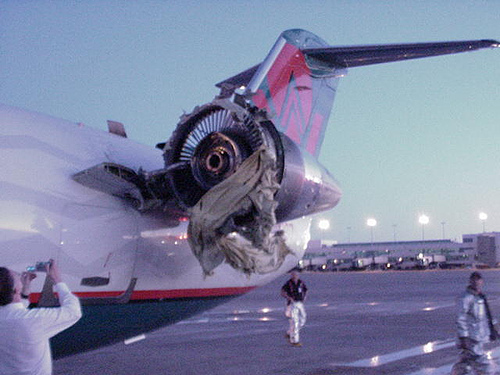
I thought we'd been down this road before? Perhaps Classified wants to see what happens when a GE, Rolls or Pratt and Whitney tosses a blade?


What is your main point? Why were you inquiring about barium in jet fuel to begin with? What do you think is the importance, significance, or effect of the trace amounts that can be found in jet fuel?I never claimed barium was added to jet fuel. I provided several gov links stating jet fuel as a source of barium, at which point Mick said these were mistakes.
Then he provided data showing barium naturally occurring in jet fuel. So I am still confused why I cant get a straight answer about anything here.
First the barium sources were mistakes, next contrail cirrus do not affect the weather, and then they do according to the glider pilot, and finally Mick states that the overall contrail warming effect is not as important as lowering Co2 emissions.
This is a debunking debacle.
I never claimed barium was added to jet fuel. I provided several gov links stating jet fuel as a source of barium, at which point Mick said these were mistakes.
Then he provided data showing barium naturally occurring in jet fuel. So I am still confused why I cant get a straight answer about anything here.
First the barium sources were mistakes, next contrail cirrus do not affect the weather, and then they do according to the glider pilot, and finally Mick states that the overall contrail warming effect is not as important as lowering Co2 emissions.
This is a debunking debacle.
I have to ask the obvious: At the concentrations documented does it MATTER if there is barium in jet fuel?

So why is barium in jet fuel?
http://www.atsdr.cdc.gov/toxguides/toxguide-24.pdfExternal Quote:Barium and compounds are used in oil and gas drilling muds, automotive paints, stabilizers for plastics, case hardening steels, bricks, tiles, lubricating oils, and jet fuel as well as in various types of pesticides.
This was your original question. You got more information here than is available at any chemtrails site, yet you seem dissatisfied. It almost seems like you came here intending to be dissatisfied. Frankly, I don't care because you don't seem to care yourself. You won't even respond when asked a very simple question which you should have answered yourself which is how much barium would be present in the atmosphere naturally. That is yet another question which should easily be available at chemtrail sites but is not.
You might think you are being cute. I think you are simply a wastrel of our time.
The nice thing is that, regardless of the intent or behavior of the OP, in the process of examining the question we gained some good information. Although it was unlikely that barium was being added to jet fuel, I don't know how many of us had tried to find out before if there was any barium to be found in it. Now when someone else brings up the question, we can say: yes, there is a trace amount of barium in jet fuel, much like there is in the gasoline you put in your car.It seems every time someone comes on this site to test the debunkers, I learn a little bit (sometimes a lot). With that said, I don't see any of this as a waste of time; however, it does reaffirm my efforts to debunk chemtrails.
It seems this debunk (argument) is over...


Now when someone else brings up the question, we can say: yes, there is a trace amount of barium in jet fuel, much like there is in the gasoline you put in your car.

I never claimed barium was added to jet fuel. I provided several gov links stating jet fuel as a source of barium, at which point Mick said these were mistakes.
Then he provided data showing barium naturally occurring in jet fuel. So I am still confused why I cant get a straight answer about anything here.
First the barium sources were mistakes, next contrail cirrus do not affect the weather, and then they do according to the glider pilot, and finally Mick states that the overall contrail warming effect is not as important as lowering Co2 emissions.
This is a debunking debacle.
I want to know what effects contrails and jets are having on the atmosphere, and why these contrail cirrus clouds are considered water, or just an eye sore, rather than the unintentional weather modification and source of global warming that they are. I have posted several studies showing an overall positive temp change yet there are still people claiming contrails do not warm the planet.
I do not know how much barium is naturally present in the atmosphere, but is it possible for trace amounts to eventually build to higher levels, extending damage to the atmosphere?
I want to know what effects contrails and jets are having on the atmosphere, and why these contrail cirrus clouds are considered water, or just an eye sore, rather than the unintentional weather modification and source of global warming that they are. I have posted several studies showing an overall positive temp change yet there are still people claiming contrails do not warm the planet.
I do not know how much barium is naturally present in the atmosphere, but is it possible for trace amounts to eventually build to higher levels, extending damage to the atmosphere?
- There was a question as to if barium is in jet fuel, your question: "So why is barium in jet fuel?"
- CDC docs said that barium is USED in jet fuel
- Myself and others said this has to be a mistake, as there's no known USE for barium in jet fuel
- Old research was uncovered that suggests that it was briefly experimented with 40 years ago, and this crept into the literature
- Test results show that barium, like all natural metals, naturally exists in jet fuel in normal background levels, just like it exists in blood, or gasoline.
I want to know what effects contrails and jets are having on the atmosphere, and why these contrail cirrus clouds are considered water, or just an eye sore, rather than the unintentional weather modification and source of global warming that they are. I have posted several studies showing an overall positive temp change yet there are still people claiming contrails do not warm the planet.
I do not know how much barium is naturally present in the atmosphere, but is it possible for trace amounts to eventually build to higher levels, extending damage to the atmosphere?
Yes your explanation is sufficient Mick, that there is no barium added to jet fuel currently, but it has been used previously and it naturally occurs now.
Also I did not start this thread, Mick moved my comments here from the case orange debunked thread.
Yes your explanation is sufficient Mick, that there is no barium added to jet fuel currently, but it has been used previously and it naturally occurs now.
Also I did not start this thread, Mick moved my comments here from the case orange debunked thread.
"but it has been used previously", keeping in mind, the barium was not used in the jet fuel, but in a separate system within the engine, and it was not metallic/elemental barium. and only in test/experiment equipment;]
Yes your explanation is sufficient Mick, that there is no barium added to jet fuel currently, but it has been used previously and it naturally occurs now.
"but it has been used previously", keeping in mind, the barium was not used in the jet fuel, but in a separate system within the engine, and it was not metallic/elemental barium. and only in test/experiment equipment;]
I want to know what effects contrails and jets are having on the atmosphere, and why these contrail cirrus clouds are considered water, or just an eye sore, rather than the unintentional weather modification and source of global warming that they are. I have posted several studies showing an overall positive temp change yet there are still people claiming contrails do not warm the planet.
I do not know how much barium is naturally present in the atmosphere, but is it possible for trace amounts to eventually build to higher levels, extending damage to the atmosphere?
After reviewing the indirect evidence for the regional climatic impact of contrail-generated cirrus clouds (contrail-cirrus), the author presents a variety of new measurements indicating the nature and scope of the problem. The assessment concentrates on polarization lidar and radiometric observations of persisting contrails from Salt Lake City, Utah, where an extended Project First ISCCP (International Satellite Cloud Climatology Program) Regional Experiment (FIRE) cirrus cloud dataset from the Facility for Atmospheric Remote Sensing has captured new information in a geographical area previously identified as being affected by relatively heavy air traffic. The following contrail properties are considered: hourly and monthly frequency of occurrence; height, temperature, and relative humidity statistics; visible and infrared radiative impacts; and microphysical content evaluated from in situ data and contrail optical phenomenon such as halos and coronas. Also presented are high-resolution lidar images of contrails from the recent SUCCESS experiment, and the results of an initial attempt to numerically simulate the radiative effects of an observed contrail. The evidence indicates that the direct radiative effects of contrails display the potential for regional climate change at many midlatitude locations, even though the sign of the climatic impact may be uncertain. However, new information suggests that the unusually small particles typical of many persisting contrails may favor the albedo cooling over the greenhouse warming effect, depending on such factors as the geographic distribution and patterns in day versus night aircraft usage.
[h=2]Cited by[/h]U. Schumann, B. Mayer, K. Graf, H. Mannstein. (2012) A Parametric Radiative Forcing Model for Contrail Cirrus.Journal of Applied Meteorology and Climatology 51:7, 1391-1406
Online publication date: 1-Jul-2012.
Abstract . Full Text . PDF (2560 KB)
U. Schumann, B. Mayer, K. Gierens, S. Unterstrasser, P. Jessberger, A. Petzold, C. Voigt, J-F. Gayet. (2011) Effective Radius of Ice Particles in Cirrus and Contrails. Journal of the Atmospheric Sciences 68:2, 300-321
Online publication date: 1-Feb-2011.
Abstract . Full Text . PDF (1750 KB)
J. J. Curto, E. Also, E. Pallé, J. G. Solé. (2009) Sunshine and synoptic cloud observations at Ebro Observatory, 1910-2006.International Journal of Climatology 29:14, 2183-2190
Online publication date: 30-Nov-2009.
CrossRef
Ulrike Burkhardt, Bernd Kärcher. (2009) Process-based simulation of contrail cirrus in a global climate model. Journal of Geophysical Research 114:d16, D16201
CrossRef
Andrew M. Carleton, David J. Travis, Kara Master, Sajith Vezhapparambu. (2008) Composite Atmospheric Environments of Jet Contrail Outbreaks for the United States. Journal of Applied Meteorology and Climatology 47:2, 641-667
Online publication date: 1-Feb-2008.
Abstract . Full Text . PDF (5170 KB)
Gang Hong, Ping Yang, Patrick Minnis, Yong X. Hu, Gerald North. (2008) Do contrails significantly reduce daily temperature range?. Geophysical Research Letters 35:23, L23815
CrossRef
Amanda Gounou, Robin J. Hogan. (2007) A Sensitivity Study of the Effect of Horizontal Photon Transport on the Radiative Forcing of Contrails. Journal of the Atmospheric Sciences 64:5, 1706-1716
Online publication date: 1-May-2007.
Abstract . Full Text . PDF (921 KB)
David J. Travis, Andrew M. Carleton, Jeffrey S. Johnson, James Q. DeGrand. (2007) US jet contrail frequency changes: influences of jet aircraft flight activity and atmospheric conditions. International Journal of Climatology 27:5, 621-632
Online publication date: 1-Apr-2007.
CrossRef
Prem Lobo, Donald E. Hagen, Philip D. Whitefield, Darryl J. Alofs. (2007) Physical Characterization of Aerosol Emissions from a Commercial Gas Turbine Engine. Journal of Propulsion and Power 23:5, 919
CrossRef
David Atlas, Zhien Wang, David P. Duda. (2006) Contrails to Cirrus—Morphology, Microphysics, and Radiative Properties. Journal of Applied Meteorology and Climatology 45:1, 5-19
Online publication date: 1-Jan-2006.
Abstract . Full Text . PDF (1002 KB)
Patrick Minnis, Yuhong Yi, Jianping Huang, Kirk Ayers. (2005) Relationships between radiosonde and RUC-2 meteorological conditions and cloud occurrence determined from ARM data. Journal of Geophysical Research 110:d23, D23204
CrossRef
A. O. Langford, R. W. Portmann, J. S. Daniel, H. L. Miller, C. S. Eubank, S. Solomon, E. G. Dutton. (2005) Retrieval of ice crystal effective diameters from ground-based near-infrared spectra of optically thin cirrus. Journal of Geophysical Research 110:d22, D22201
CrossRef
David P. Duda, Patrick Minnis, Louis Nguyen, Rabindra Palikonda. (2004) A Case Study of the Development of Contrail Clusters over the Great Lakes. Journal of the Atmospheric Sciences 61:10, 1132-1146
Online publication date: 1-May-2004.
Abstract . Full Text . PDF (562 KB)
Patrick Minnis, J. Kirk Ayers, Rabindra Palikonda, Dung Phan. (2004) Contrails, Cirrus Trends, and Climate. Journal of Climate 17:8, 1671-1685
Online publication date: 1-Apr-2004.
Abstract . Full Text . PDF (540 KB)
David J. Travis, Andrew M. Carleton, Ryan G. Lauritsen. (2004) Regional Variations in U.S. Diurnal Temperature Range for the 11–14 September 2001 Aircraft Groundings: Evidence of Jet Contrail Influence on Climate. Journal of Climate17:5, 1123-1134
Online publication date: 1-Mar-2004.
Abstract . Full Text . PDF (1025 KB)
Patrick Minnis, J. Kirk Ayers, Michele L. Nordeen, Steven P. Weaver. (2003) Contrail Frequency over the United States from Surface Observations. Journal of Climate 16:21, 3447-3462
Online publication date: 1-Nov-2003.
Abstract . Full Text . PDF (567 KB)
S. Marquart, M. Ponater, F. Mager, R. Sausen. (2003) Future Development of Contrail Cover, Optical Depth, and Radiative Forcing: Impacts of Increasing Air Traffic and Climate Change. Journal of Climate 16:17, 2890-2904
Online publication date: 1-Sep-2003.
Abstract . Full Text . PDF (865 KB)
David J. Travis, Andrew M. Carleton, Ryan G. Lauritsen. (2002) Climatology: Contrails reduce daily temperature range.Nature 418:6898, 601-601
Online publication date: 8-Aug-2002.
CrossRef
Lisheng Xu, Jilie Ding, Andrew Y. S. Cheng. (2002) Scattering Matrix of Infrared Radiation by Ice Finite Circular Cylinders. Applied Optics 41:12, 2333
Online publication date: 20-Apr-2002.
CrossRef
Jilie Ding, Lisheng Xu. (2002) Light scattering characteristics of small ice circular cylinders in visible, 1.38-μm, and some infrared wavelengths. Optical Engineering 41:9, 2252
Online publication date: 1-Jan-2002.
CrossRef
Michael Ponater. (2002) Contrails in a comprehensive global climate model: Parameterization and radiative forcing results.Journal of Geophysical Research 107:d13, 4164
CrossRef
Jennifer M. Comstock, Kenneth Sassen. (2001) Retrieval of Cirrus Cloud Radiative and Backscattering Properties Using Combined Lidar and Infrared Radiometer (LIRAD) Measurements. Journal of Atmospheric and Oceanic Technology18:10, 1658-1673
Online publication date: 1-Oct-2001.
Abstract . Full Text . PDF (693 KB)
Kenneth Sassen, Jennifer M. Comstock. (2001) A Midlatitude Cirrus Cloud Climatology from the Facility for Atmospheric Remote Sensing. Part III: Radiative Properties. Journal of the Atmospheric Sciences 58:15, 2113-2127
Online publication date: 1-Aug-2001.
Abstract . Full Text . PDF (238 KB)
Kenneth Sassen, Jennifer M. Comstock, Zhien Wang. (2001) Parameterization of the radiative properties of midlatitude high and middle level clouds. Geophysical Research Letters 28:4, 729
Online publication date: 1-Jan-2001.
CrossRef
Gunnar Myhre, Frode Stordal. (2001) On the tradeoff of the solar and thermal infrared radiative impact of contrails.Geophysical Research Letters 28:16, 3119
Online publication date: 1-Jan-2001.
CrossRef
W. L. Smith, S. Ackerman, H. Revercomb, H. Huang, D. H. DeSlover, W. Feltz, L. Gumley, A. Collard. (1998) Infrared spectral absorption of nearly invisible cirrus clouds. Geophysical Research Letters 25:8, 1137
Online publication date: 1-Jan-1998.
CrossRef
Kenneth Sassen, Vitaly I. Khvorostyanov. (1998) Radar probing of cirrus and contrails: Insights from 2D model simulations. Geophysical Research Letters 25:7, 975
Online publication date: 1-Jan-1998.
CrossRef
David J. Hofmann, Robert S. Stone, Matthew E. Wood, Terry Deshler, Joyce M. Harris. (1998) An analysis of 25 Years of balloonborne aerosol data in search of a signature of the subsonic commercial aircraft fleet. Geophysical Research Letters 25:13, 2433
Online publication date: 1-Jan-1998.
CrossRef
K. N. Liou, P. Yang, Y. Takano, K. Sassen, T. Charlock, W. Arnott. (1998) On the radiative properties of contrail cirrus.Geophysical Research Letters 25:8, 1161
Online publication date: 1-Jan-1998.
CrossRef
Vitaly Khvorostyanov, Kenneth Sassen. (1998) Cloud model simulation of a contrail case study: Surface cooling against upper tropospheric warming. Geophysical Research Letters 25:12, 2145
Online publication date: 1-Jan-1998.
CrossRef
Kenneth Sassen, Ching‐yu Hsueh. (1998) Contrail properties derived from high‐resolution polarization lidar studies during SUCCESS. Geophysical Research Letters 25:8, 1165
Online publication date: 1-Jan-1998.
CrossRef
Michael I. Mishchenko, Kenneth Sassen. (1998) Depolarization of lidar returns by small ice crystals: An application to contrails. Geophysical Research Letters 25:3, 309
Online publication date: 1-Jan-1998.
CrossRef
And I think the bottom line there is: more research needed.

Yes your explanation is sufficient Mick, that there is no barium added to jet fuel currently, but it has been used previously and it naturally occurs now.
Exactly; something so complex to model as global climate change requires intense study of many factors involved. Contrail-created cirrus clouds are just one subject where they are not quite yet sure the total implications to global climate change.
External Quote:Your comment would be expected given your profile avatar. You never cease to amaze me with your intellect.
http://journals.ametsoc.org/doi/abs/10.1175/1520-0477(1997)078<1885:CCATPF>2.0.CO;2
Just a few to get you started.
[/FONT][/COLOR]

Lets take a look at something a little more recent than the 97' AMS study.
This work is two pronged, discussing 1) the morphology of contrails and their transition to cirrus uncinus, and 2) their microphysical and radiative properties.... The synthesis of these findings with those of prior investigators provides confidence in the present results. Various authors find that contrail-generated cirrus such as reported here contribute to net regional warming.
An overview of global climate changing in current scenario and mitigation action
Pragya Nemaa,∗, Sameer Nemab, Priyanka Roya
a Electrical Engineering Department, Netaji Subhash Engineering College, Kolkata, W.B. 7000115, India
b Lafarge A&C, Kolkata, India
a r t i c l e i n f o
Article history:
Received 24 August 2011
Received in revised form 10 January 2012
Accepted 11 January 2012
Available online 23 February 2012
Are you suggesting that abstract is from the paper you listed?? Because its not- the abstract is from this paper:
http://journals.ametsoc.org/doi/abs/10.1175/JAM2325.1
Yes you are correct, I grabbed the wrong link.
External Quote:We may summarize the various studies as follows:
These estimates are based upon the work of Minnis et al. (1998), Ponater et al. (2002), Palikonda et al. (2002), and Minnis et al. (2004). The latter authors also project an aircraft scenario for 2050 that would produce a regional radiative forcing of 1.5 W m−2 over Europe, a global coverage of 0.5%, and a radiative forcing of 0.05 W m−2. In short, the present-day effects are significant regionally but in the noise globally. Further research is necessary to assess factors such as the amount of cirrus that is initiated by the contrails but not distinguishable from natural cirrus.
- regional effects in the 1990s in the United States and Europe have a cover of 0.5%–2% with a maximum over Europe of 0.35%, and warming of 0.1–0.2 W m−2, and
- global effects that are about 0.1 of the regional values.
Are we off barium as a subject now, and onto whether or not contrail-cirrus affects weather or climate??


If you beleive in the conspiracy then by definition you already believe the Govt isn't perfect - why can't they make a mistake like this?
As I said - I can find no evidence of barium in jet fuel - the usual material quoted as including it is Stadis 450 (lots of chemtrail sites mention it) but it appears to not actually include barium, and I can find no other reference to barium in jet fuel, either as an additive or in any other context.
So given that I HAVE done some research, and cannot find any evidence of Barium in jet fuel, why would I not suggest it is in error?
If you think I am wrong how about doing some research yourself and providing some information to support that conclusion? I'm hapy to admit I'm wrong if there's evidence of it.
What we can actually debunk is stuff that can be debunked - and in this case it happens to be a .govt webstite - debunking is not limited to loony conspiracy theories!
So why is barium in jet fuel?
http://www.atsdr.cdc.gov/toxguides/toxguide-24.pdfExternal Quote:Barium and compounds are used in oil and gas drilling muds, automotive paints, stabilizers for plastics, case hardening steels, bricks, tiles, lubricating oils, and jet fuel as well as in various types of pesticides.


