Origin of iconic alien face?

It'd be interesting if there were lots of these, but only looks like 2 well known examples, and this one seems like a real stretch to me.

Paranormal investigators 'crack Da Vinci Code and find aliens in Mona Lisa:
https://www.irishmirror.ie/news/weird-news/paranormal-investigators-crack-da-vinci-5664332


greye.JPG


Someone get Robert Langdon on the message board.
 
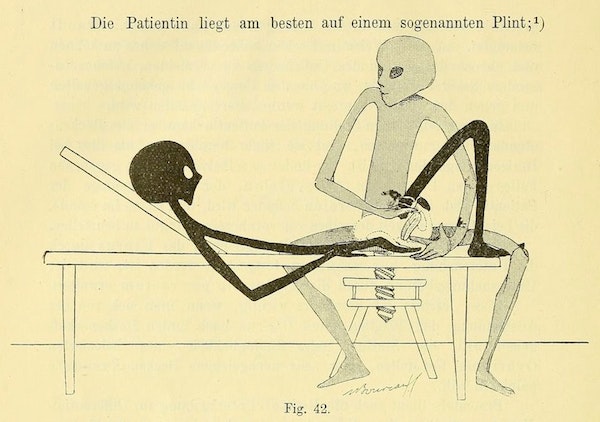
From a late-1800s German gynecological exercise guide:
20881324291_a08debb46f_o.jpg

The images in this particular text are eye-catching today less for the gynecological technique they depict but more the bizarre similarity between the rakishly thin figures employed in demonstrating the exercises (no doubt an attempt to de-sexualise the images) and the figure of the so-called "Grey Alien" - thin body, huge head, large eyes - which wouldn't hit popular consciousness for another 65 years.
Source: https://publicdomainreview.org/collection/gynecological-gymnastics-from-outer-space-1895/

I'm not saying this is the origin, but it's pretty trippy.

(edit: I have butterfingers and posted too early :) )
 
From a late-1800s German gynecological exercise guide:

Maybe an early Grey scouting expedition retrieved this one book,
and they interpreted it as advice about how they were meant to introduce themselves to humans... :)

That would help explain the rather strange and undignified "investigations" that some abductees report
(which make little scientific sense, unless the alien's knowledge of medical imaging etc. is far inferior to ours).

They're aren't performing examinations- -they're just saying "hello" :eek:
 
I've tried looking for proto-Greys on American pulp SF magazine covers (and some later magazines) online.
While many of these magazines (roughly from the 30's to 50's) would have had relatively small circulations, they must have been eye-catching additions to newsstands and stores across the country.

Elsewhere on Metabunk we've seen examples of disc- and spherical- shaped spacecraft on pulp covers that pre-date the first "acknowledged" sightings of flying saucers (e.g. Kenneth Arnold in 1947) by many years.

The pulp artwork also often featured archetypal rockets, fat cigar shapes with tailfins and narrowing to a point at the front, years before large rockets were actually built;
External Quote:
...but the rockets on the covers of the Gernsback pulps had fallen on London in the dead of night, screaming
-in one of William Gibson's more chilling lines, from The Gernsback Continuum, 1981 short story.
The first American space rockets took flight in 1958, but between 1947 and then maybe rockets had too grim (or maybe martial) an image to be the preferred transports for the extraterrestrials (the first true space rocket was of course for Sputnik 1 in 1957, essentially a huge ICBM- a fact not lost on many in the West). Anyway; we had saucers and rockets on magazine covers long before saucers were reported or large rockets were built; for whatever reason the aliens- or, just maybe, the people who reported them- preferred saucers.

(I'm blathering, forgive my folk psychology). Cut a long story short, I was hoping to find proto-Greys featured on pre-UFO era magazine covers. I was surprised I couldn't find many- maybe not any- credible Grey antecedents. A few shaky contenders,

309-1.jpg
821889.jpg


Above left, Astounding Science Fiction, 1956. The face is perhaps similar to our conception of a Grey (if not the colour).
Right, in fairness not very "Grey" at all apart from the large head, Adventures Fiction, don't know the date, France (I think).

1f36f54e44b23661f5daa52927fa66c9.jpg
Hmm- shame about the ears. Galaxy Science Fiction, July 1968
(I've edited the image of the cover to reduce large amounts of white dead space).

So some Grey characteristics in different illustrations, but no obvious match. And they're not particularly well-known covers even within the genre, as far as I know.

On another thread,
I came across a few alien pictures that many hold to be of real aliens

image 2.jpg
ebe_1.jpg


ParanoidSkeptik2 explains that both the above were April Fool's stunts by West German publications,
on the left newspaper Wiesbadener Tagblatt in 1950, at right, from Neue Illustrierte, a popular illustrated current events/ general interest magazine, 1950; reproduced in Donald Keyhoe's Flying Saucers from Outer Space, 1953, as real.

I've seen both pictures in several books/ articles about UFOs, sometimes heavily (and dishonestly) edited, e.g. I've seen the US MP's at left clumsily altered to represent WW2 German troops.
People with an active interest in UFOs (such as people who, before the internet, might have borrowed library books about them) may well have seen these pictures, even if they weren't generally well-known outside of the original German readership.

The picture at left was reproduced in Charles Berlitz and William Moore's The Roswell Incident (1980), generally taken to be the first time that claims of alien bodies at Roswell were made beyond tiny "fringe" circles.
Wikipedia, https://en.wikipedia.org/wiki/The_Roswell_Incident_(1980_book)
Reference for photo being in The Roswell Incident -possible unsafe "antivirus" links on webpage, http://hoaxes.org/af_database/permalink/a_martian_in_the_usa -Visit at own risk.

The French / Czechoslovakian film La Planète Sauvage, 1973 (Fantastic Planet in USA/ other English-speaking countries)
is quite well known among movie-buffs. But the aliens are blue, not grey, and have delicate ears. Oh, and they're giants.

234669a1304470744-big.jpg
PLANETESAUVAGECD_480x480.jpg


If you've ever wondered if sophisticated intelligences radically different to our own could exist, this film proves they do-
- and they worked in French / Czechoslovakian animation in the early '70s. It is a bit "trippy".

Again, unlikely to have penetrated American culture enough to have influenced descriptions of Greys;
incidentally, reports of Greys vary by nation, this from Wikipedia, https://en.wikipedia.org/wiki/Grey_alien:
External Quote:
Among reports of alien encounters, Greys make up about 50% in Australia, 73% in the United States, 48% in continental Europe, and around 12% in the United Kingdom.

The same Wikipedia article has some examples of early possible influences on the popular image of Greys,
including Den okända faran ("The Unknown Danger"), 1933 by Swedish author Gustav Sandgren, who describes
External Quote:
...extraterrestrials who wore clothes made of soft grey fabric and were short, with big bald heads, and large, dark, gleaming eyes
I found this book cover online, but I'm guessing it's from the 50s or later; the alien looks like he's been inspired by Dan Dare's Treen enemies, maybe The Mekon himself

DenOkändaFaran.jpg

Wikipedia continues
External Quote:
This description would become the template upon which the popular image of grey aliens is based
...but I suspect this might be more coincidence than causation.

"The First Men in the Moon" by HG Wells. NOT modern gray aliens, but they look pretty clearly to be in the ancestry of the modern consensus alien.
The earliest sci fi writing describes anything that I think is grey alien like, is The Man of the Year Million in 1893 by HG wells.
Whatever 1930's Swedish SF has to offer us, JMartJr and tobigtofool are of course right, descriptions of aliens or "evolved" humans with Grey characteristics go back to the late 19th century (long before anyone claimed they were real beings).

Mr Wells wondered if our heads and eyes would expand, our noses, ears, teeth and hair disappear and our bodies atrophy as we become more "cerebral" and sedentary. This is a Lamarckian take on evolution- features that are used are more strongly expressed in the next generation, those not used will fade- and is wrong.
Wells (obviously a man of great intelligence) didn't know that; but modern authors should know better, including
Michael P. Masters, who
argues that if humans were to continue to evolve over thousands or millions of years, they would likely develop physical features that resemble the classic "grey alien" archetype commonly associated with UFO sightings.
(From thread: Claim: Time-Travelling Humans are Causing Close Encounter Experiences).

Even in 1893, some were having a bit of fun with this conjecture; this from Punch magazine (UK) 25 November 1893:
TheManOfTheYearMillionPunchExtract.jpg
Certainly the heads are Grey-ish...

It's been remarked on elsewhere that Greys arguably have some neotenic features- the rounded heads and large eyes, small or modest stature. In the past I've wondered if there might be some underlying psychological mechanism that is common to us all (or at least to many of us) that accounts for this. After all, human-like entities from folklore have sometimes (not always) been described or depicted in this way (fairies, pixies, elves etc.)
I don't think it's likely though; proposed neotenic traits in humans, more evident in adult women than adult men, is hypothesized to have arisen because it evokes caring, or at least non-combative, responses in males to females.
Whatever the truth of this, I don't think the Grey's appearance makes me feel well-disposed towards them.

Going off at a bit of a tangent to this, 2001: A Space Odyssey (1968) famously ends with its "Star child".
When I first saw the film I was quite young, but I remember I found the model foetus unsettling.
Whether it was because I was young and didn't want to think about human reproduction, or whether it was an early example of the "uncanny valley" effect I don't know. This was a good few years before it was common for expectant parents to coo over ultrasound images of their child.
Maybe 2001, at some level, succeeded in associating this impassive, large-headed, big-eyed (and powerful?) most unnatural of foetuses with the mysteries of the Universe in the minds of some of its many viewers.

2001-A-Space-Odyssey-307.jpg
 
Last edited:
It seems to me that TV and movies had a large hand in shaping the current appearance of what we consider Aliens to look like. The rise of TV being key. As more and more homes across the world had a TV in their living rooms they started seeing the same images. Before that there was a WIDE variety to the forms and shapes of ufonauts being reported. Here is a favorite graphic of mine that Joe Nickell put together.

I guess too much TV watching destroys imagination? :)
tbf the abduction cases aliens all look kinda the same
 
Yeah. People propose that Betty and Barney Hill were inspired by The Outer Limits. And the TV movie "The UFO Incident" which was based on their encounter, aired on NBC on Oct 20, 1975. It was on Nov 5th, that Travis Walton had his encounter. So he was probably inspired by that film.

And so on and so on.
 
People propose that Betty and Barney Hill were inspired by The Outer Limits.
I think the whole cultural milieu around UFOs probably plays a large part, with a small amount of added "authenticity" from people who have experienced sleep paralysis or similar states and who have experienced what are, to them, very real events
(it's been discussed elsewhere that the misperceptions during sleep paralysis are culturally determined).

For most reports, it might not be possible to pin down a specific origin, but it's interesting to think through the possibilities.
But there are exceptions- IIRC, a former serviceman (Clifford Stone I think- apologies if wrong) gave an account of US aircraft downed by UFOs over Vietnam. He described how surviving aircrew were captured by Communist forces, and forced to play Russian roulette. Now, there is absolutely no doubt that captured Americans were often grievously mistreated and tortured (including the late John McCain), some perhaps murdered on capture. But survivors gave no accounts of Russian roulette- this is a direct "borrow" from the film The Deer Hunter.
https://screenrant.com/the-deer-hunter-russian-roulette-soldiers-vietnam-fact-check/

More often, "abductees" relate details which have strong parallels with Close Encounters, episodes of The X-Files, Whitley Streiber's Communion etc. etc., but the shared nature of science fiction tropes (and, much less creatively, contemporary conspiracy theories) mean it's often hard to identify where influences on witness accounts might have come from.

George Adamski https://en.wikipedia.org/wiki/George_Adamski claimed to have met Orthon, a pleasant and wise human-appearance alien who warned of the dangers of nuclear war, in November 1952. This was a year after the release of The Day The Earth Stood Still, in which the pleasant and wise human-appearance alien tells us,
External Quote:
"Your choice is simple: join us and live in peace, or pursue your present course and face obliteration."
Adamski claimed Orthon was from Venus, and described him
External Quote:
...as being a medium-height humanoid with long blond hair and tanned skin
The British comic "Eagle" featured Venusians with long (for men of that time) blonde hair and tanned skin in the strip Dan Dare, from November 1950, two years before Adamski met Orthon.
They were called Therons, and were pleasant, wise and peace-loving.

v2.JPG
v3.JPG


(Literally while typing this, it's just struck me that the names "Theron" and "Orthon" are rather similar in some ways...)

Anyway, the point being there were already a number of possible influences/ inspirations even for Adamski back in 1952.

As JWrightBrain points out, an Outer Limits episode that aired not long before the Hill's "abduction" has been proposed as a possible explanation for Barney's sketch (done under hypnosis).

But the sketch is rough (to say the least). If anything, it vaguely resembles some Japanese Kabuki masks,
kab1.jpg

or perhaps some of the more extreme caricatures of Japanese people in WW2 US propaganda.

-That might seem an odd observation, but we know that the Hills attended lectures about anthropology and "The Races of Man", including at least one slide show given by Carleton S. Coon, whose views are now questioned (to put it politely),
Wikipedia https://en.wikipedia.org/wiki/Carleton_S._Coon.

Betty Hill clearly describes the "alien's" eyes in terms of what we would (hopefully) consider normal epicanthic folds,
one of them looked like the people on the space ship. Barney and I both recognized this at the same time! It was the slide of a woman that lives in a very cold climate and showed her physical adaptation to this very cold. I believe she is of Mongolian background , with very distinct slant eyes. Her adaptation is the formation or a fatty substance around her eyes, which causes the appearance of a large eye extending around to the side.

IIRC, Dr Benjamin Simon (who conducted the 1964 hypnosis, audio file of this in the above-linked post) thought that Barney's responses were at least in part caused by the stresses of being a black man in a "mixed marriage" at that time and place.
Certainly in the tape of the session, issues of race arise; from approx. 15 minutes, Barney describes a man with a friendly face looking over his shoulder through the "window" of the UFO;

External Quote:
"...I think of a red-haired Irishman, I don't know why, but, I think I know why, because, Irish are usually hostile to negroes...
...and
At 17:15, "..and the evil face- he looks like a German Nazi" and Barney goes on to describe a black uniform, and a black scarf around his neck draped over one shoulder. Later, Hill says the figure is wearing a black shiny jacket.
18:12, apparently about the "German Nazi", "...his eyes were slanted but not like a Chinee.."

Very much like in a dream narrative, Barnie describes a man who looks like a German Nazi, but then goes on to describe "slanted" eyes (presumably an uncommon feature in real Nazi officers).

It's possible that Barney's sketch was influenced by The Outer Limits, and maybe his reaction (under hypnosis) when "recalling" the eyes- but there are, I think, clearly other factors in play which influence his description.

Other than, arguably, the drawing (complete with hat), Barney's aliens do not resemble Greys.
They are a red-headed Irishman with a round, smiling face, and a German Nazi with a scarf, black shiny jacket and "slanted" eyes. Other crew are present on the UFO,
External Quote:
...they're men - all with black jackets..
Many UFO/ abduction narratives nowadays follow a common narrative, or at least feature similar descriptions of Grey aliens.
But the Hill's "aliens" are not archetypal Greys. They're not credible extraterrestrials at all.
The "UFO community", and their protectors of the lore as it were, believe- or would have others believe- that the Hills saw Grays, and that descriptions of Grays have a high level of consistency. But this isn't the case.
 
Last edited:
I recommend Martin Kottmeyer's article Varicose Brains, it's in three parts and too long to extract here but he takes a historical look at the origin of the alien Grey in literature and gives many examples.
http://magoniamagazine.blogspot.com/2013/12/varicose-brains-part-1-entering-grey.html

EDIT: You should also seek out Ken Ammi's Fifty Shades of Grey. It's a 475 page book on this topic.

Screenshot 2023-09-18 at 20.15.24.png


In addition there are also many examples of the Grey alien in French Science fiction and it's illustrations that look and behave like the alien greys that lurk around people's bed or attack/capture humans.
La guerre des vampires by Gustave le Rouge is one good example. The illustrations look like:
Screenshot 2023-09-18 at 13.44.15.png
Screenshot 2023-09-18 at 13.44.04.png


Written at similar time is Le Docteur Omega by Arnould Galopin (1906) that includes a scene where travellers to a distant world find themselves attacked/captured by little people with large heads.

The scan of the illustration is pretty poor quality.
Screenshot 2023-09-18 at 13.51.53.png


You could also consider Le Horla, a story by Guy de maupassant, about a man convinced he's experiencing a being from another world - not dissimilar to alien abduction accounts. The cover illustration from the 1908 edition depicts that entity as somewhat Grey-like.
Screenshot 2023-09-18 at 14.27.55.png

https://en.wikipedia.org/wiki/The_Horla#/media/File:Guy_de_Maupassant_le_Horla-edition1908.jpg

Also, I wrote an essay which, amongst other things, argues that Margaret Keane's artwork of the 1960's played an unsung role in the development/refinement of the dark staring eyes of the iconic Grey alien. (Folklorist Thomas E. Bullard, who I consulted with agreed, saying "She [Keane] offers a persuasive cultural source where the science fiction literature, though scattered with suggestive influences, offers many not taken, and many abductees likely had little or no exposure to science fiction imagery." - source: personal communication with permission.
The key observation is that alien eyes lacked a consistent form prior to Keane's artwork.
https://gideonreid.co.uk/the-abduction-of-margaret-keane/
Country Girl 1963.png

Country Girl, 1963, Margaret Keane.
 
Last edited:
That's great. I've read the Horla, and it more closely resembles "Old Hag" sleep paralysis than anything. But you post does highlight the idea that "little people" have been with us in legend, lore and fiction for a long time before the modern UFO craze.
 
Another SF magazine alien which has some "gray" characteristics, the head anyway, from Strange Stories #1.

I first found this cover on a tumblr post, where it was labelled as "Strange Stories #1 - #5 1960 #horror comic #british comic" so not the US Strange Stories pulp magazine of 1939-1942 (https://en.wikipedia.org/wiki/Strange_Stories_(magazine)).

Comic Strange No1 stated as 1960 British.jpg


The 1960 date got my interest, as this predates the Barney and Betty Hill incident (1961) and the 1964 Outer Limits episode "The Bellero Shield" whose alien has been proposed as a possible influence on Barney Hill's account under hypnosis, which commenced 12 days after Bellero Shield aired (alien below).
Bellero.png


Actually, neither of the Hills described a stereotypical gray at any stage, and Barney's descriptions under hypnosis are so bizarre that it's perhaps not surprising that what he actually said is rarely mentioned or analysed by UFO enthusiasts. Betty later claimed that Mongolians or South American natives closely resembled the supposed aliens (also rarely mentioned by UFO enthusiasts or in retellings of the 1961 incident in books about UFOs).

An image search of the Strange Stories cover led to the information
External Quote:
Short lived John Spencer title initially edited by Mick Anglo
Comic Vine website https://comicvine.gamespot.com/strange-stories/4050-47428/. On checking the Fandom wiki Albion British Comics Database, it turns out [UK] Strange Stories commenced in 1966, closing in 1967 https://britishcomics.fandom.com/wiki/John_Spencer_&_Co., so it's less interesting.
Nonetheless the cover picture predates most claims of grays in UFO lore (not sure about all).

It's unlikely Strange Stories had much impact on the cultural milieu, it lasted 6 issues, British Comics Database says the magazines
External Quote:
...generally were not particularly well done, the impression being that they were put together in a hurry.
I'd guess it was unknown in the USA or anywhere else outside of Britain (and probably not well-known there).

But, a bit like the flying discs and orbs on the covers of US pulp SF mags from as early as 1929, this cover shows people were imagining gray-like beings before many people believed they were real, and depictions of these imaginary proto-grays would have been visible on the shelves of newsagents/ magazine sellers.
 
Okay, I just ran across this two year old thread, for the first time...I'd never heard of the "Hill abduction."

So, I started at Wikipedia.

Barney & Betty? Aren't those Fred Flintstone's neighbors? Seriously? So now I'm primed for a gag.

Soon Barney says: "...this object that was a plane was not a plane," which, when seen on this site,
such comments almost always are exactly what a witness needs you to immediately rule out, if
their outlandish claims have any chance of being taken seriously.

Then: "Barney claimed to have seen eight to eleven humanoid figures, who were peering out of the craft's windows," but, in my haste, I didn't notice the r in "peering"...so that was (finally) an entertaining moment.

Then we find out that much of their "sighting" corresponds tremendously with multiple sci-fi shows
broadcast just before their sleep-deprivation yarn.

Then Betty spends years and years calling everything she sees a UFO.

And to think this one almost got past me! :D
 
I'd never heard of the "Hill abduction."
WOWSERS!
people were imagining gray-like beings before many people believed they were real, and depictions of these imaginary proto-grays would have been visible on the shelves of newsagents/ magazine sellers.
In studying Margaret Keane's art I'm convinced that she played a pivotal role in the development of the grey alien gaze and eye shape, that has not been fully realized in the literature.

Eddie Bullard's two part comparative study of alien abduction cases UFO ABDUCTIONS:
THE MEASURE OF A MYSTERY Vols 1&2
(1987) and his follow up articles trace the development of the appearance of abducting aliens over hundreds of reports, and one thing that stands out from his work is that observation of how the eye shape description changes from rounded to more feline while the iris expands almost to the point of filling the whole eye.

This change occurs at the same time that Keane becomes the best selling artist in the world (between 1960-1974). Her repetitious big-eye motif was not just confined to galleries but was mass produced as prints, postcards, and even figurines. So transmission had both time and mechanism in it's favor.

Some examples:
KeaneAlienFaceTimeline_GReid.png


Before Keane, "aliens" were almost always depicted with goggling wide eyes, often round in shape with a proportional iris — aliens had a "wild-eyed" stare. But once her art became widely disseminated this changes noticeably. The eyes are more feline, female and darker. The gaze becomes more mysterious, direct, with a mysterious lack of expression—this is also derived from Keane's art IMO.

For example. Note how similar Ted Seth Jacobs' Communion painting is to Keane's art. There's a reason why people seeing it in a bookstore felt a sense of familiarity with it, and it's (probably) not because they had been abducted by those same aliens, but because that face had existed in many iterations in culture for almost two decades prior.
Jacobs was an accomplished realist painter and draftsman. (Some examples of his art here: https://www.artrenewal.org/artists/ted-seth-jacobs/2312) The Communion commission, worked out with Whitley Strieber's input, is a radical and simplistic departure from his typical style that deliberately references Keane's popular works.

1987-Ted_Seth_Jacobs_grey_KEANE-WEB.jpg
 
Last edited:
Okay, I just ran across this two year old thread, for the first time...I'd never heard of the "Hill abduction."

It's the original alien abduction story, as opposed to "contactee" stories about friendly blonde dudes (e.g. George Adamski's claims).
External Quote:
Their story was adapted into the best-selling 1966 book The Interrupted Journey and NBC's 1975 television film The UFO Incident.
-Wikipedia, Barney and Betty Hill Incident https://en.wikipedia.org/wiki/Barney_and_Betty_Hill_incident.

The Hill's accounts, which evolved over time, include features that have become almost tropes of abduction narratives: Suppressed memories, "missing time", strange (and unsettling) "medical examinations", aliens voluntarily supplying information (the map) while later apparently inducing amnesia.

It's a key part of UFO lore. But many retellings mention some aspects of the alien's appearances given by the Hills at various times (short stature, greyish skin, slanted eyes/ Barney's sketch) and very noticeably ignore others* (the Jimmy Durante noses, the peaked caps, the Nazi [a WW2 officer or Gestapo type?] in a black shiny coat and scarf**, the smiling red-haired guy who Barney thinks looks like an Irishman*** and Barney's comments about this. Left with the short stature, greyish skin and "slanted eyes" / Barney's sketch, the reader of some of these retellings might think the Hills described grays. Frankly, I think this is sometimes deliberate on the part of the authors. But the Hills didn't describe grays.
Betty later stated photos of natives of the southern tip of South America, and a Mongolian woman, showed features near-identical to the aliens.

The Hills were not particularly shy of publicity. Here's Barney appearing on the CBS panel show "To Tell The Truth", December 12, 1966
(YouTube, posted by ALIENTEJANO PT c. 2020):

Source: https://www.youtube.com/watch?v=WZA6RPdQOJM


*Or ascribe the changing/ inconsistent accounts to suppressed memories and revelations under hypnosis, allowing the re-teller to pick and choose which descriptions are "real": often, those that might support the now-common abduction narrative and descriptions of grays.
**I guess there's no reason why extraterrestrials might not invent scarfs, but considering the engineering required to maintain a habitable temperature on board a spaceship, penny-pinching on the heating seems odd.
***We don't know, but Barney is probably thinking about Americans of Irish descent. Most (all?) of us might imagine stereotypical representations of other cultural groups/ nationalities etc., Barney's feelings on (supposedly) seeing a red-haired man might stem from this.
 
I'd never heard of the "Hill abduction."

As noted above, WOW!! It's THE abduction case. If you don't have time to read through Charlie Wiser's excellent compendium, Toby Ball's podcast Strange Arrivals season 1 does a really good job breaking it down. IIRC, in one episode a guy literally retraces the drive through the mountains showing how it took much longer than anticipated, thus the "lost time" and the possibility that the craft with the people peering out the windows is lodge at the top of a tramway.

https://www.grimandmild.com/strangearrivals

And while looking up Strange Arrivals the podcast, I found that Hollywood is going back to the Hill case for a new film titled...Strange Arrivals.

The Film: Strange Arrivals (Upcoming)
  • Stars: Demi Moore (Betty Hill) & Colman Domingo (Barney Hill).
  • Story: A romantic drama inspired by the first widely known alien abduction story of Betty and Barney Hill in 1961.
  • Director: Roger Ross Williams.
  • Writer: Jane Anderson.
  • Producers: See-Saw Films (known for Slow Horses).
Not sure how they're going to play this with the currently 63 year old Moore playing Betty, who was 42 when the abduction took place (1961):
External Quote:

Barney (1922–1969) was a World War II veteran employed by the United States Postal Service, while Betty (née Eunice Barrett)[5] (1919–2004) was a social worker.
https://en.wikipedia.org/wiki/Barney_and_Betty_Hill_incident

And Domingo is currently 56, so 10 years older than Barney was when he passed.

It's supposedly a romance, but again the ages seem a bit off. Even if the focus is after the abduction, Barney unfortunately passed only 8 years later at 47, leaving Betty just 50. I guess it is Hollywood.
 
Martin Kottmeyer's article:

Entirely Unpredisposed: The Cultural Background of UFO Reports

is probably of most relevance to this thread and @NoParty 's mention of the Hill Abduction. It tackles the question of how the Hill's arrived at their story and what could have influenced them. (However, personally I've never found his Outer Limits: The Bellero Shield argument compelling, but it's since become one of the most cited arguments for media influence).
https://magoniamagazine.blogspot.com/2013/11/entirely-unpredisposed-cultural.html

I think equally as likely an influence on Betty Hill are the dreams described in Jung's Flying Saucers (1959). She had been interested in both UFOs and psychology and was searching for a method to investigate he own dreams in the years before she and Barney went for hypnosis, so it seems likely she would have found Jung's book instructive.
(It also seems very likely she'd read Donald Keyhoe's The Flying Saucer Conspiracy, it's footnoted just a few pages in to Jung's book - actually IIRC I think Phillip Klass confirms that she had taken Keyhoe's book out of the library.)

Take dream 5 for example:
External Quote:

Two women were standing on the edge of the world, seeking. The
older was taller but lame. The younger was shorter and had her arm
under that of the taller, as if supporting her. The older one looked out
with courage (I identified her in some way with X), and the younger
stood beside her with strength but feared to look. Her head was bowed
(I identified myself with this second figure). Above was the crescent
moon and the morning star. To the right the rising sun. An elliptical,
silvery object came flying from the right. It was peopled around its rim
with figures which I think were men, cloaked figures all silvery white.

The women were awed and trembled in that unearthly, cosmic space, a
position untenable except at the moment of vision
and compare with Barney Hill's description of the UFO (via John G. Fuller in his 1965 book The Interrupted Journey):

External Quote:
As it glided closer he [Barney Hill] was able to see inside this object, but not too closely. He did see several figures scurrying about as though they were making some hurried type of preparation...

One figure was observing us from the windows. From the distance, this was seen, the figures appeared to be about the size of a pencil [held at arm's length], and seemed to be dressed in some type of shiny black uniform...

Behind the clearly structured windows he could see the figures, at least half a dozen living beings" "They seemed to be bracing themselves against the transparent windows, as the craft tilted down toward his direction. They were, as a group, staring directly at him."

The Interrupted Journey, Fuller, 1964, p.16, p.30


A painting of the dream that appears in Jung's book. (rotated so the UFO is level)
Screenshot 2026-01-04 at 11.07.27.png

Barney Hill's drawing:
Screenshot 2026-01-04 at 11.08.37.png
 
Last edited:
I've never found his Outer Limits: The Bellero Shield argument compelling,

I'm a bit lukewarm about that theory as well. But (along with many other examples) The Bellero Shield demonstrates that depictions of aliens, sometimes with features similar to those claimed by abductees/ UFO witnesses, existed in popular culture before some people claimed that creatures with those features were real.

Maybe Betty Hill read Jung's Flying Saucers, she had a keen interest in UFOs after the 1961 incident, Barney perhaps less so (conjecture) and under hypnosis he sometimes appears to be very stressed by the whole thing. However, he too might have read Flying Saucers, or Betty might have brought it to his attention if she had read it.

The resemblance between the illustration in Jung's book and Barney's sketch might be a coincidence, though. The idea that UFOs (meaning in this instance alien spacecraft) were disc-shaped had become a trope since the famous misdescription of Kenneth Arnold's 1947 sighting*, and had spawned numerous B-movies (and the superior The Day The Earth Stood Still) prior to 1961. The term "flying saucer" was in widespread use (and of course inspired Jung's book).
George Adamski's Venusian "scout ship", now (generally!) accepted to be a hoax, was very influential in the public perception of what flying saucers look like, it had portholes around its circular cabin (for want of a better term); other accounts / depictions in movies (e.g. This Island Earth) and magazines featured craft with portholes/windows around their periphery or around an inhabited cabin perched on top of the saucer's "skirt".
If someone saw such a craft, it sort of makes sense that any crew seen would be at the periphery of the craft (or at least its cabin) looking out through the windows as per Barney's account.

Personally, I feel Barney's testimony under hypnosis is influenced, unintentionally, by things of concern to him or which were anxiety-provoking which don't have any credible connection to ET spacecraft (the red-headed man who Barney associates with people hostile to African American men like him; the Nazi**; the police- or military-style caps***).
What he says might be a pretty good example of the unfiltered free association that some people appear to demonstrate under hypnosis.
I don't see how anyone listening to what Barney actually said could interpret it as an accurate or in any way reliable description of alien visitors, but some UFO enthusiasts did.


*And had been prefigured by illustrations of disc/ orb-shaped spaceships on the covers of US "pulp" SF magazines from at least 1929, some example pictures in post #150 in the What evidence of aliens would convince skeptics? thread.

**You can't tell someone's political views from their appearance, unless they're wearing emblems or clothes (sometimes hairstyles) displaying their allegiance. The "Nazi" recalled by Barney must have looked like his conception of what a Nazi looked like, the black shiny coat suggests a Gestapo (or perhaps SS) officer, who were known to favour long black leather coats, an appearance familiar in post-WW2 popular culture:
Himmler and senior officers (Gestapo or SS) in 1936; prison officer, The Colditz Story 1955, Gestapo officer, Gold of Rome 1961
black leather coats.jpg


***As with the scarf, I suppose there's no reason why aliens shouldn't have invented hats, but it does seem a bit incongruous to me.
 
The resemblance between the illustration in Jung's book and Barney's sketch might be a coincidence, though
There's the sketch itself, but there's also the dream. Two people faced with an extraordinary sight of a disc "peopled around its rim." all of which nudges it slightly beyond mere coincidence, IMO.
Also, Keyhoe's book is littered with examples of important people saying they believe we're being observed by extraterrestrial beings who visit us from their troubled worlds in spacecraft.

With so many examples of flying discs and aliens already in existence it amazes me that "flying saucers" didn't occur decades before 1947.

This story includes "flying shells" piloted by genetically modified "monkey men." an obvious grey alien antecedent in that they are "workers." The craft are powered by energy beam and are difficult to fly with erratic flight, often crashing. (There are also giant flying spheres). They can also eject a vapour making themselves invisible.

Illustration from La fin d'illaJose Moselli, 1925
Screenshot 2023-09-12 at 15.21.45.png
 
The alien face evolved. A big step in the development was this illustration of the little guy in the spacesuit from The Aliens by Hayden Hewes, 1970...

That's interesting. I'd seen that picture (of the small alien with the large head) before but I don't recall where.
@Curt Collins, do you have a copy of The Aliens? Does it say where artist Hal Crawford got his inspiration from, maybe who claimed to have seen it?
(If anyone else knows, please share).
 
I don't see how anyone listening to what Barney actually said could interpret it as an accurate or in any way reliable description of alien visitors, but some UFO enthusiasts did.

It is worth noting that their hypno-therapist did not believe the abduction happened.
External Quote:

Students of the alleged alien abduction of Portsmouth's Betty and Barney Hill know there is a third primary character in their adventure. The credibility of their story among abduction believers rests in the hands of Dr. Benjamin Simon of Boston, who hypnotized, interviewed and taped the Hills. Transcripts of those tapes are the heart of the seminal book about the Hill case, "The Interrupted Journey" (1966) by paranormal enthusiast and best-selling author John G. Fuller.
...
In 1975, six years after Barney's death, a movie version of the Hill story, "The UFO Incident," aired on NBC-TV starring James Earl Jones as Barney. Interviewed on the Larry Glick radio show soon after the film came out, Dr. Simon reinforced his opinion that Barney's hypnosis sessions revealed the "marked anxiety he had of being a black man in a white culture." Whatever Barney saw in the dark on the road that fateful night was created or intensified by his pre-existing "feeling of anxiety, feeling of being watched, feeling of dangers," according to Simon. It was Betty, never Barney, Simon added, who believed in UFOs. And it was Betty's nightmares, the Boston psychologist concluded, that fed the extremely dreamlike narrative of her alien abduction.
...
In an appearance together on the TODAY television show, both Betty Hill and Dr. Simon agreed the film effectively portrayed the Hills interracial marriage. "I think [the film] captured the relationship between Barney and me quite well," Betty said on the show, "and the parts showing the two of us under hypnosis in Dr. Simon's office were really excellent."
Dr. Simon agreed, but continued to debunk the abduction story that had made him famous. "Did you conclude that they actually went aboard a spacecraft," the Today show host asked Simon, "or did you conclude that it was a fantasy?"

"I concluded that ... it was a fantasy, as you put it," Simon said on camera. "In other words, that it was a dream. ... The abduction did not happen. ... I feel quite confident that there was a whole experience, and an experience with a UFO, if we clearly define that. It does not involve visitations from outer space, but it does involve seeing an object which cannot be identified at the time, whatever it is. I think that did take place. But from there on, I think it was largely a dream."
Source: https://www.seacoastonline.com/story/lifestyle/2020/05/28/historic-portsmouth-simon-says-it-was-dream/1141163007
 
The Bellero Shield demonstrates that depictions of aliens, sometimes with features similar to those claimed by abductees/ UFO witnesses, existed in popular culture before some people claimed that creatures with those features were real
It seems just as likely that non-science fiction influences, such as surrealist art, played their part in helping people imagine strange alien faces.
Ant Face - Salvador Dali, 1936
The Bellero Shield, The Outer Limits, 1964
1767577856728.png
 
The alien face evolved. A big step in the development was this illustration of the little guy in the spacesuit from The Aliens by Hayden Hewes, 1970 by artist by Hal Crawford. It was most widely seen when used in The National Enquirer.

That brow is interesting. Mike Rogers' illustration of Travis Walton's aliens had that brow. These days the alien grey seems to have big immobile alien eyes (i.e. no eye/face muscles for expression such as squinting) (I'm referring to human-like aliens not reptoids, insectoids etc) whereas both these guys from 1970 and 1978 have squinty eyes that are basically human...

1767766061769.png


... and eye whites. (This is another Mike Rogers pic from Fire in the Sky.) Travis has changed his descriptions over the years to conform to the "standard" alien grey of the time.
1767766185848.png


I've heard the "almond-shaped" big blank black eyes described as [removable] "lenses" to explain why previous iterations had small eyes with visible eye whites - for example, Skinny Bob. But if we take the common immobile big alien eyes as real eyes, that species is obviously different from Walton's aliens and does not come from the same environment.
 
These days the alien grey seems to have big immobile alien eyes (i.e. no eye/face muscles for expression such as squinting)
One wonders if this is because there are now enough alien halloween masks out there that when many pople think of a "gray alien," they are picturing in their minds such a mask...
delme.jpg

An eye that doesn't need to blink is a plus for a mask designer... much simpler to make...
 
I've heard the "almond-shaped" big blank black eyes described as [removable] "lenses" to explain why previous iterations had small eyes with visible eye whites

What appears to be a representation of a removable contact lens (or maybe it's meant to be some form of membrane) features in the infamous 1995 Ray Santilli hoax film, Alien Autopsy (Wikipedia https://en.wikipedia.org/wiki/Alien_Autopsy_(1995_film)).

Seen here from YouTube, "Alien Autopsy - Fact or Fiction (1995 FOX Documentary)" posted by muvyscnes c. 2024

Source: https://www.youtube.com/watch?v=MHPAkC2FnjA&t=2478s


The hostile, human-looking aliens in the 1970 British science fiction TV series UFO (Wikipedia https://en.wikipedia.org/wiki/UFO_(British_TV_series)) had contact lenses; I can't remember the rationale.
The opening credits briefly feature a scene of a lens being removed from a captured alien, approximately 9-10 seconds in
(screengrab from "Gerry Anderson's UFO (1970) - Opening Titles" posted on YouTube by Gerry Anderson c. 2015 (the show's creator was called Gerry Anderson; he died in 2012):

Screenshot 2026-01-07 170335.jpg
 
Like most things cultural, there is probably a number of influences converging that result in various takes on the alien face. One thing not yet mentioned, unless I missed it, is gracilization. Anatomically modern humans are more gracile, or slight of build and baby-faced, then our ancestors:

External Quote:

The human face is characterized by a very gracile morphology in comparison with our fossil ancestors, but also relative to the great apes of today. In the course of human evolution, the modalities and timing of this gracile morphology remain poorly understood.
1767807536931.png

https://www.college-de-france.fr/en...ugh-the-example-of-the-mandible-in-humans-and

While not entirely understood by anthropologists, I think it is intuitively recognized by average people. Neanderthals are still often seen as dumb brooding "cave-men" with heavy brows and jaws:

1767807873278.png
1767807905418.png


To the average person, Neanderthals are also seen as "primitive human ancestors" that weren't as intelligent as modern humans, though they are more like cousins. Again, I'm talking about general perception, not what anthropologist currently understand about various human ancestors.

When Gary Larson wanted to draw a less than intelligent cave man, he used the heavy brow as an indicator of the cartoon character's evolutionary status, compared to the more gracile forehead of the smart guy (plus he has glasses):

1767808662475.png


So, if modern intellectually superior humans are more gracile than our dumber ancestors, it stands to reason more advanced versions of ourselves or others will be even more gracile. Even less of a brow and an almost non-extant chin, or the classic alien face reduced to it's simplest form:

1767809028144.png


Taken to the extreme we end up with Spielberg's aliens literally being played by children and the almost fetal-like ambassador alien:

1767809197725.png
1767809235843.png


The afore mentioned alien autopsy victim continues this tradition with a gracile child-like face:

1767809451669.png


The child-like face and build invokes an innocence as well as evolutionary progress. A benevolent intelligence beyond our violent ancestry that we have yet to completely shed.

To that end, when the classic gracile alien face is involved in more nefarious claims, like the Travis Walton case mentioned by @Charlie Wiser, a heavier brow is included, resulting in a more evil version:

1767809760113.png


Evil looking aliens, at least ones based on the classic alien face, have an evolutionary backwards heavy brow:

1767809887063.png


They are less gracile.
 
The alien face evolved. A big step in the development was this illustration of the little guy in the spacesuit from The Aliens by Hayden Hewes, 1970 by artist by Hal Crawford. It was most widely seen when used in The National Enquirer.
AVvXsEgCDqEBFMASIBzBLfrYi8QLKjOPLnLZDZ3T3rIMc6EnQvO2eVAyszZb2aBNUpHBdKs-tgML2A15F9aaIS1qCcCMNoM5FTFSk2CsBvv2_3vK3CKBHLKQl1igntB29d2PsoXFeE9mXoX59ZzFeEgfUSDgTJ5PK3PQhQv-ZdrPegxp7fYjk6N7I_ZbCaBi=s882
There are many similar versions. Like these large headed, big-browed aliens with dark eyes from 1960 riding human slaves (a future halloween costume I think!).
1767817346878.png
 
Like these large headed, big-browed aliens with dark eyes from 1960

The large dark eyes are also reminiscent of descriptions of grays.

Edited to add:
Anatomically modern humans are more gracile, or slight of build and baby-faced, then our ancestors
I mused a bit about gracile and neotenic (child-like) features in post #38 of "Claim: Time-Travelling Humans are Causing Close Encounter Experiences", from after the second quote.

There's quite a bit in that thread which might have relevance to this one; it discussed a claim that reported gray-like aliens are actually time travellers descended from humans.
 
Last edited:
I was going to bring up the green, bulgy-eyed, pointy-eared, flat-nosed antagonists of The Space Willies from 1958, though there is no shortage of odd-looking aliens dating back to the pulp era. (I might still have this in a box somewhere.)
The-Space-Willies.jpg
 
There's no shortage of odd-looking aliens illustrating fiction. Inarguable fact. However, presenting more does not advance the thread towards finding the origin of the iconic form.
 
There's no shortage of odd-looking aliens illustrating fiction. Inarguable fact. However, presenting more does not advance the thread towards finding the origin of the iconic form.
There is no single origin of the iconic form - there's no Johnny Appleseed. There's over a hundred years of iteration and refinement to get to this point where what is considered an "alien" face is the product of a "designed by committee" process of cultural exchange and diffusion of ideas from science fiction and folklore. Ears, noses, teeth, hair, and muscularity have been gradually whittled away. Countless SF stories consider these dispensable human attributes, unlikely to survive our evolution toward a more perfect form. The remainder is the "Grey" alien — possibly the most boring "alien" thing one could imagine.

Then there are stand-out artists (such as Margaret Keane) who gained massive popularity and influence the form subtly in new directions.

So, I welcome more examples that show how this form changed over time because that's all there is.

The Prisoner of the Planet Mars, Gustave le Rouge, 1909
1767834932134.png
 
Back
Top