War.gov/UFO - Department of War Releases UAP Files - 2026 Release 1

If they can't give us anything serious, then we have no real argument against the UFO folks, it's just our "trust me bro" vs their "trust me bro".
This just isn't true. The only thing that might silence the UFO crowd is conclusive evidence that ET is here and that the U.S. government knows all about it. Anything less will inevitably be interpreted as proof that the government is hiding the truth.

Suppose the Pentagon released a remarkable multi-sensor case that appeared extraordinary at first glance. If a thorough investigation later showed that it could be explained without invoking exotic technology, it would change absolutely nothing. Believers would simply argue that the "real" cases still remain hidden from public view.
 
"Seems unlikely"? Why would, for example, David Fravor's case not be "anomalous"? Is his word alone not be enough?
I think not, but even if it was, it's AARO categorization method that I find weird.
The Fravor, Dietrich accounts are eyewitness reports. They did not have radar contact. They did not use FLIR or other optics/ cameras.

The FLIR-1 footage was from another flight, in which the aircrew saw nothing unusual outside the aircraft- it was seen on-screen only.


Where does AARO say they do that? That (you are implying) they don't regard LIZ cases as "truly anomalous"?

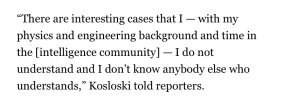
When Koslovki said this (attached) was he thinking about eye witness accounts with no data?
Or grainy videos?
I doubt it, that being said, I'm referring to those statements.
I won't debate the tic tac, it's pointless (pun intended).
 

Attachments

  • IMG_6061.jpeg
    IMG_6061.jpeg
    58.3 KB · Views: 2
I don't think you do, but many here are so used to "anomalies" being equated with aliens, we sometimes have a knee-jerk reaction. IF there is a video or account that seems to "defy conventional physics" it often can be slotted into a number of categories:

  1. Misunderstanding or confusion about what is seen. This would include things like balloons, parallax, lost tracking and other things that create the appearance of anomalies.
  2. Breakthrough technology from the US.
  3. Breakthrough technology from US allies.
  4. Breakthrough technology from US adversaries.
  5. Aliens.
I've noted multiple times in other threads, I don't think there is any such thing as "breakthrough technology". Technology builds up on previous technology. The F35, isn't breakthrough technology, it's a follow on from the Wright brothers Wright flyer.

The idea that the Russians, Iranians or Chinese have some sort of super technology that allows them to overfly the US in anomalous appearing advanced craft is a red hearing or straw-man. It's an argument to get people riled up and take UAP seriously, particularly by UFOs as aliens enthusiasts. The Iranians are trying to keep '70s era F4s and F14s in the air with their effective, but decidedly low-tech, Shahed drones. The Russians have yet to establish air superiority over their smaller neighbor, Ukraine. The Chinese J20 and J35 may rival the US F22 and F35, but they are still advanced convention aircraft.

We're really left with 1 or 5 in an attempt to explain supposedly anomalous videos. Time and again, when there is sufficient data, option 1 prevails.
I have really no more info than you to speculate on the "what if", I was pointing out AARO directors weird statements about how they treat the anomalous vs the "simply unidentified".
And I wanted to clarify I don't believe in aliens on earth but not even Chinese anti gravity.
My questions were about the supposed "perfect transparency" of the Pursue program and stuff.
 
When Koslovki said this (attached) was he thinking about eye witness accounts with no data?
Or grainy videos?
I doubt it, that being said, I'm referring to those statements.
When investigating the Chilean case, there were many scientists and government officials who didn't understand what they were looking at. Kosloski saying that there are cases he and his colleagues "do not understand" doesn't mean they are anything other than the usual birds, balloons, and planes.

Some people say we need to see "all the data," but I tend to disagree. To me, the demand for transparency isn't an entirely positive thing. Whole batches of videos and documents are being released, and there's hardly enough time to thoroughly debunk them all. Demanding even more videos doesn't change the fact that people will continue making outrageous claims.

When people argue that the government should release its "best cases," it's often implied that strange craft are flying around in our atmosphere. But the truth is that we have no real reason to believe that's the case. UFOs, space ghosts, and human anti-gravity technology exist in the LIZ. They live and thrive there, like the monsters we were afraid of as children, hiding in the shadows when the bedroom light was off. But as soon as the light is turned on, they immediately turn into piles of clothes or strange shadows. Asking for more funky videos from the government is like listening to the spookiest ghost stories just before bedtime, while keeping the light of.

With all that said, I do think it's good and important that skeptics continue debunking the declassified videos being released by the Pentagon. Not because I think the subject has any scientific value whatsoever, but because extraordinary claims made without evidence should be met with facts.
 
When investigating the Chilean case, there were many scientists and government officials who didn't understand what they were looking at. Kosloski saying that there are cases he and his colleagues "do not understand" doesn't mean they are anything other than the usual birds, balloons, and planes.

Some people say we need to see "all the data," but I tend to disagree. To me, the demand for transparency isn't an entirely positive thing. Whole batches of videos and documents are being released, and there's hardly enough time to thoroughly debunk them all. Demanding even more videos doesn't change the fact that people will continue making outrageous claims.

When people argue that the government should release its "best cases," it's often implied that strange craft are flying around in our atmosphere. But the truth is that we have no real reason to believe that's the case. UFOs, space ghosts, and human anti-gravity technology exist in the LIZ. They live and thrive there, like the monsters we were afraid of as children, hiding in the shadows when the bedroom light was off. But as soon as the light is turned on, they immediately turn into piles of clothes or strange shadows. Asking for more funky videos from the government is like listening to the spookiest ghost stories just before bedtime, while keeping the light of.

With all that said, I do think it's good and important that skeptics continue debunking the declassified videos being released by the Pentagon. Not because I think the subject has any scientific value whatsoever, but because extraordinary claims made without evidence should be met with facts.
I agree with the idea that we don't need "more videos".
We don't, we need more "complete videos" not black boxes all over screen info.
 
Also because as you said before (with good reason) we cannot debunk them all, and we cannot debunk stuff like a grainy something with no further data.
Since this data is somewhere, I'd love to have that released as well.
I'm really not speculating on aliens, new technology, Chinese antigravity, interdimensional whatever. I don't care, but scientific debunking needs data (like what Mick did with GOFAST, or the Syrian acceleration video).
The real "transparency" it's not there with the latest released stuff.
Even Corbell's supposedly "leaked" stuff is more thorough than what we've seen.
 
Last edited:
The FLIR1 thermal video is public, and the Navy formally confirmed radar integration at the time.
They also seem to have discarded this radar data at a later date, so this 'formal confirmation' can't be examined in detail. We are relying on human memories and second-hand accounts.
 
They also seem to have discarded this radar data at a later date, so this 'formal confirmation' can't be examined in detail. We are relying on human memories and second-hand accounts.
Perhaps because the cases that do not have that sort of issue get resolved several steps before the "getting leaked or released as anomalous" step.
 
It might worth clarifying AARO's actual congressionally mandated duties, as I think they are often misunderstood to include release of analysis and data of UAP cases as a primary duty. Their actual primary mission is to collect and analyze data for potential threats in restricted airspace (e.g., drones, lighter than air ISR platforms) and report to Congress their findings.

Mission statement:
External Quote:
Mission

Minimize technical and intelligence surprise by synchronizing identification, attribution, and mitigation of UAP in the vicinity of national security areas.

Vision

Effectively and efficiently detect, track, analyze, and manage anomalous detections and UAP via normalized and systematized DoW, IC, and civil business practices adhering to the highest scientific and intelligence-tradecraft standards with transparency and shared awareness.
Source: https://www.aaro.mil/About/Mission-Vision/

50 U.S.C §3373(c)
External Quote:
(c) Duties

The duties of the Office shall include the following:

(1) Developing procedures to synchronize and standardize the collection, reporting, and analysis of incidents, including adverse physiological effects, regarding unidentified anomalous phenomena across the Department of Defense and the intelligence community, in coordination with the Director of National Intelligence, which shall be provided to the congressional defense committees, the congressional intelligence committees, and congressional leadership.

(2) Developing processes and procedures to ensure that such incidents from each component of the Department and each element of the intelligence community are reported and stored in an appropriate manner that allows for the integration of analysis of such information.

(3) Establishing procedures to require the timely and consistent reporting of such incidents.

(4) Evaluating links between unidentified anomalous phenomena and adversarial foreign governments, other foreign governments, or nonstate actors.

(5) Evaluating the threat that such incidents present to the United States.

(6) Coordinating with other departments and agencies of the Federal Government, as appropriate, including the Federal Aviation Administration, the National Aeronautics and Space Administration, the Department of Homeland Security, the National Oceanic and Atmospheric Administration, the National Science Foundation, and the Department of Energy.

(7) As appropriate, and in coordination with the Secretary of State, the Secretary of Defense, and the Director of National Intelligence, consulting with allies and partners of the United States to better assess the nature and extent of unidentified anomalous phenomena.

(8) Preparing reports for Congress, in both classified and unclassified form, including under subsection (j).
Source: https://uscode.house.gov/view.xhtml?hl=false&edition=prelim&req=granuleid:USC-2021-title50-section3373&num=0#substructure-location_c

The historical report requirement in 50 U.S.C §3373(j) was a one off task. AARO is also designated as the official department that can receive all levels of classified UAP reports in 50 U.S.C §3373b, including whistleblower claims about hidden crash retrieval programs, but that is also secondary in so far as it does not align with the primary duties above.

If AARO cannot identify some object, even with multi-modal sensor data and with some apparently anomalous behavior, the best thing to do in keeping with mission directives is to report it as an unknown to Congress and then sit on it and compare it with any new data that comes in. Publicly releasing it would let the cat out of the bag if it turned out to be a real enemy development.
 
It might worth clarifying AARO's actual congressionally mandated duties, as I think they are often misunderstood to include release of analysis and data of UAP cases as a primary duty. Their actual primary mission is to collect and analyze data for potential threats in restricted airspace (e.g., drones, lighter than air ISR platforms) and report to Congress their findings.

Mission statement:
External Quote:
Mission

Minimize technical and intelligence surprise by synchronizing identification, attribution, and mitigation of UAP in the vicinity of national security areas.

Vision

Effectively and efficiently detect, track, analyze, and manage anomalous detections and UAP via normalized and systematized DoW, IC, and civil business practices adhering to the highest scientific and intelligence-tradecraft standards with transparency and shared awareness.
Source: https://www.aaro.mil/About/Mission-Vision/

50 U.S.C §3373(c)
External Quote:
(c) Duties

The duties of the Office shall include the following:

(1) Developing procedures to synchronize and standardize the collection, reporting, and analysis of incidents, including adverse physiological effects, regarding unidentified anomalous phenomena across the Department of Defense and the intelligence community, in coordination with the Director of National Intelligence, which shall be provided to the congressional defense committees, the congressional intelligence committees, and congressional leadership.

(2) Developing processes and procedures to ensure that such incidents from each component of the Department and each element of the intelligence community are reported and stored in an appropriate manner that allows for the integration of analysis of such information.

(3) Establishing procedures to require the timely and consistent reporting of such incidents.

(4) Evaluating links between unidentified anomalous phenomena and adversarial foreign governments, other foreign governments, or nonstate actors.

(5) Evaluating the threat that such incidents present to the United States.

(6) Coordinating with other departments and agencies of the Federal Government, as appropriate, including the Federal Aviation Administration, the National Aeronautics and Space Administration, the Department of Homeland Security, the National Oceanic and Atmospheric Administration, the National Science Foundation, and the Department of Energy.

(7) As appropriate, and in coordination with the Secretary of State, the Secretary of Defense, and the Director of National Intelligence, consulting with allies and partners of the United States to better assess the nature and extent of unidentified anomalous phenomena.

(8) Preparing reports for Congress, in both classified and unclassified form, including under subsection (j).
Source: https://uscode.house.gov/view.xhtml?hl=false&edition=prelim&req=granuleid:USC-2021-title50-section3373&num=0#substructure-location_c

The historical report requirement in 50 U.S.C §3373(j) was a one off task. AARO is also designated as the official department that can receive all levels of classified UAP reports in 50 U.S.C §3373b, including whistleblower claims about hidden crash retrieval programs, but that is also secondary in so far as it does not align with the primary duties above.

If AARO cannot identify some object, even with multi-modal sensor data and with some apparently anomalous behavior, the best thing to do in keeping with mission directives is to report it as an unknown to Congress and then sit on it and compare it with any new data that comes in. Publicly releasing it would let the cat out of the bag if it turned out to be a real enemy development.
Yeah. And if it is a real enemy development, would you still trust their "transparency"?
That's all i'm saying, their science is classified, so they're not really "doing science" in a classic, open, academical way.
 
Yeah. And if it is a real enemy development, would you still trust their "transparency"?
That's all i'm saying, their science is classified, so they're not really "doing science" in a classic, open, academical way.
I agree with you, we are forced to trust their analysis which is hidden from us. They are probably getting some stuff wrong (just because mistakes always happen), and it's frustrating not to be able to independently analyze their data and confirm their conclusions for each case. Jon Kosloski said he saw some things that even after analysis he couldn't explain. I would love to be able to see that data. I just think it's unlikely we will see it given their current mission. Based on their public reports and testimony, I am currently in the camp of believing they are mostly trustworthy, mistakes notwithstanding.
 
That's all i'm saying, their science is classified, so they're not really "doing science" in a classic, open, academical way.

Echoing MonkeeSage above, you nailed it and possibly some of the confusion associated with AARO. It isn't doing science in an academic way. It's doing science as prescribed by Congress for congressional needs and trying to do that with a variety of competing government agencies that have their own agendas and fiefdoms to protect. And while "transperancy" gets tossed around a lot, the quote from up thread has a few important words in it (bold by me):

External Quote:

Nevertheless, as established by law and in accordance with direction from the Secretary of War, AARO places a heavy emphasis on transparency in facilitating the declassification and release of information so the public can see the results of AARO's reviews for themselves.
External Quote:

AARO seeks to build trust through increased openness and analytic rigor as it executes its important national security mission. AARO will continue to demonstrate its commitment to transparency by publishing declassified information, engaging with partners across the U.S.Government, and transferring records to public archives
https://www.aaro.mil/Portals/136/PDFs/Information Papers/AARO_Declassification_Info_Paper_2025.pdf

Explained here by Kirkpatrick:

External Quote:

32:40
Why is an video of a balloon classified?

(Off camera voice from audience): Sources and methods

Sources and methods 100% has absolutely nothing to do with the target. It has everything to do with the sensor. If my sensor, if my camera is classified, anything I take a picture of with that camera is classified. Period. N dot.

33:10
If it's a sensor that was in an operation that we weren't supposed to be in or we didn't acknowledge, that's an operational classification. So
now I have technical sources and methods and then I have operations both of which have different classifications for things. So now if I have an F-35 of which every sensor is classified and they're all classified differently which makes it all even better and they're classified differently depending on which service owns the F-35. So the Air Force has a different set of classifications than the Navy.

33:52
And then if you take on top of that that I'm flying this F-35, say in the Middle East on an operation and I happen to pick up something, then now I've got operational classification on top of the technical classification. So in order to take any one of those things and go get it declassified, it has to go through all of those people.

So, if it's an Air Force mission on an Air Force F-35, it has to go through the F-35 program office. It has to go through the Air Force. It has to go
through the owning Joint Combatant Command. How fast do you think that happens?
This is regardless of what someone like the President or Congress wants:

External Quote:

34:42

Right. So, I've got a backlog of things that have been resolved that need to be declassified. And I'm sorry, but no presidential treat tweet is going to make it go faster because they still have to go through that process, right? You still have to go and get all of them. The only thing that's going to happen is they might put a higher priority on it, but it's not going to be zero analysts. It'll be one, right? It's still going to go through that process.

Um, and then once that's declassified, it gets published.
It's all rather convoluted. Link to Kirkpatrick:


Source: https://www.youtube.com/watch?v=bi0H_mkwTW0
 
Back
Top