Transients in the Palomar Observatory Sky Survey

I saw mention somewhere that the authors of the Villaroel paper represented the earth's shadow as a cylinder, instead of a cone. What is the source of that information?

If that is correct, it completely invalidates their 'transients in the shadow' calculations. They are assuming that the earth's shadow is much larger than it actually is. Suggesting that the authors are very confused.
 
The diameter of the Earth is 12726km. The shadow is a cone, reducing its extent at GEO orbit to 12400km.

Also the Earth's shadow moves; it passes across the sky quite quickly in a 50 minute exposure.
To quote my earlier post
The circumference of Geostationary orbit is 264,869 kilometres, and the diameter of the Earth's shadow is 12400km at that distance. That means that the Earth's shadow moves its own width across the stars every 67 minutes.
For a 50 minute exposure, only a small patch of sky remains in total shadow, about 26% as large as the full shadow. All the rest of the sky gets some sunlight at different times during this exposure period. Most of the sky is, of course, in full sunlight at all times.
 
Circling back to my post with the discussion between Wood and Sage about this paper, he made these claims:
[Metabunk has] an agenda, and it isn't getting to the truth or doing science. West himself even admits it in his book....Pseudo-skeptics control the narrative. It's what they do. This can be seen all across scientific history. Time and time again. That's why we must ALWAYS be aware of that intellectual trap, if we are ever going to get to the ground truth. We are ALL susceptible to that trap. Pseudo-skeptics with an agenda take advantage of that. West literally admits to being that kind of a pseudo-skeptic in his book along with a long list of actions on his part. The pseudo-skeptics have controlled the narrative long enough.
As I've bolded, he claims to have read ETRH (most likely in a close-minded passive-agressive state).

Does anyone have ETRH on hand to see where in the heck he could get some nonsense like this?

He's obviously either intentionally misrepresenting/misinterpreting passages from the book, or (due to his close-mindedness) simply just didn't understand what Mick wrote.
 
Last edited:
Does anyone have ETRH on hand to see where in the heck he could get some nonsense like this?
I have no idea what specifically he's referring to. But he's probably just misinterpreting some of my advice as disingenuous, despite my insistence on honesty at every level.

What does this have to do with Palomar?
 
I saw mention somewhere that the authors of the Villaroel paper represented the earth's shadow as a cylinder, instead of a cone. What is the source of that information?

If that is correct, it completely invalidates their 'transients in the shadow' calculations. They are assuming that the earth's shadow is much larger than it actually is. Suggesting that the authors are very confused.
Honestly, the 3% error of this are swallowed up by the other inaccuracies: a change in altitude changes drastically how much of the visible sky is in shadow (100% at altitude 0, getting less as you go up), and the orbit they're using (geostationary) is not motivated by any kind of evidence.

In fact, we could claim that a geostationary satellite positioned above Palomar is spectacularly unsuited to observe British nuclear tests in Australia, Russian tests, or even the 1954 Operation Castle tests on the Bikini atoll. The plate data should show where the satellite actually was, and whether it could have observed the nuclear test if it was geostationary.

In fact, comparing satellite positions is the first thing I would have done if I believed I had actually found a non-human geostationary satellite. Where is the thing actually? Since the night sky rotates (apparently) as Earth orbits the sun, the telescope can map the sky by repeatedly looking in the same position at different times throughout the year. This means that we probably have several plates looking in the same direction. If a satellite flashes so frequently that 3 flashes are recorded in a single 50-minute exposure, then that satellite must appear on other photographs taken in the same direction. In fact, of the multi-flash anomalies found, we would expect some of them to originate from the same satellite.

If that's not the case, the assumption that these dots originate from geostationary satellite must be questioned; and then of course the (unfounded) altitude assumption goes out the window completely, and with that, any assumptions about the visible shadow's size.

The fact that this investigation is based on assumptions that are never validated dwarfs any slight inaccuracy with respect to the shadow calculations.
 
Another take from X:
@opngate said:
I went through [West's] argument against Dr Villarroel - it was a really complicated way of saying it's plate defects, of which she goes over extensively and lays out quite beautifully why that can't account for all transients. His argument was hot air.
From what I recall of the paper Villarroel et al didn't really provide anything that substantive to outright reject this hypothesis. It's been a while since I last read it though.
 
If a satellite flashes so frequently that 3 flashes are recorded in a single 50-minute exposure, then that satellite must appear on other photographs taken in the same direction. In fact, of the multi-flash anomalies found, we would expect some of them to originate from the same satellite.
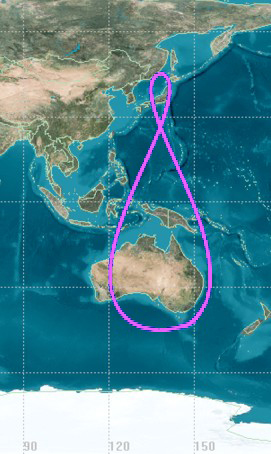
Sometimes. If these geostationary satellites were in an equatorial orbit, they would always appear in the same direction; but geostationary satellites in equatorial orbits are easy to distinguish, because they cluster around 0° Declination in the equatorial sphere. If Villaroel's alien satellites are free to appear anywhere in the sky (and anywhere on the plates) then they must be in inclined geosynchronous orbits, in which case they are constantly moving up and down the sky in a pattern called a lemma.

Here's an example of an inclined geosynchronous orbit above Australia and Japan, showing the sites where the satellite appears directly overhead over time.
Qzss-45-0.09.jpg


So a a geosynchronous satellite would appear in the same general direction over time, but move about significantly in a north-south direction.
 
They write a thesis project, not a doctoral thesis.
EDIT: Straw man. No-one mentioned a doctoral thesis. - thanks for the implicit correction @Mendel
Under the Bologna process rules, all higher educational degrees in Europe, both bachelor and master, require a thesis.
Utter nonsense. My bachelor's degree required no thesis when I took it and requires none now.
 
Last edited:
I did a dissertation for my degree, not a thesis. My daughter, a PhD, did write a thesis for her doctorate. Both UK.
 
If Villaroel's alien satellites are free to appear anywhere in the sky (and anywhere on the plates) then they must be in inclined geosynchronous orbits, in which case they are constantly moving up and down the sky in a pattern called a lemma.
But then different observations of the same satellite could still occur, and still be linked.
 
Yes, but would they be detectably linked? A satellite moving north-south in a lemma pattern would appear in a range of different locations in the sky, which would be difficult to link causally. On a single 50 minute photographic plate we might observe some alignments, since the 'transients' from a single satellite might occur in close proximity. But it is also significant that we never, ever see transients in these plates which are aligned with the rotation of the Earth, since many real GEO transients are long enough to show a streak, and these streaks are always aligned in this way.

Once again the whole premise seems unlikely. Why would geosynchronous satellites appear briefly during a UAP flap or nuclear testing period, and why would these satellites rotate so that they only display half-second glints at irregular intervals?

I suspect that the cherry-picking in this paper occurs when they choose which UAP events and nuclear tests to correlate with. There were many nuclear tests in this era, and many UFO reports.
 
Even the barely evolved apes who operate satellites here on Earth are aware of many other useful orbital configurations besides geosynchronous.

The Russians made use of the Molniya orbit almost from the dawn of the space age.

External Quote:
A Molniya orbit (Russian: Молния, IPA: [ˈmolnʲɪjə] , "Lightning") is a type of satellite orbit designed to provide communications and remote sensing coverage over high latitudes. It is a highly elliptical orbit with an inclination of 63.4 degrees, an argument of perigee of 270 degrees, and an orbital period of approximately half a sidereal day.[1]
Not to be outdone, the US used the same orbits for some of the surveillance spacecraft it used to monitor the USSR. Monitoring nuclear test sites was a high priority for American intelligence services. If the unattributed 'glints' correlate with the dates of Soviet tests, they should not be in GEO at all.

[edited to add text from the wiki link per link policy]
 
Last edited:
Yes, but would they be detectably linked? A satellite moving north-south in a lemma pattern would appear in a range of different locations in the sky, which would be difficult to link causally.
But it would be confined to a range of longitudes, plus we'd have some motion vectors.
It just makes no sense to me that they didn't calculate the positions if they thought these were real satellites.
 
This is my first post. Thanks for the venue!

A quick "meta" note for Metabunk: for me, Metabunk is often a haven where reason, facts, and logic form a rational island amid the chaos of the internet. Threads like this are at their best when claims are tied to calculations and data, not just priors.

Two things feel worth centering:
  • Peer review matters. Villarroel's team has two recent, peer-reviewed papers (PASP; Nature Portfolio's Scientific Reports). These cleared referees. This is now part of the astronomical literature, not a social-media claim.
  • Don't ignore the outliers by habit. Think "zoo blindness" (animals tune out a constant stimulus): one-frame transients usually get stamped "uncorrelated" and set aside. Their work says: pull that pile back in and test it at scale. Some of the patterns they report don't behave like random plate defects.
Constructive asks (for those with the tools/skills):
  1. Independent re-calculation of the Earth-shadow transient deficit using actual plate times/pointings.
  2. A pre-registered replication on other pre-Sputnik plate archives.
    If those erase the signal, great—case closed. If they persist, that's important. If this has already been done, a link would be perfect.
Thanks again for the skeptical venue.
 
But it would be confined to a range of longitudes, plus we'd have some motion vectors.
It just makes no sense to me that they didn't calculate the positions if they thought these were real satellites.
I keep stepping back through the rationale:
  • SETI-related paper suggests you might be able to detect civilizations around distant planets by the optical characteristics of their geostationary satellite debris.
  • Conclude you might be able to detect ancient pre-human satellites by looking for them in long-term stable geostationary orbits around earth.
  • Look at POSS-1 sky survey from before the launch of terrestrial satellites for glints, since we can rule out human satellites as the cause.
  • Find some POSS-1 transients, dismiss critics who say they're essentially noise from the emulsion.
  • Find more and more POSS-1 transients.
  • But those POSS-1 glints don't show up in later surveys, so those glints can't be the ancient satellites being looked for because they would still be there.
  • Point to nuclear tests and UFO report correlations to suggest these weren't ancient pre-human satellites, but modern non-human satellites that don't show up in later surveys and can't be found now because they left orbit... for reasons.
 
long-term stable geostationary orbits
but they're not stable

these weren't ancient pre-human satellites, but modern non-human satellites that don't show up in later surveys and can't be found now because they left orbit... for reasons.
I'd still want to know where they were, and their minimum altitude that would bring them out of the umbra
 
I don't know where I have "insisted" on this before. No US MD would ever claim to have a doctoral degree or to have done a doctoral thesis, and any PhD would be quite upset than an MD is called a doctoral degree. And it's not just terminology. An MD is not a doctor, an MD is a physician, i.e. a person with a medical degree. A doctor is a PhD or equivalent. For some reasons the US calls physicians medical doctors, instead of just using "doctor" as a courtesy title at most as in the rest of the world. A doctoral thesis is a synonym for a PhD thesis, and if you just say thesis you mean a PhD thesis. What you are refeering to is a master project, or a Master of Science thesis. Otherwise, you could call any Master of Science/Philosophy/etc a a doctoral degree just because a thesis is required.
@Shen — you're absolutely correct, of course. The original poster had written, "If you try this for your doctoral thesis, you're going to get laughed out of med school," and that's what I was lightly teasing them about. It's funny to me that they couldn't just concede the point and move on — especially since it's so off-topic anyway.
 
I get what you are saying, but I think you missunderstod my point about considering bizarre hypotheses. What I was trying to say is that I think the authors are right in ruling out 99% (or whatever) of the transients as perfectly normal things....
@Shen I think we're actually closer in view than it might appear.

The key misunderstanding, I think, lies in how the paper's actual working hypothesis has been paraphrased here. The authors weren't testing whether pre-space-flight satellites exist; their stated goal was to determine whether all detected transients could be explained as known instrumental or astronomical phenomena. That's a limited, falsifiable question — and finding even a few residual anomalies directly addresses it.

Where you and I likely agree is that the later framing (especially the references to "artificial satellites" and nuclear-test correlations) pushes the tone into speculation. That narrative layer makes it sound like they began with a conclusion in mind. But methodologically, the underlying test was exploratory: are all signals artifacts, or not? That's a legitimate starting point for anomaly classification.

I share your wish that they'd spent more of the discussion on improbable but natural combinations. That would strengthen the Bayesian groundwork before jumping to higher priors. But to suggest the entire approach is data mining misses the nuance: it's exploratory science that perhaps overreached rhetorically, not pseudoscience.

So yes, the rhetoric constrains the hypothesis space, but the design itself was intended to test whether that constraint was justified.
 
But it would be confined to a range of longitudes, plus we'd have some motion vectors.
It just makes no sense to me that they didn't calculate the positions if they thought these were real satellites.
I understand that you need three observations to get a good orbit, but these 'glints' (if they really are glints) can only be tied down to a period of half a second, located in time somewhere within the 50 minute exposures concerned. This is not accurate enough. So any calculated orbit would have extremely large error bars.
 
The authors weren't testing whether pre-space-flight satellites exist; their stated goal was to determine whether all detected transients could be explained as known instrumental or astronomical phenomena. That's a limited, falsifiable question — and finding even a few residual anomalies directly addresses it.
I don't know... I'm just an old kite flier and all... but that sounds like classic "anomaly hunting." It sounds like saying that unless you can identify every single one, then Aliens.
 
Last edited:
I understand that you need three observations to get a good orbit, but these 'glints' (if they really are glints) can only be tied down to a period of half a second, located in time somewhere within the 50 minute exposures concerned. This is not accurate enough. So any calculated orbit would have extremely large error bars.
Though in Aligned, Multiple-transient Events in the First Palomar Sky Survey, they do identify several specific candidate transients along a line; each transient is supposedly the same object glinting at intervals along its path.
In a previous white paper, Villarroel et al. (2022a) proposed a methodology to search for solar reflections from artificial objects in GSO using photographic plates from before the satellite era (pre-1957). One key signature is the presence of several point-like transients that are aligned along a line within a single exposure. A statistical framework was also developed to assess the significance of such alignments.

In this paper, we carry out that test. We apply the published methodology and statistical framework to a published sample of POSS-I transients from Solano et al. (2022).
1761498108859.png
 
The authors weren't testing whether pre-space-flight satellites exist; their stated goal was to determine whether all detected transients could be explained as known instrumental or astronomical phenomena.
The answer seems obvious; these anomalies can all be explained by known instrumental or astronomical phenomena; the ones that aren't stars or distant galaxies can be explained fully by flaws in the emulsion.
The question of whether some of them are artificial (alien) satellites is unresolved. So is the question of whether these anomalies were caused by Ted Serios the psychic photographer. I know where my money lies.
 
Though in Aligned, Multiple-transient Events in the First Palomar Sky Survey, they do identify several specific candidate transients along a line; each transient is supposedly the same object glinting at intervals along its path.
Supposedly so.
However each glint lasted a maximum of 0.5 seconds, since they are not streaks; this means we have a number of incidents that may have occurred at different times within the 50 minute exposure. The top one might have happened first, then the bottom one thirty minutes later, then the middle one fifteen minutes after that. This would rule out any possibility that the events were associated with the same object; satellites don't zig-zag back and forth at random.

The most likely scenario remains that all three anomalies occurred at the same time, during the processing of the photographic plate, and they do not represent real objects at all. Indeed, if these photographic flaws are caused by some mechanical or chemical disruption to the plate, there may be a good chance that the anomalies are aligned because they were all caused at the same time during plate processing by the same flaw in manufacture, handling or processing.
 
Last edited:
Though in Aligned, Multiple-transient Events in the First Palomar Sky Survey, they do identify several specific candidate transients along a line; each transient is supposedly the same object glinting at intervals along its path.

View attachment 85301

The issue with this is - the 'transients' arent in a line like we would expect a distant geosynchrous orbing object to make. They are within a track (as illustrated in the images below by @Kyle Ferriter in post 19 of this thread). Of course I understand that there has to be some tolerances when classifying object classification metrics, but it would seem that the tolerance here is rather broad.

Compare that with an acutal multi-second glint on astronomical plates which is referred to in the A glint in the eye paper.
 
Last edited:
Supposedly so.
However each glint lasted a maximum of 0.5 seconds, since they are not streaks; this means we have a number of incidents that may have occurred at different times within the 50 minute exposure. The top one might have happened first, then the bottom one thirty minutes later, then the middle one fifteen minutes after that. This would rule out any possibility that the events were associated with the same object.

The most likely scenario remains that all three anomalies occurred at the same time, during the processing of the photographic plate, and they do not represent real objects at all. Indeed, if these photographic flaws are caused by some mechanical disruption in the plate, there may be a good chance that the anomalies are aligned because they were all caused at the same time during plate processing.
The suggestion in the paper is that it's a single pass by a single object, possibly tumbling, reflecting the sun's light from some shiny surface that's only periodically hitting the camera.

Since we know within a specific 50-minute window when the image was captured and the object would have to be at a high enough altitude to be in sunlight, you'd theoretically have some parameters for narrowing down its orbit.

My point being, if you really thought this object and the other objects were in high orbits in the early 1950s and so bright they were incidentally recorded with slow emulsion, why wouldn't you try to prove their existence by looking for them now? It would only take one...
 
My point being, if you really thought this object and the other objects were in high orbits in the early 1950s and so bright they were incidentally recorded with slow emulsion, why wouldn't you try to prove their existence by looking for them now? It would only take one...
It's fine, in a sense. Of course it's scientifically viable to look for specific anomalies.

Of course, the paper would inarguably be better and less prone to bias if they had instead looked for and tried to identify transients, dividing them up into different groups and maybe tried to statistically correlate them with various probable outside factors. A tentative title would then be "Categorization and identification of transients in Palomar data". In such a setup, no transients should be excluded, but they should simply have made a table of their characteristics and then tried to match them with tentative identifications. For example, if they wanted to correlate with UFO-sightings or nuclear tests this should have been done with all the transients, not just the ones they could not exclude. If the now excluded transients also correlate with nuclear tests, then that heavily implies that the now included transients share an origin with the excluded ones, for example. This kind of design would have hugely improved the generalisability and statistical reliability of the results, and provided a lot more details and data for others to interpret and judge the validity of the results. This they could have easily done with the available data, and such a methodology would have been better on all points.

Another viable route would be to a priori define a model for the characteristics that should define a satellite or geostationary satellite or other artificial object in orbit and look for these specific characteristics in the dataset, including a few variables that could conceivably be connected with the data with which they will try to correlate the candidate cases. A tentative title would be "Matching signatures of artificial satellites with Palomar observatory data". This design would avoid confirmation bias.

What the authors actually do is kind of a hybrid combining the weaknesses of both designs. They look at the dataset to see what characteristics the data shows, and then determine the characteristics matching artificial satellites based on the cases which they can't otherwise exclude. They then do a couple of post-hoc correlation analyses with variables that are just thrown in at the end. Both design flaws introduces unavoidable bias. Correlating with factors where there are no causative relations is exactly what you should never do, and especially not post-hoc. Even a very significant result is impossible to interpret as there is basically an infinite amount of variables that could be correlated with.
 
I understand that you need three observations to get a good orbit, but these 'glints' (if they really are glints) can only be tied down to a period of half a second, located in time somewhere within the 50 minute exposures concerned. This is not accurate enough. So any calculated orbit would have extremely large error bars.
well, they have assumed an orbit, and so an orbital speed, I'm not worried about that, but given the orbital speed, any transient line aligns with a group of "parallel" orbits given by the time elapsed from first to last point within the 50-minute exposure time.
I don't know... I'm just an old kite flier and all... but that wounds like classic "anomaly hunting." It sounds like saying that unless you can identify every single one, then Aliens.
that's exactly my point!
their paper doesn't say "look, we found some satellites, here's all the data on them that we got", it says "here's something weird that could be aliens". It's in their interest to not investigate it further, because that risks the "weirdness" going away. It's not science.
 
I don't think it's much larger; it's like 4% larger than the umbra at geo.
I've added Show Earth's Shadow to the Show/Hide->Celestial Menu, with adjustable shadow altitude.

2025-10-26_14-15-05.jpg


2025-10-26_14-15-19.jpg
Of course the shadow extends off into space, but this shows the area of the sky is for the umbra and penumbra.

Here it is at geostationary orbit distance over 24 hours (in 24 seconds). Umbra and Penumbra are pretty much the same.


https://www.metabunk.org/sitrec/?cu...m/1/Palomar Earth_s Shadow/20251026_210706.js
 
It's fine, in a sense. Of course it's scientifically viable to look for specific anomalies....
@Shen
Where I might differ slightly is in how we interpret the intent and sequencing of the work. Villarroel et al. weren't attempting a full taxonomic survey of all transients — that would indeed be a useful follow-on study — but a narrower, exploratory test: could all Palomar transients be dismissed as known instrumental or astronomical phenomena? In that sense, isolating and inspecting residuals was the experiment. A broader classification effort would be the logical next phase after confirming that such residuals exist at all.

Likewise, the idea of defining a priori models for possible artificial-object signatures would make sense only once there's a justified basis for doing so. Starting with a fixed model before establishing that any unexplained class exists would pre-bake assumptions into the analysis and risk missing novel signal types altogether. Discovery science often begins with anomaly detection; modeling comes later.

I also don't see evidence that the team "derived satellite-like parameters from the residuals." They reported observed characteristics (brightness, spacing, persistence) and compared them against known phenomena to see what remained unmatched. That's exploratory inference, not circular reasoning.

Where I do agree with you is on the correlation section...the links to UFO reports and nuclear tests were unnecessary and methodologically weak. Those are narrative flourishes, not statistical findings, and the paper would stand better without them.

Finally, I'd push back gently on the "data-mining" charge. Intent should be inferred from design, not presumed simply because of the authors' association with the UFO topic. Their methods were transparent and replicable, and the data are open for others to test. That's the opposite of bad-faith mining; it's the invitation to replication that good science depends on.

 
It's fine, in a sense. Of course it's scientifically viable to look for specific anomalies....
Villarroel et al. weren't attempting a full taxonomic survey of all transients (that would be a useful follow-on study) but a narrower, exploratory test: could all Palomar transients be dismissed as known instrumental or astronomical phenomena? In that sense, isolating and inspecting residuals was the experiment. A broader classification effort would be the logical next phase after confirming that such residuals exist at all.

Likewise, the idea of defining a priori models for possible artificial-object signatures would make sense only once there's a justified basis for doing so. Starting with a fixed model before establishing that any unexplained class exists would pre-bake assumptions into the analysis and risk missing novel signal types altogether. Discovery science often begins with anomaly detection; modeling comes later.

I also don't see evidence that the team "derived satellite-like parameters from the residuals." They reported observed characteristics (brightness, spacing, persistence) and compared them against known phenomena to see what remained unmatched. That's exploratory inference, not circular reasoning.

Where I do agree with you is on the correlation section...the links to UFO reports and nuclear tests were unnecessary and methodologically weak. Those are narrative flourishes, not statistical findings, and the paper would stand better without them.

Finally, I'd push back gently on the "data-mining" charge. Intent should be inferred from design, not presumed simply because of the authors' association with the UFO topic. Their methods were transparent and replicable, and the data are open for others to test. That's the opposite of bad-faith mining; it's the invitation to replication that good science depends on.
 
@Shen — you're absolutely correct, of course. The original poster had written, "If you try this for your doctoral thesis, you're going to get laughed out of med school," and that's what I was lightly teasing them about. It's funny to me that they couldn't just concede the point and move on — especially since it's so off-topic anyway.
Nice use of them-vs-us.

@Mendel narrowed it to the field of people doing research degrees and your jibe was effectively "not everyone does research degrees". How was that even worth posting, it doesn't counter his point at all?
 
The answer seems obvious; these anomalies can all be explained by known instrumental or astronomical phenomena; the ones that aren't stars or distant galaxies can be explained fully by flaws in the emulsion.
The question of whether some of them are artificial (alien) satellites is unresolved. So is the question of whether these anomalies were caused by Ted Serios the psychic photographer. I know where my money lies.
The claim that "these anomalies can all be explained" is precisely what the study was designed to test. The authors didn't start from that assumption — they evaluated possible instrumental and astronomical explanations, documented which ones fit, and found a small subset that didn't. Saying a priori that "they can all be explained by film flaws" is an assertion, not a result. Unless you've reproduced the data and ruled out all non-instrumental causes, you're just restating your prior belief.
 
Unless you've reproduced the data and ruled out all non-instrumental causes, you're just restating your prior belief.
But they have not ruled anything out. They admit that there is no difference between the anomalies caused by emulsion flaws and the ones supposedly caused by imaginary satellites.

From here;
https://iopscience.iop.org/article/10.1088/1538-3873/ae0afe
Thus, profile sharpness alone cannot conclusively distinguish between artifact and astrophysical origin.
 
Back
Top