Mitch McConnell Hospital Bed Photo - Is It Authentic?

Two photos taken from this primer on the effects of perspective distortion and portrait photography.
https://learn.zoner.com/why-should-i-zoom-in-for-portraits/

Shortest possible lesson. Entirely visual. Why you don't get up close to your subject with a wide angle lens. Why you get a good distance away from your subject with a telephoto lens.

Wide angle lens up close
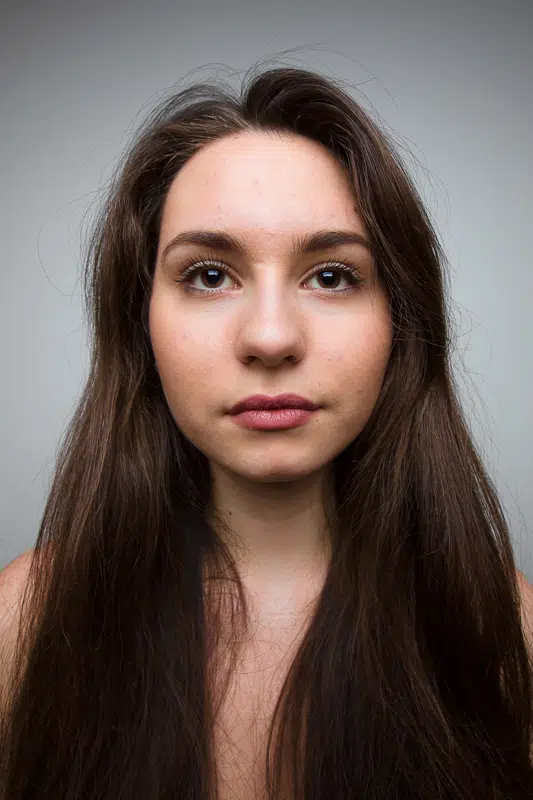
020mm.png


Telephoto lens at good distance
150mm.png


Same model. Hard to believe, isn't it? It's not the lens that causes the distortion, it's the distance. It's a matter of proportional distances.

And these were taken with the camera at the same level. Camera angle also can add to perspective distortion. A wacky camera angle looking down at the model would make her image look even wackier.

Believe it or not it takes training to be a photographer. You've got to develop an eye the way a musician develops an ear.

And people with no eye don't understand what they're looking at... they just think they do. Dunning-Kruger effect.
 
Last edited:
Joseph II was deaf because he had no ears, according to Salieri.

vlcsnap-2026-07-28-06h59m39s033.png

vlcsnap-2026-07-28-07h00m06s710.png


Ear: In music, having "an ear" refers to the capacity to perceive, analyze, and recreate auditory elements like pitch, rhythm, harmony, timbre, and tonal relationships accurately.

A musician with "a good ear" can identify intervals or chord progressions by sound alone (aural skills), play or transcribe music without reading written scores, sing or play precisely in tune, and subtlety adjust their dynamics and timing to harmonize with other musicians in real time.


Eye: In visual art and photography, having "an eye" refers to an intuitive ability to perceive and recognize visual composition, form, lighting, color and perspective.
 
Last edited:
Believe it or not it takes training to be a photographer. You've got to develop an eye the way a musician develops an ear.
You've given us a primer on professional portrait photography. Does that have anything to do with a rehab photo of McConnell? Or was it just an informal picture quickly taken with a phone (by a reporter, perhaps, not a professional photographer) with no fussy setup to tire a recuperating patient?
 
So far it seems that people, for the most part, are accepting this as a genuine photo. I briefly touched on that in post #33.

The new conspiracy theory that I'm attempting to debunk is the idea that this new proof of life photo shows that McConnell is so out of it, (or completely brain dead?), that his eyes are wandering randomly.

But people are misperceiving. It's a complicated subject and I've been building a case as to why people are misperceiving the direction of McConnell's gaze.

The problems with the snapshot are at the very heart of the matter.

In post #40 I go into...
Why and how perspective distortion has fooled people into misperceiving the direction of McConnell's gaze.

Post #41 is a follow up on the subject of perspective distortion, and also touches on the subject of people being instant experts in photography without recognizing the mistakes they're making. They know so little about the subject that they don't even think they need to know anything about it.

Just like people with no ear sing loudly in public... off key. They have no ear so they sing off key. They don't know they're singing off key because they have no ear.

And they'll loudly tell you you're wrong. They sing byu-tiff-ul.


That was a popular plot point in '60s sitcoms. They used it twice in The
Andy Griffith Show
(Barney) and once in Gomer Pyle USMC (Sergeant Carter). It seems to me they might have used it in I Dream of Jeannie too.
 
Last edited:
And these were taken with the camera at the same level. Camera angle also can add to perspective distortion. A wacky camera angle looking down at the model would make her image look even wackier.
A classic effect to exploit in cinematography - the "Vertigo" zoom:

Source: https://www.youtube.com/watch?v=u5JBlwlnJX0

Lots of examples within, the most famous ones such as Vertigo, and Jaws, but plenty of others from more modern genres (less heavy dramas) and contexts (CGI, where you don't need a dolly to perform it).

It misses my favourite, which blends into a really visceral composited effect, at 4:17 here - warning, strong language before that point, but you will want at least ~20s of context earlier in the scene, the whole of which is positively peppered with deliberate uses of close up distortion of faces and limbs.

Source: https://www.youtube.com/watch?v=S2cAJe6JOHk
 
Back
Top