Keen eyes needed for volcano, please

peacerunner7

New Member
I stumbled upon this video.
Source: https://www.facebook.com/reel/1418652579859120


Can you guys tell me if those are birds flying in and out of the lava?

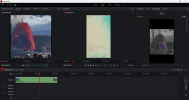
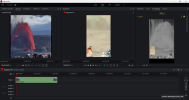
I'm no video specialist but I like to play around with Lightworks. I slowed the video down to 15% speed and gave it a negative effect. I can make out wings flapping or what I think is wings flapping but there is some stuff that is beyond me.

At :08 there appears something like a bird shape but it was there for 2/100th of a second on Lightworks. Then at 2:40 something jets from mid left to upper right and seems to punch through the lava. Lastly I spotted this perfect triangle shape in the lava. Hopefully my clips and pictures make sense.

If looking on the original fb video, the possible bird is at :02 and the jetting object at :25.
 

Attachments

  • Screenshot 2025-12-26 173516.png
    Screenshot 2025-12-26 173516.png
    478.5 KB · Views: 22
  • Screenshot 2025-12-26 173216.png
    Screenshot 2025-12-26 173216.png
    447 KB · Views: 10
  • triangle and punch through.mp4
    2.3 MB
  • negative lava.mp4
    51.1 MB
The lava fountain is miles away from the people. It's about 1500 feet high.

I do see white birds. But think about it. If those birds were also miles away - at the same distance as the lava fountain - they would be:

-huge
-flying at hundreds of miles per hour

The lowdown is that the lava is miles away, the birds are maybe a hundred yards from the people. Two hundred yards? Hard to say. But in that neighborhood.

Please see this post about forced perspective:
https://www.metabunk.org/threads/cl...ured-by-photographer.13182/page-3#post-302869


You might want to look at the rest of the thread. A butterfly - a close and small object - was believed to be a flying saucer - a large and distant object.
 
It's potato quality imagery with lots of digital zoom, and small white dots can simply get lost as the image processing and compression is applied. We've had a thread before where birds appeared to port through a high-rise. Note that sunlight and shadow can contribute to that.

When we see something sensational on video, a good question to consider if whether it was already there at the time. The video shows a large group of people, so if they all had seen birds fly through lava, we'd already know about it.
"I looked through the footage at home months later" revelations are often camera artifacts.
 
I stumbled upon this video.
Description from the Facebook video post:
External Quote:
The Uekahuna Overlook allows you to get within a mile of the Kilauea eruptions! From here you can feel the heat of the lava on your face and get right up into the molten fountains with your camera! This was the site of the Jaggar Museum before the building was damaged beyond repair during the 2018 collapse of Halemaumau Crater. Recent renovations have made this a premier viewing area, and is the closest you can get to the action!! Be sure to notice the tiny USGS workers with their equipment on the edge of the caldera at bottom right, giving scale to this 1200 foot lava geyser from Episode 38!
In volcanology, an "episode" refers to a distinct continuous phase of a longer eruption, e.g. a specific fountaining period.

Kilauea is the most active volcano in Hawaii, and one of the most active in the world. USGS has a live stream on YouTube, and many other webcams.

Koaʻe kea (white-tailed tropicbird) are frequently observed around Kīlauea eruptions within Halemaʻumaʻu crater, including lava fountains. They exploit the thermal updrafts from the lava and nest in the caldera walls, taking advantage of the warmth and security against ground predators. Search for relevant USGS multimedia here, here and here.

1767234306358.png


Koa'e kea riding thermals during Episode 38 (from Reddit) which commenced Dec 6, 2025.


Koa'e kea during Episode 9 (from Facebook, recorded Feb 11, 2025 10:40 AM). The circling activity may also be associated with searching for new nesting sites.


Article:

Undeterred By Earthquakes and Eruptions

Many tropicbird nesting sites were destroyed in the massive crater collapse of Kīlauea in 2018. Halema'uma'u crater grew to a depth of 1,600 feet. Park rangers including Ranger Dean Gallagher observed tropicbirds circling the giant ash clouds that accompanied the collapse events.

"We were heartbroken at the thought of all their nesting sites being destroyed, but what followed was even more amazing," says Dean. "Using a spotting scope, I was able to observe the birds weren't frantically searching for their old nesting sites but rather choosing new sites in the now greatly enlarged crater. Given the ancient nature of these birds, I think both they, and their ancestors, have seen their fair share of earthquakes and volcanic eruptions."

Dean calls tropicbirds "living fossils." They belong to an order of birds called Phaethontidae that is one of the most ancient lineages on the planet. "There is a perfectly preserved fossil of a white-tailed tropicbird found in New England that is over 50 million years old," says Dean, "predating humans by a long shot!"
 
Back
Top