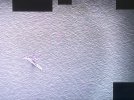
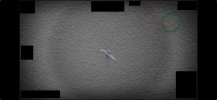
DOW-UAP-PR067 Multiple Spherical UAP USO near Sub

Link to War.gov page with original video download link
Link to Reddit discussion that alerted me

I want to discuss one specific moment in this video. At 3:02 a few bright spots at the top left are moving in different directions. One seems to disappear and reappear, zipping off in a new direction.
At the beginning of the video, the slowly floating spot made me think "balloon", potentially with some parallax effects. But having multiple spots floating in different directions, and potentially changing directions, reduces the likelihood of balloons and makes parallax a non-explanation.

My next hypothesis was birds. But the speed of the movement at 3:04 makes me question whether any pelagic birds move this fast. I am assuming they would be pelagic rather than migratory because they are moving independently rather than in a group. If we assume this is one object that changes directions and not two different objects, there is a separate question about acceleration, but let's just focus on speed.

To put an upper bound on the speed, we can estimate speed over the surface of the water. The zoom of the camera at 3:04 looks similar to the zoom around 3:18-4:25 when the sub is in the frame. Submarines are similar in size to each other, but let's guess this is a Delta IV class sub and we are looking at about half of its 166m length. I would guess the spot at 3:04 moves about that same length in around 30 frames (1 second). So a maximum speed of around 83 meters per second, or about 185 mph, or 298 kph.

If the bird was much closer to the camera, it could appear to be going faster. But drones like this only fly as low as 25,000 ft, and unlike migratory birds, pelagic birds stay within 50m of the water surface.

ChatGPT reports that the fastest a pelagic bird will dive is around 100 mph for "some large gull, skua, or gannet under exceptional wind conditions". So unless my estimate of the submarine size is very wrong, and there are "exceptional wind conditions" as well, this is almost certainly not a bird.

Here is a diagram, showing an accumulation of the bright spots during the 3:04-3:05 fast section, plus a separate shot of the submarine at 3:17 composited on top and flipped left-right.

max_frames_000025-000125 copy.png
 
Last edited:
Hard to be 100% sure without more location/speed data, but I think it can be explained by the filming drone movement and a bird "maneuvering".

At first the bird movement has a component in the same direction as the forward movement of the drone, then it turns a bit and this component is now in the opposite direction :
bird.png

The parallax would make the first part of the flight look way slower than the second part.

Here is a quick animation of this scenario in blender :

The orb is moving at the same speed in both halves of the video, but on opposite directions, the apparent speed difference is due to the camera movement.
 
I corrected the first link, thank you very much for the heads up ♡

The "link to video" just gives a 404 error. The 2nd link seems to work:

https://www.war.gov/UFO/search/DOW-...ear-Sub-CALLSIGN-20220325-in-and-out-of-water

That's why best practice is to embed and show exactly what you're talking about. Same with the reddit link, if it's just a heads up than say so, if there is something significant we should know from reddit, pleas copy and paste that info so we don't have to search for it.

Submarines are similar in size to each other, but let's guess this is a Delta IV class sub and we are looking at about half of its 166m length. I would guess the spot at 3:04 moves about that same length in around 30 frames (1 second). So a maximum speed of around 83 meters per second, or about 185 mph, or 298 kph.

That would be an upper limit "at sea level". If the object is higher than sea level, it's moving slower.

If the bird was much closer to the camera, it could appear to be going faster. But drones like this only fly as low as 25,000 ft, and unlike migratory birds, pelagic birds stay within 50m of the water surface.

While the drone may be at 25'k and the sub is at sea level, we still don't know how high the object is, only that it is between the drone and the sub. What does your calculation say about the speed of the object if it were at 50m? And are we limited to 50m?

At the 3:02 Mark, the sub is not visible, so trying to say the zoom is the same and therefore IF the sub were visible it would appear the same based on how the waves look? Maybe. What is noticeable is that, either this sub was under constant attack from UFOs, or the platform/operator filmed a lot of birds flying around.

One comes by at 02:13:

Screenshot 2026-05-22 2.43.44 PM.png


There's one in the lower corner at 00:46 that the operator follows:

Screenshot 2026-05-22 2.45.52 PM.png


The one above is then followed and a 2nd one comes in from the bottom:

Screenshot 2026-05-22 2.47.55 PM.png


Just prior to the one your describing, the operator is following one at 02:56, near the center and the zoom or something changes a couple of times prior to the fast one in the upper left:

Screenshot 2026-05-22 2.50.37 PM.png


These sure look like birds and the fast one your commenting on seems consistent with a diving bird accelerating into the sea.
 
Submarines are similar in size to each other, but let's guess this is a Delta IV class sub and we are looking at about half of its 166m length.

Contemporary military submarines with a very roughly similar configuration (long essentially cylindrical hull, vertical "fin" or "sail") vary in length.
North Korea's Sang-O class is 34 metres long https://en.wikipedia.org/wiki/Sang-O-class_submarine), Russia's Borei class, https://en.wikipedia.org/wiki/Borei-class_submarine; US Ohio class https://en.wikipedia.org/wiki/Ohio-class_submarine are 170 metres.*

So a Borei is 5 times longer than a Sang-O.
A Delta IV is toward the upper end of this range (166 m, https://en.wikipedia.org/wiki/Delta-class_submarine#Delta_IV_(Project_667BDRM_Delfin)_7_boats) but the sub in the video is not a Delta IV.

The sub in the video, note the pronounced "step" along the forward part of the hull top, the circular feature in front of the fin, the lack of hydroplanes on the fin:

ssk prov 1.jpg


Delta IV.

div.jpg


The sub in the video is probably an Iranian Fateh class, https://en.wikipedia.org/wiki/Fateh-class_submarine, only 48 metres long.
(While writing this I noticed @3db beat me to it!)

rroi fateh.jpg


The Fateh is a shade under 30% the length of a Delta IV. This will have a significant impact on the estimates of the speed of the (probably) flying features in the video, which I suspect are birds.

The Iranian Navy rarely conducts operations far from its coastline, meaning a greater variety of bird species might be seen in footage of their vessels than might be encountered e.g. mid-Atlantic, mid-Pacific.


*There might be smaller subs of older design in service; there are much smaller specialist and non-military subs with different configurations. The largest subs ever built, the USSR's Typhoons, were 175 metres long.
 
Perhaps more interesting than the likely birds, is this comment that goes with the video (bold by me):

External Quote:

On March 6, 2026, eight members of the U.S. House of Representatives requested access to 51 potentially UAP-related records allegedly held by the Department of War and the Intelligence Community. The All-domain Anomaly Resolution Office (AARO) identified a collection of responsive materials held on a classified network. Many of these materials lack a substantiated chain-of-custody.

AARO assesses that this video, whose uploader-defined title is, "Multiple Spherical UAP USO near Sub. [CALLSIGN] 2022/03/25 in and out of water," is likely derived from an infrared sensor aboard a U.S. military platform. A user uploaded this video to a classified network in May 2024.
Someone uploaded this a couple of years ago, with no provenance. How many of these videos are just something that some anonymous user uploaded?
 
Perhaps more interesting than the likely birds, is this comment that goes with the video (bold by me):

External Quote:

On March 6, 2026, eight members of the U.S. House of Representatives requested access to 51 potentially UAP-related records allegedly held by the Department of War and the Intelligence Community. The All-domain Anomaly Resolution Office (AARO) identified a collection of responsive materials held on a classified network. Many of these materials lack a substantiated chain-of-custody.

AARO assesses that this video, whose uploader-defined title is, "Multiple Spherical UAP USO near Sub. [CALLSIGN] 2022/03/25 in and out of water," is likely derived from an infrared sensor aboard a U.S. military platform. A user uploaded this video to a classified network in May 2024.
Someone uploaded this a couple of years ago, with no provenance. How many of these videos are just something that some anonymous user uploaded?
I do wonder how the people in Congress knew to request these particular videos??? (End Sarcasm)
Does seem that people have been "priming the pump" to make sure there would be things to look at.
True Believers on the lookout for things

The objects in this video are obviously birds. When following one "mysterious orb" it flies past multiple identical white dots that are not moving so fast. Either there are a lot of aliens flying around or the fast things and the slower things are the same things, birds.
 
Fateh looks much closer! Good research @3db and @John J.

It's 48 m. It's hard to see exactly, but let's say in my upscaled pic above the sub is 870px long from the prop to the bow. And the spot travels 1290px in 36 frames. That's 71m in 1.2 seconds, around 132 mph or 213 kph.

This is still too fast to be explained by a sea bird diving alone.

Regarding parallax: this comes into play when there is a large distance between an object and the background. But if we assume this is a bird that is diving, it is necessarily close to the water and parallax cannot be the main explanation for the speed.
 
It's 48 m. It's hard to see exactly, but let's say in my upscaled pic above the sub is 870px long from the prop to the bow. And the spot travels 1290px in 36 frames. That's 71m in 1.2 seconds, around 132 mph or 213 kph.

This is still too fast to be explained by a sea bird diving alone.

But again, that's at sea level, traveling in a straight line. If the bird, and there were lots of them, is diving from a higher altitude and going at an angle to the camera, it would appear to cover more distance than it really did. It's a 2D image of a 3D occurrence. There are little to no reference points, aside from the sea and the assumption that zoom during that occurrence is the same as when the sub is calculated to be 48m.

Do all the other white dots in the video look like birds? If so, why is this particular one different?
 
But drones like this only fly as low as 25,000 ft,

In addition to what Mick wrote in post #13, the US Dept. of War webpage (https://www.war.gov/UFO/search/DOW-...ear-Sub-CALLSIGN-20220325-in-and-out-of-water) says the footage

External Quote:
...is likely derived from an infrared sensor aboard a U.S. military platform.
It doesn't say it is from a drone. USN MH-60R Seahawk helicopters carry Raytheon MTS multispectral imaging systems (AN/AAS-44; Reaper drones carry AN/AAS-52. I don't know if we can tell from the footage which, if either, is in use here).

Unlike Predator/ Reaper etc. drones, the MH-60R is an anti-submarine system, with dipping sonar and sonobuoy launchers
(Airforce Technology website, "MH-60R Seahawk Multimission Naval Helicopter", 03 April 2020 https://www.airforce-technology.com/projects/mh60r-seahawk/?cf-view) so it might be used to find a submarine. But we don't know what the platform was.

The Seahawk has a service ceiling of 12,000 ft / 3700 m (https://en.wikipedia.org/wiki/Sikorsky_SH-60_Seahawk) though I would guess much of the time they operate at substantially lower altitudes (where helicopters are more efficient, avoiding land-based radar might also be a consideration).

Edited to add, as the first mystery object enters the scene from left, it seems to me that its brightness (and perhaps shape) fluctuates, perhaps a bird rapidly beating its wings. Just a subjective impression though, could be mistaken.
 
Last edited:


I tracked and analyzed the brightness of the object at 45 seconds.

I compared the brightness within a small circle to the brightness of an annulus around the circle. That way if there is brightness variation inherent to panning across the ocean swells, it is accounted for.

I found that the object is definitely alternating in brightness for most of this first movement, at somewhere around 10 Hz.

It also stabilizes in that variation briefly around 57.7 seconds into the video, so if this flashing is an artifact it's not consistently present throughout the video.

I asked ChatGPT if any fast birds or seabirds flap their wings around 10 Hz, and it said that birds like peregrine falcons flap around 2-5 Hz, and frigatebirds are similar. It also mentioned that white-throated needletails and common swifts flap around 7-12 Hz, but they may not meet the speed requirement of 100+ mph.
 
I found that the object is definitely alternating in brightness for most of this first movement, at somewhere around 10 Hz.

Um, my impression while watching the video was of a rather slower rate, but I could easily be mistaken. 10 Hz might not rule out birds:

External Quote:
While most birds flap their wings at a rate of 5 to 10 times per second...
"Learn Birdwatching", 16 May 2024, Vince Santacroce https://learnbirdwatching.com/how-fast-do-hummingbirds-flap-their-wings/

"Birdful" website lists a few maximum wingbeat frequencies, including 38 beats per second for common swifts (which can fly hundreds of miles over water); Eurasian collared dove, 6-11 beats per second (an extremely common bird but unlikely over the sea), starlings 15 beats per second (unlikely over open sea, common in littoral environments); and
External Quote:
When flying faster, ducks may up their wing beat frequency to around 10 Hz.
"Which bird flaps its wings the fastest?", 19 February 2024, Peter Knight https://www.birdful.org/which-bird-flaps-its-wings-the-fastest/
I'm not proposing any of these species as candidates, but it seems wingbeats of 10 Hz are not that uncommon.

To me, the footage between approx. 2:47 - 2:58 shows the objects- at least the one furthest right, nearest the crosshairs- wavering slightly in flight in a way that might be caused by a bird flapping its wings at a considerably lower rate than 10 Hz, but I guess that's subjective.

The submarine is obviously in open water, but we don't know how far from land. We do know the Iranian navy isn't (and wasn't) a blue-water navy and most of its operations are close to the Iranian coast, although some individual vessels have (or had) the ability to travel much further.
It is possible the submarine is within range of non-pelagic birds, just as we see gulls (which are not pelagic birds) badgering trawlers.

We don't know when the footage was taken. We don't know the platform used (AFAIK), its altitude or its distance from the submarine.
We don't know the altitude of the flying objects or their distance from the camera. We don't know the speed or direction of travel of the viewing platform.
Parallax effects can't be ruled out as a possible factor in creating an impression of the objects moving faster than they actually were.

Parallax played a significant role in the misinterpretation of the GO FAST "UAP" footage, which like this video was taken from a US military IR camera and released as possible evidence of something extraordinary. There was an illusion of great speed partly caused by the assumption that the target was just above the sea's surface.
 
Back
Top