There seems to be some strange fascination that Flat Earthers have with Lighthouses. I have seen many memes which make claims yet offer no visual evidence to support it.
Nearly every meme or post I have seen about lighthouses, and the distance in which they are visible, claim that the curvature of the Earth should not allow the lighthouse to be seen. Yet not one, literally, not one post has backed up the claim with any evidence at all.
Flat Earther Eric Dubay's page is filled with the inconsistency issues.
http://www.atlanteanconspiracy.com/2015/04/flat-earth-enlightenment.html
If you visit the page, you will see outlandish claims. The problem is that he is not quoting actual maritime lighthouse references. Instead he is quoting from the Zetetic Cosmogony book from 1899. Not one Flat Earther has gone out to verify these claims in over 100 years as Chew pointed out. But here is the bigger issue. Flat Earthers are taking this Zetetic reference information at face value without even checking the facts. And when they post about these measurements they fall FLAT on their faces.
Case in point "The Isle of Wight" or "St. Catherine's" lighthouse Chew mentions above.
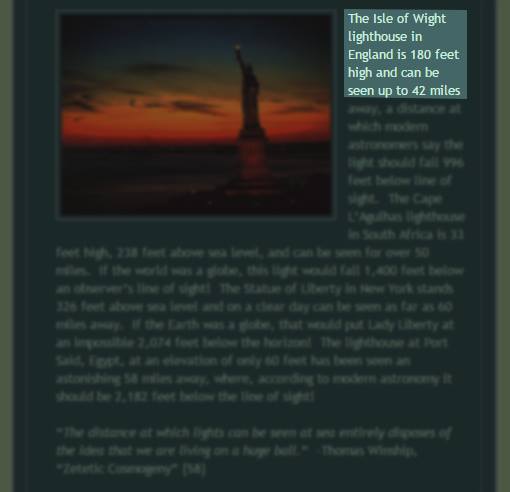
Both on Eric Dubay's page and in his book he states: "The Isle of Wight lighthouse in England is 180 feet high and can be seen up to 42 miles away, a distance at which modern astronomers say the light should fall 996 feet below line of sight."
Is he saying that the lighthouse can be seen?
Or is he saying the light from the lighthouse can be seen?
HUGE DIFFERENCE!
If he is saying the lighthouse can be seen from that distance, then he is flat our WRONG!
Or there was an awesome superior mirage! But at night?
The claims appear to come from the book "Zetetic Cosmogony" and you can see what it says and download it for FREE from Google Books. It clearly says the LIGHT is visible from 42 miles and that is it 7,000,000 candle power. So sure I believe the light can be seen and here is why.
Info below Credit:
https://britannica.com/topic/lighthouse
External Quote:
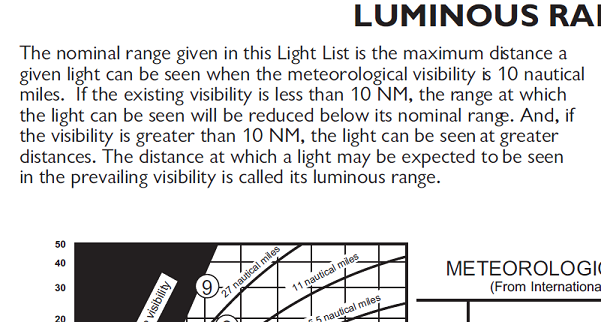
The luminous intensity of a light, or its candlepower, is expressed in international units called candelas. Intensities of lighthouse beams can vary from thousands to millions of candelas. The range at which a light can be seen depends upon atmospheric conditions and elevation. Since the geographic horizon is limited by the curvature of the Earth, it can be readily calculated for any elevation by standard geometric methods. In lighthouse work the observer is always assumed to be at a height of 15 feet, although on large ships he may be 40 feet above the sea. Assuming a light at a height of 100 feet, the range to an observer at 15 feet above the horizon will be about 16 nautical miles. This is known as the geographic range of the light. (One nautical mile, the distance on the Earth's surface traversed by one minute of arc longitude or latitude, is equivalent to 1.15 statute miles or 1.85 kilometres.)
The luminous range of a light is the limiting range at which the light is visible under prevailing atmospheric conditions and disregarding limitations caused by its height and the Earth's curvature. A very powerful light, low in position, can thus have a clear-weather luminous range greater than that when first seen by the mariner on the horizon. Powerful lights can usually be seen over the horizon because the light is scattered upward by particles of water vapour in the atmosphere; this phenomenon is known as the loom of the light.
[...]