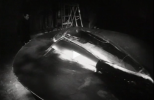
CLAIM: 1950 McMinnville (OR) photo by the Trents is a 25' flying saucer

this would be lightweight enough for wires or fishing line.
Article:
or a Dual record changer spindle part from 1940,

From the ufoexplorations website, the author suggests the LIFE photographer realized how the hoax was done and set up the boy on the ladder to hint at it (though the photo was not printed) and I agree it seems likely:
External Quote:
One has to consider Dean's motivation. It is probable that he took the photo to 'pictorially hint' his belief that Paul Trent's
photos were hoaxed. Was Dean trying to visually document one way in which he thought that the prank might have been pulled?
[Source]

I don't know what order the LIFE pix were taken but this is presumably a set-up shot, since in the other photo the ladder is tipped over.

The article also points out that forced perspective works better from a low angle:

External Quote:
If Trent crouched down low, he could make the flying saucer look farther away than it really was:
By kneeling down even a little bit, and by shooting up from that position, he could force the perspective of the resulting photo to make it appear to have greater distance, yet remain reasonably sharp in focus.

re. Dual record changer spindle part from 1940
Interesting. The profile matches the UFO pretty well (I've never found a wing mirror or shaving mirror profile that matches), but the hole for the spindle is centered. I haven't found a photo of the underside of this object to see if it's hollow or has a flat base.

1715645017410.png


(That part from the 1940s became this arm in the 1970s to hold the waiting record horizontal while waiting to drop)
1715645786063.png
 
Last edited:
see if it's hollow or has a flat base.
its hollow. the spindle you see on it is not attached to it, that is the phonograph spindle. so they added something different to it and if they didnt screw it tight (nut and bolt) it would be loose and could lean.

1715647356977.png

1715647404566.png

https://www.dual-board.de/index.php?thread/1369-1001/

and I agree it seems likely:
totally. i think the photographer also asked to get a photo of him next to his truck.

i dont think hubby was home during the ladder shots, thats why i asked if Loomis Dean (Life photographer)ever said the ladder when there when they arrived. Evelyn alleged at one point she let two men rifle through her entire house (the drawers and all) at one point, so if the photographer asked if she had a ladder i doubt she would say "no", but would let him go get it.
 
Last edited:
just rough idea. took pic from about 10 feet away, then zoomed in once uploaded to computer. round tupperware type lid.

1715649223100.png

1715648918244.png


the lids have a little bump in the middle which i assume is dead center. so made hole there
1715649566362.png
 
Last edited:
One query about the model hanging from the wire theory is that the wires are quite dark, whereas the 'flying saucers' are faded, exhibiting the 'aerial perspective' you'd associate with an object further away.
 
One query about the model hanging from the wire theory is that the wires are quite dark, whereas the 'flying saucers' are faded, exhibiting the 'aerial perspective' you'd associate with an object further away.
Also known as atmospheric perspective in art. And yes it does.
 
One query about the model hanging from the wire theory is that the wires are quite dark, whereas the 'flying saucers' are faded, exhibiting the 'aerial perspective' you'd associate with an object further away.
But we don't know what material the object is made from. If the wires themselves are insulated with a black coating, and the object is made of some light-colored material like aluminum, the comparative values may have nothing to do with aerial perspective. Remember, one of the pictures taken shows an entirely different exposure, or perhaps an entirely different lighting condition if the sun is shining through the cloud cover more brightly.
 
One query about the model hanging from the wire theory is that the wires are quite dark, whereas the 'flying saucers' are faded, exhibiting the 'aerial perspective' you'd associate with an object further away.
I think I gotta disagree. The UFO is not as dark, but it may in fact not have been as dark as the wires. Comparing how sharp the edges of the UFO and the wire are, by moving a bit of the wire in close to the UFO then zooming in on both, I'm not sure I see much difference.

ufo edge v wire edge.png
 
I think I gotta disagree. The UFO is not as dark, but it may in fact not have been as dark as the wires. Comparing how sharp the edges of the UFO and the wire are, by moving a bit of the wire in close to the UFO then zooming in on both, I'm not sure I see much difference.

View attachment 68682

What difference there might be, could have been enhanced a little if the model were moving a bit, while the wires are stationary.
 
Here are the photos, supposedly taken 30 seconds apart. Note that Paul says after taking the first photo, the object began accelerating off to the left so he moved right to take the second photo, then it shot away. Robert Sheaffer reproduced a stereoscopic exercise on his blog that supposedly shows the object is small and close and also did not move between frames, as well as reporting on two studies that possibly detected a wire, but I wanted to try something else...

1715053881934.png
1715053891877.png

Except....he doesn't move to the right to take the second photo. He cannot have done, because that pole that is exactly to the right of the fuel tank in photo 1 is now further to the right of the fuel tank....which would only occur if he had moved left. Also, judging the small bush thats more or less in line with that pole to be behind it, that is all the more evidence that actually he moves to the left after taking the first photo.

BUT...we then have the bizarre anomally that the background horizon is more extensive to the left in photo 2 ( see for example the extent of it compared to where that notch in the hill is ) as if he had moved to the right.

This does not make sense. Some aspects of the photo indicate he moved one way...and other aspects indicate he moved the other way.
 
What difference there might be, could have been enhanced a little if the model were moving a bit, while the wires are stationary.
I suspect the edge of the saucer being more curved might also be a factor, as the compression jaggedness is more pronounced -- for that reason, I used the most curved bit of the wire in the image, but the degree of curve there is still much less...
 
Except....he doesn't move to the right to take the second photo. He cannot have done, because that pole that is exactly to the right of the fuel tank in photo 1 is now further to the right of the fuel tank....which would only occur if he had moved left. Also, judging the small bush thats more or less in line with that pole to be behind it, that is all the more evidence that actually he moves to the left after taking the first photo.
This does not make sense. Some aspects of the photo indicate he moved one way...and other aspects indicate he moved the other way.
I think I see what you mean. In the darker photo the scraggly bush by the left pole is on the right side of the pole, and in the lighter photo it's more on the left side. But in the lighter photo the mountains and building in the further distance appear shifted more to the right. In the darker photo the slope of the edge of the shed roof is a shallower angle, and in the lighter photo it's steeper, which I think would also indicate the lighter one is taken from further to the right. Trying to figure out the parallax with the bush and the more distant objects is making my head hurt.

1716167093537.png
1716167172464.png
 
Trying to figure out the parallax with the bush and the more distant objects is making my head hurt.
try setting up small objects on your livingroom floor or wherever you can move a bit. if they are small enough you can even use a long diningroom table.

this pic helps you "see" the darker pic a bit better...this photographer isnt in the exact position but everything is clearer (note: the barn door is open so the telephone pole is only visible through the little opening above the barn door.)
dacafd5c58536f8e_large.jpg
 
this pic helps you "see" the darker pic a bit better...this photographer isnt in the exact position but everything is clearer (note: the barn door is open so the telephone pole is only visible through the little opening above the barn door.)
Ah excellent, thank you. I didn't realize the bush was much closer and in front of the pole, I was wrongly thinking it was some ways behind the pole. Brain no longer hurts. :)
 
Just correcting what I wrote in #80. The yellow pin labled "house" can't be the house in the photos. There was another building [labled "Barn A" below], possibly idential, that is now no longer there, which has to be building we see in the two photos. "Barn B" I think is out of the frame.
Corrected using this aerial photo from 1954. https://earthexplorer.usgs.gov/download/options/aerial_combin/AR1VFLHC0010051/

Screenshot 2024-05-20 at 14.37.37.png
 
I think I see what you mean. In the darker photo the scraggly bush by the left pole is on the right side of the pole, and in the lighter photo it's more on the left side. But in the lighter photo the mountains and building in the further distance appear shifted more to the right. In the darker photo the slope of the edge of the shed roof is a shallower angle, and in the lighter photo it's steeper, which I think would also indicate the lighter one is taken from further to the right. Trying to figure out the parallax with the bush and the more distant objects is making my head hurt.

Yes, its actually a good example of how deceptive photography can be, because to me the pole and the bush 'look like' they are adjacent to the end of the garage. In reality they are twice as far away as shown in post #99... https://www.metabunk.org/threads/cl...rents-is-a-25-flying-saucer.13460/post-316174

But that also highlights just how easily a 2 foot wide model could appear to be a mile away.
 
noticed this second photo from Life magazine and realized the angle of the ladder legs might help people visualize the situation better.

Yes, it does. But it also highlights just how lacking in forward dimensional extent the original two photos are. That is, the photo already contains stuff where a viewer might confuse the distance, even without the UFO being thrown in. The Calvine UFO in Scotland is a similar case, where there's confusing visual cues aside from the UFO.
 
Yes, it does. But it also highlights just how lacking in forward dimensional extent the original two photos are. That is, the photo already contains stuff where a viewer might confuse the distance, even without the UFO being thrown in. The Calvine UFO in Scotland is a similar case, where there's confusing visual cues aside from the UFO.
Interesting, now I want to go look at more classic UFO pics, and see if that is a common feature. One could speculate that this might help with the illusion passing off a small model UFO for a larger distant one -- meaning that UFO images with such such visual cues would enjoy an advantage in competing with other pictures to BECOME classic UFO pics!
 
Interesting, now I want to go look at more classic UFO pics, and see if that is a common feature. One could speculate that this might help with the illusion passing off a small model UFO for a larger distant one -- meaning that UFO images with such such visual cues would enjoy an advantage in competing with other pictures to BECOME classic UFO pics!

I think @Scaramanga and @JMartJr are onto something here. I'm not aware of unsolved UFO photos with clear depth cues,
e.g. a craft hovering in front of/ partly occluding the Hollywood sign, pylons/ tall buildings or identifiable trees.

It's like a kind of natural selection, the more visual information in the photo the easier it is to debunk; it's harder to explain an object apparently in clear sky.
 
Speaking of which, by cropping the Condon photo to match the Trent photo, it's clear the two photographs were taken at different angles (i.e. tilt). The white rectangles below mark the same house. The white arrows show where the distant hills are intersecting with the garage. The LIFE photo was taken at a tilt in between these two extremes.

1715056413864.png
The height of the horizon indicates the level of the camera. You can compare where it meets the house/tank. Paul Trent's photos were taken from a lower position than the LIFE photographer's. A possible reason:
The article also points out that forced perspective works better from a low angle:
External Quote:
If Trent crouched down low, he could make the flying saucer look farther away than it really was:
By kneeling down even a little bit, and by shooting up from that position, he could force the perspective of the resulting photo to make it appear to have greater distance, yet remain reasonably sharp in focus.
For example, the camera might be set up on a tripod at waist height.

Unless Paul Trent was a midget (or the kid actually took the pictures), this also disproves the tale that these photos were snapshots, because it'd be weird (and it is not told) to crouch down for these.
 
I'm amazed that we're in 2025 and this has yet to be debunked
I have a fairly good idea what happened.
As did Mr Hartmann, working for Condon, back then.

I am also not amazed that we're in 2025, and we still don't have a clear shot of a flying saucer, much less formal relations with another planet.
 
For the Condon Report on this case by Hartmann, [..]: [p. 614, download pdf here]
page 608:
SmartSelect_20250601-081016_Samsung Notes.jpg

It seems strange that, given these movements, the photographer ended up in the backyard. I'd expect the couple to meet on the driveway in front of the house; or, if exiting the house through the back door, to run around it to the front, instead of running away from it and the UFO towards the yard where the overhead wires are.

page 610:
SmartSelect_20250601-081211_Samsung Notes.jpg

This shows that the Trents did not attach much value to the photos; as if they were self-fabricated trick shots that had turned out a disappointment.
 
The height of the horizon indicates the level of the camera. You can compare where it meets the house/tank. Paul Trent's photos were taken from a lower position than the LIFE photographer's. A possible reason:

For example, the camera might be set up on a tripod at waist height.

Unless Paul Trent was a midget (or the kid actually took the pictures), this also disproves the tale that these photos were snapshots, because it'd be weird (and it is not told) to crouch down for these.
Agree. This is not due to camera tilt. Camera tilt does not cause parallax effects. This is due to camera position. The camera in the UFO photo is lower to the ground than is the camera in the 1967 photo.

Due to parallax effects, nearby objects "rise" in relation to distant objects when the camera is lowered.

That's all explored in depth here: https://web.archive.org/web/20020606025701/http://www.ufx.org/mcminn/photo.htm

Kneeling with one knee on the ground is not a great position... it hurts your knee and it hurts your neck. Kneeling with two knees isn't really any better.

roamerpose.jpg


These folks had a tripod? Not likely. Very few people other than advanced amateurs had tripods at the time.

roamerwlf.jpg


If I were taking a hoax photo, and wanted a low angle, I'd be sitting on a chair. ... or a lower rung of a ladder?
 
Last edited:
In those photos you've posted... Look at how awkward this is. Sitting on something, even the ground is so much better.

Look at the neck of these people and the awkward angle to the viewfinder. And... They're not tilting the camera up. Try it. Sitting is so much better. You can lean your body back.

But that's just speculation based on my experience. If it were me, I'd sit on that ladder. Or a chair. Why not be comfortable? Why not lean back? Instead of breaking your neck...

Second choice would be to sit on the ground. Much more stable and the rocks don't hurt your knee. (But I'm not sure about sitting in a farm yard. Did they keep chickens?)

Or... you could rest the camera on a lower rung.
 
Last edited:
To be fair, we don't know why that ladder appears in the LIFE photos. The LIFE people may have dragged it out to get a photo of the boy on the ladder, to get an idea of the position of the saucer in the sky.

Then after they got that shot, they knocked it over so that it wasn't in the way.

Or... the Trents may have used it on a daily basis for something. Like loading something on a truck bed?
 
Last edited:
This shows that the Trents did not attach much value to the photos; as if they were self-fabricated trick shots that had turned out a disappointment.

I forgot about that part of the story! Not that it makes much sense. A reporter hears about the sighting from some bankers? So, the Trent's, or someone else the Trent's spoke to, passed this story to at least 2 people in town and it made it's way to the reporter. Then he goes out to the ol' farmstead and starts looking around their house? If true, I suppose after talking to the Trents he helped them look for the photo, or maybe they had the photo and they all went looking for the negatives. Strange, though it does point out nobody seemed overly impressed with the photo(s) at the time.

I'm amazed that we're in 2025 and this has yet to be debunked

It's from 75 years ago, so we're largely left speculating. The context of the photo fits the UFO zeitgeist of the time, it's a flying saucer, not an orb or TicTak or black triangle of more modern times. There were no other witnesses or physical evidence associated with it. Even if real, the Trent's didn't seem overly concerned about it. They didn't have the film developed until some time later, didn't seem to say a lot about it and when a reporter came asking, the negatives were under the couch.

Like the Calvine photo of the '90s, the Gulf Breeze photos of the '80s and Billy Meier's photos of the '70s, this photo can be done in camera with little to no extra steps. Likely in this case, it's a model hung off the wires between the house and garage. But, even if one goes out to the current house with a vintage camera, hangs a model up and recreates the photo, it just shows it could be done that way, not that it necessarily was.

It appears to be a product of its time and corresponds to the "Flying saucer" craze of the late '40s. In January of 1950, a low budget B movie called The Flying Saucer was released with of course a flying saucer:
1748791198657.png
1748791304206.png


Interesting side note, the lead character in the movie is named "Mike Trent".

The book Flying Saucers are Real, by Donald Keyhoe, the granddaddy of disclosure, also came out in 1950.

The current cultural impact of these photos nowadays is more a result of them being used as an excuse for a party and the McMinnville UFO Festival. Now in it's 25th year.
 

Attachments

  • 1748791253541.png
    1748791253541.png
    1.2 MB · Views: 43
page 610:
View attachment 80835
This shows that the Trents did not attach much value to the photos; as if they were self-fabricated trick shots that had turned out a disappointment.

Note that there's no record of the Trents reporting their sighting (May 11) to anyone until they got the photos back from processing (they didn't even drop off the film for a few days). Then he shows them around with the UFO story and the banker takes note and tells the local reporter, and the local paper runs a story - this is a month after the photos were taken:

1748835144660.png

Source: Telephone Register, Jun 8, 1950 "At Long Last - Authentic Photographs of Flying Saucer? (p.1)

Then local radio. Then more west coast papers. Then LIFE magazine. Then they're being flown to New York to appear on TV.

With every step it very quickly spins further out of control. It becomes harder and harder for the Trents to confess. Every neighbor who vouched for their honesty as salt-of-the-earth hardworking farmers (a "man of integrity") would be made a fool of.

1748834759239.png


Over the next 3 decades, sporadic interviews revive the case and suddenly the Trents are talking about other witnesses, all conveniently unavailable for comment - his parents down the road (dead), a neighbor (dead), another neighbor (moved away, lost touch).

They didn't attach value to the photos (and discarded the negatives) until others took them seriously.
 
Back
Top