Transients in the Palomar Observatory Sky Survey

For some context:
arXiv is a forum for professional members of the scientific community, providing rapid distribution of new research. As part of the service all submissions are subject to moderation. Material submitted to arXiv is expected to be self-contained and of interest, relevance, and value to the disciplines we serve.

Please note that the arXiv moderation process is not a peer-review process. arXiv staff and moderators cannot give feedback on the submission.
Who are arXiv moderators?
arXiv moderators are volunteer subject matter experts with terminal degrees in their field. They evaluate each submission's content and category, following arXiv policies. arXiv moderators are approved by their discipline-level advisory committees and by arXiv staff.
What policies guide moderation before public announcement?
The moderation process primarily occurs after a user submits a work and before the work is made public. Each work is evaluated based on its content. arXiv moderation decisions may be influenced by the publication status of the submission, but prior publication does not guarantee acceptance in arXiv. Submitters who have had works previously delayed or declined by arXiv should anticipate closer scrutiny on future submissions. arXiv reserves the right to reclassify or decline any submission.
Declined submissions
arXiv, in its sole discretion, may decline to post works submitted to the platform. The following list includes example topics that could lead to a submission being declined. This is not an exhaustive list, and some works that have been published or accepted by a journal may still be declined at arXiv's discretion.

Scholarly Standards
Submissions to arXiv must comply with appropriate standards of scholarly communication in form, including appropriate and carefully prepared sections, figures, tables, references, etc. Language standards require professional communication, and sufficiently neutral tone (see also Code of Conduct). General scrupulousness and care of preparation are required.

Scholarly interest
arXiv moderators expect submissions to be of scholarly archival interest to the communities they represent. A submission may be declined if the moderators determine it lacks originality, novelty, significance, and/or contains falsified, plagiarized content or serious misrepresentations of data, affiliation, or content. Submissions should focus entirely on the scientific research and avoid extraneous personal or political statements. [emphasis added]

Submissions that do not contain original or substantive research, including course projects, research proposals, news, or information about political causes (even those with potential special interest to the academic community) may be declined.
[emphasis added] Submissions in need of significant review and revision may also be declined.
Duplicated content
If we notice that an author has made multiple similar submissions, or that a new submission appears to be a revision of a recent submission, we may request that the submissions be consolidated or versioned
Can I appeal a moderation decision?
It is possible to appeal the classification of an announced article or the decision to decline a submission. In some cases, we may require that a paper be accepted for publication in a conventional journal before an appeal is considered. Note that some works that have been published or accepted by a journal may still be declined at arXiv's discretion.

I've seen, for example, Avi Loeb updating a 3I/Atlas preprint with a second versioned draft of the same preprint on Arxiv, but the vague description of the Villarroel "companion papers" that were removed makes it sound like they were neither new versions of the previous nuclear correlations paper (which had already been on Arxiv and was later published) or entirely papers being submitted to a journal for publication, just a remix.
 
It's a good reminder about how unserious these people are.

Just me, but I think Mellon is very serious. There are certainly those in UFOlogy that are grifters and likely a large amount of quasi-grifters, but Mellon seems to really believe this stuff.

I think these Villarreol papers were a very big deal in the UFO world. One can go back through this thread and find some proponents claiming that people on Metabunk should not even dare to question Villarreol's findings. It was all reviewed, published and well beyond anyone here's understanding. We were further told that any attempt to critique any of Villarreol's findings MUST follow from a pre-stated falsifiable hypothesis, even though Villarreol seemed to skip this step.

These papers were touted in and on nearly every UFO media site. Villarreol did the interview circuit and pulled out the Galileo defense. These were full on peer reviewed, published papers that found transients, likely Techno-signatures (UFOs), from back in the '50s. Follow up papers showed definite correlation to these transients and UFO sightings and nuclear testing. These were UFOs, on old plates, linked to reports and the known interest of UFOs for nuclear stuff. These weren't videos on r/UFOs that turned out to be Starlink. This was the real deal. I think these papers were monumental in some circles.

Now the whole basis for them, the transients, has been called into question. And not by the skeptics. Rather it was group of UFOlogist that took Villarreol down, including one of her own collaborators. This could be huge in the UFO world. The recent Trump UFO announcement has glossed over this for now, but this could lead to a big split in the UFO world.

Mellon is definitely in the Skinwalker Ranch aligned camp, with close ties to Elizondo, Puthoff, Davis and TTSA at its beginning, but by and large the UFO/Disclosure community sticks together.

Recall that the paper The New Science of UAP credited Elizondo's own 5 Observables to the DoD, recounted lots of dubious UFO events and was co-authored by many of popular, as well as up and coming UFO people. Everyone from Nolan and Vallee to the Tedescos AND Villarreol were credited as coauthors.

Now the lead author, Kevin Knuth, along with other New Science of UAP coauthors, including Villarreol's collaborator WA Waters, have seriously rebutted Villarreol's main contentions. They went so far as to accuse her of circular reasoning in addition to her not having even a basic understanding of the relevant literature concerning images on the plates. Again, these are not skeptics, these are UFOlogist.

but the vague description of the Villarroel "companion papers" that were removed makes it sound like they were neither new versions of the previous nuclear correlations paper (which had already been on Arxiv and was later published) or entirely papers being submitted to a journal for publication, just a remix.

I think if one is in the Villarreol camp, as Mellon appears to be, then ANY attempt to have any of her work "censored" is cause for concern.
 
Note:
External Quote:
Note that some works that have been published or accepted by a journal may still be declined at arXiv's discretion.
Tip: Use the square button next to the quote button for external content. The quote button is intended for forum content, and it'll get cut when replying to your post.
 
Beatriz Villarroel noted that arXiv is looking to hire a new CEO. She would prefer one friendlier to UFO/UAP papers such as her own:

Also, if any of you are qualified and interested, the salary is expected to be around $300k:

https://jobs.chronicle.com/job/37961678/chief-executive-officer

According to the Gemini, "arXiv receives over 24,000 new submissions per month," but I'm sure the CEO will make an effort to screen all UFO/UAP related work personally.
/s
 
Dr. Villarroell posted on X about a preprint that reports finding similar transients in sky survey from the 1950's conducted at Hamburg Observatory.


Source: https://x.com/DrBeaVillarroel/status/2036379674477998209


I haven't had a change to read through it yet but the paper is here:

https://arxiv.org/pdf/2603.20407

Abstract:
External Quote:
Fast astronomical transients were observed by the VASCO Project (B. Villarroel et al. 2020) in photographic sky surveys conducted in the 1950s. Those searches analyzed the Palomar Observatory Sky Survey (POSS-I and POSS-II) digitized plates. In this article, we present a preliminary report on a similar but independent search using archival plates taken at the Hamburg Observatory with the Großer Schmidtspiegel 1.2-m Schmidt camera, also from the mid-1950s. These plates were digitized by the APPLAUSE Archive, which provides both images and tables of detected objects. By analyzing pairs of plates taken in rapid sequence (about 30 minutes apart) of the same sky regions, we find evidence of transients similar to those previously reported by the VASCO Project for POSS plates. While the analysis is ongoing, one notable result is that our findings independently confirm that these transients exhibit systematically narrow full width at half maximum (FWHM) compared to stellar point spread functions. This provides further support for their interpretation as sub-second optical flashes, consistent with reflections from flat, rotating objects in orbit around Earth.
 
@MonkeeSage - beat me to it!

Another paper has been released stating that they have found "evidence of transients similar to those previously reported by the VASCO Project for POSS plates" but in other plates.

https://arxiv.org/abs/2603.20407

Fast astronomical transients were observed by the VASCO Project (Villarroel et al 2020) in photographic sky surveys conducted in the 1950s. Those searches analyzed the Palomar Observatory Sky Survey (POSS-I and POSS-II) digitized plates. In this article, we present a preliminary report on a similar but independent search using archival plates taken at the Hamburg Observatory with the Großer Schmidtspiegel 1.2-m Schmidt camera, also from the mid-1950s. These plates were digitized by the APPLAUSE Archive, which provides both images and tables of detected objects. By analyzing pairs of plates taken in rapid sequence (about 30 minutes apart) of the same sky regions, we find evidence of transients similar to those previously reported by the VASCO Project for POSS plates. While the analysis is ongoing, one notable result is that our findings independently confirm that these transients exhibit systematically narrow full width at half maximum (FWHM) compared to stellar point spread functions. This provides further support for their interpretation as sub-second optical flashes, consistent with reflections from flat, rotating objects in orbit around Earth.

There only seems to be one photo of a suspected 'transient'....
1774351130262.png

Their method only appears to find 'transient', that is - objects that are in one expose but not the next. It doesnt seem to have the 'three transients in a line' criteria that that the Villaroel paper had.


Attachments

I find this very sloppily worded:
"While the analysis is ongoing, one notable result is that our findings independently confirm that these transients exhibit systematically narrow full width at half maximum (FWHM) compared to stellar point spread functions."

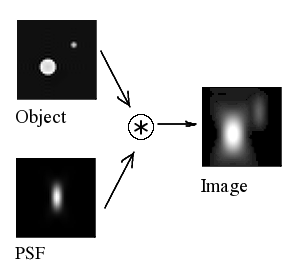
Stars don't have point spread functions. Point spread functions are a property of the optical system in use. They represent the idealised distribution of how a theoretical point source at infinity would spread light across the sensor. Non-point-sources have their signal convolved with the PSF, but this is a linear function, the smearing of a sum of parts is the sum of the smearings of the parts. I say idealised, as there can be deviations away from the centre of the frame.

Convolution_Illustrated_eng.png

img link: https://upload.wikimedia.org/wikipedia/commons/c/c2/Convolution_Illustrated_eng.png
via: https://en.wikipedia.org/wiki/Point_spread_function

If he's saying "these things don't distort through the optics how stars distort through the optics" then that might point to "these didn't come through the optics", surely?
 
Stars don't have point spread functions. Point spread functions are a property of the optical system in use. They represent the idealised distribution of how a theoretical point source at infinity would spread light across the sensor. Non-point-sources have their signal convolved with the PSF, but this is a linear function, the smearing of a sum of parts is the sum of the smearings of the parts. I say idealised, as there can be deviations away from the centre of the frame.
Stars don't have PSFs, but this paper contains some good ideas. Radial profiling of nearby stars is awesome. I'm going to try that.
The method of comparing two plates with overlapping FOVs is also great. Sadly this method cannot be used with POSS-I red plates.
 
Given the weight attributed to the FWHM by the author attempting to point to short duration flashes, an enterprising person could go back and compare the FWHM for the removed X-Y scan direction defects and see if they are similar to the FWHM in the supposed transients.

https://arxiv.org/pdf/2603.20407 p4
External Quote:
While the final interpretation of the morphological properties of the detected transients is still under analysis, onenoteworthy result should be highlighted regarding their FWHM. Specifically, the events exhibit systematically FWHMcompared to stellar point spread functions, consistent with their interpretation as extremely short-duration flashes(see Fig. 2). As discussed by (B. Villarroel et al. 2025a), unresolved flashes lasting less than a second naturally appearsharper and more circular than stellar images, particularly on long-exposure plates where stars are significantly blurredby seeing and tracking errors. Such profiles are therefore an expected observational signature of sub-second opticalflashes, further reinforcing the transient interpretation.
 
I find this very sloppily worded:
"While the analysis is ongoing, one notable result is that our findings independently confirm that these transients exhibit systematically narrow full width at half maximum (FWHM) compared to stellar point spread functions."

Stars don't have point spread functions. Point spread functions are a property of the optical system in use. They represent the idealised distribution of how a theoretical point source at infinity would spread light across the sensor. Non-point-sources have their signal convolved with the PSF, but this is a linear function, the smearing of a sum of parts is the sum of the smearings of the parts. I say idealised, as there can be deviations away from the centre of the frame.

Idealised? Why? I believe it is an rather exact function, calculated from the optical specifications. Or are you referring to the additional aberrations from the optics? Or atmospheric seeing conditions?
 
Back
Top