Syria UAP 2021- Apparent Instantaneous Acceleration

Mick West

Administrator
Staff member

Source: https://youtu.be/nKtJslcHlCQ


External Quote:

DATE - 2021

LOCATION - Syria / imaged from the border of Jordan (32°05'39.2"N, 36°53'54.4"E)

IMAGING TYPE - Thermographic / Forward Looking Infrared (FLIR)

PLATFORM - MQ-9 Reaper / Multi-Spectral Targeting System (MTS-B)

EVENT DESCRIPTION - Filmed by a platform operating under the direction of the United States Air Force. The UAP was observed and actively tracked - the Reaper established a weapons-quality lock. The UAP appeared to demonstrate abrupt directional changes, instantaneous acceleration, and intelligent control. Absence of traditional propulsion or thermal signatures during performance - as well as an examination of shape and acceleration - were noted in documentation. Origin, intent, and capabilities remain unknown.


Best reference footage:
https://sitrec.s3.us-west-2.amazonaws.com/1/Syria Combined Clip B 29.97-8b0bbf42b44a.mov
 
Last edited:
It's FLIR1-like, except there isn't a change in field of view when the object apparently zips off.
I also don't see apparent jumps in both aircraft and camera heading values. But I'm sure people will look into this in detail.
An interesting one for once.
 
2026-02-03_22-14-23.jpg

This is the frame where it loses lock. I suspect because of a lack of contrast.
 
There's some oddness going on with the gain, and it's not clear what time this oddness happened. Here's is just before the "move". Note how "bright" it is (i.e. colder than the background)
2026-02-03_22-32-56.jpg


A few frames later it's less bright. I've stabilized it on the object. While it seemed like it moved up, I'm not sure. There's a dark region in both

2026-02-03_22-34-10.jpg


2026-02-03_22-34-10.jpg


Then it reaces the edge of the brighter region, fairly bright again
2026-02-03_22-39-53.jpg


Two frames later, it's much smaller.
2026-02-03_22-40-37.jpg


This is very clearly a video artifact causing the shrinkage. Possibly some kind of localized gain adjustment. But what is odd is that it also affects the on-screen display.

2026-02-03_22-43-19.jpg


So I think we are seeing the illusion of motion away from the camera dues to some odd localized gain reduction, and the vertical motion is possibly the camera stopping tracking it due to the loss of contrast
 
The weird dark areas can be seen through the video, in particular there's a large dark region we see here centered on the N
2026-02-03_22-53-58.jpg


Later, we see this dip down to the level of the object.


With a very similar thing with apparent movement


So I think a balloon seems quite likely here, combined with some interesting camera artifacts.
 
Last edited:
Also much smaller, given slant range and 4x UNFOV zoom. Plus that number next to the brackets (e.g. 5M), corresponding size on the ground in meters?
2026-02-03_23-00-54.jpg


Yeah, and it's interesting how much bigger it gets at different gain levels inside a 5M box.

I think at most it's 1m wide, and likely half that or less.

Small, cold, not really moving much....
 
Except that it's BLK (black is hot), and this is a cold (white) object.

This is not necessarily the case. Some objects can be more reflective than emissive. Hypothetically speaking, if this object was a mylar balloon it could be reflecting IR from its surroundings more than the heat and IR from within. Here's an example from Dave Falch showing two mylar balloons in IR and they appear to be both hot and cold. What is actually happening here is that the balloons are reflecting the warm ground and the cold sky around their hemispheres giving the appearance of an object with a weird "hot and cold" heat signature.


Source: https://www.youtube.com/watch?v=jtyDrgiU-v0
 
Last edited:
My initial reaction to this is I saw stepping/jerking in the camera before and after it loses lock - similar to the stepping that occurs on gimbal, you can tell by watching the horizon, though I don't see any on-screen readouts that would suggest this is a gimbal system (but I don't know enough about that). Moments before it loses lock, you can see several vertical jerky movements of the camera, as if the system is approaching its gimbal lock position and needs to sharply rotate.

My instant reaction is that the graininess, combined with contrast, combined with stepping/jerking forces the system to lose lock and the object "darts off" just like the FLIR video.

(please correct me if I'm not using the correct terms here)

Also: typical LIZ video, as usual.
 
and the vertical motion is possibly the camera stopping tracking it due to the loss of contrast

The precise LOS coordinates at the bottom right seems to indicate the camera starting to pan more upwards around the loss of lock, versus mostly left to right before. The second number remains around 92850 when the object is locked, then it starts going up, lock is lost, and it ends up around 93350 before the change of zoom.

Because the object is going up in the FOV along with the line of sight, this looks to me like the object is causing this motion, not the camera. If the object didn't change its position and the camera was suddenly panning up, it would move down in the FOV, no?
 
My initial reaction to this is I saw stepping/jerking in the camera before and after it loses lock - similar to the stepping that occurs on gimbal, you can tell by watching the horizon, though I don't see any on-screen readouts that would suggest this is a gimbal system (but I don't know enough about that). Moments before it loses lock, you can see several vertical jerky movements of the camera, as if the system is approaching its gimbal lock position and needs to sharply rotate.

My instant reaction is that the graininess, combined with contrast, combined with stepping/jerking forces the system to lose lock and the object "darts off" just like the FLIR video.

(please correct me if I'm not using the correct terms here)

Also: typical LIZ video, as usual.
Possibly the least impressive of the military-sourced videos, since most of the action appears to be the zoomed-in and gimballed camera on a moving platform at elevation trying to keep track of a small, distant object.
 
Rough Sitch
https://www.metabunk.org/sitrec/?custom=https://sitrec.s3.us-west-2.amazonaws.com/1/Syria 2021/20260204_183340.js

For some reason I got the video exported at 60fps, so frames reflect that. It's actually at 30, so I'll have to redo a little (no change to the results, I'll just divide the frame numbers by 2)


But the immediate result we see is that there's a crossover region in the lines of sight, which suggests the drone is following something that's not at ground level and something slow.
2026-02-04_10-43-34.jpg

So this feels consistent with a wind-blow mylar balloon.

This was from a relatively small number of points. It might benefit from a more fine-grained record of what happens at the time of the apparent fly-away. The numbers are very hard to read at times, and the military grid display's last two numbers are generally indecipherable
The 20,000ft altitude is rough, from the matching the early slant range
 

Attachments

Last edited:
To duplicate the above, drag in the video first, and then the drone and ground tracks. Then set the camera track to the drone and "follow target"

I've updated the MQ9 UI to display more of what we see
https://www.metabunk.org/sitrec/?cu...amazonaws.com/1/Syria 2021/20260205_055537.js
2026-02-04_18-32-57.jpg


Does someone have information on what the military coordinates exactly mean? What's their unit?
It MGRS. 5 digits means 1 meter resolution within a 100km square.
https://en.wikipedia.org/wiki/Military_Grid_Reference_System
 
Last edited:
This is very clearly a video artifact causing the shrinkage. Possibly some kind of localized gain adjustment. But what is odd is that it also affects the on-screen display.
It looks like it's a screen being filmed, so not the original footage - tell-tale signs being (a) the above; and (b) tearing/sync issues. If so, we now have twice as many degrees of freedom when it comes to mundane imaging issues that can be misperceived.

EDIT: in the interests of honesty, I would also like to have seen some display-resolution-based spacial aliasing artefacts to properly confirm the above hypothesis, but I don't remember seeing any. Therefore don't take it as any kind of truth, merely something on the table.
 
Last edited:
@Mick West , a few remarks about the balloon hypothesis.

1. For once we have exact coordinates for the aircraft, and the LOS. Don't you expect to find a compelling path for the balloon you hypothesize? What clear path do you see in Sitrec to say the object is "consistent with a wind-blow mylar balloon" ?

2. The object goes in the direction of the camera (up) when lock is lost. This looks like a change of direction of the object (why other debunkers on X favor the drone hypothesis).

3. The object exits the FOV in a few frames, but it doesn't seem that there is a jump in the camera at that moment, from the military coordinates. A caveat for that is that we don't quite see the last two digits, so maybe it's happening but it's minimal if so. Also unless proven otherwise the object cannot be found on screen after unzooming 4X, and it should be in the frame if it maintained constant speed/heading. So where did it go? It was clearly visible in the prior NAR and UNAR FOV segments.
 
1. For once we have exact coordinates for the aircraft, and the LOS. Don't you expect to find a compelling path for the balloon you hypothesize?
No. These are not particularly accurate numbers. I would not expect a perfect path to pop out.

2. The object goes in the direction of the camera (up) when lock is lost. This looks like a change of direction of the object (why other debunkers on X favor the drone hypothesis).
If the object was going screen-up before, why would it not continue after the lock was lost? I think it's very difficult to determine what is going on with the local contrast adjustments that seem to be happening.
3. The object exits the FOV in a few frames, but it doesn't seem that there is a jump in the camera at that moment, from the military coordinates. A caveat for that is that we don't quite see the last two digits, so maybe it's happening but it's minimal if so.
It might be useful to extract those numbers at a finer resolution, and plot them.
 
If the object was going screen-up before, why would it not continue after the lock was lost? I think it's very difficult to determine what is going on with the local contrast adjustments that seem to be happening.
It does go up after the lock is lost, and the camera follows it (the "northing" coordinate goes up, and we see the background going down).
Screenshot from 2026-02-05 12-46-56.png
Screenshot from 2026-02-05 12-46-40.png


From 92860ish to 92930ish (can't read the last digit). So the camera has gone looking more to the North (up) and the object is now above the bracket (even more to the North/up).
 
Also unless proven otherwise the object cannot be found on screen after unzooming 4X, and it should be in the frame if it maintained constant speed/heading. So where did it go? It was clearly visible in the prior NAR and UNAR FOV segments.
When they switch out of 4x to 2x they immediately pan right about 1.2 screens wide. It would be lost in the initial motion blur, and then off screen, even in ULTN
 
When they switch out of 4x to 2x they immediately pan right about 1.2 screens wide. It would be lost in the initial motion blur, and then off screen, even in ULTN
Made some napkin math for this, when last seen, the object is on screen at about 12100/92900, slightly off center.

Center of the screen when looking at the scene in UNAR (1'15) timestamp is about 12500/93300, FVW/FVH is 240/1400m corresponding distance seen on screen -> we see between 12380 and 12620 horizontally, between 92600 and 94000 vertically (approximately).
Screenshot from 2026-02-05 13-41-00.png


Between timestamp 1'00 and 1'15, the object goes laterally from 09100 to 12100 in 15s->3000/15=200m/s (apparent travel in east-west direction).

5 seconds later is when we get the UNAR view (4X unzoom), assuming constant speed we can expect the object has traveled laterally by 5*200=1000m.

So if my calculation here is correct (please check!) it would be around 13100m already? Well past the [12380/12620] window we see on screen.
And yes in that case it's not expected to be on screen.
 
1. For once we have exact coordinates for the aircraft, and the LOS. Don't you expect to find a compelling path for the balloon you hypothesize? What clear path do you see in Sitrec to say the object is "consistent with a wind-blow mylar balloon" ?
I found the LOS plot in post #14 fairly convincing. The target clearly was a lot slower than the camera.
A small LOS "focus" region does not happen easily by chance, it means that the object was there and did not move much.
 
I found the LOS plot in post #14 fairly convincing. The target clearly was a lot slower than the camera.
A small LOS "focus" region does not happen easily by chance, it means that the object was there and did not move much.
If you look at the Aguadilla reconstructions, there is a pretty clear balloon path that pops out from the LOS.
i.e. with precise coordinates, we can gets a fairly precise reconstruction of potential flight paths.
1770329701177.png


I don't see that here (yet). It's not straight at all, like you expect from a balloon flying in the wind.

1770329775938.png


Why I'm wondering how Mick concluded it's the most likely explanation.
 
If you look at the Aguadilla reconstructions, there is a pretty clear balloon path that pops out from the LOS.
i.e. with precise coordinates, we can gets a fairly precise reconstruction of potential flight paths.
1770329701177.png
In that situation, we were able to very precisely align the LOS through the object with a very detailed background. Just using the pure numbers on screen gave pretty much a random walk. It was a very fiddly manual process, and slight deviations made the solution explode. But the end result had very high fidelity with the original video

Now we have a ground track that's approximate, and we then use a different elevation database to translate that to actual 3D points. It's just not going to be great as there's basically zero ground reference when zoomed in.

I don't see that here (yet). It's not straight at all, like you expect from a balloon flying in the wind.

View attachment 88343

Why I'm wondering how Mick concluded it's the most likely explanation.

Basically, the presence of a crossover in the LOS where a low velocity object would give this kind of motion.

Playing around with it, I think it's more likely at the saddle or on the camera side. A static or drifting object works very well there. But it's not clear what happens during the vanish.
 
It does go up after the lock is lost, and the camera follows it (the "northing" coordinate goes up, and we see the background going down).

At that moment, the background still shows plenty of lateral movement. That quite obviously stops right at the point of the 'acceleration'.
 
It might be something as simple as the balloon hitting an updraft
It doesn't need to be natural, it could even be a vortex from a prior plane transit of the area, as they can persist for quite a while. If it's a balloon that's been weakened by the UV light of the sun, such a shock might even be enough to rupture it, making it a less coherent near-spherical reflector.
 
Has anyone considered this point?

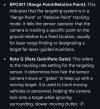
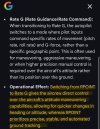
RPOINT to Rate G changes the flight control system from "hold this position/track" to "maneuver at this rate," providing the pilot with more responsive control over the aircraft's physical movement in space. It's during this slight transition period that the pilot most likely lost track of the object and it veered out of view of the sensor, giving the appearance "instantaneous acceleration".
 
Last edited by a moderator:
Is there any sort of actual definition for what is meant by "instantaneous acceleration" in UFO investigating? As opposed to normal, quick acceleration? Or is it just a term that sounds amazingand so it is applied to UFOs to make them seem to be "physics defying?"


Slowed down at 25%.

In the couple frames during when the object exits the screen, what makes the appearence of instantaneous (or very fast) acceleration is that there is no apparent jump in the background by at least half a FOV, like the object. But it's all so grainy that it's difficult to judge.

I think a way to look into this further is to compare with earlier "zipoffs" between timestamps 0'25 and 0'30, that are from the camera operator trying to recenter the object. To check if the background moves differently compared to here.
 
Last edited:
Is there any sort of actual definition for what is meant by "instantaneous acceleration" in UFO investigating? As opposed to normal, quick acceleration? Or is it just a term that sounds amazingand so it is applied to UFOs to make them seem to be "physics defying?"
I think when ufo-fans say "instantaneous acceleration" they actually mean zero acceleration and a change from being stationary to moving at high speed without acceleration - kinda like what AutoMan did in his car if anyone remembers that TV show from the 80s.
 
Has anyone considered this point?

RPOINT to Rate G changes the flight control system from "hold this position/track" to "maneuver at this rate," providing the pilot with more responsive control over the aircraft's physical movement in space. It's during this slight transition period that the pilot most likely lost track of the object and it veered out of view of the sensor, giving the appearance "instantaneous acceleration".
View attachment 88349

Is the transition from "RPOINT" to "RATE G" called by the operator, or an automatic switch after loss of lock?

Because the 1st time it happens (0'27), I count 111 frames between the frame when the brackets disappear, to when "RPOINT" switches to "RATE G" (frames 1661->1772).

The second time (final loss of lock), it's between frames 4436 and 4544-> 108 frames. Done in Sitrec video player after uploading the video.
That's 3% timing difference. Feels a bit machine-like, or the operator was very reactive and consistent when they pushed the "RATE G" button.
 
Last edited:
I think when ufo-fans say "instantaneous acceleration" they actually mean zero acceleration and a change from being stationary to moving at high speed without acceleration - kinda like what AutoMan did in his car if anyone remembers that TV show from the 80s.
Or if you think about graphing the change in speed over time, an "instantaneous acceleration" would have undefined slope, due to being perfectly vertical.
 
Or if you think about graphing the change in speed over time, an "instantaneous acceleration" would have undefined slope, due to being perfectly vertical.
Or essentially infinite acceleration. Which would certainly break the laws of physics, as we know them.

Of course, what they really mean is a very rapid acceleration, something that reaches significantly velocity in a fraction of a second, less than a single frame of a video, so it seems instant. Maybe we could understand ufology's "instant" acceleration as being a more colloquial "in an instant", where an "instant" is a jiffy or a frame, which is 1/30 or 1/60th of a second.

Such a thing is not difficult to do by hitting one object with another - think pool balls, when one hits another, they both get an acceleration with a duration of about 0.001 seconds, experiencing momentary forces of over 1000g.

But for a larger object in the air, that's quite a challenge, unless you have some quasi-magical drive; it would require basically a small violent explosion, directing some mass away at very high speed.

Of course, we don't actually have any clear examples of this happening. This one certainly isn't clear.
 
Someone on reddit claims to have found an explanation:
Source: https://www.reddit.com/r/UFOs/comments/1qvb5n0/instantaneous_acceleration_militaryfilmed_ufo/o3yjd8s/


From what I understand he's saying that the drone is performing a banking left turn while looking at an object due North in a high-precision tracking mode RPOINT. When the FLIR begins to fail high-precision tracking due to physical constraints, the mode gets changed to RATE G. This results in the sensor joining the drone's left-handed motion which in turn makes the object move out of frame to the right. The high zoom makes this motion appear very sudden i.e. "instantaneous".

Rings true or nah?
 
Is the transition from "RPOINT" to "RATE G" called by the operator, or an automatic switch after loss of lock?

Because the 1st time it happens (0'27), I count 111 frames between the frame when the brackets disappear, to when "RPOINT" switches to "RATE G" (frames 1661->1772).

The second time (final loss of lock), it's between frames 4436 and 4544-> 108 frames. Done in Sitrec video player after uploading the video.
That's 3% timing difference. Feels a bit machine-like, or the operator was very reactive and consistent when they pushed the "RATE G" button.
This is what I pulled from Google in the transition from RPOINT to RATE G:
 

Attachments

  • IMG_4475.jpeg
    IMG_4475.jpeg
    86 KB · Views: 2
  • IMG_4473.jpeg
    IMG_4473.jpeg
    302.2 KB · Views: 5
  • IMG_4472.jpeg
    IMG_4472.jpeg
    327.7 KB · Views: 3
Someone on reddit claims to have found an explanation:
Source: https://www.reddit.com/r/UFOs/comments/1qvb5n0/instantaneous_acceleration_militaryfilmed_ufo/o3yjd8s/


From what I understand he's saying that the drone is performing a banking left turn while looking at an object due North in a high-precision tracking mode RPOINT. When the FLIR begins to fail high-precision tracking due to physical constraints, the mode gets changed to RATE G. This results in the sensor joining the drone's left-handed motion which in turn makes the object move out of frame to the right. The high zoom makes this motion appear very sudden i.e. "instantaneous".

Rings true or nah?

This is what I was stating on X. Here's where I sourced that info from and what it states:
 

Attachments

  • IMG_4470.jpeg
    IMG_4470.jpeg
    325.3 KB · Views: 6
  • IMG_4471.png
    IMG_4471.png
    414.7 KB · Views: 4
  • IMG_4472.jpeg
    IMG_4472.jpeg
    327.7 KB · Views: 4
  • IMG_4473.jpeg
    IMG_4473.jpeg
    302.2 KB · Views: 5
From what I understand he's saying that the drone is performing a banking left turn while looking at an object due North in a high-precision tracking mode RPOINT. When the FLIR begins to fail high-precision tracking due to physical constraints, the mode gets changed to RATE G. This results in the sensor joining the drone's left-handed motion which in turn makes the object move out of frame to the right. The high zoom makes this motion appear very sudden i.e. "instantaneous".
I think it really can just be boiled down to the fact that the "fly-off", which looks like a camera motion, coincides exactly with a change in camera modes. This is unlikely to be a coincidence, given the alternative is breaking the laws of physics. Occam goes with camera motion.

Arguments against are that you don't see the camera motion in the background. But you don't really see ANYTHING in the background. There's some weird contrast adjustments going on that give an impression of things being there, but there's no consistency from frame to frame. It's even had to say what is a "frame" here. We've got a 60fps video of something that looks like it was replaying at some point at 10 or 15 fps, and seems to be videoed off a screen, with the aforementioned weird contrast changes.

Not that most of what looks like pixel level detail is fixed sensor noise and random sensor noise mixed together.

It starts like this. Mideway between two frames, the G is just appearing on RATE G. (Previous frame was just RATE, the one before that was RPOINT
2026-02-06_15-44-18.jpg


Then, we see some glitching pixes under the -120 dividng the screen. There's a few grey pixles in the mid upper right.
2026-02-06_15-47-31.jpg


Then it seems like a contrast adjustment we see more of what looks like a streak, but really I think this is the same frame, but with different contrast adjustments.
2026-02-06_15-48-48.jpg


Then one more with more of the streak
2026-02-06_15-54-31.jpg


Then finally a different frame, different background.

2026-02-06_15-54-56.jpg
 
Back
Top