

You are using an out of date browser. It may not display this or other websites correctly.
You should upgrade or use an alternative browser.
You should upgrade or use an alternative browser.
The 1933 Hugh Gray Loch Ness monster photo
- Thread starter Andreas
- Start date
The dark area in the upper right section of the sepia version looks like it could be a reflection of an object (building/mountain) on the far side of the water.
Can we say anything about the direction Gray was pointing his camera, and whether the date he gave matches the weather conditions?There are many trees in the area now on both shores which could have given dark reflections
According to the Daily Record, Gray claimed he took the photo on Sunday, November 12, 1933, at "about one o'clock." He's also quoted as saying, "the loch was as still as a mill pond and the sun was shining brightly." I don't know how to find historical weather reports for Scotland, and I'm no expert in determining the sun's position at that time of year over Loch Ness. Maybe someone with the right skills could help me out here. But if I've understood correctly, the sun would have been in the southwest, relatively low in the sky, at about 14 degrees above the horizon. That would mean shadows should be fairly long and cast toward the northeast. Am I right?
Looking at the shadows in Gray's photo, it seems as though the sun was somewhere in front of the photographer, since there's a dark shadow in front of the "object."
And yes, there do appear to be darker streaks across the water, which become even more noticeable if you increase the contrast. They don't really look like cloud shadows, but more like those cast by trees (or possibly even a person, if the object was really small and close to the camera).
If the often-cited spot is correct, Gray would likely have been pointing his camera northwest. If so, any shadows should be coming in from the left side of the scene, right? As I said, I'm no expert in this. But the big question is: are the shadows in the photo consistent with it having been taken on November 12, 1933, at about one in the afternoon, with the camera pointing roughly northwest?

captancourgette
Senior Member
It seems as if most people think the dark object with the white thing above it are one object.
To me it looks as if only the dark part is a real object, the white part is an artifact (I suppose it could also be a splash) it looks semi transparent.
Parts of the image look like they are from a double exposure/motion blurred or the like
To me it looks as if only the dark part is a real object, the white part is an artifact (I suppose it could also be a splash) it looks semi transparent.
Parts of the image look like they are from a double exposure/motion blurred or the like

Ann K
Senior Member.
And the bagpipes!You'll always have the haggis.
(I was once camping at Natural Bridge, Kentucky when I heard bagpipes. In one camp, dad played the pipes to tell the kids to come home for supper, knowing that they could easily be heard a mile away.)
Agreed—the white areas are definitely artifacts, possibly water splashes but more likely overexposure, motion blur, or similar issues. It even looks like there may be some double exposure involved. The real question is whether these white artifacts are obscuring an actual object.It seems as if most people think the dark object with the white thing above it are one object.
To me it looks as if only the dark part is a real object, the white part is an artifact (I suppose it could also be a splash) it looks semi transparent.
Parts of the image look like they are from a double exposure/motion blurred or the like
To me, the whole story sounds like a deliberate hoax. If that's the case, one might expect the hoaxer (Mr. Gray) to have staged something using a "monster model." For instance, he could have built a whale-like sculpture, placed it in the water, and snapped a few pictures. Conveniently, the true shape would have been mostly concealed by the artifacts produced by his low-quality camera.
That strikes me as the most likely explanation—especially considering that Gray himself admitted he went out looking for the monster and, within just a few minutes, supposedly managed to capture it on film.
A bagpipe tossed into the loch could probably pass for a plesiosaur…And the bagpipes!
(I was once camping at Natural Bridge, Kentucky when I heard bagpipes. In one camp, dad played the pipes to tell the kids to come home for supper, knowing that they could easily be heard a mile away.)

Mauro
Senior Member.
And the bagpipes!
(I was once camping at Natural Bridge, Kentucky when I heard bagpipes. In one camp, dad played the pipes to tell the kids to come home for supper, knowing that they could easily be heard a mile away.)
https://almabooks.com/wp-content/uploads/2021/06/Three-Men-in-a-Boat-revised-text.pdf page 122I knew a young fellow once who was studying to play the bagpipes, and
you would be surprised at the amount of opposition he had to contend
with. Why, not even from the members of his own family did he receive
what you call active encouragement. His father was dead against the
business from the beginning, and spoke quite unfeelingly on the subject.
My friend used to get up early in the morning to practise, but he had
to give that plan up, because of his sister. She was somewhat religiously
inclined, and she said it seemed such an awful thing to begin the day
like that.
So he sat up at night instead, and played after the family had gone to
bed, but that did not do, as it got the house such a bad name. People,
going home late, would stop outside to listen, and then put it about all
over the town, the next morning, that a fearful murder had been com-
mitted at Mr Jefferson's the night before, and would describe how they
had heard the victim's shrieks and the brutal oaths and curses of the
murderer, followed by the prayer for mercy, and the last dying gurgle
of the corpse...


deirdre
Closed Account
the "papers" and blog posts that do the deep dive math analysis stuff point out it's not really a shadow but a reflection. ie the object reflecting onto the water.since there's a dark shadow in front of the "object."
ex Roland watsons stuff:
middle line is at time of alleged sighting.
Article: 227journalofscientificexploration.org JOURNAL OF SCIENTIFIC EXPLORATION • VOL. 36, NO 2 – SUMMER 2022Roland Watson EMPIRICAL ANALYSIS OF THE HUGH GRAY 'NESSIE' PHOTOGRAPH
e geographical position is well-known given the ac-counts in Whyte (1957, p. 2) and Holiday (1968, p. 26). e azimuth of the sun is given as 179° and the elevation as 15°.
Based on the shape of the reection, it can be inferred that Hugh Gray photographed the creature with the sun behind him, so he and the creature were positioned somewhere along the direction of the dotted line in Figure 16. How-ever, one should not assume that the reection is a perfect representation of the creature's dimensions, but it can help to make some deductions.
Firstly, reections lengthen and shorten according to the sun's position. At a solar elevation of 15° this gives us the rough diagram in Figure 17.Here, x is the height of the creature above the water and y is the length of the reection. e angle at the apex is our 15°. e one assumption made is that the creature formed a roughly semicircular shape out of the water when viewed laterally. e analysis can be done on this and the ratio y:x is 2.7:1. at is, the reection y is 2.7 times longer than the height of the animal out of the water.
But you then look at the photograph and it is evident that the reection is not 2.7 times longer than the apparent shape of the crea-ture. is is due to the angle at which the observer viewed the object. Imagine the observer was directly over the crea-ture. In this case, the witness would see the entire reec-tion length at 2.7 times the height of the creature. At the opposite extreme, if the witness was at the same eye level as the animal, no reection would be seen.
So, at this range from 90° to 0° was an angle at which the observer viewed the creature, and which would proportionately present a foreshortened reection.Now from what the author can ascertain from Holiday (1968) and Whyte's (1957) information, Hugh Gray estimat-ed that he saw the creature from about 100 yards and was about 50 feet above it. If this was accurate, Figure 18 yields the resulting approximate diagram (in meters).Figure 16. Position of the sun at the time and place of H. Gray's sighting at Loch Ness. Figure 17. Calculating the position of the ob
deirdre
Closed Account
he went out every sunday with his camera "as was my custom". so it was in a matter of months, not minutes.especially considering that Gray himself admitted he went out looking for the monster and, within just a few minutes, supposedly managed to capture it on film.
Well, sure—he frequently went out to "scan the loch," looking for the monster. He had seen the "monster" before, but either he didn't have his camera with him on that occasion, or he simply failed to capture it on film. This time, though, he spotted the monster almost immediately.he went out every sunday with his camera "as was my custom". so it was in a matter of months, not minutes.
I'm not so sure about that. To me, it behaves more like a shadow—especially considering how it interacts with the rest of the shading. I've read the "papers," but unfortunately they're often written by people who claim to see a mouth with sharp teeth lurking in the clutter.the "papers" and blog posts that do the deep dive math analysis stuff point out it's not really a shadow but a reflection. ie the object reflecting onto the water.
I've tried to track down a weather report for November 12 but haven't had any luck yet. Generally, though, Scotland was under a strong low-pressure system that weekend, bringing cold fronts, clouds, rain, and windy conditions. Gray, on the other hand, described full sunshine and a calm loch. I'll see if I can find an actual weather report specifically for the Loch Ness area.
deirdre
Closed Account
i imagine one of the reporters who print up weather in their newspapers would have noticed if his description of the day was way off.Generally, though, Scotland was under a strong low-pressure system that weekend, bringing cold fronts, clouds, rain, and windy conditions. Gray, on the other hand, described full sunshine and a calm loch. I'll see if I can find an actual weather report specifically for the Loch Ness area.

JMartJr
Senior Member.
Possibly, but would they have said so? DK.i imagine one of the reporters who print up weather in their newspapers would have noticed if his description of the day was way off.

NoParty
Senior Member.
I strongly prefer that there be no campers in sites near mine.And the bagpipes!
(I was once camping at Natural Bridge, Kentucky when I heard bagpipes. In one camp, dad played the pipes to tell the kids to come home for supper, knowing that they could easily be heard a mile away.)
Bagpipes might be th' ticket!
deirdre
Closed Account
true. at that point, i read, the tourist pushing was pretty ramped up.Possibly, but would they have said so? DK.
Perhaps—or perhaps not. The Daily Record probably paid quite a sum for the photo (I'm just speculating, but the article does mention that Gray had been offered a considerable amount of money by several sources), and they surely saw it as a great opportunity to sell papers. Featuring the story on the front page, with several related articles inside and a huge photo on the back page, says a lot. Debunking the story wouldn't have been a smart strategy for a newspaper hoping to profit from a sensational scoop.i imagine one of the reporters who print up weather in their newspapers would have noticed if his description of the day was way off.
Interestingly, the sighting was first reported to have occurred on November 26, but this was soon changed to November 12. Why? Possibly an honest mistake—or perhaps Gray thought the 12th made for a more plausible date. Let's say, for instance, that the weather was even less sunny on the 26th. Just speculation, of course. Nevertheless, much about this story remains unclear. According to the Daily Record article, Gray was unable to determine either the size of the creature or its distance from him. Yet it's often claimed that he did provide such estimates. Perhaps he did so later, but if that's the case, they're far less reliable than his initial testimony.
We're left with some basic, indisputable facts: Hugh Gray claimed to have seen the "monster" before; he was out looking for it that Sunday and "had hardly sat down on the bank" when he saw the "beast" and snapped a photo of it. He couldn't estimate the distance (though he said it was pretty close). He was eager to tell his story to several newspapers and proudly gave not only his name but also his place of work. At the time, there had been several reported sightings of the "monster." According to the Daily Record article, it had been seen "no fewer than four times last week." (Quite a week!)
In other words, in the middle of a Nessie-hype, a self-described monster-hunter managed to snap a photo he claimed depicted the "monster." A misidentification or a hoax? That's obviously for each of us to decide. To me, though, this practically screams hoax. Since more than ninety years have passed, and everyone involved has long since died, we'll never know for certain. But checking whether the reported weather conditions were accurate is at least one way of gauging the trustworthiness of the story. If November 12 really was cloudy, windy, and rainy, then I think we can safely dismiss the whole backstory.
Ann K
Senior Member.
View attachment 83403He went out for a walk, but is there any knowledge as to which direction he walked? If he went north from the mouth of the river, the shoreline has a strong dip in it, so his viewpoint could have included tree reflections from the SAME side of Loch Ness. I only see his statement that he walked a mile, not which way he went. The loch drains to the northeast, so any debris that came down the river would most likely end up in that direction.
And yes, we know of a spot where the photo is said to have been taken, but since no landmarks are visible, we have no way of confirming it. It could be there—but just as easily it could have been some small pond, or even the river.
As a small parenthesis: there's a pier stretching from the loch all the way to the aluminum factory. Gray probably visited this docking spot daily for work, and it would have been an ideal place to stage a hoax. It could also have been nothing more than some oddly shaped debris in the shallow water by the pier that inspired a young monster-hunter to take a picture. Just speculation, of course—and we'll most probably never know what really happened that Sunday.
Last edited:
deirdre
Closed Account
what was the date of the Daily Record article?Perhaps—or perhaps not. The Daily Record probably paid quite a sum for the photo (I'm just speculating, but the article does mention that Gray had been offered a considerable amount of money by several sources), and they surely saw it as a great opportunity to sell papers. Featuring the story on the front page, with several related articles inside and a huge photo on the back page, says a lot. Debunking the story wouldn't have been a smart strategy for a newspaper hoping to profit from a sensational scoop.
i was talking about when it was first reported which was in the Iverness Courier. I didnt save my links but i read that write up was on page 6 or so. anyway, i dont know where the Daily Record is located or when the article was so they likely wouldnt bother looking up the weather of that day. But i figured Iverness reporters -who live in the area- someone might have thought "no, we had storms that Sunday."
deirdre
Closed Account
yea that quote you screenshot is a bit ambiguous to me. the wording is funny. i know he claimed decades later to have seen the monster several times during those decades, but not 100% sure he saw it prior to the photo sighting.We're left with some basic, indisputable facts: Hugh Gray claimed to have seen the "monster" before;
ps you still havent provided the actual links to any of your screenshots.
yea youve said that like a dozen times now. we know you think that.To me, though, this practically screams hoax.
agreed so youll have to pay for access to newpaper archives and try to find an article on the Monday after* to see if storms were mentioned.But checking whether the reported weather conditions were accurate is at least one way of gauging the trustworthiness of the story.
*or prior forecasts of storms expected in that region.
Fair point. The Daily Record articles (along with the full-page photo reproduction) were published on Wednesday, December 6. I haven't seen the Inverness Courier article—did they interview Gray in person, and did he make any claims about the weather there? The Daily Record sent a reporter to Foyers to interview Gray directly, and the statements about the weather conditions came from that interview.what was the date of the Daily Record article?
i was talking about when it was first reported which was in the Iverness Courier. I didnt save my links but i read that write up was on page 6 or so. anyway, i dont know where the Daily Record is located or when the article was so they likely wouldnt bother looking up the weather of that day. But i figured Iverness reporters -who live in the area- someone might have thought "no, we had storms that Sunday."
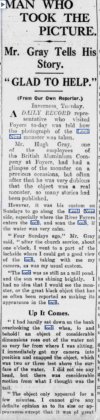
All quotes are from the Daily Record, December 6, 1933. I already provided the link to the article in my first post in this thread. (You'll need a subscription to read it in full, but I've shared several screenshots for those who can't access it.)yea that quote you screenshot is a bit ambiguous to me. the wording is funny. i know he claimed decades later to have seen the monster several times during those decades, but not 100% sure he saw it prior to the photo sighting.
ps you still havent provided the actual links to any of your screenshots.
I'm not sure why the quote would be considered "ambiguous." The Daily Record actually sent a reporter to Foyers to interview Gray in person. Unlike most other contemporary articles, this one was based on a direct meeting with him. The article states:
"Mr. Hugh Gray, one of the employees of the British Aluminium Company at Foyers, had had a glimpse of the monster on a previous occasions, but often after that he was very dubious that the object was a real monster, so many stories had been published."
I can't really interpret this any other way than that Gray had seen something out on the loch previously—something he thought might be the monster, though he couldn't be sure since he didn't get a clear enough look at it.
"However, it was his custom on Sundays to go along the Loch Ness side, especially where the River Foyers enters the loch, and scan the loch, if the water was very calm. "Four Sundays ago," Mr. Gray said, "after the church service, about one o'clock, I went to a part of the lochside where I could get a good view of the loch, taking with me my camera, as was my usual custom."
To me, this can only be read one way: Gray was fascinated by the monster stories, and in an effort to help solve the mystery, he regularly patrolled the shores on Sundays, hoping to capture the creature on camera.
The reason I keep repeating these testimonies and quotes from the Daily Record article is because they give us valuable context. They help us understand the exact circumstances under which the photo was taken.
JMartJr
Senior Member.
THis is interesting, I think. A stupid click bait video crossed my screen today, the last few seconds of it show a manatee bing panicked by a kayaker, and has some similarities to this Nessie pic. I am NOT suggesting here are manatees in Loch Ness, but I think it does at least demonstrate that a large animal might indeed photograph somewhat like this picture:

Source: https://www.facebook.com/reel/1108982021117012

I guess a seal could look similar.
Source: https://www.facebook.com/reel/1108982021117012
I guess a seal could look similar.
https://abbeyholidayslochness.com/blog/loch-ness-wildlife/External Quote:Although not a common occurrence, seals have been spotted in the River Ness and even in the loch itself on occasion. But for a better chance to see them, the Beauly Firth and Moray Firth near Inverness are known for sightings of both common and grey seals. Autumn is considered the best time to spot them, as they are likely to come closer to the shore.
What am I supposed to be noticing in that video?THis is interesting, I think. A stupid click bait video crossed my screen today, the last few seconds of it show a manatee bing panicked by a kayaker, and has some similarities to this Nessie pic. I am NOT suggesting here are manatees in Loch Ness, but I think it does at least demonstrate that a large animal might indeed photograph somewhat like this picture:
View attachment 83408
Source: https://www.facebook.com/reel/1108982021117012
View attachment 83410
Oh, the huge manatee!
deirdre
Closed Account
oh! thanks. you hyperlinked them so i didnt even recognize the quotes as links.I already provided the link to the article in my first post in this thread.
deirdre
Closed Account
on A previous occasion.on a previous occasions
OR on previous occasionS. ?
but you also quoted
so did the Daily Record reporter think November 26 was the photo but November 12th "four Sundays ago" was another sighting?
or just general confusion since he had 2 different dates?
either way, as you say it was a long time ago. If you want to believe it was a deliberate hoax, that is fine not gonna argue with you as i cant prove if it was a hoax or not now 90 years later. And really even on stormy days its possible for the sun to shine for an hour during that day. It's gonna be kinda impossible to prove anything one way or the other now.
Ann K
Senior Member.
Please remember, 67°F and intermittent drizzle is a lovely summer day in Scotland!did they interview Gray in person, and did he make any claims about the weather there?

It is a bit confusing, but that part of the article is actually a quote. The article begins: "Yesterday, the Glasgow Herald published the following report about the Loch Ness Monster"—and then follows with a long quotation in which November 26 is given as the date of the event.so did the Daily Record reporter think November 26 was the photo but November 12th "four Sundays ago" was another sighting?
or just general confusion since he had 2 different dates?
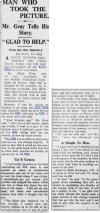
Later in the article, the Daily Record reporter spends quite some time criticizing the Glasgow Herald, pointing out errors in their report. Most interesting is this section, where the Daily Record addresses the reported size of the creature:
"The distance mentioned in the above report does not coincide with Mr. Gray's considered statement. He can only say that he was standing some distance off and at a certain height."
I hadn't read the full interview with Hugh Gray as published in the Daily Record in 1933. (Honestly, I had missed the last third of the text—and it's rather interesting reading.) Once I did, the whole story became a bit clearer, but also even more confusing. And this, in fact, makes the "misidentification of a playing dog" hypothesis more plausible. Let's lay out a timeline of events:either way, as you say it was a long time ago. If you want to believe it was a deliberate hoax, that is fine not gonna argue with you as i cant prove if it was a hoax or not now 90 years later. And really even on stormy days its possible for the sun to shine for an hour during that day. It's gonna be kinda impossible to prove anything one way or the other now.
November 12 (Sunday): Hugh Gray (1901–1967) allegedly has a close encounter with the "beast."
December 1 (Friday): Hugh's older brother Alexander Gray (1900–1949) finds the film roll lying around at their mother's home. He takes it to a chemist in Inverness and has it developed.
December 4 (Monday): The Daily Record secures the original negative and the rights to publish the photograph. They send a reporter to Foyers to interview Hugh Gray.
December 5 (Tuesday): Several newspapers feature the story, but the Daily Record holds back, deciding to investigate further. There's no rush, since they alone possess the photo.
December 6 (Wednesday): The Daily Record finally publishes the photograph, along with several articles about the event.
There are a few interesting things to notice here. First, there's a significant gap in the timeline between November 12 and December 1. This raises several questions. Was the photo really the one taken on November 12? How could Hugh be so sure of that? Did he recognize the blurry "something" in the photo as the monster he thought he had seen that day? In the interview, Hugh even admits he was surprised the creature showed up at all, saying: "I afterwards went home thinking that, from the brief view I had of the object, so far as the photograph was concerned, nothing would show on the surface of the water."
If we, for the moment, set aside the possibility of a deliberate hoax and assume Gray did take a photo on November 12, another explanation could fit. Perhaps he saw a wave or an otter, tried to capture it on film, but the photo turned out poorly. That wouldn't be surprising—he was probably stressed and excited. Convinced nothing usable would appear, he left the film in his camera and continued using it over the following weeks. At some later point, he snapped a picture of a/his dog playing with a stick in the water. When his brother Alexander—reportedly fascinated by the Loch Ness Monster—saw the developed roll, he was stunned by the distorted image of the dog, convinced it was the elusive "monster." The rest, as they say, is history.
In this scenario, a dog splashing in the water (or even a swan, for that matter) fits quite well with the context. Gray could still have been fully convinced the "monster photo" was taken on November 12, even if it actually showed something else on a later date. His sticking to the story for the rest of his life also makes sense under this explanation—he genuinely believed it was accurate.
Attachments

Mendel
Senior Member.
Well, it does answer why Nov 26th came up, as a "it happened on a Sunday" recollection would suggest that date, which upon reflection may have turned out to be two weeks prior.First, there's a significant gap in the timeline between November 12 and December 1. This raises several questions. Was the photo really the one taken on November 12?
In the OP, you quoted the Daily Record: "He had his camera with him and took five snapshots, only one of which has been successful." So Gray's judgment was not far wrong.In the interview, Hugh even admits he was surprised the creature showed up at all, saying: "I afterwards went home thinking that, from the brief view I had of the object, so far as the photograph was concerned, nothing would show on the surface of the water."
Ann K
Senior Member.
This isn't digital photography, in which a person can casually snap a dozen pictures and throw eleven of them away. In 1933, taking a photo was more of a significant event. As has been discussed elsewhere, it was usual to wait until the roll was finished before taking it in for developing. If it was only taken for processing the next time someone went in to Inverness, a gap of three weeks is not at all surprising.There are a few interesting things to notice here. First, there's a significant gap in the timeline between November 12 and December 1.
JMartJr
Senior Member.
That is at least plausible -- but I think inserting the dog is not warranted, the image looks somewhat like a dog's head, but it is not at all clear that it actually is one. Examples of pareidolia that are quite convincing are easy to come by:If we, for the moment, set aside the possibility of a deliberate hoax and assume Gray did take a photo on November 12, another explanation could fit. Perhaps he saw a wave or an otter, tried to capture it on film, but the photo turned out poorly. That wouldn't be surprising—he was probably stressed and excited. Convinced nothing usable would appear, he left the film in his camera and continued using it over the following weeks. At some later point, he snapped a picture of a/his dog playing with a stick in the water. When his brother Alexander—reportedly fascinated by the Loch Ness Monster—saw the developed roll, he was stunned by the distorted image of the dog, convinced it was the elusive "monster." The rest, as they say, is history
(Yes, I posted it again! But it STILL blows my mind, and some folks may not have seen it the other zillion times! ^_^)
And instances that look like dog heads are pretty common!
But the idea that a picture was taken of something else, unrelated to a Nessie search, looked odd and unidentifiable after it was developed (as opposed to when it was taken) and this was not noticed until the film was developed, and at THAT point it was decided maybe this was (or could be claimed to be) the Beast Itself is not inherently unlikely -- we've certainly seen it enough with UFO pictures...
The more curious part of the timeline for me is the quick turnaround taking the roll of film to the Inverness chemist for developing on Friday, Dec. 1 and the Glasgow newspaper buying the rights to the negative on Monday, Dec. 4.This isn't digital photography, in which a person can casually snap a dozen pictures and throw eleven of them away. In 1933, taking a photo was more of a significant event. As has been discussed elsewhere, it was usual to wait until the roll was finished before taking it in for developing. If it was only taken for processing the next time someone went in to Inverness, a gap of three weeks is not at all surprising.
No, I'm not saying it's suspicious—because it definitely isn't. That wasn't my point. I just wanted to note that several weeks had passed before Hugh finally saw the photo himself. And he hadn't developed it personally; his brother had. That gap does open the door to confusion, false memories, and other factors that make the story harder to sort out.This isn't digital photography, in which a person can casually snap a dozen pictures and throw eleven of them away. In 1933, taking a photo was more of a significant event. As has been discussed elsewhere, it was usual to wait until the roll was finished before taking it in for developing. If it was only taken for processing the next time someone went in to Inverness, a gap of three weeks is not at all surprising.
Yeah, we don't need to add a playing dog to the equation. Let's say Hugh snapped a picture of a cute little otter playing in the water—or maybe a swan diving gracefully—and that alone would be enough. And this wouldn't necessarily make Hugh a liar. Perhaps there really were photos taken on November 12 of some odd-looking wave or something similar, but they turned out poorly and showed nothing but blurry, overexposed water. Then, on another occasion, there was also the blurry shot of the swan/otter/whatever. A believer in the "monster" could easily conclude that all the shots came from the same occasion.But the idea that a picture was taken of something else, unrelated to a Nessie search, looked odd and unidentifiable after it was developed (as opposed to when it was taken) and this was not noticed until the film was developed, and at THAT point it was decided maybe this was (or could be claimed to be) the Beast Itself is not inherently unlikely -- we've certainly seen it enough with UFO pictures...
Agreed, it's a bit strange. For this to be true, the chemist would have had to develop the film while the customer waited. I'm not sure if that kind of service was available in the 1930s, but perhaps it was.The more curious part of the timeline for me is the quick turnaround taking the roll of film to the Inverness chemist for developing on Friday, Dec. 1 and the Glasgow newspaper buying the rights to the negative on Monday, Dec. 4.
deirdre
Closed Account
i'm more surprised they had school buses in Foyers in 1930.I'm not sure if that kind of service was available in the 1930s, but perhaps it was.
Ann K
Senior Member.
Not at all surprising. Foyers itself has a population of a whopping 276 people today. Almost all the schoolchildren, now as then, come from outlying farms and crofts.i'm more surprised they had school buses in Foyers in 1930.

John J.
Senior Member.
i'm more surprised they had school buses in Foyers in 1930.
Not at all surprising. Foyers itself has a population of a whopping 276 people today. Almost all the schoolchildren, now as then, come from outlying farms and crofts.
As Ann implies, there are many small villages and hamlets near Loch Ness and in the area around Inverness that aren't large enough to support their own schools, so many children would have had to attend schools in Inverness or other towns.
There have been motorised bus services in Scotland since at least 1913, and a manufacturer, Alexander, made buses in Falkirk from 1924.
Falkirk is 157 miles/ 253 km from Inverness by road, but that road is the already-mentioned A9 which runs directly from Falkirk to Inverness, so probably no major problems in delivering them even in the 1920s. Below, a 1913 charabanc bus in Scotland, bought by Walter Alexander (later founder of the Alexander bus construction company).
Alexander Dennis company website, https://www.alexander-dennis.com/company/about-us/, which continues (1924),External Quote:Bicycles are also the start into business for Walter Alexander, who opens a cycle shop in the Falkirk suburb of Camelon, in Central Scotland. He buys his first bus – an open charabanc – in 1913 and sets up regular local bus services, as well as running excursions and tours.
There isn't a UK tradition of buses specifically for school use like the yellow buses of the USA and Canada, but buses are contracted from local bus service providers for the "school run". I'm guessing there were broadly similar arrangements in the 1930s.External Quote:To satisfy demand for its rapidly growing bus services, Alexander begins to build its own buses at its workshops in Falkirk. Although some of these single deck buses and coaches are sold to other companies, the bulk of the production is for fleets in the Scottish Motor Traction group, which becomes Alexander's owner in 1929 and operates throughout Scotland.
Last edited:
FatPhil
Senior Member.
When what is now considered a suburb of London was being referred to locally as "the village", indeed. However, that would be a (solitary, admittedly) data point from the early 50s (and in that particular case, the school was even more remote from London than the village was).There isn't a UK tradition of buses specifically for school use like the yellow buses of the USA and Canada, but buses are contracted from local bus service providers for the "school run". I'm guessing there were broadly similar arrangements in the 1930s.
Last edited:
Ann K
Senior Member.
I went to high school in Cincinnati under the same kind of arrangement in 1960. City buses were labeled "school bus", and we paid half the regular fare. If I recall, I generally bought a week's worth of tokens rather than fumble for twelve cents in change every trip. Yellow school buses were used in rural areas.There isn't a UK tradition of buses specifically for school use like the yellow buses of the USA and Canada, but buses are contracted from local bus service providers for the "school run". I'm guessing there were broadly similar arrangements in the 1930s.
Similar threads


- Replies
- 6
- Views
- 5K

- Replies
- 87
- Views
- 30K

- Replies
- 1K
- Views
- 250K

Latest posts
-
-

-
-
Raytheon's Multi-Spectral Targeting Systems
- Latest: RobertBillyBob
-


