Transients in the Palomar Observatory Sky Survey

Where is the evidence? I'd like to see the data and code that was used.
CODE AND DATA OR GTFO

Seriously. It should be unacceptable to publish without reproducibility.

And linking to the front page of the website with billions of different datasets doesn't count. The data should be pre-packaged and ready to go with a README that establishes exactly where the data came from if more info is needed.
 
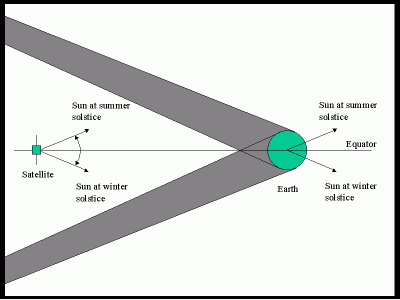
The position of the Earth's shadow with respect to geostationary orbit is a complex subject. Because the Earth is tilted, the cone of the Earth's shadow tilts towards the tropics of Cancer and Capricorn at different times of the year.
fig-3a.gif


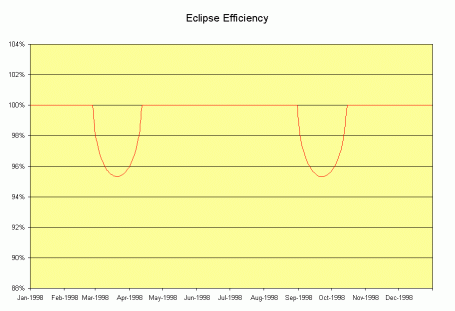
If we only consider the geostationary belt around Earth's equator, the period of eclipse for each satellite is extremely short; 70 minutes or less each day, only during the vernal and autumnal equinoxes.
fig-5a.gif

Nearly all terrestrial (human-made) geostationary satellites are in this narrow band (the Clarke orbits) so they are rarely eclipsed for long.
For more information see this article.
https://celestrak.org/columns/v04n09/

--------------
Of course, the restrictions of practical usefulness that dictate that most terrestrial geostationary satellites are confined to this narrow band may not apply to alien satellites.
 
Of course, the restrictions of practical usefulness that dictate that most terrestrial geostationary satellites are confined to this narrow band may not apply to alien satellites.
I don't think there anything that requires these to be geostationary, or in any particular orbit.

All the transients, as far as I know, are just one-off flashes in one position. There are no repeats (although there are some clusters, but possibly Texas Sharpshooter style)
 
CODE AND DATA OR GTFO

Seriously. It should be unacceptable to publish without reproducibility.

And linking to the front page of the website with billions of different datasets doesn't count. The data should be pre-packaged and ready to go with a README that establishes exactly where the data came from if more info is needed.
Well, it is a pre-print, so technically it's not "published." :cool:
 
My point is that the Earth's shadow is a very small patch of the sky, especially in geostationary orbit, and in any orbit outside LEO.
 
I don't think there anything that requires these to be geostationary, or in any particular orbit.

All the transients, as far as I know, are just one-off flashes in one position. There are no repeats (although there are some clusters, but possibly Texas Sharpshooter style)

That was my other objection. Without a second photo from a different time or separate physical location to get a parallax measurement, they cannot establish that the artifacts (they cannot establish these are actually "flashes") originate at ANY specific distance, including the surface of the plate itself.
 
My point is that the Earth's shadow is a very small patch of the sky, especially in geostationary orbit, and in any orbit outside LEO.
So my sense is that the lower you are (if you are a satellite) and the closer your orbit is to the ecliptic, the more time you will spend in shadow, approaching 12 hours per day (not accounting for atmospheric blurring, if that's the right term, around your local sunrise and sunset) in low orbits along the ecliptic. With the understanding that an orbit might vary in altitude and plane over time, given atmospheric drag or applied thrust or some other factor I haven't considered...

Feel free to correct that if I'm wrong -- many of you know more about this stuff than I do, so this is me seeing if I am understanding correctly!
 
So my sense is that the lower you are (if you are a satellite) and the closer your orbit is to the ecliptic, the more time you will spend in shadow, approaching 12 hours per day (not accounting for atmospheric blurring, if that's the right term, around your local sunrise and sunset) in low orbits along the ecliptic. With the understanding that an orbit might vary in altitude and plane over time, given atmospheric drag or applied thrust or some other factor I haven't considered...
That's about right; I'm curious about how the authors of this paper determined where the Earth's shadow falls at any one time, and what orbits they are talking about.

Satellites that orbit far away would be in shadow for a much shorter time, anywhere from several hours to a few minutes.
 
Last edited:
Is that normal? "Don't share the data" seems contrary to the way I was taught science should work, but admittedly that was a LONG time ago! Perhaps there is a "don't share the data widely until published" clause we were not taught back then!

I have seen other data providers have license agreements prohibiting redistributing the original data, meaning you can link back to them and distribute sufficiently modified or analytically synthesized forms of it but can't just re-host their data on your own system. There are pros and cons. Some organizations like nonprofits that depend on unreliable funding want to ensure people using their data are going to their website and seeing their branding and funding info and such. The data may be freely available and you can link to it, refer to resource identifiers, and distribute software which retrieves or processes it, but they want users to get it from them directly. This also enables them to fix true errors in the data, and be sure that others are not distributing out-of-date/wrong information under their name.

That being said it sounds like they could provide the software they made/used to retrieve and process the tile data. And detail exactly what pieces of data they included in their analysis, so that it is reproducible from end to end. Like what queries parameters to the website they did, what resource identifiers, etc.

Regarding "shadow of the Earth", I'm curious how precise they're being with that terminology. You can't know whether a position in space is within the shadow of the Earth only using the viewing angles, not knowing how far away from Earth it is. The Earth casts a conical shadow that tapers to a point, and a camera pointed into the shadow cone may see objects outside the cone which are still illuminated. As an example, this is how full moons work. A full moon is a moon that is as close to the vertical axis of the shadow of the earth that its current orbit allows, without being a lunar eclipse. It is also how the starlink flaring phenomenon works: a line of sight into the shadow of the Earth (albeit at a low angle) sees something outside the shadow of the Earth that is still close/big enough to be seen with the naked eye when the sun hits it. Of course objects can be further out than than the point as well.

(NOT TO SCALE, NOT EXACT)

Full moon:
Screenshot 2025-08-14 at 2.42.25 PM.png

Lunar eclipse:
Screenshot 2025-08-14 at 2.43.53 PM.png
 
As for the actual image data, I think this is where you get it.

I'm not entirely sure this is the data though and there doesn't seem to be a bulk download option. Again, you'd probably need to email someone to get access to the bulk data.

In their paper they said they got the data here. Although this is just another way to access the same data.

https://archive.eso.org/dss/dss/

And they have a client that allows to make batch requests.

The purpose of the remote client application is to enable the creation of batch jobs to retrieve at once large number of fields, or to be integrated into other application software, scripts or automated observing tools and telescopes.

https://archive.eso.org/cms/tools-documentation/the-eso-st-ecf-digitized-sky-survey-application.html

I'm guessing this is how anyone here who is serious about trying to reproduce their results should get the data. And again, the data listing the transients they identified is here.

http://svocats.cab.inta-csic.es/vanish//index.php
 
Proof of concept paper: "A Cost-Effective Search for Extraterrestrial Probes in the Solar System", 4-Aug-2025, Villarroel et.al https://academic.oup.com/mnras/advance-article/doi/10.1093/mnras/staf1158/8221885
We focus here on a fourth approach, which involves using Earth's shadow as a filter when searching for optically luminous objects in near-Earth space. We demonstrate a proof-of-concept of this method by conducting two searches for transients in images acquired by the Zwicky Transient Facility (ZTF), which has generated many repeated 30-second exposures of the same fields.

During a quick review of this paper, I found some Python code that can be used to calculate if objects are in Earth's shadow. Repository: https://github.com/guynir42/earthshadow This paper contains references to previous studies that might be useful as they may contain links to data sources and software
 
Last edited:
Regarding "shadow of the Earth", I'm curious how precise they're being with that terminology. You can't know whether a position in space is within the shadow of the Earth only using the viewing angles, not knowing how far away from Earth it is. The Earth casts a conical shadow that tapers to a point, and a camera pointed into the shadow cone may see objects outside the cone which are still illuminated.
That's a good point. Satellites in LEO would fall into the shadow of the Earth for many minutes every orbit; satellites halfway to GEO would fall into the Earth's shadow much less frequently, and satellites in GEO would only fall into shadow for a few minutes during certain segments of their orbit in certain months of the year. For the vast majority of their orbit they would be in full sunlight.

However - satellites in LEO are moving very rapidly, with a motion that is easy to see even with the naked eye. Any satellite in LEO would make an elongated trace (a blur) on the photograph, depending on how long the exposure is.

On the other hand satellites in GEO would be motionless with respect to the Earth, and so they would be motionless with respect to the tracking of the telescope, which would presumably be moving in order to compensate for the rotation of the Earth. Do we have any information about how long each of these exposures were? Unless the exposure time was very short indeed, we should see any LEO satellites as elongated blurs, and the blur would get shorter and shorter as the satellite orbit approaches GEO.

Note that even a satellite in GEO would move with respect to the fixed stars unless it was in an equatorial orbit (which is a relatively minute fraction of the sky).
 
Last edited:
Thanks!
5.0E1= 50 seconds. That is a relatively long exposure. Even satellite glints that occur for less than a second would show up as elongated traces. We've seen plenty of momentary glints in the videos of Elon Musk's Starlink satellites; I've seen a number of Iridium glints, and they last a second or two and move across the sky.

An Iridium glint

960px-Comet_holmes_and_iridium_flare.jpg

If the 'satellites' concerned were really at GEO, (and therefore motionless), they would only be in shadow for a few minutes for two months of the year.

Whatever these are, they are not satellites.
 
Last edited:
I can't see any physical way for these to be satellites of any description.
Their hypothesis is that these are "glints" - i.e., short-duration flashes of light, possibly from reflecting sunlight. Although I'm not sure how that makes physical sense. We'd need to model the entire image acquisition process to test that.
 
Well, we'd need to determine just how long these 'glints' are, in duration, in order to show no elongation in the direction of travel. A satellite in LEO moves several arc-minutes per second. Perhaps they carry tiny mirrors that reflect the sun for a fraction of a second. But these 'transients' are typically sharper than stars or galaxies, and not elongated at all, as far as I can see.

Place the satellites further away from the Earth's centre in higher orbits, and the cone of the Earth's shadow starts to shrink into triviality.
 
Their hypothesis is that these are "glints" - i.e., short-duration flashes of light, possibly from reflecting sunlight. Although I'm not sure how that makes physical sense. We'd need to model the entire image acquisition process to test that.
I know in one of their papers they suggested that it could be an object in orbit that's spinning. I don't remember which one though.
 
It is worse than I thought; the ISS moves at 5900 arc-seconds per second, as seen from Earth; that is three Moon diameters per second. In 50 seconds it would be 75 degrees away.
I know in one of their papers they suggested that it could be an object in orbit that's spinning. I don't remember which one though.
It would have to be a large, spinning disco ball with only one single tiny mirror.
 
Last edited:
It is worse than I thought; the ISS moves at 5900 arc-seconds per second, as seen from Earth; that is three Moon diameters per second. In 50 seconds it would be 75 degrees away.

It would have to be a large, spinning disco ball with only one single tiny mirror.
Found it. Page 15

Funnily enough, one geometry they tested was just that.
9. THE GSO HYPOTHESIS
9.1. Object Properties
In this section, we discuss the conditions under which reflections from objects in geosynchronous orbit (GSO) could produce the observed glints. An important question is what types of object shapes and reflective geometries are capable of creating the transient signatures observed in the POSS-I plates. A rapidly spinning object may produce multiple glints during a 50-minute exposure, whereas a more slowly rotating object might generate only one or two. If we assume a fast spin rate and interpret the observed stripe length dmax as corresponding to the path traversed by the object during the exposure, we can estimate a projected velocity of approximately 0.5 arcsec/s. This is significantly slower than the nominal angular velocity of an object at GSO (∼15 arcsec/s). Under these circumstances, we might expect additional transients to be visible along the same narrow band, particularly if the image were extended. Conversely, if the object spins slowly and has only a few small, highly reflective surfaces distributed across a predominantly non-reflective structure, glints may occur only briefly during the exposure, and only at specific orientations.

To explore this further, we use the open-source graphics engine Blender to simulate how various 3D shapes could produce glinting patterns similar to those observed. We model five distinct geometries: a sphere, a multi-faceted polyhedron, a cone, a double pyramid, and a structure with two reflective panels. Each shape is composed primarily of non-reflective material, with limited flat surfaces capable of producing strong specular reflections when oriented precisely between the observer and the Sun. In addition to rotation, we allow for precession in some models, which modulates the visibility and timing of glints. The five test geometries are shown in Figure 6.

As expected, a purely spherical object does not generate short, distinct glints; flat, mirror-like surfaces are required. In the cone model, we assume that the top and bottom surfaces are reflective, yielding double glints per rotation cycle. Adding precession further restricts glint visibility, producing only a few observable flashes per exposure. The double pyramid model illustrates another plausible case: a reflective structure that becomes partially degraded over time, leaving only small reflective regions. With rotation and precession, such objects may produce intermittent glints, consistent with what we observe in the data.

1755285983974.png

Figure 6. Simulated shapes. We show five different shapes that under slow spinning could produce a handful of glints
and in particular double glints. Each shape has two highly reflective surfaces. From top to bottom: (a) cone-like shape, (b)
multifaces shape, (c) sphere, (d) 3D hexagone, (e) piece of debris. Each object has both dull and reflective materials on its
surface, painted in grey respective light tones. Each object spins around an axis that also has precession, causing the reflective
surface not to be visible at all times.
Overall, we find that each of the five test shapes—under specific assumptions regarding spin, precession, and reflective surface coverage—can, in principle, reproduce a glinting pattern compatible with the transients observed in POSS-I images. The geometric models presented in this section are intended to demonstrate the plausibility of producing aligned glint patterns from tumbling or precessing objects in high-altitude orbits. We emphasize that these models are illustrative rather than predictive, and no attempt is made to fit the specific time separations or angular offsets of the individual candidates.

While no clear periodicity has been identified in the current POSS-I data, it is well known from modern short-exposure surveys that some Earth-orbiting objects, including those in geosynchronous orbit, can produce isolated, PSF-like glints without clear repetition patterns (e.g., Nir et al. 2020). This lack of periodicity may result from slow rotation, irregular shapes, or specific phase-angle constraints that produce only a few observable flashes per orbital cycle.

Additionally, the observed sky distribution of aligned transients does not always follow a simple great-circle geometry, which could reflect the possibility of complex trajectories, attitude drift, or even the presence of multiple independent objects. Powered objects could even change their altitudes or trajectories. We acknowledge these uncertainties and note that more detailed modeling would be required to establish stronger constraints on orbital parameters or glint periodicity.
 
Overall, we find that each of the five test shapes—under specific assumptions regarding spin, precession, and reflective surface coverage—can, in principle, reproduce a glinting pattern compatible with the transients observed in POSS-I images. The geometric models presented in this section are intended to demonstrate the plausibility of producing aligned glint patterns from tumbling or precessing objects in high-altitude orbits.
This should be testable. If the 'object' is spinning, it must be spinning fast or the glint would be elongated, like the glint in an Iridium satellite. So we can say that the reflective surface is very, very small, but it is never seen again despite the long (50 second) exposure time. As I said, a very, very small mirror on a very large ball. None of the speculative shapes in those images are anything like that.
 
If the exposure is 50 minutes, but the 'glint' lasts for a fraction of a second (due to the fact there is no elongation), then the brightness of that glint must be very high indeed, to register within a 50 minute exposure. A glint from a tiny, shiny surface in orbit would not be bright enough to be visible on the photo.
 
If the exposure is 50 minutes, but the 'glint' lasts for a fraction of a second (due to the fact there is no elongation), then the brightness of that glint must be very high indeed, to register within a 50 minute exposure. A glint from a tiny, shiny surface in orbit would not be bright enough to be visible on the photo.
As usual, disclaimer for potential dumb question. For a long exposure like this setup, how do you know if a point of light on the resulting film is low intensity and long duration versus high intensity and short duration?
 
If the object is in GEO and in an equatorial orbit, then the satellite would be stationary, so you could not tell if it were a short, bright glint or a long, dim glint.

This could easily be testable; a motionless satellite in GEO must be in an equatorial orbit, otherwise it would move gradually north and south from the celestial equator. This would be visible as an elongation.

How far from the celestial equator are each of these transients?
 
As usual, disclaimer for potential dumb question. For a long exposure like this setup, how do you know if a point of light on the resulting film is low intensity and long duration versus high intensity and short duration?
Essentially, the only way of knowing is by motion blur of various forms.

The "short glints" hypothesis cames as a response to Hambly and Blair 2024 On the nature of apparent transient sources on the National Geographic Society–Palomar Observatory Sky Survey glass copy plates (attached)

Hambly makes the case that the transients are plate defects, in part by noting that they are sharper than similar magnitude stars which have motion blur from imperfect tracking (the motion of the telescope trying to counter the motion of the Earth, and atmospheric motion (sort of motion blur, but with the optical path changing with the atmosphere's turbulence and density profile)

Their conclusion:
External Quote:

We have undertaken an independent study of nine apparent optical
transients identified by Villarroel et al. (2021) in publicly available
digitized scans of POSSI copy plates. We have verified the presence
of those detections on locally held copy plates from which SSS scans
were made, noting subtle differences between them and other stellar
images of similar brightness. We also noted the presence of emulsion
blemishes (holes) during our visual inspection. We have made an
objective, quantitative, and statistical analysis of the morphological
properties of the publicly available catalogues of all detections on
the same plates, derived during the production of the whole-sky SSS,
from two adjacent fields. We find that (i) the image profiles of the
transients are significantly sharper than typical stellar images on the
plates;
(ii) that an ML decision-tree classifier badges the images as
spurious with high probability; (iii) that similar examples of apparent
transients are present on the copy plate of the adjacent field; and
finally (iv) that there are many hundreds of similar images on both
plates in the overlap region between the two fields. We suggest one
likely mechanism for the origin of at least some of these apparent
transients as being emulsion holes on the intermediate positive plates
used during reproduction of the copy sets.
We therefore caution that
digitized all-sky survey catalogues derived from the POSSI glass
copies are likely peppered with these isolated false detections and that
great care must be exercised when interpreting the publicly available
digitized images or when making samples of unpaired catalogue
records derived from them.
Villarroel's response is in "On the Image Profiles of Transients in the Palomar Sky Survey" (attached) says that Hambly and Blair's work supports their finding of brief flashes from unresolved sources, which I suspect Hambly and Blair would not agree with.

External Quote:

Summarizing, brief flashes of light as suggested by Villar-
roel et al. (2021, 2022a) are predicted to be sharper (i.e. nar-
rower) and more circular than star images, which agrees with
what Hambly & Blair (2024) found for nine transients from
Villarroel et al. (2021). Thus, the remarkable discoveries by
Hambly & Blair (2024) that the transient images are sharper
and more circular are consistent with a brightening duration
less than a few seconds, providing unexpected support for the
hypothesis that they are short flashes of light from unresolved
sources.
 

Attachments

Essentially, the only way of knowing is by motion blur of various forms.

The "short glints" hypothesis cames as a response to Hambly and Blair 2024 On the nature of apparent transient sources on the National Geographic Society–Palomar Observatory Sky Survey glass copy plates (attached)

Hambly makes the case that the transients are plate defects, in part by noting that they are sharper than similar magnitude stars which have motion blur from imperfect tracking (the motion of the telescope trying to counter the motion of the Earth, and atmospheric motion (sort of motion blur, but with the optical path changing with the atmosphere's turbulence and density profile)

Their conclusion:
External Quote:

We have undertaken an independent study of nine apparent optical
transients identified by Villarroel et al. (2021) in publicly available
digitized scans of POSSI copy plates. We have verified the presence
of those detections on locally held copy plates from which SSS scans
were made, noting subtle differences between them and other stellar
images of similar brightness. We also noted the presence of emulsion
blemishes (holes) during our visual inspection. We have made an
objective, quantitative, and statistical analysis of the morphological
properties of the publicly available catalogues of all detections on
the same plates, derived during the production of the whole-sky SSS,
from two adjacent fields. We find that (i) the image profiles of the
transients are significantly sharper than typical stellar images on the
plates;
(ii) that an ML decision-tree classifier badges the images as
spurious with high probability; (iii) that similar examples of apparent
transients are present on the copy plate of the adjacent field; and
finally (iv) that there are many hundreds of similar images on both
plates in the overlap region between the two fields. We suggest one
likely mechanism for the origin of at least some of these apparent
transients as being emulsion holes on the intermediate positive plates
used during reproduction of the copy sets.
We therefore caution that
digitized all-sky survey catalogues derived from the POSSI glass
copies are likely peppered with these isolated false detections and that
great care must be exercised when interpreting the publicly available
digitized images or when making samples of unpaired catalogue
records derived from them.
Villarroel's response is in "On the Image Profiles of Transients in the Palomar Sky Survey" (attached) says that Hambly and Blair's work supports their finding of brief flashes from unresolved sources, which I suspect Hambly and Blair would not agree with.

External Quote:

Summarizing, brief flashes of light as suggested by Villar-
roel et al. (2021, 2022a) are predicted to be sharper (i.e. nar-
rower) and more circular than star images, which agrees with
what Hambly & Blair (2024) found for nine transients from
Villarroel et al. (2021). Thus, the remarkable discoveries by
Hambly & Blair (2024) that the transient images are sharper
and more circular are consistent with a brightening duration
less than a few seconds, providing unexpected support for the
hypothesis that they are short flashes of light from unresolved
sources.
Thank you for the response!

That Hambly and Blair paper is very cool for several reasons: they link to their data, use machine learning with proper methodology, specifically citing multiple of the GOATs for data science (Hastie T., Tibshirani R., Friedman J., Efron B., just to name a few), and they even use automated hyperparameter tuning. My only complaints are they appear to show only samples of their code, and they didn't include the code for training the machine learning models. (Possibly just missing it though.)

And I also agree that Villarroel et al. seem to be misrepresenting the findings of Hambly and Blair. Just another example of possibly inappropriate behavior.

(GOAT = Greatest of All Time)
 
As usual, disclaimer for potential dumb question. For a long exposure like this setup, how do you know if a point of light on the resulting film is low intensity and long duration versus high intensity and short duration?
I think you'd have to take multiple shorter exposures instead of one long one. With the assumption that the period of exposure is not a simple multiple of the period of duration, the point should vary in comparative brightness.
 
Their hypothesis is that these are "glints" - i.e., short-duration flashes of light, possibly from reflecting sunlight. Although I'm not sure how that makes physical sense.

Unlike 1949-1958, there are now many objects in NEO and in geostationary orbits whose precise locations are known.

Bruehl and Villaroel could have tested the real-world validity of their claims by looking for evidence of "glints"/ transient flashes of light, similar to those that they believe are recorded on the Palomar Observatory Sky Survey plates, caused by light reflected from known satellites.
As far as I know they have not.
These astronomers have made extraordinary claims without taking steps to gather evidence that might support (or weaken) those claims.
 
Unlike 1949-1958, there are now many objects in NEO and in geostationary orbits whose precise locations are known.

Bruehl and Villaroel could have tested the real-world validity of their claims by looking for evidence of "glints"/ transient flashes of light, similar to those that they believe are recorded on the Palomar Observatory Sky Survey plates, caused by light reflected from known satellites.
As far as I know they have not.
These astronomers have made extraordinary claims without taking steps to gather evidence that might support (or weaken) those claims.

The glint phenomenon has been studied by others, but I am not sure about the details in terms of exposure time and the specific technology used in the 1950s.

A high-rate foreground of sub-second flares from geosynchronous satellites

The Weizmann Fast Astronomical Survey Telescope (W-FAST) is a 55cm optical survey telescope with a high cadence (25Hz) monitoring of the sky over a wide field of view (~7deg^2). The high frame rate allows detection of sub-second transients over multiple images. We present a sample of ~0.1--0.3s duration flares detected in an un-targeted survey for such transients. We show that most, if not all of them, are glints of sunlight reflected off geosynchronous and graveyard orbit satellites. The flares we detect have a typical magnitude of 9--11, which translates to ~14--16th magnitude if diluted by a 30s exposure time. We estimate the rate of events brighter than ~11mag to be on the order of 30--40 events per day per deg^2, for declinations between -20 and +10^\circ, not including the declination corresponding to the geostationary belt directly above the equator, where the rate can be higher. We show that such glints are common in large area surveys (e.g., ZTF and LSST), and that some of them have a point-like appearance, confounding searches for fast transients such as Fast Radio Burst counterparts and Gamma-ray bursts. By observing in the direction of the Earth's shadow we are able to put an upper limit on the rate of fast astrophysical transients of 0.052deg^{-2}day^{-1} (95\% confidence limit) for events brighter than 11mag. We also suggest that the single image, high declination flare observed in coincidence with the GN-z11 galaxy and assumed to be a Gamma-ray burst, is also consistent with such a satellite glint.

https://arxiv.org/abs/2011.03497
 
They address similar points in a different paper. No idea if they used the same techniques here. You can find that one here. I personally find it more interesting than the other ones posted.
I was just looking at this paper (Aligned, multiple-transient events in the First Palomar Sky Survey) and noticed:
To independently verify the number of transients located within Earth's shadow, we implemented a custom code
(using ChatGPT-assisted scripting) that follows a similar principles to EarthShadow.
Using ChatGPT isn't bad, per se, but it's just another red flag. Villarroel's papers tend to cite herself more than anyone else, misrepresent the findings of others, demonstrate poor statistical knowledge, don't share data or code, make seemingly arbitrary decisions like taking subsets of images, and those are just the red flags off the top of my head. Villarroel comes across very amateurish in so many different ways.
 
Some 'satellite-watchers' do keep an eye out for glints from geostationary satellites; these things are and far away, so 'glints' (satellite flares) at that distance are rare and dim, but some reach naked-eye visibility.
https://skyandtelescope.org/observing/how-to-see-and-photograph-geosynchronous-satellites/
Many geosynchronous satellites shine between magnitudes 10–12, so you can spot them in telescopes as small as 4 inches. They're also easy to photograph. High ISOs and fast, low light lenses aren't necessary, just a camera capable of a several-minute-long time exposure — long enough for the stars to trail, so you can easily tell them apart from the satellites. Set your shutter speed to "B" and ISO at 400. You can hold the shutter button down with your finger, but a shutter release cable is much better and vibration-free. Use a 100–200-mm telephoto lens, focus sharply, and expose for 2–4 minutes. When you enlarge the image, you'll should see long trails and a line of pinpoint dots — satellites!
Of course - even geostationary satellites move with respect to the fixed stars; one rotation per day. I'd forgotten about that.
--------------------
Here are observers watching real geostationary flares.
https://britastro.org/forums/topic/flaring-of-synchronous-satellites-from-kelling-heath

It clearly showed they were drifting against the stars and fixed relative to the landscape and their apparent declination was 7 °S which means they were almost certainly Geostationary satellites. 7°S is about where you'd expect to see them from our latitude.
I was surprised at how bright they could become considering the distance, almost mag +2. The ISS reaches mag -3 or so but these things are around 100 times further away. Inverse square law would imply 10,000 fold diminution of brightness, or 10 magnitudes. Sun-glint? I was further surprised at just how many there were and how long it all went on for. The first one was at 0m 24s (22:53) and the last at 01m 06s (02:34) and that was only ended by the low cloud. There were quite a number between 0m 40s (00:14) and 00:49 (01:00)
...the flare reaches around 2nd mag at 01:09:56 and lasts for around 15s.

So a real geostationary glint would last several seconds and move against the fixed stars; nothing like the dimensionless specks in the Villaroel paper.
 
Back
Top