"Self-healing" Ceramic Material from Skinwalker Ranch - SEM (Scanning Electron Microscope) Analysis

Mick West

Administrator
Staff member
1755011523191.png


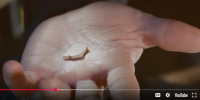
At the start of this season (six) of Skinwalker Ranch, they posted a segment on the recovery and analysis of some small pieces of what look like ceramic tile.

2025-08-12_08-37-08.jpg


They think this came from an alien artifact buried deep underground, but it seems to be something an archeologist fished out of the spoils pit, so lacks a clear chain of custody to prove its initial location.

They take the samples to Dr Brian Patchett at Utah Valley University, and he put it in a SEM.
2025-08-12_08-38-29.jpg

They do a variety of scans, the first one displayed shows the artificial-seeming texture lines on the tile.
2025-08-12_08-41-16.jpg


They then show an animation that seems to show some holes getting bigger.


They then use the time-tested diagnostic technique of "turning it off and on again", and get a new image (on the left here)
2025-08-12_08-48-41.jpg


The holes seem to vanish.
Dr Patchett says: "I've never seen anything that is capable of doing this. This stuff is fixing itself."
Dr Taylor says "Yes, it's healing, that's exactly right"

So I asked ChatGPT and it suggested a couple of possibilities. First there the phenomenon of "charging artifacts" where electrons build up on the surface, kind of like static electricity, and this messes with the image.

Secondly, note the 5.0 kV on the left and 10 kV on the right. Higher voltages penetrate samples more, so can reveal sub-surface details, making the same area look very different. Like in this example:
2025-08-11_17-07-08.jpg


Wanting some human input, I posted this on X

Source: https://x.com/MickWest/status/1955058756888432830


I quickly got a reply from Arnold Kruize, an SEM expert who used to work for Tescan (the SEM used here). He gave a detailed analysis of what is going on, and gave me permission to share here:

External Quote:

Because this hits right into my area of expertise (25 years) I thought I might give you a bit more insight into what is shown here. I now work for JEOL and in the past also worked for and with Tescan (the SEM brand in this video)

At first, he loads two samples on carbon tabs, and the material seems to be ceramic.
Then he images these samples at 20kV, using the Secondary Electron Detector.
Ceramics are mostly insulators and don't conduct electricity well. In a SEM this will cause problems, and the higher the voltage used the heavier the effect: The electrons that are used for imaging can't escape in a normal way, causing local charging and discharging effects. These effects usually result in many different kind of imaging artifacts. One of them is this rectangular patterns 3:19 into the video. "it doesn't look like mother nature" someone says. But of course this looks weird if you don't know what really happens when you are looking with improper conditions or not well prepared samples.

At around 3:40 the holes seem to get bigger, but this is just the charging effect, also at 3:46 this is exactly what happens in the top right of the image. You can see something light up and get darker. The longer the same area is bombarded the samples gets charged up, creating a local electric field which charges and discharges. Someone asks isn't this just the beam doing this? Well, it's just exactly that! In combination with an insulating sample.

Then they "switch it off" , but at 4:09 it is still in external scan mode. The external scan is used for the EDAX system that's attached to this microscope. This system identifies the chemical composition of what you're looking at.
Now... if you are looking at "alien material", the first you would like to know is what it is made of, wouldn't you?
Well, this is what the EDAX system is for. The only reason not to show this is because they would probably reveal that the material is something like alumina or some other very common ceramic material. Because the system is coming out of external scan mode I guess they just finished with the EDAX measurement and concluded it's nothing special.

Then they compare two images. One taken at 10kV and one at 5kV. Indeed they are different. But the magnification is really low for a SEM, and the penetration depth difference of 5kV vs 10kV is not the reason for the differences in the images. It's all charging effects. I guess they did a relatively long EDAX analysis, at 10kV (you generally use a higher voltage to excite more electrons and get a better spectrum) , while heavily bombarding the sample, after which the charging effect of the sample is in full effect.

Any experienced microscopist would not bother looking at this sample this way when the charging effect is so heavy. Standard practice would be to go to Lowvac mode (20-100Pa pressure) to eliminate charging, or simply coat the sample with a conductive layer to avoid charging effects. Using 1kV is another trick that can be used to reduce charging effects, but the Tescan Vega system is not so good at imaging under these conditions, and you can't use the EDAX at 1kV. Also, on these systems 1kV is not for novice users, because this requires heavy manual adjustment of this microscope.

Also, Dr. Patchett seems to be an expert in a different field of Physics and I don't see any track record on electron microscopy. What I see in this video is a novice user improperly analyzing a non conductive sample, making many beginner's mistakes.
and a follow up when I asked why there was such a pronounced difference in the side-by-side image if it was just charging artifacts:

External Quote:

The side by side images are indeed from the same area. The change in voltage has some effect, but I believe extensive scanning on the same area completely charged up the parts that are bright; they discharge, which will saturate the secondary electron detector. The dark part is simply dark because it has not charged up that much and not releasing so many electrons. How exactly the charge buildup has distributed is hard to say, but the charge effect is really severe.

Any somewhat experienced microscopists would notice and not base any conclusions on this. It is just really bad data. Charging is SEM users biggest foe and learning to identify it is given on a training on day 1.

Also locally heavily charging samples will create its own electric field and deform the image, and in time make it even move or change shape. The effect can even be so severe you can use a charging sample as an electron mirror. I have once seen the polepiece of the microscope that way.

Proper way to do this is to apply a 5-10nm carbon coating. Then the charging is gone, and nothing will move. But will make for less attractive TV eh.....

I am on vacation now, but next month back in the office and in the lab. Can stick a random piece of quartz or alumina in the SEM and likely reproduce these results. If only they showed the EDX spectrum I would have known what kind of ceramic they were looking at. EDX provides the microscopist with the chemical composition within weight1%.
I also got a useful response from "MinuteofZombie", on X:
External Quote:

I watched this carefully kind of expecting to "gotcha"
@MickWest
on this clip.

I've studied a lot of SEM techniques and ordered SEM as NDI of ceramics, metals and composites.

Sad to say this clip is very dishonest about what's going on. It's hard to believe the physicist operating the instrument doesn't understand what's happening:

A very widely understood effect of SEM at accelerating voltages near or above 10 kV on insulating materials is that the electrons you're firing at the material stick around and build an electric charge. Over the course of several seconds or a few minutes, a local electric field forms in the region that you're imaging and this begins to deflect incoming electrons, causing the imaging brightness in the region to drop, causing black spots to grow in size.

This is a well known beam-sample interaction artifact in SEM, especially with insulative materials like ceramics. The fact that it goes away after you turn the beam off is exactly what you expect because the charge held in the material dissipates. This doesn't happen at lower voltages because the electrons don't penetrate as deeply and can dissipate along the surface more rapidly. Porous material has higher capacitance in the bulk.

The physicist saying "oh my God it's healing itself" is quite disappointing. It is hard to imagine he has that little familiarity with SEM so as to interpret that this way.
@BrandonFugal
I'm not a habitual SWR shit poster but this is definitely a party foul.
Then I asked " do you think it is more the result of charging artifacts than subsurface penetration from the different accelerating voltage?"

External Quote:
It's a beam-sample charging artifact, but it's caused in part by the greater penetration of higher beam voltage. It probably does imply that this sample is porous in the bulk. There's a lot to say about the appearance of natural or industrial SiC in that part of Utah. It could be a natural moissanite formation but that's quite rare in North America. Drilling additives and runoff could be in the area, as there's lots of nearby drilling. A good SEM characterization technician would know how to discriminate— the type of porosity, and distribution of metals and oxides in the pores, is quite different between the two, even if we're considering exotic manufacturing, the internal structure of an NHI ceramic will arguably look even less like natural SiC. Wouldn't be hard for an honest assessment to quickly and easily determine natural or industrial origin.
I'm going back to this clip from Episode 1 because it's actually something that happened much later in the season - the latest episode repeats it. I was a little confused as to why they were showing the same segment twice, but it seems to be a "flashforward" to give people something more amazing to look forward to while they do the usual season of rocket experiments and radio interference.

Ultimately, though, it seems like they just found some normal bits of ceramic and somehow fooled themselves (with bad analysis) into thinking it was a "self-healing" material (and hence of alien origin).

The fact that they did not consult with other SEM experts seems typical for the show. The producers are uninterested in solving mysteries, as that's not their job. The SWR team seems willing to trust the opinions of a few people who really should know better but seemingly don't.
 
Last edited:
Very much appreciate this compelling analysis and -- to my eye -- quite thorough exposure of the web of mistakes and deception going on in this clip/series. Two sub-points I'd like to underline:
  • "Chain of custody": As Mick notes, the generally breathless excitement in SWR over little odds and ends that turn up in the spoils sure is damning given the apparent lack of any curiosity about non-alien explanations for how such material might end up there (regional mining history, the drill tech itself perhaps, etc.?)
  • "People who really should know better": And the show's increasing reliance on presumably "legit" scientists -- in ways that merely enable further glossing over of actual analysis or undercutting of actual expert knowledge -- is especially dispiriting. Besides Travis, we now have an anthropologist playing along at the spoils pit, a biologist throwing around dire-wolf facts, and Pratchett here apparently grossly mismanaging the SEM data. This trend is starting to feel like one of the most perverse of the series.
Thanks for tackling this clip!
 
Not an exact match, but the backside of modern manufactured ceramic porcelain tile usually has a patterned/textured surface to aid in application of such tile.
It adds pockets for the cement or glue to adhere, and it increases surface area so that the cement/glue has more surface to adhere to -- all of this aids toward a stronger bond and less failure.
tile_1.png
tile_2.png
 
I reached out to Dr Pratchett for comment. He's constrained by NDAs, but was able to say, "While the individuals on the website [Metabunk] are completely correct about the effects they describe, they are incorrect in the assumptions of what the material composition was." and "I am not at liberty (unfortunately) to say what analysis we did, but you can clearly see the equipment we had on hand to use."

By which I assume he's referring to what Kruize said:
External Quote:

Then they "switch it off" , but at 4:09 it is still in external scan mode. The external scan is used for the EDAX system that's attached to this microscope. This system identifies the chemical composition of what you're looking at.
Now... if you are looking at "alien material", the first you would like to know is what it is made of, wouldn't you?
Well, this is what the EDAX system is for. The only reason not to show this is because they would probably reveal that the material is something like alumina or some other very common ceramic material. Because the system is coming out of external scan mode I guess they just finished with the EDAX measurement and concluded it's nothing special.
The clip on YouTube is from Episode 1. The full analysis has not yet been aired, I just saw a "coming soon" at the end of Episode 10, but it seems like there will be more in Episode 11 (tonight), see the preview here:


Presumably, this will include the EDAX analysis. But I doubt it will change anything related to the self-healing nature of the material.

Dr Pratchett did say he had no input to the show after his segment was filmed.
 
I'm attempting to dig a little into the possibility that some of the mysterious ceramic fragments could simply be a byproduct of drilling technology -- especially since the drilling rig has, for many episodes, been shown to function imperfectly and sustain damage while trying to penetrate the mesa. I claim no knowledge of this field; I'm simply following my skeptical curiosity to see what can be gleaned from online resources related to industrial drilling rigs.

After a little hunting around it seems that "mud pump liners" -- which can include a ceramic "inner sleeve" -- might be something to focus on, so here's some info from a range of manufacturers. I would be happy to hear what others think!

One helpful overview explains: "Mud pump liners are vital to the drilling process, as they provide a protective barrier between the pump's piston and the drilling fluids," noting that some liners "are made from high-strength ceramics such as zirconia or alumina. They offer excellent wear resistance and are suitable for abrasive drilling environments." Zirconia liners especially "are used in extreme drilling conditions where other materials may fail," which would align with the show's emphasis on the challenging nature of the mesa as a drilling site.

Similarly, another site describes how zirconium ceramic liners can be "adapted to some tough environment (sic) such as deep oil reservoir, hard stratum and severe earthiness" since this tech "has various advantages such as wear-resistance, erosion-resistance, high-pressure-resistance, high-temperature-resistance, high strength and high hardness."

Yet another site goes into a little more detail about the manufacturing process and their use of "high purity nano zirconia and alumina powder, through the advanced cold pressing process of a molding (sic), high temperature sintering, assembly, and finally through high precision grinding and polishing. The ceramic cylinder liner has high abrasion resistance, high temperature resistance, high fracture toughness and acid and alkali corrosion resistance." The image they offer:

A close-up of a cylindrical object  AI-generated content may be incorrect.


And finally, some additional photos from another site, giving a sense of the ceramic "inner sleeve":


ceramic-liner-cylinder-for-fmc-mud-pump3.jpg


ceramic-liner-cylinder-for-fmc-mud-pump5555.jpg


Thoughts?
 
a follow up when I asked why there was such a pronounced difference in the side-by-side image if it was just charging artifacts:

....."Also locally heavily charging samples will create its own electric field and deform the image"
for the record the image isnt 'deformed'. Like your example photo (of A,B,C,D pics), all the crevices are the same shape and in the same place. i dont understand the electron talk, but if you imagine the dark spots on the right as literal holes then the pic on the left is what would happen if you hung drop lights into the "holes".
1755090871920.png
 
I'm watching Episode 11 now. Eric Bard gets a piece of the ceramic and show that it is attracted to a magnet. They then say (but don't exactly demonstrate) that it is repelled. Presumably meaning it is itself slightly magnetic and polarized. However, Travis flips the sample and says it still repels the magnet. He does not demonstrate this, just holds the sample over a magnet and says it is being pushed. It would be trivial to demonstrate, but he does not.
2025-08-13_08-45-30.jpg

The chemical composition shows 1% iron.
2025-08-13_08-46-01.jpg

Travis concludes from this that it's a room-temperature superconducter
 
I'm watching Episode 11 now. Eric Bard gets a piece of the ceramic and show that it is attracted to a magnet. They then say (but don't exactly demonstrate) that it is repelled. Presumably meaning it is itself slightly magnetic and polarized. However, Travis flips the sample and says it still repels the magnet. He does not demonstrate this, just holds the sample over a magnet and says it is being pushed. It would be trivial to demonstrate, but he does not.
...
Travis concludes from this that it's a room-temperature superconducter
Sounds diamagnetic to me. Ceramics can be diamagnetic:
A random[*] quote saying such:
External Quote:
Although diamagnetism is well known, it is only during the last 30 years that researchers have applied magnetic processing to various classes of diamagnetic materials such as ceramics, biomaterials, and polymers.
-- https://pmc.ncbi.nlm.nih.gov/articles/PMC7408077/
External Quote:
Is all ceramic magnetic?
[...] In fact, most ceramics are diamagnetic. Diamagnetism is a property where a material creates a magnetic field in the opposite direction of an applied magnetic field. This means that when you put a diamagnetic ceramic in a magnetic field, it will be weakly repelled.
-- https://www.jymdentallab.net/blog/is-all-ceramic-magnetic-693953.html

[* not really, I believe the top few search engine hits were to AI-generated pages, and they don't count as sources]
 
Then with lab analysis of the exterior he deduces it's radar-cloaking
2025-08-13_09-07-38.jpg

2025-08-13_09-08-11.jpg


The interior is different:
2025-08-13_09-08-58.jpg

2025-08-13_09-09-20.jpg


A higher iron content.

They then decide they won't drill any more because they might damage the spaceship (after they have already drilled 40 feet through it).

They note that for 40 feet of drilling it was odd that they only found a few bits of tile. They don't make the connection that the tile might have come from somewhere else. They decide to try to put a camera up the borehole.

They later find a coin in the spoils. It's just a 1964 nickel.
2025-08-13_09-20-55.jpg


Eric Bard suggests the most likely explanation, that it just fell in to the open spoils pit from the material at the drill head.

Travis says it shows that someone removed an artifact in 1964 and dropped a coin to mark the date.
 
Last edited:
Funnily, the 1964 nickel is the most common nickel, with 2.8 billion of them minted.
https://en.wikipedia.org/wiki/United_States_nickel_mintage_figures

The date is pretty meaningless in terms of accurately putting a time on when the coin arrived there. There's probably millions of them still in circulation, so basically any time between 1964 and 2024

All of this points to some random garbage contaminating the spoils.
 
I reached out to Dr Pratchett for comment. He's constrained by NDAs, but was able to say, "While the individuals on the website [Metabunk] are completely correct about the effects they describe, they are incorrect in the assumptions of what the material composition was." and "I am not at liberty (unfortunately) to say what analysis we did, but you can clearly see the equipment we had on hand to use."

By which I assume he's referring to what Kruize said:
External Quote:

Then they "switch it off" , but at 4:09 it is still in external scan mode. The external scan is used for the EDAX system that's attached to this microscope. This system identifies the chemical composition of what you're looking at.
Now... if you are looking at "alien material", the first you would like to know is what it is made of, wouldn't you?
Well, this is what the EDAX system is for. The only reason not to show this is because they would probably reveal that the material is something like alumina or some other very common ceramic material. Because the system is coming out of external scan mode I guess they just finished with the EDAX measurement and concluded it's nothing special.
The clip on YouTube is from Episode 1. The full analysis has not yet been aired, I just saw a "coming soon" at the end of Episode 10, but it seems like there will be more in Episode 11 (tonight), see the preview here:

View attachment 83081

Presumably, this will include the EDAX analysis. But I doubt it will change anything related to the self-healing nature of the material.

Dr Pratchett did say he had no input to the show after his segment was filmed.

I hope Dr Pratchett talked to a lawyer before he signed that NDA.
Problem is that once he signs that they are free to say pretty much anything they want and imply (if not directly say) that it's what he said. Is he willing to go to court to try and prove something is not what he said (and pay the lawyer bills)? Reality (?) tv is quite willing I am sure to pay him well for his screen time, but those minutes are going to follow him.
 
Sounds diamagnetic to me. Ceramics can be diamagnetic:
Diamagnetic materials always repel. The only thing they actually show is the some pieces being picked up by the magnet. Then one piece they feel suddenly starts to repel. This is not demonstrated

 
Travis says it shows that someone removed an artifact in 1964 and dropped a coin to mark the date.
Hmmm... still no Arcuturian orbit-number-19,356 transmedium sixty-four greznark piece (4D triangular coin-oid made of an element 151 and transparent aluminum alloy.)

Or equivalent.

I am unimpressed.
 
Diamagnetic materials always repel. The only thing they actually show is the some pieces being picked up by the magnet. Then one piece they feel suddenly starts to repel. This is not demonstrated

View attachment 83103
Ah, sorry, eyes were squiffy and I misread your first line. It does sound like normal ferromagnetism with the poles on the flat surfaces.

However, the important part is that it's clearly not a room temperature superconductor.
 
Last edited:
However, the important part is that it's clearly not a room temperature superconductor.
In the "Next Week" segment, Travis says, "This material is a superconductor," while showing it chilling in a vat of liquid nitrogen.


Bard: "This makes no sense at all"
Taylor: "It does if it's like a Space Shuttle tile"
 
Funnily, the 1964 nickel is the most common nickel, with 2.8 billion of them minted.
https://en.wikipedia.org/wiki/United_States_nickel_mintage_figures

The date is pretty meaningless in terms of accurately putting a time on when the coin arrived there. There's probably millions of them still in circulation, so basically any time between 1964 and 2024

All of this points to some random garbage contaminating the spoils.
Mick there was "NO" inferences made concerning the rarity of a "1964" nickel; It only lent to the element of a possible timeline.
 
It's a lower bound for the date of dropping the coin, it's not a lower bound for anything else in the vicinity.
With the side note that the upper limit is "that day, possibly inadvertently, by somebody making the show."

By the way, is there some importance I am missing in the 1964 date? Presumably finding crashed aliens would be a major discovery, whether they crashed 5,000 years ago or yesterday.
 
Q. Does the video or the transcript establish how and when the alleged damage took place and the elapsed time to the alleged self healing?

IOW unless they imaged it, started a timer and damaged it in a controlled manner, imaged the damage, waited time = t and only then reimaged it to show "self healing" nothing else they say matters.
If they have not modified the sample in any way, it should already have "self healed" any and all damage during its unspecified time in the ground.
 
With the side note that the upper limit is "that day, possibly inadvertently, by somebody making the show."

By the way, is there some importance I am missing in the 1964 date? Presumably finding crashed aliens would be a major discovery, whether they crashed 5,000 years ago or yesterday.
Nostalgia?
External Quote:

Unidentified Flying Objects (UFOs) phenomenon of the 1960s


The UFO phenomenon of the 1960s marked a significant evolution in public perception and scientific investigation of unidentified flying objects. Following a surge of sightings initiated by Kenneth Arnold's iconic "flying saucer" report in 1947, the 1960s saw an escalation in claims, including notable incidents involving alleged abductions, such as the well-documented case of Betty and Barney Hill in 1961. This couple's experience of missing time and supposed extraterrestrial examination shifted public narratives from the benevolent portrayals of UFO occupants to more sinister depictions of abduction and threat.
-- https://www.ebsco.com/research-starters/history/unidentified-flying-objects-ufos-phenomenon-1960s
 
Q. Does the video or the transcript establish how and when the alleged damage took place and the elapsed time to the alleged self healing?

IOW unless they imaged it, started a timer and damaged it in a controlled manner, imaged the damage, waited time = t and only then reimaged it to show "self healing" nothing else they say matters.
If they have not modified the sample in any way, it should already have "self healed" any and all damage during its unspecified time in the ground.
What they've said can be synthsised down to "we witnessed matter being created out of nothing". That's pretty important, as it violates well-established laws of physics.

This is just another case of extraordinary claims, and garbage evidence.
 
A question, in S6E1 they are shown using a horizontal boring machine at night. Why the hell would they be doing this at night?

1755182318501.png


I know the first answer is to beat the unbearable heat of the day in the open Utah plains. But no, Vernal Utah is close enough to host the Skinwalker Ranch festival and it was only in the upper '80s F (31C) on the 25, so not to hot at all.

1755182961910.png


Guys regularly operate these boring machines around here in 100F+ all the time. I suspect they are doing it at night, like a lot of what goes on at Skinwalker Ranch, simply for dramatic effect. It looks better, more furtive and more mysterious on screen in the dark of night with the eerie fake lighting. Once again showing the show isn't about anything serious, just pure entertainment. Assuming you find a bunch of bros farting around in Utah somehow entertaining.

Travis says it shows that someone removed an artifact in 1964 and dropped a coin to mark the date.

Can we get a direct quote from the show for this Mick? On YouTube, S6E11 is just a short preview, not the full episode yet. Seems an awfully silly statement.
 
A question, in S6E1 they are shown using a horizontal boring machine at night. Why the hell would they be doing this at night?

View attachment 83141

I know the first answer is to beat the unbearable heat of the day in the open Utah plains. But no, Vernal Utah is close enough to host the Skinwalker Ranch festival and it was only in the upper '80s F (31C) on the 25, so not to hot at all.

View attachment 83142

Guys regularly operate these boring machines around here in 100F+ all the time. I suspect they are doing it at night, like a lot of what goes on at Skinwalker Ranch, simply for dramatic effect. It looks better, more furtive and more mysterious on screen in the dark of night with the eerie fake lighting. Once again showing the show isn't about anything serious, just pure entertainment. Assuming you find a bunch of bros farting around in Utah somehow entertaining.


Can we get a direct quote from the show for this Mick? On YouTube, S6E11 is just a short preview, not the full episode yet. Seems an awfully silly statement.
Another reason to film at night is that it allows retakes and do-overs without any tell-tale shifts in shaddow directions and lengths. As long as stars or the moon are not visible you can re-order film segments as much as you like. During the day debunkers would catch time-gaps (shaddow changes) and other sun angle continuity issues. When they are using heavy equipment (especially if they are not proficient with it) they might have to re-do things multiple times to get a smooth finished film that makes them look like pros.
 
By the way, is there some importance I am missing in the 1964 date? Presumably finding crashed aliens would be a major discovery, whether they crashed 5,000 years ago or yesterday.
They were speculating that it might be evidence of a much earlier dig - hinting at early UFO crash retrieval of interdimensional entity investigations in the 1960s.
 
With all due respect to poor Dr. Patchett, this really resembles more an SNL sketch,
or a bunch of guys cosplaying as scientists, then a serious scientific endeavor.

On the other hand, I am now carrying a pocketful of shiny new 2025 nickels, that I plan to drop
(one at a time of course...I'm not nuts) at each location in which I find extraterrestrial goodies.
 
The clip on YouTube is from Episode 1. The full analysis has not yet been aired, I just saw a "coming soon" at the end of Episode 10, but it seems like there will be more in Episode 11 (tonight), see the preview here:

View attachment 83081

Presumably, this will include the EDAX analysis. But I doubt it will change anything related to the self-healing nature of the material.

Dr Pratchett did say he had no input to the show after his segment was filmed.
 
I can't stand these shows. Instead of verifying the material or showing chemical analysis, or any scientific rigor, they cue the suspense music and go full "tune in next week for the shocking reveal!"


No peer-reviewed data. No controls. No proper lab work. Just bad science dressed up as cosmic mystery.


This isn't an investigation, it's entertainment theater wearing a sci-fi mask.
 
Also... no shocking reveal. The only thing you know for sure when watching a "search for the supernatural" show is that they will not find it. If they found a "real UFO" or whatever, you'd have heard about it weeks before on the news. And if they actually found proof of Aliens, their part of the story is done as actual scientists step in and start doing the work. And the show is over. And UFO conventions dwindle away, along with speaking fees for them. NOT finding mysterious stuff is a great gig. FINDING it, if it existed, ends the gig.

Cryptid fans like to point to gorillas and coelocanths as examples -- but how many cryptid-ists are involved in gorilla research?
 
A couple of additional thoughts on the coin:

I'm somewhat amazed they've dared to include Eric's brief moment of critical thinking: "… could it have somehow fallen from the surface near the spoils pit, made its way into that slurry …." (Of course this line of thinking isn't pursued, and a moment later Travis brings the narrative back to breathless conclusion-jumping: "How'd a nickel even get inside the mesa that far?")

Is it worth noting that Chris Roberts also seems to want to treat the coin as long-buried? He says: "It's got really heavy wear and patina on it, that in a way kinda matches, you know, the iron oxide we're finding in there, and the gypsum; it looks very similar with the orange and the pink colors."

Not that this claim is (to my eye) very well supported by the bare glimpse we get of the thing:

Screenshot 2025-08-15 at 1.12.56 PM.png


Might also be worth noting that Chris Roberts is the one to trigger the whole "maybe it was left there by archeologists in 1964" fantasia when he offers, in response to Travis' gobsmacked questions, "Something they do archeologically, when you do an excavation, you throw a new coin in, and then you backfill it, so that you know when that was dug."

So here's another academic/scientist becoming -- inadvertently or enthusiastically -- more actively involved in the tomfoolery ...
 
For most folks, it us not intuitively obvious how VERY careful you need to be in talking to media on the record. That would go double for "infotainment" media that is less cautious about getting things right, and at least somewhat more interested in making the story entertaining and engaging than is the more serious media.

What feels like a casual throw away comment to the friendly guy you've been chatting with, if the cameras are rolling can become a much bigger deal than it deserves to be... and heaven help you if a half joking moment can be made to appear serious!

This is something I used to stress to clients and coworkers back in my political days. But it's hard to internalize until you get burned once or twice.

All that to say, I have some sympathy for Roberts and others who get caught up in this stuff.

Edited -- to spell "you" correctly.
 
Last edited:
As always, great information and comments. This was another one of those 'scream at the TV' episodes for me. Yes, wife thinks I'm nuts.

Personally, I find it hard to believe that they got so lucky as to drill a 5-6" hole and just happened to hit the exact spot where a nickel "was buried." And retrieved it without it being all scratched up from a carbide drill bit. OK, it could have narrowly escaped that wrath among all the other rock fragments breaking off, but c'mon.

Travis is especially going way more off the deep end, IMO. Claiming that the TF-2 meter is measuring radioactivity (as Mick pointed out in a recent video he did) and to the episode before this where he claims that his NVR was hacked into all because he either does not know how to interpret NVR logs or that maybe (IMO) Prometheus is scripting the narration dialog for the actors...uhh, I mean...scientists. Or both.

TV production has gotten out of hand.
 
All that to say, I have some sympathy for Roberts and others who get caught up in this stuff.

Not disagreeing with you my friend, however, we are on season 6 now. It should be painfully obvious to anyone what kind of rubbish is routinely spewed on this show. You sign up for it, your're a willing participant. The one caveat might be the producers select people completely ignorant of the show to appear on it as "guest experts". Even then, if your're asked for a "scientific opinion" while signing an NDA, one would think a quick glance at YouTube or the Discovery Channel would enlighten said ignorant expert.
 
Not disagreeing with you my friend, however, we are on season 6 now. It should be painfully obvious to anyone what kind of rubbish is routinely spewed on this show. You sign up for it, your're a willing participant. The one caveat might be the producers select people completely ignorant of the show to appear on it as "guest experts". Even then, if your're asked for a "scientific opinion" while signing an NDA, one would think a quick glance at YouTube or the Discovery Channel would enlighten said ignorant expert.
a. Pay increases are hard to come by and they need the money.
b. Having forced myself to watch 15 minutes of "The Batchelor" our cultural drift towards narcissism seems to be seeping into all walks of life. Just being on TV appears to be all the motivation some people need, a STEM degree not withstanding.
 
External Quote:
Something they do archeologically, when you do an excavation, you throw a new coin in, and then you backfill it, so that you know when that was dug.

Is there any evidence for this being a practice in archaeology? Somehow I doubt it.

Maybe documenting the dig would be a better idea. But hey, what would I know, living in the rational world.
I've sent an e-mail to Wessex Archaeology (who have conducted many digs) asking if they have any opinion on this.
 
Is there any evidence for this being a practice in archaeology? Somehow I doubt it.

Maybe documenting the dig would be a better idea. But hey, what would I know, living in the rational world.
I've sent an e-mail to Wessex Archaeology (who have conducted many digs) asking if they have any opinion on this.
I would not be surprised if it was just a mangled understanding of the practice of using found coins to date an archeological site.

But as you've asked some experts, I'm interested to see what the reply is.
 
Back
Top