IR (Non-Thermal) Modified Camera

Leifer

Senior Member.
Some new dedicated IR cameras from Fujifilm...


Screenshot_20250714_144946_Chrome.jpg
 
https://petapixel.com/2025/07/14/yo...eement-to-buy-fujifilms-new-infrared-cameras/
External Quote:

You Have to Sign an Agreement to Buy Fujifilm's New Infrared Cameras

From the same reference:
External Quote:

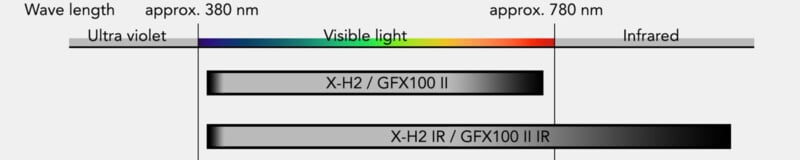
A typical Fujifilm X or GFX Series camera includes an infrared-cut, or IR-cut, filter in front of its image sensor. This ensures that images look "right," and are sharp with accurate color rendering. Thanks to the IR-cut filter, a standard Fujifilm digital camera sensor is exposed to visible light, ranging in wavelength from approximately 380 to 780 nanometers. Infrared light, which has wavelengths beyond 780 nanometers, is prevented from reaching the image sensor by the IR-cut filter.


A diagram showing the electromagnetic spectrum from ultraviolet (380 nm) to infrared (780 nm), highlighting visible light. It compares the wavelength sensitivity of X-H2/GFX100 II and X-H2 IR/GFX100 II IR cameras.


The GFX100II IR and X-H2 IR models ditch this sensor, enabling them to capture infrared wavelengths of light. This is useful for very specific applications.

I couldn't find precise data about wavelengths. The non-IR version uses a CMOS device, which are usually based on Silicon (sensitive to visible and near IR up to ~1 micron in wavelength)
https://www.fujifilm-x.com/global/products/cameras/x-h2/specifications/
External Quote:

Image Sensor 23.5mm x 15.7mm (APS-C) X-Trans CMOS 5 HR with primary color filter
It seems like the cameras are sensitive to near IR by changing the filters before the sensors, tailoring the sensor sensitivity, or both.
 
From the same reference:
External Quote:

A typical Fujifilm X or GFX Series camera includes an infrared-cut, or IR-cut, filter in front of its image sensor. This ensures that images look "right," and are sharp with accurate color rendering. Thanks to the IR-cut filter, a standard Fujifilm digital camera sensor is exposed to visible light, ranging in wavelength from approximately 380 to 780 nanometers. Infrared light, which has wavelengths beyond 780 nanometers, is prevented from reaching the image sensor by the IR-cut filter.


A diagram showing the electromagnetic spectrum from ultraviolet (380 nm) to infrared (780 nm), highlighting visible light. It compares the wavelength sensitivity of X-H2/GFX100 II and X-H2 IR/GFX100 II IR cameras.


The GFX100II IR and X-H2 IR models ditch this sensor, enabling them to capture infrared wavelengths of light. This is useful for very specific applications.
I couldn't find precise data about wavelengths. The non-IR version uses a CMOS device, which are usually based on Silicon (sensitive to visible and near IR up to ~1 micron in wavelength)
https://www.fujifilm-x.com/global/products/cameras/x-h2/specifications/
External Quote:

Image Sensor 23.5mm x 15.7mm (APS-C) X-Trans CMOS 5 HR with primary color filter
It seems like the cameras are sensitive to near IR by changing the filters before the sensors, tailoring the sensor sensitivity, or both.
Correct. These filters (IR cut) are in every consumer camera. I even removed a few myself in the past, to be able to detect 1064nm laser signals (with Basler CCD).
 
I couldn't find precise data about wavelengths.
You can usually find better data on sensitivity (quantum efficiency) at specific wavelengths of cameras designed for astronomical telescopes. I'm not sure they'd suit your purposes as they are not designed to be used during the day.
 
Correct. These filters (IR cut) are in every consumer camera. I even removed a few myself in the past, to be able to detect 1064nm laser signals (with Basler CCD).
I wonder if you may also have removed the UV filter as well.

Did you have to select specific lenses with glasses chosen to pass IR, or was the laser so strong the point was moot?
 
I wonder if you may also have removed the UV filter as well.

Did you have to select specific lenses with glasses chosen to pass IR, or was the laser so strong the point was moot?
It is been a long time, I recall it had a quartz element objective. But it was all laserbeam breadboarding work, so no imaging going on.
 
Back
Top