
You are using an out of date browser. It may not display this or other websites correctly.
You should upgrade or use an alternative browser.
You should upgrade or use an alternative browser.
Isis/Osiris consipracy, sexual and occult symbology in art, crucifixion scenes
- Thread starter Mick West
- Start date

I've not idea what point you are making with your Vietnam reference.
What's the scientific stuff?
The point I am making with Vietnam, is there are different ways which people interpret facts which then fall into different schools of thought i.e. some say Vietnam was justified, others say it wasn't; some say the wars in the M.E are justified, others say it isn't... some say the government theory that a guy in a cave told around 16 people to attack America with passenger planes, others see the same facts leading to a different theory that the U.S Government was involved in a false flag operation... it is different sides of the argument. It is a fallacy to suggest that people who believe the latter are in some way unpatriotic.
I don't know what scientific stuff you are referring to.

I don't know what scientific stuff you are referring to.
I mean:
I take it you don't even accept the Babylonian Religion as being on two level, the esoteric, scientific level and the exoteric rituals for the masses.
I mean:
Well I am amazed. I explained that the Babylonian Priests were fundamentally scientists. They have a long history of mathematics and tracking the planets and being able to predict things from that. Factual things like eclipses and equinoxes etc, which make them powerful people of the time.
They used the knowledge in symbolic/allegorical terms and created a religion for the uneducated but which they themselves understood. The Priests knew the reality, the peasants had the symbolism
External Quote:Taken from: Secret Teachings concealed within the Rituals, Allegories, and Mysteries of all Ages
By Manly P. Hall
From Preface: Hall self-published this massive tome in 1928, consisting of about 200 legal-sized pages in 8 point type; it is literally his magnum opus. Each of the nearly 50 chapters is so dense with information that it is the
equivalent of an entire short book.
From chapter: The Ancient Mysteries and Secret Societies
Which Have Influenced Modern Masonic Symbolism
p. 21
WHEN confronted with a problem involving the use of the reasoning faculties, individuals of strong
intellect keep their poise, and seek to reach a solution by obtaining facts bearing upon the question.
Those of immature mentality, on the other hand, when similarly confronted, are overwhelmed. While the
former may be qualified to solve the riddle of their own destiny, the latter must be led like a flock of
sheep and taught in simple language. They depend almost entirely upon the ministrations of the
shepherd. The Apostle Paul said that these little ones must be fed with milk, but that meat is the food of
strong men. Thoughtlessness is almost synonymous with childishness, while thoughtfulness is symbolic
of maturity.
There are, however, but few mature minds in the world; and thus it was that the philosophic-religious
doctrines of the pagans were divided to meet the needs of these two fundamental groups of human
intellect--one philosophic, the other incapable of appreciating the deeper mysteries of life. To the
discerning few were revealed the esoteric, or spiritual, teachings, while the unqualified many received
only the literal, or exoteric, interpretations. In order to make simple the great truths of Nature and the
abstract principles of natural law, the vital forces of the universe were personified, becoming the gods
and goddesses of the ancient mythologies. While the ignorant multitudes brought their offerings to the
altars of Priapus and Pan (deities representing the procreative energies), the wise recognized in these
marble statues only symbolic concretions of great abstract truths.
Was there any science besides astrology?
They were extremely enlightened/scientific/educated for the time. They were the cradle of civilization.
Wikipedia touches on it, barely scratching the surface really.
http://en.wikipedia.org/wiki/Babylonia#Astronomy
External Quote:Tablets dating back to the Old Babylonian period document the application of mathematics to the variation in the length of daylight over a solar year. Centuries of Babylonian observations of celestial phenomena are recorded in the series of cuneiform tablets known as the 'Enūma Anu Enlil'. The oldest significant astronomical text that we possess is Tablet 63 of 'Enūma Anu Enlil', the Venus tablet of Ammi-saduqa, which lists the first and last visible risings of Venus over a period of about 21 years and is the earliest evidence that the phenomena of a planet were recognized as periodic. The oldest rectangular astrolabe dates back to Babylonia ca. 1100 BC. The MUL.APIN, contains catalogues of stars and constellations as well as schemes for predicting heliacal risings and the settings of the planets, lengths of daylight measured by a water-clock, gnomon, shadows, and intercalations. The Babylonian GU text arranges stars in 'strings' that lie along declination circles and thus measure right-ascensions or time-intervals, and also employs the stars of the zenith, which are also separated by given right-ascensional differences.[7]
Medicine
Medical diagnosis and prognosisWe find [medical semiotics] in a whole constellation of disciplines.... There was a real common ground among these [Babylonian] forms of knowledge... an approach involving analysis of particular cases, constructed only through traces, symptoms, hints.... In short, we can speak about a symptomatic or divinatory [or conjectural] paradigm which could be oriented toward past present or future, depending on the form of knowledge called upon. Toward future... that was the medical science of symptoms, with its double character, diagnostic, explaining past and present, and prognostic, suggesting likely future....The oldest Babylonian texts on medicine date back to the First Babylonian Dynasty in the first half of the 2nd millennium BC. The most extensive Babylonian medical text, however, is the Diagnostic Handbook written by the ummânū, or chief scholar, Esagil-kin-apli of Borsippa,[9] during the reign of the Babylonian king Adad-apla-iddina (1069-1046 BC).[10]
—Carlo Ginzburg[8]
Along with contemporary ancient Egyptian medicine, the Babylonians introduced the concepts of diagnosis, prognosis, physical examination, and prescriptions. In addition, the Diagnostic Handbook introduced the methods of therapy and aetiology and the use of empiricism, logic and rationality in diagnosis, prognosis and therapy. The text contains a list of medical symptoms and often detailed empirical observations along with logical rules used in combining observed symptoms on the body of a patient with its diagnosis and prognosis.[11]
Pythagoras spent 22 years studying in Babylonia. He did it for a reason. The Babylonians had secrets and understanding way beyond the Greeks and Romans
Even CNN acknowledge it. Well I suppose they have to be right sometimes
http://edition.cnn.com/2010/WORLD/meast/12/17/old.babylonian.math/index.html
Even CNN acknowledge it. Well I suppose they have to be right sometimes
http://edition.cnn.com/2010/WORLD/meast/12/17/old.babylonian.math/index.html
External Quote:(CNN) -- Over 1,000 years before Pythagoras was calculating the length of a hypotenuse, sophisticated scribes in Mesopotamia were working with the same theory to calculate the area of their farmland.
Working on clay tablets, students would "write" out their math problems in cuneiform script, a method that involved making wedge-shaped impressions in the clay with a blunt reed.
These tablets bear evidence of practical as well as more advanced theoretical math and show just how sophisticated the ancient Babylonians were with numbers -- more than a millennium before Pythagoras and Euclid were doing the same in ancient Greece.
"They are the most sophisticated mathematics from anywhere in the world at that time," said Alexander Jones, a Professor of the History of the Exact Sciences in Antiquity at New York University.
Alex Jones eh? 
Mathematics and science had to start somewhere. There was plenty going on in China and Egypt at that time too.
I'm really not seeing this big science based secret society there, especially one that supposedly lasted 5,000 years.
I think the focus of your theory is vastly too narrow, even though it's deep. There's plenty of other religions, science, and civilizations have have influenced history.
http://www.davidrumsey.com/luna/ser...5~3001080:The-Histomap--Four-Thousand-Years-O
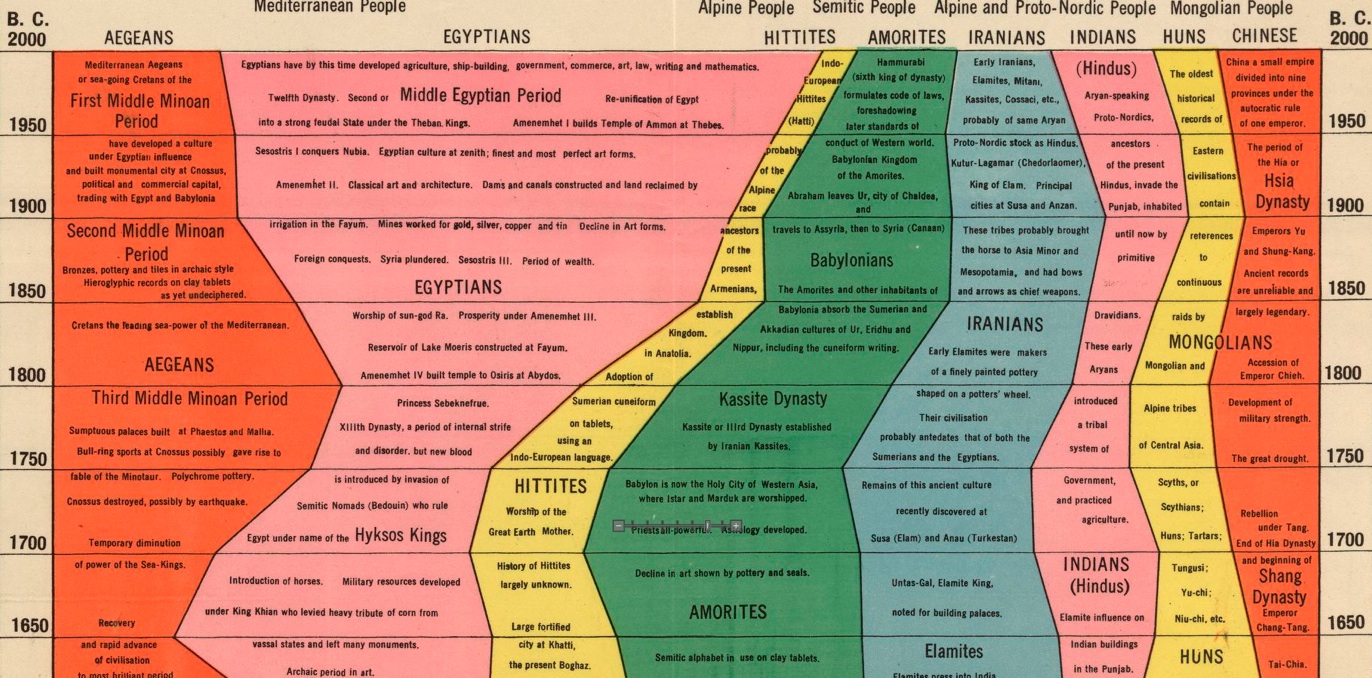
And what did exist back then (science-wise) was really quite simple.
Mathematics and science had to start somewhere. There was plenty going on in China and Egypt at that time too.
I'm really not seeing this big science based secret society there, especially one that supposedly lasted 5,000 years.
I think the focus of your theory is vastly too narrow, even though it's deep. There's plenty of other religions, science, and civilizations have have influenced history.
http://www.davidrumsey.com/luna/ser...5~3001080:The-Histomap--Four-Thousand-Years-O
And what did exist back then (science-wise) was really quite simple.
Last edited:
Alex Jones eh?
Mathematics and science had to start somewhere. There was plenty going on in China and Egypt at that time too.
I'm really not seeing this big science based secret society there, especially one that supposedly lasted 5,000 years.
I think the focus of your theory is vastly too narrow, even though it's deep. There's plenty of other religions, science, and civilizations have have influenced history.
And what did exist back then (science-wise) was really quite simple.
Alex Jones eh?... I don't understand.
Anyway, Babylonian knowledge was the basis of the other civilisations you mention. Naturally they had their own learned peoples, Magi, Priests whatever you wish to call them.
Pythagoras spent 22 years trying to understand Babylonian BS, (spread around the region) and then returned with knowledge that made him famous and revered among his contemporaries and even to date?
http://9waysmysteryschool.tripod.com/sacredsoundtools/id13.html
Pythagoras of Samos (560BC - 480BC)
He was a Greek philosopher who was responsible for important developments in the history of mathematics, astronomy, and the theory of music. He founded the Pythagorean Brotherhood and formulated principles that influenced the thoughts of Plato and Aristotle. The influence of Pythagoras is so widespread, and coupled with the fact that no writings of Pythagoras exist today, this short article will attempt to guide the reader through the life of this most remarkable teacher.
The Bible is based on Babylonian teachings, directly and indirectly through the Egyptians.
Moses was brought up in the Pharaoh's palace.
http://judaism.about.com/od/jewishbiographies/a/moses.htm
Moses, the son of Amram and Jochebed (Yocheved) of the tribes of Levi, was born in the period of the greatest Egyptian oppression - the second half of the 13th century B.C.E. when Ramses II was Pharaoh of Egypt.
To save him from the Pharaoh's decree to kill all Hebrew male babies, Moses' mother put him in a basket which she sent floating on the Nile river. The baby were found by the Pharaoh's daughter, and thus Moses was raised in Pharaoh's palace.
Moses wrote the Bible.
http://en.wikipedia.org/wiki/Torah
According to religious tradition, all of the teachings found in the Torah, both written and oral, were given by God to Moses, some of them at Mount Sinai and others at the Tabernacle, and all the teachings were written down by Moses, which resulted in the Torah we have today. According to a Midrash, the Torah was created prior to the creation of the world, and was used as the blueprint for Creation.[4]
If I wrote 'Moses got his information from the vast libraries of the Pharaoh's', in many places I would be pounced on and corrected with... 'No he got the Word from God', but I expect better here.
The Egyptians got much of their knowledge from the Babylonians, ergo Judaism drives from Babylon Mystery Schools.
http://www.jesusneverexisted.com/babylon.htm
[FONT=Verdana, Arial, Helvetica, sans-serif]The Jews had much to learn from the rich, cosmopolitan culture of Mesopotamia. Here they witnessed trade, commerce and religion on an imperial scale. In Babylon the Great, walled 'City of Wisdom', there were numerous gods and no fewer than fifty five temples. Here was to be found a vast literature of religious texts, in particular the great epic of creation, the story of Gilgamesh. Here too were legends of the origin of kingship and moralistic fables.[/FONT]
[FONT=Verdana, Arial, Helvetica, sans-serif] In Babylon, the Jews learned of prayer, dream interpretation, astrology, almanacs, and omens. For the first time, they encountered the notion of a personal 'immortality' and the fantasy of 'resurrecting' the dead. Impressed by the high culture of their hosts, the Jews adopted the lunar calendar of the Babylonians, and, like them, began their year in the spring. In the Babylonian setting the Jews met in 'gatherings' ('synagogues' in Greek) for the first time. Leadership of these assemblies assumed a 'priestly' character. One such leader, Ezekiel, kept the clan together by stressing the role in the community of this Yahweh priesthood and how the 'glory' of their god, even without an Ark or temple, was there with them in Babylon. Thus Yahweh floated free of confinement to 'sacred space'.[/FONT]
If anyone is interested, I recommend the PDF documents, obtainable by free download, (Thank you very much to the guys, (including Microsoft), who make this possible)
Manly P Hall "Secret Teachings of All Ages"
Robinson "Dungeon, Fire and Sword, The Knights Templar"
Albert Pike "Morals and Dogma"
It seems like this myth just plucks one possible thread out of history, picking the thread that fits the narrative, and says that's what happened.
There's much larger degree of uncertainty to history than you suggest. Take your tale of Pythagoras:
That interpretation does not even fit the link you gave to support it:
http://en.wikipedia.org/wiki/Pythagoras
There's much larger degree of uncertainty to history than you suggest. Take your tale of Pythagoras:
Pythagoras spent 22 years trying to understand Babylonian BS, (spread around the region) and then returned with knowledge that made him famous and revered among his contemporaries and even to date?
That interpretation does not even fit the link you gave to support it:
Even that's rather specific, and not at all provable by known facts:External Quote:
He traveled widely in his youth with his father Mnesarchus, who was a gem merchant from Tyre. His family settled in the homeland of his mother, Pythais, on the island of Samos, where he studied with the philosopher Pherekydes. He was introduced to mathematical ideas and astronomy by Thales, and his pupil Anaximander in Miletus when he was between 18 and 20 years old. Thales advised Pythagoras to travel to Egypt to learn more of these subjects.
[...]
He spent the next 22 years perfecting himself in mathematics, astronomy, music, and was initiated into the Egyptian Mysteries. When Cambyses II, the king of Persia invaded Egypt in 525BC, he made Pythagoras his prisoner and sent him to Babylon. He utilized this misfortune as an opportunity for growth, and for the next 12 years he studied with the Magi and was initiated into the Chaldean Mysteries. Leaving Babylon, he made his way through Persia to India, where he continued his education under the Brachmanes. At that time India was still feeling the effects of the spiritual revival brought about by Gautama the Buddha. Although Pythagoras arrived in India too late to come into personal contact with the Buddha, he was greatly influenced by his teachings. He went to India a student, he left it as a teacher, and even to this day he is known in that country as Pitar Guru, and as Yavanacharya, the Ionian Teacher.
http://en.wikipedia.org/wiki/Pythagoras
You seem to be interpreting EVERYTHING through the lens of "The Babylonians Started Everything, and everything is based on Babylon", and then simply writing a history that agrees with that statement.External Quote:It was natural for the ancient biographers to inquire as to the origins of Pythagoras' remarkable system. In the absence of reliable information, however, a huge range of teachers were assigned to Pythagoras. Some made his training almost entirely Greek, others exclusively Egyptian and Oriental. We find mentioned as his instructors Creophylus,[12] Hermodamas of Samos,[13] Bias,[12]Thales,[12] Anaximander,[14] and Pherecydes of Syros.[15] He is said too, to have been taught by a Delphic priestess namedThemistoclea, who introduced him to the principles of ethics.[16][17] The Egyptians are said to have taught him geometry, thePhoenicians arithmetic, the Chaldeans astronomy, the Magians the principles of religion and practical maxims for the conduct of life.[18] Of the various claims regarding his Greek teachers, Pherecydes is mentioned most often.Diogenes Laertius reported that Pythagoras had undertaken extensive travels, and had visited not only Egypt, but Arabia,Phoenicia, Judaea, Babylon, and even India, for the purpose of collecting all available knowledge, and especially to learn information concerning the secret or mystic cults of the gods.[19] Plutarch asserted in his book On Isis and Osiris that during his visit to Egypt, Pythagoras received instruction from the Egyptian priest Oenuphis of Heliopolis.[20] Other ancient writers asserted his visit to Egypt.[21] Enough of Egypt was known to attract the curiosity of an inquiring Greek, and contact between Samos and other parts of Greece with Egypt is mentioned.[22]
It is not easy to say how much Pythagoras learned from the Egyptian priests, or indeed, whether he learned anything at all from them. There was nothing in the symbolism which the Pythagoreans adopted which showed the distinct traces of Egypt. The secret religious rites of the Pythagoreans exhibited nothing but what might have been adopted in the spirit of Greek religion, by those who knew nothing of Egyptian mysteries. The philosophy and the institutions of Pythagoras might easily have been developed by a Greek mind exposed to the ordinary influences of the age. Even the ancient authorities note the similarities between the religious and ascetic peculiarities of Pythagoras with the Orphic or Cretan mysteries,[23] or the Delphic oracle.[24]
It seems like this myth just plucks one possible thread out of history, picking the thread that fits the narrative, and says that's what happened.
There's much larger degree of uncertainty to history than you suggest. Take your tale of Pythagoras:
You seem to be interpreting EVERYTHING through the lens of "The Babylonians Started Everything, and everything is based on Babylon", and then simply writing a history that agrees with that statement.
I used Pythagoras sojourn in the Semitic regions simply as a well known example of a outstanding mathematician/philosopher who learned from the Babylonians. That's all.
You keep saying, 'The Babylonians were just another ignorant race... show me their science'... If you want to believe or promulgate that, that's up to you.
http://en.wikipedia.org/wiki/Hanging_Gardens_of_Babylon
I take it you accept the Judaic connection and Moses authoring the first five books of the Bible?External Quote:In ancient writings the Hanging Gardens of Babylon were first described by Berossus, a Babylonian priest of Marduk who lived in the late 4th century BC, although his books are known only from quotations by later authors (e.g., Flavius Josephus). There are five principal writers (including Berossus) whose descriptions of Babylon are extant in some form today. These writers concern themselves with the size of the Hanging Gardens, why and how they were built, and how the gardens were irrigated.
Josephus (ca. 37–100 AD) quoted Berossus (writing ca. 280 BC), when he described the gardens.[7] Berossus described the reign of Nebuchadnezzar II, the king he credits with the construction of the Hanging Gardens.[8]"In this palace he erected very high walks, supported by stone pillars; and by planting what was called a pensile paradise, and replenishing it with all sorts of trees, he rendered the prospect an exact resemblance of a mountainous country. This he did to gratify his queen, because she had been brought up in Media, and was fond of a mountainous situation."[9]Diodorus Siculus (active ca. 60–30 BC) seems to have consulted the early 4th century BC texts of Ctesias of Cnidus for his description of the Hanging Gardens:
Strabo (ca. 64 BC – 21 AD) described of the Hanging Gardens as follows, in a passage that was thought to be based on the lost account of Onesicritus from the 4th century BC:"Babylon, too, lies in a plain; and the circuit of its wall is three hundred and eighty-five stadia. The thickness of its wall is thirty-two feet; the height thereof between the towers is fifty cubits; that of the towers is sixty cubits; and the passage on top of the wall is such that four-horse chariots can easily pass one another; and it is on this account that this and the hanging garden are called one of the Seven Wonders of the World. The garden is quadrangular in shape, and each side is four plethra in length. It consists of arched vaults, which are situated, one after another, on checkered, cube-like foundations. The checkered foundations, which are hollowed out, are covered so deep with earth that they admit of the largest of trees, having been constructed of baked brick and asphalt – the foundations themselves and the vaults and the arches. The ascent to the uppermost terrace-roofs is made by a stairway; and alongside these stairs there were screws, through which the water was continually conducted up into the garden from the Euphrates by those appointed for this purpose, for the river, a stadium in width, flows through the middle of the city; and the garden is on the bank of the river."[5]
The great Flood: the Babylonian story
http://www.livius.org/fa-fn/flood/flood3.html
http://www.livius.org/fa-fn/flood/flood3.html
External Quote:The Babylonian story of the Great Flood has come down to us in three versions, which contain so many echoes that it is likely that tradition was not oral, but written. The Biblical account can be seen as the fourth branch to this tree.
http://en.wikipedia.org/wiki/Tower_of_Babel
The Tower of Babel (Hebrew: מגדל בבל Migdal Bavel Arabic: برج بابل Burj Babil) forms the focus of a story told in the Book of Genesis of the Bible.[1] According to the story, a united humanity of the generations following the Great Flood, speaking a single language and migrating from the east, came to the land of Shinar (Hebrew: שנער), where they resolved to build a city with a tower "whose top may reach unto heaven; and let us make us a name, lest we be scattered abroad upon the face of the whole earth."[2]
God came down to see what they did and said: "They are one people and have one language, and nothing will be withheld from them which they purpose to do." "Come, let us go down and confound their speech." And so God scattered them upon the face of the Earth, and confused their languages, so that they would not be able to return to each other, and they left off building the city, which was called Babel "because God there confounded the language of all the Earth".[3]
I used Pythagoras sojourn in the Semitic regions simply as a well known example of a outstanding mathematician/philosopher who learned from the Babylonians. That's all.
You keep saying, 'The Babylonians were just another ignorant race... show me their science'... If you want to believe or promulgate that, that's up to you.
That's not what I'm saying at all. I'm saying there have been several civilizations in the past that developed various bits of mathematics in the past. Pythagoras went to Egypt to learn.
You seem to be saying that everything Babylon touched is then part of Babylon. It's nonsensical. Like you've invented some kind of ancient super-science that permeates everything up to the present day. Its nonsense. All they had was some astrology and math, just like Egypt, Greece, China and India - and independently later in the Mayan culture. It's nothing special, just normal progress.
I take it you accept the Judaic connection and Moses authoring the first five books of the Bible?
No, of course not:
http://en.wikipedia.org/wiki/Authorship_of_the_Bible#Torah
External Quote:According to Rabbinic tradition the five books of the Torah were written by Moses, with the exception of the last eight verses of Deuteronomy which describe his death.[2] Today, the majority of secular scholars agree that the Pentateuch does not have a single author, and that its composition took place over centuries.
That's not what I'm saying at all. I'm saying there have been several civilizations in the past that developed various bits of mathematics in the past. Pythagoras went to Egypt to learn.
You seem to be saying that everything Babylon touched is then part of Babylon. It's nonsensical. Like you've invented some kind of ancient super-science that permeates everything up to the present day. Its nonsense. All they had was some astrology and math, just like Egypt, Greece, China and India - and independently later in the Mayan culture. It's nothing special, just normal progress.
No, of course not:
http://en.wikipedia.org/wiki/Authorship_of_the_Bible#Torah
External Quote:According to Rabbinic tradition the five books of the Torah were written by Moses, with the exception of the last eight verses of Deuteronomy which describe his death.[2] Today, the majority of secular scholars agree that the Pentateuch does not have a single author, and that its composition took place over centuries.
Well I guessed as much... I think we must be Babeling on
Some people may appreciate this so I will post it.
http://www.uhcg.org/Lost-10-Tribes/walt1-Sumerians.html
http://www.uhcg.org/Lost-10-Tribes/walt1-Sumerians.html
External Quote:Some astronomical firsts of the Sumerians are amazing. Their very accurate calendars were fashioned around the mind-boggling timeframe of 25,920 years, the "Great Year" based on a sophisticated celestial phenomenon known as precession [the time Earth's polar axis needs to circle the sky and point again at the same North Star]. They predicted sun risings and settings that were accurate enough to predict eclipses. Necessary to predict eclipses was knowledge of the shapes, movements, and relationships between the earth, moon, and sun. They accomplished this by using the same heliacal system we use today, by measuring the rising and setting of the stars and planets in our skies relative to the sun.
External Quote:A number of star features that could not be seen without the use of a telescope were given the same names in different languages in both the Old and New Worlds. Such was the Scorpion, a star cluster containing a comet, which reminded both the (Sumero-) Babylonians and the Maya of Central America of a scorpion and was called by that name by both races. Greek astronomers adopted the observation of the Babylonians that Uranus regularly covered its moons, an occurrence also unable to be seen by the naked eye, and converted it to a legend that the god Uranus had the habit of alternately eating and later disgorging his children.
"In mythology, Mars, the god of war, had two fierce horses, Phoebos (fear) and Deimos (terror), to pull his chariot, the planet Mars, a legend possibly drawn from ancient knowledge that Mars had two moons. But in the centuries between ancient and modern civilization, the moons of Mars were forgotten until Ashap Hall saw them by telescopic observation in 1877 and appropriately named them after the war god's two horses. [Jonathan Swift, in Gulliver's Travels (1726), wrote that Mars had two moons and correctly gave their dimensions and distance from the planet.]
"The ancient references, which are really astronomical data disguised as legends, to the two moons of Mars, the multiple moons of Jupiter, the five disappearing and reappearing moons of Uranus, the nine moons of Saturn, and even the horns of Venus, suggest that astronomers of former cultures were capable of using artificial sight amplification that was probably a form of telescope.
Some people may appreciate this so I will post it.
http://www.uhcg.org/Lost-10-Tribes/walt1-Sumerians.html
External Quote:Some astronomical firsts of the Sumerians are amazing. Their very accurate calendars were fashioned around the mind-boggling timeframe of 25,920 years, the "Great Year" based on a sophisticated celestial phenomenon known as precession [the time Earth's polar axis needs to circle the sky and point again at the same North Star]. They predicted sun risings and settings that were accurate enough to predict eclipses. Necessary to predict eclipses was knowledge of the shapes, movements, and relationships between the earth, moon, and sun. They accomplished this by using the same heliacal system we use today, by measuring the rising and setting of the stars and planets in our skies relative to the sun.External Quote:A number of star features that could not be seen without the use of a telescope were given the same names in different languages in both the Old and New Worlds. Such was the Scorpion, a star cluster containing a comet, which reminded both the (Sumero-) Babylonians and the Maya of Central America of a scorpion and was called by that name by both races. Greek astronomers adopted the observation of the Babylonians that Uranus regularly covered its moons, an occurrence also unable to be seen by the naked eye, and converted it to a legend that the god Uranus had the habit of alternately eating and later disgorging his children.
"In mythology, Mars, the god of war, had two fierce horses, Phoebos (fear) and Deimos (terror), to pull his chariot, the planet Mars, a legend possibly drawn from ancient knowledge that Mars had two moons. But in the centuries between ancient and modern civilization, the moons of Mars were forgotten until Ashap Hall saw them by telescopic observation in 1877 and appropriately named them after the war god's two horses. [Jonathan Swift, in Gulliver's Travels (1726), wrote that Mars had two moons and correctly gave their dimensions and distance from the planet.]
"The ancient references, which are really astronomical data disguised as legends, to the two moons of Mars, the multiple moons of Jupiter, the five disappearing and reappearing moons of Uranus, the nine moons of Saturn, and even the horns of Venus, suggest that astronomers of former cultures were capable of using artificial sight amplification that was probably a form of telescope.
Have you checked all that? Because the Jonathan Swift claim is incorrect, and I suspect several others are also.
Can you actually back up those claims with evidence?
Have you checked all that? Because the Jonathan Swift claim is incorrect, and I suspect several others are also.
Can you actually back up those claims with evidence?
http://en.wikipedia.org/wiki/Moons_of_Mars
][Perhaps inspired by Johannes Kepler (and quoting Kepler's third law of planetary motion), Jonathan Swift's satire Gulliver's Travels (1726) refers to two moons in Part 3, Chapter 3 (the "Voyage to Laputa"), in which Laputa's astronomers are described as having discovered two satellites of Mars orbiting at distances of 3 and 5 Martian diameters, and periods of 10 and 21.5 hours, respectively. The actual orbital distances and periods of Phobos and Deimos are 1.4 and 3.5 Martian diameters, and 7.6 and 30.3 hours, respectively.[1
Is this what you meant?
Yes.
Does that answer your question... if not, can you be more specific?
Does that answer your question... if not, can you be more specific?
My question was
Have you checked all that? Because the Jonathan Swift claim is incorrect, and I suspect several others are also.
Can you actually back up those claims with evidence?
So no, it does not answer it. I don't see how the question could be more specific.
This is interesting as it deals with the 'influence' that Babylonian Mystery Religion appears to have on world leaders of today.
http://binnallofamerica.com/rr12.12.9.html
http://binnallofamerica.com/rr12.12.9.html
External Quote:[h=4]Perhaps the creepiest and definitely the strangest parallel, though, is that just as in The Devil Rides Out (and again the Star Wars films, strangely enough), after being initiated into The Order of Skull and Bones members are given new Satanic sounding names. George Bush senior's Skull and Bones name allegedly being "Gog" or "Magog."
How seriously anyone in Skull and Bones or the Bohemian Club take these strange rituals is anyone's guess. However, the elite have certainly put a lot of time, money and research into something they claim is just a bit of harmless recreational fun. Whether Dennis Wheatley knew about either of these secret societies and their rituals isn't known but one things for sure: what they appear to be is exactly the sort of obscene practices he was writing about in his books and, with Christopher Lee, wanted to warn the world about in the Hammer adaptations.
[/h]
Well let's deal with the Jonathan Swift claim first.
What is it that you are unhappy about with this... what, apart from minor discrepancy, is wrong with it?
The claim was that he "correctly gave their dimensions and distance from the planet"
He did not.
The claim was that he "correctly gave their dimensions and distance from the planet"
He did not.
Fair enough, he was slightly off on their dimensions and distance but lets put that in context.
http://en.wikipedia.org/wiki/Moons_of_Mars
External Quote:Mars has two moons, Phobos and Deimos, which are thought to be captured asteroids. Both satellites were discovered in 1877 by Asaph Hall and are named after the characters Phobos (panic/fear) and Deimos (terror/dread) who, in Greek mythology, accompanied their father Ares, god of war, into battle. Ares was known as Mars to the Romans.
As Swift's reference predates the actual 'scientific' discovery by over 150 years and given the 'fact' that he is not far wrong, it is very unlikely that it is a 'mere coincidence', any more than the rising of the Sun can be construed as 'a mere coincidence'.External Quote:Perhaps inspired by Johannes Kepler (and quoting Kepler's third law of planetary motion), Jonathan Swift's satire Gulliver's Travels (1726) refers to two moons in Part 3, Chapter 3 (the "Voyage to Laputa"),
http://en.wikipedia.org/wiki/Phobos_(mythology)External Quote:The names, originally spelled Phobus and Deimus, respectively, were suggested by Henry Madan (1838–1901), Science Master of Eton, from Book XV of the Iliad, where Ares summons Fear and Fright.
Mars has long been the symbol of 'the god of war'. Is it coincidence that the 'dogs of war', Phobos and Deimos should be associated.External Quote:Phobos (Ancient Greek: Φόβος, pronounced [pʰóbos], meaning "fear" or "terror") is the personification of fear in Greek mythology. He is the offspring of Aphrodite and Ares. He was known for accompanying Ares into battle along with the ancient war goddess Enyo, the goddess of discord Eris (both sisters of Ares), and Phobos twin brother Deimos.
In Classical Greek mythology, Phobos is more of a personification of the fear brought by war and does not appear as a character in any myths. Timor is his Roman equivalent.
http://www.theseekerbooks.com/articles/sitchen.htm
And what of the Dogon tribe?External Quote:His aliens have bases on Mars. They are behind the failures of our space probes to Mars and the 1989 failure of a Soviet-launched satellite called Phobos 2. This satellite was named for a real Mars moonlet (Mars has two very small moons called Phobos and Diemos) and its mission was to enter an orbit that shadowed the real Phobos, which it did in January1989. However, the Soviets lost contact with their satellite right after receiving some bizarre photos from it. One shows anomalous features on the surface of Mars, strange geometric shapes that look artificial; the other shows a shadow of something that must have been between the satellite and Mars. Could it have been an alien space ship and could it have destroyed Phobos 2? Sitchen thinks that's exactly what happened.
http://en.wikipedia.org/wiki/Dogon_people#Culture_and_religion
"the Dogon believe that the brightest star in the sky, Sirius (sigi tolo or 'star of the Sigui'[18]), has two companion stars, pō tolo (the Digitaria star), and ęmmę ya tolo, (the female Sorghum star), respectively the first and second companions of Sirius A."External Quote:The Dogon talk about Nommo - amphibian deities that arrived from the sky in their fantastic sky ship. They preached to the people who assembled in large numbers around the lake that was created around the ship.[14]
Certain researchers investigating the Dogon have reported that they seem to possess advanced astronomical knowledge, the nature and source of which have subsequently become embroiled in controversy. From 1931 to 1956 the French anthropologist Marcel Griaule studied the Dogon. This included field missions ranging from several days to two months in 1931, 1935, 1937 and 1938[15] and then annually from 1946 until 1956.[16] In late 1946 Griaule spent a consecutive thirty-three days in conversations with the Dogon wiseman Ogotemmêli, the source of much of Griaule and Dieterlen's future publications.[17] They reported that the Dogon believe that the brightest star in the sky, Sirius (sigi tolo or 'star of the Sigui'[18]), has two companion stars, pō tolo (the Digitaria star), and ęmmę ya tolo, (the female Sorghum star), respectively the first and second companions of Sirius A.[19] Sirius, in the Dogon system, formed one of the foci for the orbit of a tiny star, the companionate Digitaria star. When Digitaria is closest to Sirius, that star brightens: when it is farthest from Sirius, it gives off a twinkling effect that suggests to the observer several stars. The orbit cycle takes 50 years.[20] They also claimed that the Dogon appeared to know of the rings of Saturn, and the moons of Jupiter.[21]
Griaule and Dieterlen were puzzled by this Sudanese star system, and prefaced their analysis with the following remark:-
The problem of knowing how, with no instruments at their disposal, men could know the movements and certain characteristics of virtually invisible stars has not been settled, nor even posed.[
Sirius B was not 'discovered' until 1862
http://en.wikipedia.org/wiki/Sirius#Discovery_of_a_companion
External Quote:In 1844 the German astronomer Friedrich Bessel deduced from changes in the proper motion of Sirius that it had an unseen companion.[38] Nearly two decades later, on January 31, 1862, American telescope-maker and astronomer Alvan Graham Clark first observed the faint companion, which is now called Sirius B, or affectionately "the Pup".[39] This happened during testing of an 18.5-inch (470 mm) aperture great refractor telescope for Dearborn Observatory, which was the largest refracting telescope lens in existence at the time, and the largest telescope in America.
Fair enough, he was slightly off on their dimensions and distance but lets put that in context.
http://en.wikipedia.org/wiki/Moons_of_Mars
External Quote:Mars has two moons, Phobos and Deimos, which are thought to be captured asteroids. Both satellites were discovered in 1877 by Asaph Hall and are named after the characters Phobos (panic/fear) and Deimos (terror/dread) who, in Greek mythology, accompanied their father Ares, god of war, into battle. Ares was known as Mars to the Romans.
As Swift's reference predates the actual 'scientific' discovery by over 150 years and given the 'fact' that he is not far wrong, it is very unlikely that it is a 'mere coincidence', any more than the rising of the Sun can be construed as 'a mere coincidence'.External Quote:Perhaps inspired by Johannes Kepler (and quoting Kepler's third law of planetary motion), Jonathan Swift's satire Gulliver's Travels (1726) refers to two moons in Part 3, Chapter 3 (the "Voyage to Laputa"),
The ONLY thing he got right was the number of moons. He was way off both on their size and position. At that time it was well known that planets had moons, it was known that Earth had one, Jupiter and Saturn were known to have several, and I'd imagine several people hazarded a guess as to how many Mars might have. Swift gets a mention because he made a lucky guess, a very simple extrapolation based on known science at the time.

Pete Tar
Senior Member
And what of the Dogon tribe?
Weren't you making a case for Babylon being the source of all knowledge at a higher level than was possible at the time?
So are you saying the Dogons learnt this from the Babylonians?
Mars has long been the symbol of 'the god of war'. Is it coincidence that the 'dogs of war', Phobos and Deimos should be associated.
Well, wouldn't that be the point, choosing those names? Astronomers like a consistent theme as much as anyone else.
Weren't you making a case for Babylon being the source of all knowledge at a higher level than was possible at the time?
So are you saying the Dogon's learnt this from the Babylonians?
Not necessarily, All I suggest is the Babylonian/Sumerian/Arkadian civilisation are the main source of both science and religion. That does not exclude other sources.
The reason I broach the subject of Babylonian Mystery Religion is because there is strong evidence that it threads through history and through religious doctrines and impacts on the world today through secret societies.
I am not saying that I personally believe 'in it', (although many aspects sound quite reasonable when viewed from a certain viewpoint)
I am saying that to deny the existence of this religion impacting on the modern world (and throughout history), is the same as denying that 'any other major religion' has impacted and is impacting on the world.
Let me make myself clear, I believe religion has been a major contributor/instigator of much of man's inhumanity to man. It has by and large been 'foisted' upon mankind as a tool for control by the elite. I do not believe that Christianity would have been harmful to mankind if it had not been usurped and completely transformed around 300 ad by Constantine and those who followed him... i.e. subsequent popes.
I think much of all the world religions are allegorical.
The practices of the elite, both past and present are rooted in an esoteric doctrine which uses symbolism (which is very apparent and in plain sight) which they understand but which the masses take on face value.
If I could produce evidence that Popes x, y and z had a shrine to an owl at which he offered burnt offerings in the form of a child, that would show clearly that they were not sincere in their protestations that they were adherents of the Abrahamic derived religion which they profess publicly to believe in.
Yet when the elite, who profess to be staunch Christians and believers in God, are conclusively shown to do that and much much more, viz blood oaths to keep their fellows secrets up to and including murder and treason, rebirths from coffins, (as in the Osiris legends), it is said 'Oh they are just playing around enjoying themselves'. Like the previous post stated: the elite have certainly put a lot of time, money and research into something they claim is just a bit of harmless recreational fun
That is certainly one explanation and I do not discount it. It is when you start putting things in context that the other explanations become more viable.Well, wouldn't that be the point, choosing those names? Astronomers like a consistent theme as much as anyone else.
Much in religion and politics has been deliberately changed and obfuscated so it is obviously difficult to get to the truth but there are certain things that really stand out.
That is: the elite are out for themselves and are abusing their powers by making war, physically, economically, psychologically and they are actually using/manipulating the masses to do it.

MikeC
Closed Account
All I suggest is the Babylonian/Sumerian/Arkadian civilisation are the main source of both science and religion. That does not exclude other sources.
How do you quantify how much any given civilisation is a "source" of science and religion?
How do you quantify how much any given civilisation is a "source" of science and religion?
A very good question and I suggest not exactly easy to answer in a truly definitive fashion. But I would hazzard as a rule of thumb by how 'adopted' or 'integrated', (even on a hidden level) that 'source' has been throughout the ages.
Science is built upon the knowledge and understanding of our forefathers.
Here it can be clearly seen how interwoven early Abrahmic religion is with Babylonian religion, albeit that they were ideologically oppesed and indeed mortal enemies.
http://prophecytimes.com/default.aspx?content_id=2950
This only serves to magnify the dichotomy produced by merging the Christian religion with the Babylonian religion as has been evidenced by writings and rituals which ensued after the Papalisation of Christianity. (sorry if I made up a word but I'm sure you know what I mean).External Quote:The prophecy refers to the conflict between the followers of Jesus Christ and their enemies: "the beast," "the false prophet," and "the kings of the earth." These are new names for Gog and Magog. In both passages the birds are invited to the great supper of God.62 In Ezek 39 birds eat the defeated forces of Gog and his allies, while in Rev 19 birds prey on the defeated army of the beast and the false prophet who are thrown into the fiery lake of burning sulfur (Rev 19:20). Imagery of the banquet interconnects this prophecy with other biblical authors (Isa 34:5–11; Jer 46:10; Lam 2:21–22; Zeph 1:7–9), but the parallel between Ezek 39 and Rev 19 is the most specific.63 Revelation 19:19 describes the conspiracy of the beast, the kings of the earth, and their armies, who together with the false prophet have gathered to make war against Christ and those who are with Him. Then Rev 19:20– 21 depicts God's intervention and their total defeat.
So yes, tracing back to the earliest mention of things like the Great Flood of Noah's time etc and seeing it thread through later religions is the only way I see possible of quantifying these ideas.
http://www.historyguide.org/ancient/gilgamesh.html
Tying these things together and trying to understand what is really being relayed is the only scientific way I can see of doing it.External Quote:The Gilgamesh epic celebrates the Sumerian king, Uru-inim-gina, as tragic hero. A masterpiece of Mespotamian literature, the epic recounts the pursuit of fame and immortality by the semi-legendary king of Uruk. Based on at least five earlier Sumerian legends, the epic was amalgamated into a unified whole early in the second millennium B.C.
Naturally, there will be different interpretations. The Bible has been interpreted and re interpreted many times to 'prove' this or that. At one time only the Clergy were allowed to interpret, and only then in a set way from which they could not deviate for fear of heresy.
The fact is, the elite make much of these symbols and take the names, e.g Gog Magog etc as George Bush by taking the name and as the City of London using them as protectors and even today clebrating in carnival fashion through the streets annually.
http://en.wikipedia.org/wiki/Gog_and_Magog
A typical 'history rewrite of convenience:External Quote:Gog and Magog (Arabic: يَأْجُوج وَمَأْجُوج Yaʾjūj wa-Maʾjūj; Hebrew: גּוֹג וּמָגוֹג Gog u-Magog) are names that appear primarily in various Abrahamic scriptures, as well as numerous subsequent references in other works. Their context can be either genealogical (as Magog in Genesis 10:2) or eschatological and apocalyptic, as in the Book of Ezekiel and Revelation. They are sometimes individuals, sometimes peoples, and sometimes geographic regions. The passages from Ezekiel and Revelation in particular have attracted attention due to their prophetic descriptions of conflicts said to occur near the "end times".
External Quote:Some early Christian writers (e.g. Eusebius) identified Gog and Magog with the Romans.[26] After the Roman Empire became Christian this was no longer possible and attention switched to Rome's northern barbarian enemies. Ambrose (d.397) identified them with the Goths,[27] and Isidore of Seville confirmed that people in his day supposed that the Goths were descended from Magog
http://www.reformation.org/gog-and-magog.html

External Quote:[FONT=Arial, Helvetica, sans-serif]Gog and Magog symbolize a worldwide Satanic confederacy that will attack the New Covenant Israel before the end of time[/FONT]
External Quote:[FONT=Arial, Helvetica, sans-serif]Two giants named Gog and Magog are the "patron saints" or "protectors" of the City of London....Every year, on the second Saturday in November, they are paraded through the streets of the City. [/FONT]
[FONT=Arial, Helvetica, sans-serif]The City of London is about a square mile area of central London where the Bank of England and the financial district are located....It is very similar to Vatican City, which is a separate jurisdiction within the city of Rome. [/FONT][FONT=Arial, Helvetica, sans-serif]The Man of Sin has two legs: One is firmly planted in Vatican City and the other is firmly planted in the City of London!![/FONT]
External Quote:[FONT=Arial, Helvetica, sans-serif]The orb and scepter were the symbols of Zeus and Jupiter as the supreme false gods of the Greek and Roman pantheons. [/FONT]
[FONT=Arial, Helvetica, sans-serif]The orb represents universal dominion. [/FONT][FONT=Arial, Helvetica, sans-serif]The goddess Nike was called Victoria at Rome. [/FONT][FONT=Arial, Helvetica, sans-serif]The cross, representing the Papal Roman Empire, was substituted for Victoria or Victory by Emperor Constantine.
[/FONT]
Last edited by a moderator:
MikeC
Closed Account
You are very limited in your approach, only look at het abrahamic religions.
India gave us "0" (zero) - it is only 1 numeral...but how much science could we do without it? AFAIK Hinduism and Budhism that it was developed under owe nothing to Babylonia - Hinduism dates to before Babylonia
China gave us gunpowder - with, AFAIK, no connection at all to Babylonia either - however gunpowder, arguably, has been an invention that has enabled "the West" to make massive strides in science and spreading of religion through warfare.
It is all very well immediately heading off to connections between Mesopotamia and abrahamic religions - you still need to show what other connections exist that do not fit that pattern in order to be able to compare.
India gave us "0" (zero) - it is only 1 numeral...but how much science could we do without it? AFAIK Hinduism and Budhism that it was developed under owe nothing to Babylonia - Hinduism dates to before Babylonia
China gave us gunpowder - with, AFAIK, no connection at all to Babylonia either - however gunpowder, arguably, has been an invention that has enabled "the West" to make massive strides in science and spreading of religion through warfare.
It is all very well immediately heading off to connections between Mesopotamia and abrahamic religions - you still need to show what other connections exist that do not fit that pattern in order to be able to compare.
I don't think anyone (other than hardcore christians) has an issue with things like Babylonian antecedents for things like the flood myth. That's found in several old cultures:
http://en.wikipedia.org/wiki/Flood_myth
http://en.wikipedia.org/wiki/Babylon
http://en.wikipedia.org/wiki/Flood_myth
Nor, I think, would people quibble with the assertion that there was a civilization in Babylon, and they had some law, math, astronomy, and science, some of which eventually evolved into things we use today.External Quote:A flood myth or deluge myth is a symbolic narrative in which a great flood is sent by a deity, or deities, to destroy civilization in an act of divine retribution. Parallels are often drawn between the flood waters of these myths and the primeval waters found in certain creation myths, as the flood waters are described as a measure for the cleansing of humanity, in preparation for rebirth. Most flood myths also contain a culture hero, who strives to ensure this rebirth.[1] The flood myth motif is widespread among many cultures as seen in the Mesopotamian flood stories, the Puranas, Deucalion in Greek mythology, the Genesis flood narrative, and in the lore of the K'iche' and Maya peoples of Central America, and the Muisca people in South America.
http://en.wikipedia.org/wiki/Babylon
What I disagree with is any evidence of ancient telescopes (or visiting spacemen), and any evidence that anyone now in power takes the babylonian connection at all seriously as anything more than theater.External Quote:The First Babylonian Dynasty was established by an Amorite chieftain named Sumu-abum in 1894 BC, who declared independence from the neighbouring city-state ofKazallu. The Amorites were, unlike the Sumerians and Akkadian Semites, not native to Mesopotamia, but were semi nomadic Semitic invaders from the lands to the west. Babylon controlled little surrounding territory until it became the capital of Hammurabi's empire a century later (r. 1792–1750 BC). Hammurabi is famous for codifying the laws of Babylonia into the Code of Hammurabi that has had a lasting influence on legal thought.
Pete Tar
Senior Member
If any great civilisation is looked at by someone who is not familiar with it, the sophistication and complexity can seem miraculous.
We just seem to assume we are the epitome of human endeavour, and in some ways we are, but the people who lived thousands of years ago are the same people we are, and just as capable of great things. Reading contemporary accounts of ancient societies really makes you see how little we've changed fundamentally.
This may influence how we interpret past civilisations as having 'knowledge they couldn't possibly have had on their own'.
History is large, and to most a vague abstraction unless you really study it.
(not sure if this is relevant)
We just seem to assume we are the epitome of human endeavour, and in some ways we are, but the people who lived thousands of years ago are the same people we are, and just as capable of great things. Reading contemporary accounts of ancient societies really makes you see how little we've changed fundamentally.
This may influence how we interpret past civilisations as having 'knowledge they couldn't possibly have had on their own'.
History is large, and to most a vague abstraction unless you really study it.
(not sure if this is relevant)

Clock
Active Member
Alex Jones eh?... I don't understand.
He is a very well known conspiracy theorist who is known for unnecessarily jumping to conclusions without any proof of it whatsoever, or misquoting people.
http://conspiracies.skepticproject.com/articles/alex-jones/
He is a very well known conspiracy theorist who is known for unnecessarily jumping to conclusions without any proof of it whatsoever, or misquoting people.
http://conspiracies.skepticproject.com/articles/alex-jones/
Sorry, I was just making a joke earlier, based on this response:
Should have used a bigger smileyPythagoras spent 22 years studying in Babylonia. He did it for a reason. The Babylonians had secrets and understanding way beyond the Greeks and Romans
Even CNN acknowledge it. Well I suppose they have to be right sometimes
http://edition.cnn.com/2010/WORLD/meast/12/17/old.babylonian.math/index.html
External Quote:(CNN) -- Over 1,000 years before Pythagoras was calculating the length of a hypotenuse, sophisticated scribes in Mesopotamia were working with the same theory to calculate the area of their farmland.
Working on clay tablets, students would "write" out their math problems in cuneiform script, a method that involved making wedge-shaped impressions in the clay with a blunt reed.
These tablets bear evidence of practical as well as more advanced theoretical math and show just how sophisticated the ancient Babylonians were with numbers -- more than a millennium before Pythagoras and Euclid were doing the same in ancient Greece.
"They are the most sophisticated mathematics from anywhere in the world at that time," said Alexander Jones, a Professor of the History of the Exact Sciences in Antiquity at New York University.
If any great civilisation is looked at by someone who is not familiar with it, the sophistication and complexity can seem miraculous.
We just seem to assume we are the epitome of human endeavour, and in some ways we are, but the people who lived thousands of years ago are the same people we are, and just as capable of great things. Reading contemporary accounts of ancient societies really makes you see how little we've changed fundamentally.
This may influence how we interpret past civilisations as having 'knowledge they couldn't possibly have had on their own'.
History is large, and to most a vague abstraction unless you really study it.
(not sure if this is relevant)
Well I agree, FWTW.
How different are we from our ancestors if we remove our trappings? Are we really any cleverer? How would we cope in any given era?
Richard Dawkins book on the 'Selfish Gene', excellent... but if you strip it right down to basics does it not equate to 'Do as you would be done by'?
And what about limiting retribution for a transgression... 'An eye for an eye', i.e. let the punishment fit the crime.
Our ancestors have made plenty of mistakes, no doubt about it and I am often reminded of the saying... 'Why does history keep repeating itself.... because we didn't learn the first time'.
Sorry, I was just making a joke earlier, based on this response:
Should have used a bigger smiley
Lol... I get it now... bit slow on that one!
I don't think anyone (other than hardcore christians) has an issue with things like Babylonian antecedents for things like the flood myth. That's found in several old cultures:
That's basically what I was attempting to demonstrate but whilst focussing on Judeo Christian teachings/dogma which has played such an integral part in 'the west's' history, although I in no way intended it as exclusive. I think Mike is wrong when he states Indo Chinese religions pre date Sumerian. I am aware many schools of thought cite Buddhism as being derived from Sumerian religions and the gods are often interchangeable. Similarly, many people ascribe the enlightenment, (and especially the physical condition) of the Chinese monks to learning from India. Shaolin temples were fundamentally religious and the physical aspect merely an extension.
http://en.wikipedia.org/wiki/Origins_of_Asian_martial_arts
External Quote:Indian martial arts may have spread to China via the transmission of Buddhism in the early 5th or 6th centuries of the common era and thus influenced Shaolinquan.
Nor, I think, would people quibble with the assertion that there was a civilization in Babylon, and they had some law, math, astronomy, and science, some of which eventually evolved into things we use today.
I think you underestimate them IMO, perhaps if you looked into it more you may be surprised.
What I disagree with is any evidence of ancient telescopes (or visiting spacemen), and any evidence that anyone now in power takes the babylonian connection at all seriously as anything more than theater.
I agree it is circumstantial evidence, but I think it is also very compelling. The practises and symbolism employed by many of the elite is clearly derived/copied directly from Babylonian Religion or indirectly through transmission into the Judeo Christian religions.
The Osiris story is about the fall of the religion and how it's proponents were scattered into different lands. Osiris represents the religious doctrine, Isis represents the church. Isis gathered in the disseminated parts and resurrected them, but in secret and lacking the penis or 'generative' part of the religion, which is why it had to stay underground.
Look at the Papal emblem
[Broken External Image]:http://beforeitsnews.com/ckfinder/userfiles/0000000000003011/images/770px-logoromanempire.jpg
and the Freemason two headed eagle.
[Broken External Image]:http://beforeitsnews.com/ckfinder/userfiles/0000000000003011/images/Morals_and_Dogma_eagle.jpg
http://beforeitsnews.com/alternativ...inati-god-of-chaos-and-deception-1108892.html
Sorry but CNN doesn't really report this stuff as a rule
http://www.grandlodgescotland.com/i...ompanies&catid=55:masonic-articles&Itemid=200
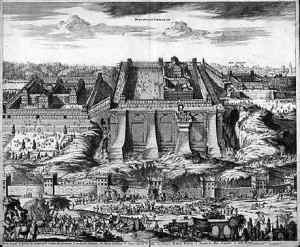
[url]http://www.elijahproject.net/abiff.html
http://higherrevelations.wordpress....nd-the-freemasons-a-study-of-the-magic-flute/External Quote:No one, of course, can be very precise in trying to trace a relationship between Speculative and Operative Masonry and their connection with the Trade or Craft Guilds and the Worshipful Livery Companies of London.
There is so little written evidence on the subject that we can only speculate as to how Masonry, as we now know it, came into existence.
Many Masonic historians claim that Masonry originated in the East -probably Egypt or China - and made its way gradually through Asia Minor, Constantinople, Greece and Cyprus to Rome. It is interesting to note that a Chinese philosopher called Mencius wrote these words three centuries Before Christ:-"A man should abstain from doing unto others, what he would not they should do to him, this is called the principle of acting on the square."
He also wrote:-"A Master Mason, in teaching his apprentices, makes use of the Square and Compasses. Ye who are engaged in the pursuit of Wisdom, must also use the Compasses and Square."
That Masonry travelled westward is suggested in the questions familiar to us:-
"Brother Junior Warden, Whence come you?"
"The East." "Brother Senior Warden, whither directing your course?" "The West."
There is no written evidence to support the idea that Speculative Freemasonry is directly linked with those days, but when the Romans came to this country they brought with them a full complement of craftsmen and artificers, among them the "Brotherhood of Masons".
External Quote:Freemasonry's stated aim was to "build the Temple of Humanity, symbolised by King Solomon's temple."[9] This ideology springs from the ritual, vocabulary and legends taken from the old masonic guilds,[10] such as the story of "Hiram, Solomon's architect, who is killed…because he refuses to divulge the secret."[11]
[url]http://www.elijahproject.net/abiff.html
External Quote:According to the Masonic legend, Hiram Abiff was a man of Tyre, the son of a widow, and the chief architect of the Temple built by King Solomon. He was the central character in the building of the Temple and one of three leading characters along with King Solomon and Hiram, King of Tyre.
Hiram Abiff, Masonry teaches, was the only one on Earth who knew "the secrets of a Master Mason," including the most important secret of all, the "Grand Masonic Word," the name of God (the "ineffable name"). In the Occult, knowing the name of a spirit is a key to having its power, there was a very great power in knowing this word.
[/URL]
Last edited by a moderator:
Why on earth would CNN report that? The two headed eagle is just a symbol from heraldry derived from ancient mythology, like a dragon, a unicorn, a griffin.
Animals with two heads, or two faces, occur in nature sometimes (conjoined twins). It's hardly surprising they are thought significant.
http://en.wikipedia.org/wiki/Gandaberunda
The use of symbols seems to me more to be a reference to the current state of things, and the aspirations of an organization, rather than some obscure occult reference. They use traditional imagery because it's a language to describe what they mean, not because they are repeating something from ages past. Or they do it basically because it's "cool", not because they believe in ancient gods.
But if you start out convinced such a connection exists, then obviously you will start seeing it everywhere.
Animals with two heads, or two faces, occur in nature sometimes (conjoined twins). It's hardly surprising they are thought significant.
http://en.wikipedia.org/wiki/Double-headed_eagleExternal Quote:
http://en.wikipedia.org/wiki/Gandaberunda
I think the problem with your theory again here is that you just grossly simplify, picking out one possibly thread from the vast complexity of history, and making connection where there are none.External Quote:The Gandaberunda (also known as the Berunda) is a two-headed mythological bird of Hindu mythology thought to possess magical strength. It is used as the official emblem by the Karnatakagovernment and it is seen as an intricately sculptured motif in Hindutemples.
The use of symbols seems to me more to be a reference to the current state of things, and the aspirations of an organization, rather than some obscure occult reference. They use traditional imagery because it's a language to describe what they mean, not because they are repeating something from ages past. Or they do it basically because it's "cool", not because they believe in ancient gods.
But if you start out convinced such a connection exists, then obviously you will start seeing it everywhere.
Similar threads


- Locked
- Replies
- 7
- Views
- 15K

- Replies
- 25
- Views
- 15K


