
You are using an out of date browser. It may not display this or other websites correctly.
You should upgrade or use an alternative browser.
You should upgrade or use an alternative browser.
War.gov/UFO - Department of War Releases UAP Files - 2026 Release 1
- Thread starter Mick West
- Start date
- Status
- Not open for further replies.

Fritzkquzerk
Senior Member
Of course not. But there is a fundamental difference between civilian scientific instruments and tactical surveillance networks.Do you think only the military operates instruments that gather data?
Academic institutions point telescopes at specific deep-space targets for astrophysics or track known orbital satellites; they do not operate all-sky, low-altitude air defense radar networks or classified early-warning satellite constellations. Airspace monitoring is a matter of national sovereignty, strictly managed by military and aviation authorities who do not share raw, classified telemetry with civilian universities.
As far as I know, this is something civilian science simply hasn't done in 80 years of history.

jarlrmai
Senior Member.
Astronomy is not limited to deep space there's a lot of wide angle astronomy;Of course not. But there is a fundamental difference between civilian scientific instruments and tactical surveillance networks.
Academic institutions point telescopes at specific deep-space targets for astrophysics or track known orbital satellites; they do not operate all-sky, low-altitude air defense radar networks or classified early-warning satellite constellations. Airspace monitoring is a matter of national sovereignty, strictly managed by military and aviation authorities who do not share raw, classified telemetry with civilian universities.
As far as I know, this is something civilian science simply hasn't done in 80 years of history.
Vera C. Rubin, ZTF for transients (at Palomar ala the recent controversial transients linked to nuclear tests study), Pan-STARRS, ATLAS etc
Then there's web camera networks, volcano/wildlife etc monitoring cameras, weather RADAR and ocean/climate stations that are non military.
Not to mention billions of people now with camera phones, of course they are less capable than military systems however it seems likely there would be SOME data that would stick out somewhere, especially given the application of current consumer/commerical technology to the same type of encounters reported and recorded many decades ago when there was much less and lower quality recording technology around.
Fritzkquzerk
Senior Member
I see your point.Astronomy is not limited to deep space there's a lot of wide angle astronomy;
Vera C. Rubin, ZTF for transients (at Palomar ala the recent controversial transients linked to nuclear tests study), Pan-STARRS, ATLAS etc
Then there's web camera networks, volcano/wildlife etc monitoring cameras, weather RADAR and ocean/climate stations that are non military.
Not to mention billions of people now with camera phones, of course they are less capable than military systems however it seems likely there would be SOME data that would stick out somewhere, especially given the application of current consumer/commerical technology to the same type of encounters reported and recorded many decades ago when there was much less and lower quality recording technology around.
However, none of those systems are calibrated to track atmospheric anomalies. Wide-angle astronomy looks for deep-space transients, weather radars filter out aircraft-sized clutter, and consumer cameras lack telemetry.
That is precisely why the NASA UAP Report explicitly stated that UAP analysis is hampered by "poor sensor calibration, the lack of multiple measurements, and the lack of baseline data."
If civilian networks or commercial tech were sufficient, NASA wouldn't have concluded that science completely lacks the necessary baseline data.
jarlrmai
Senior Member.
The problem is the UFOs can (and do) always just move into the gaps and low information zones of whatever sensors you have deployed.
However at some point you sort of have to do a reset, you take all these reports and recordings from the past and say, if there was something to these and they were still happening we'd now have data, so either the UFOs adapt to the increasing quality and volume of recording devices just staying on the edge, or they are just the inevitable result of the imperfections of all sensing technology.
And the NASA report when taken to it's logical conclusion really just misses out on saying that all sensors are imperfect. Could more cases be solved with better networks, probably, but likely more would emerge.
However at some point you sort of have to do a reset, you take all these reports and recordings from the past and say, if there was something to these and they were still happening we'd now have data, so either the UFOs adapt to the increasing quality and volume of recording devices just staying on the edge, or they are just the inevitable result of the imperfections of all sensing technology.
And the NASA report when taken to it's logical conclusion really just misses out on saying that all sensors are imperfect. Could more cases be solved with better networks, probably, but likely more would emerge.
Fritzkquzerk
Senior Member
Exactly.The problem is the UFOs can (and do) always just move into the gaps and low information zones of whatever sensors you have deployed.
However at some point you sort of have to do a reset, you take all these reports and recordings from the past and say, if there was something to these and they were still happening we'd now have data, so either the UFOs adapt to the increasing quality and volume of recording devices just staying on the edge, or they are just the inevitable result of the imperfections of all sensing technology.
And the NASA report when taken to it's logical conclusion really just misses out on saying that all sensors are imperfect. Could more cases be solved with better networks, probably, but likely more would emerge.
By admitting that we are dealing with "low information zones" and "imperfect sensing technology", you are confirming my point: civilian science has simply never had the calibrated, high-quality data networks needed for a rigorous study in the previous 80 years of history.
All sensors are imperfect, sure, but saying that people have been doing good science on UFOs for the past 50/40 years is not correct.

Nourali
Active Member
Academic science is being conducted every day by real astronomers, physicists, and engineers. Obviously, they're (for the most part) not studying flying saucers and space ghosts, because these are not real things, but they teach us more about our reality every single day. I have no reason to believe that the global community of astronomers is hiding the existence of candy-shaped objects in our atmosphere, or dinner-plate-shaped craft running around kidnapping our cows. And people working in aviation safety aren't worried about airliners colliding with intergalactic Tic Tacs. That's not because they're part of some government cover-up. It's because they study actual threats to air safety.
Studying the videos released by the Pentagon, on the other hand, is more about understanding military platforms and systems, learning how to identify different types of clutter and malfunctions, and developing new systems better suited for an airspace filled with a growing number of small objects such as balloons, drones, and aircraft. And a lot of engineers are doing just that, since it's an important part of modern warfare. This research is obviously classified; anything else would be misconduct.
There are many more-or-less-skilled people around the world studying the UFO phenomenon out of personal interest, often organized into various groups. In Sweden, we have the (surprisingly scientific) UFO Sverige. Last year, they received just over 300 UFO reports, and the results of their investigations were as follows: 64.81% were not investigated due to a lack of data or credibility, 27.04% were identified as IFOs, 7.41% were considered probable IFOs, and 0.74% were categorized as "difficult to assess." In other words, there's not really anything left for the scientific community to investigate here.
Sorry for the long post, but I'm tired of people claiming that the "UFO phenomenon" isn't researched scientifically because of government secrecy and stigma.
For the stigma :
First, the stigma is not imaginary. NASA's 2023 independent UAP report explicitly identified stigma as a problem because it can reduce reporting and therefore lead to data loss.
Using UFO Sverige to say there's no stigma in science around UFOs is a bit of a stretch. It's cool that a civilian group can do serious work, and I'm not dismissing that at all, but that's not the same thing as saying the subject is normally studied in universities, astronomy departments, aerospace research, or aviation-safety institutions.
There's also a very simple reason why the topic may be under-studied: not just stigma, but priorities and resources. For example, French Air Force general Serge Cholley recently said that some colleagues at the DRM, France's military intelligence directorate, wanted the UFO topic to be investigated more seriously. His answer was basically that there were other things to deal with. That's actually revealing.
And honestly, if you want to use an example of serious, standardized UFO investigation, UFO Sverige is not the strongest one. The best civilian/institutional example is probably the French GEIPAN, linked to CNES, and that's exactly the point: it's an exception, not the norm. Even GEIPAN has had limited resources over the years, and its work does not support your conclusion that there is "nothing left" for science to investigate. It shows something much more nuanced: most cases are explained or too weak to evaluate properly, but a small category remains unexplained after investigation.
Even if GEIPAN as an institution does not officially say "it's aliens," Claude Poher, who founded GEPAN before GEIPAN, leaned toward the idea that some unexplained cases involved real physical objects of unknown origin. Jean-Jacques Velasco, who later headed GEPAN/SEPRA, also defended the extraterrestrial hypothesis as a serious possibility and was involved with the COMETA report. Yves Sillard, former CNES director general and later president of GEIPAN's steering committee, also treated the subject as a serious scientific and institutional issue. Jacques Patenet, another former GEIPAN head, acknowledged that a small number of cases still deserved the name "UFO" even after investigation. Gilles Munsch, for example, a GEIPAN field investigator and retired mechanical-engineering professor, has said that some cases he worked on still leave him perplexed.
It's in French, but you can easily get a translation. There are around a hundred D and D1 cases available. Unlike AARO, GEIPAN publishes the actual investigation reports, so you can go through the cases yourself, review the evidence, read the investigators' reasoning
The aviation safety point is also oversimplified. Air traffic systems and radars are not designed to "detect everything in the sky" and preserve every weird return for scientific analysis. They are designed to create a usable picture of relevant air traffic. Radar systems filter clutter: ground returns, weather, birds, false plots, noise, and other unwanted returns. That is necessary, otherwise operators would drown in useless information.
So the argument "if UAP were real, civilian aviation radar would see them all the time and everyone would panic" is naive. Small objects, slow objects, low-altitude objects, non-cooperative objects without transponders, intermittent returns, or objects with unusual signatures may be filtered, misclassified, ignored, or not displayed in a useful way.
Brett Feddersen, former senior aviation and national-security official, associated with FAA national security and aviation security roles said "I can say through my experience that we are absolutely not alone in this universe." He also presents UAP as a national security and aviation safety concern.
This isn't proof, but I don't know how you can make such a confident argument about aviation security when a senior figure who worked at the highest levels of aviation security has said something like this.
O'Hare 2006 case, the FOIA-released tower audio shows that the report of a "flying disc" near gate C17 was treated with jokes and embarrassment, including the line: "I haven't seen anything, and if I did I wouldn't admit to it." That is basically stigma in real time. At first, the FAA reportedly said it had no information, but after a Chicago Tribune FOIA request, internal communications confirmed that the report had been discussed. The FAA then dismissed it as a likely weather phenomenon and declined to investigate further because it was not seen on radar or by the tower...
For the UFOs cases :
I think identified UFO cases are actually a strong argument for the reliability of genuinely unexplained UFO reports.
Why? Because explained cases show that witnesses do not simply make things up. The vast majority of reports investigated by the GEIPAN eventually receive a conventional explanation. When an observation involves an aircraft, a drone, a satellite, a meteor, a lantern, a drone, an astronomical object, or a perceptual error, investigators are usually able to identify it.
That is important because it means witness testimony, despite low or very average consistency in most cases, contains enough useful information and reliable description to allow an identification.
Of course, witnesses make mistakes. They frequently misjudge distance, size, and speed, especially at night, when objects are far away, and when there are no visual reference points. But this does not mean witnesses are useless or delusional. Most of the time, they describe the basic characteristics of what they observed surprisingly well.
Someone reporting a Starlink train is generally not going to claim they saw a Tic Tac UFO making impossible 90-degree turns before disappearing into space piloted by aliens. Instead, they will typically say something like: "I saw a line of lights, evenly spaced, crossing the sky over a certain period of time. It looked strange because I'd never seen anything like it before." They may misjudge the true distance and therefore the true speed, but they are still describing Starlink reasonably accurately. They are not inventing an entirely different phenomenon.
And the more consistent (actionable information such as the time, direction of travel, azimuth, duration, and other details that can be investigated) an observation is, the more useful the testimony becomes. Some of them are also very reliable (multiple witnesses, extended duration, relative proximity, detailed descriptions, favorable observation conditions, radar data...)
This is where the real problem begins for hardline skeptics.
A small but significant residual category of cases remains unexplained. These cases are not simply vague stories with insufficient information. On the contrary, some of them are among the most detailed, coherent, and well-documented UFO reports available. Yet they remain unidentified despite serious investigation.
The 2014 Bornel case in France is a good example.
In this case, two witnesses observed a silent luminous phenomenon displaying an orange glow. The primary witness initially believed he was observing an aircraft in distress, but quickly noticed characteristics that did not fit that interpretation. He described a bright orange object moving silently beneath a cloud layer before eventually perceiving a black triangular shape, he made a drawing of what he saw. The observation lasted long enough to allow detailed examination rather than a brief glimpse.
A photograph was taken during the event. Although the image itself is not conclusive, it does show a luminous source that broadly corresponds to the witnesses' account.
The GEIPAN report also mentions a strange detail concerning the witnesses' dog. During the sighting itself, the dog reportedly showed no reaction. However, in the day that followed, she stopped eating for three days, developed a large patch of hair loss with eczema for about eight days, and still had minor skin problems two months later.
Investigators did not dismiss the case as lacking information. The GEIPAN considered the testimony sufficiently consistent and reliable to conduct a thorough investigation. The primary witness was regarded as particularly credible due to his observational abilities and professional background. Cognitive interviews and on-site investigations revealed no significant inconsistencies.
When conventional explanations were examined, none proved satisfactory.
The GEIPAN concluded that no rational explanation clearly fit the available evidence. The drone hypothesis was described essentially as the "least bad" explanation, not because it strongly matched the observations, but because drones are such a broad category that almost any shape or lighting configuration can theoretically be imagined. Even then, the investigators considered the hypothesis weak and acknowledged that other explanations were even less convincing.
The Bornel case is also not isolated. Reports involving "black triangles" have appeared repeatedly over decades. Some involve multiple witnesses, relatively close-range observations, extended durations, physical effects, and with recurring features that are both specific and relatively obscure. All of these cases were investigated and ultimately classified as D or D1 cases.
Villers-lès-Luxeuil, 2019 : two witnesses reported a large, dark, silent triangular structure, almost stationary at low altitude, under 100 meters, with a white light at the front and a fixed red light. The object reportedly tilted on itself before disappearing.
Buchelay, 2003 : one witness described a large triangular object with nine orange rings. The object reportedly remained stationary for a few seconds, tilted about 45 degrees, then rose rapidly and disappeared.
Ussy-sur-Marne case, 1994 : Even more striking. Three gendarmes on patrol saw lights above the motorway, approached them, and then distinguished a stationary dark triangular object. After they stopped their vehicle, the object reportedly came closer and hovered above the car. When they started driving again, it left very quickly and became only a point in the distance. The report also mentions a temporary failure of their communication equipment during part of the observation, with no noise and no smoke.
Neufchâtel-en-Bray, 1994 : a motorist first saw two dark pyramid-like shapes, apparently stationary at a distance, then later a third black triangular shape flying above his car at around 80 km/h before accelerating and disappearing, This occurred only three days after Ussy-sur-Marne.
Neuvelle-lès-Lure, 1989 : three witnesses reported a large dark triangular object with three headlights and a central red point. It was silent, stayed stationary for a short time, tilted about 45 degrees, then left at high speed. A fighter aircraft was also reportedly seen in the area around the same time.
La Source, 1980 : two witnesses reported a dark triangular object moving silently at low altitude. After being visible for a short period, it tilted and disappeared rapidly. Again, the pattern is familiar: triangle, silence, low altitude, tilt, sudden departure.
And thats not all the black triangular D cases the GEIPAN have.
This match Dylan Borland's testimony and the cases described by Tim Phillips and Jon T. Kosloski.
With the ase involving a local law enforcement officer who reportedly saw a glowing orange orb several hundred feet above the ground. As the officer drove closer to investigate, he then saw a "blacker than black" triangular prism about 40 to 60 meters away. The object reportedly "reared up" at a 45-degree angle, then shot upward into the sky faster than anything the officer had ever seen.
I honestly don't know how you can look at all of this and still say, with 100% confidence, that there is nothing there, no stigma, no serious issue, and simply "nothing to see here."
jarlrmai
Senior Member.
No-one does or ever will, UFOs will just move to the gaps.Exactly.
By admitting that we are dealing with "low information zones" and "imperfect sensing technology", you are confirming my point: civilian science has simply never had the calibrated, high-quality data networks needed for a rigorous study in the previous 80 years of history.
All sensors are imperfect, sure, but saying that people have been doing good science on UFOs for the past 50/40 years is not correct.
Fritzkquzerk
Senior Member
To be fair, i don't really like the typical false dichotomy of "either it's aliens or just prosaic clutter and conspiracy theories".
It's just illogic, to me.
It's just illogic, to me.
Fritzkquzerk
Senior Member
Declaring a phenomenon permanently unknowable before even deploying the right sensors isn't just scientific in my opinion.No-one does or ever will, UFOs will just move to the gaps.
RobertBillyBob
Senior Member.
Why? Because explained cases show that witnesses do not simply make things up. The vast majority of reports investigated by the GEIPAN eventually receive a conventional explanation. When an observation involves an aircraft, a drone, a satellite, a meteor, a lantern, a drone, an astronomical object, or a perceptual error, investigators are usually able to identify it.
This only show that when witnesses give good enough informations the cases can get resolved. It does not mean that when cases remained unresolved the witnesses gave good informations.
Fritzkquzerk
Senior Member
I actually agree with you, but:This only show that when witnesses give good enough informations the cases can get resolved. It does not mean that when cases remained unresolved the witnesses gave good informations.
GEIPAN's official methodology specifically defines Category D cases as anomalous precisely because of the quantity and reliability of the data.
Furthermore, GEIPAN is a civilian branch of CNES; just like AARO, if the French military captures highly sensitive or weapon-system telemetry during an event, that data remains classified and never makes it to GEIPAN's public database. We are fundamentally dealing with the exact same data-sharing restrictions.
Fritzkquzerk
Senior Member
Here's the official GEIPAN methodology criteria for D cases.
Do I claim this proves anomalies? No.
This just proves that science on these supposed anomalies can be done but it has historically been hindered by military secrecy anyway.
While roughly 98% of solved cases turned out to be mostly clutter, there are still roughly 2% of difficult-to-explain (I don't like "unexplainable" definitions) cases that persist even with supposed good data.
However, that good, raw, scientifically shared and verifiable data is precisely what is possibly classified.
I think "80 years of investigations" needs to be better defined if we are making assumptions here on LIZ that we cannot fully access.
I won't say these 80 years history on UFOs is disappointing, it's only disappointing if you look at it from the "alien beings from space" perspective.
Do I claim this proves anomalies? No.
This just proves that science on these supposed anomalies can be done but it has historically been hindered by military secrecy anyway.
While roughly 98% of solved cases turned out to be mostly clutter, there are still roughly 2% of difficult-to-explain (I don't like "unexplainable" definitions) cases that persist even with supposed good data.
However, that good, raw, scientifically shared and verifiable data is precisely what is possibly classified.
I think "80 years of investigations" needs to be better defined if we are making assumptions here on LIZ that we cannot fully access.
I won't say these 80 years history on UFOs is disappointing, it's only disappointing if you look at it from the "alien beings from space" perspective.
Attachments


JMartJr
Senior Member.
I'd differentiate between debunking the existence of aliens or God, and debunking that a particular incident resulted from aliens flying by or a direct intervention by God. The latter seems doable, and more likely to be accepted by at least some believers. The former seems difficult to do.Debunking "their aliens" is kinda like "debunking god" for Christians.
It's just impossible, no amount of evidence supporting other plausible claims is ever gonna convince them of anything.
No amount of data would change their mind, if their belief is based on faith.

FatPhil
Senior Member.
Never said is worth believing, just pointing out that it has been said.
So by "That's all I'm saying." you meant "But I'm not saying that"?
More clarity required.
I notice that your responses to several people have basically been "that's not what I'm saying", so lack of clarity seems to be a systemic issue. Maybe find some common ground, and try to work out where we deviate when expanding away from that common ground?
Fritzkquzerk
Senior Member
Fair distinction. I completely agree with that framing. Debunking specific events with hard data is absolutely doable and necessary. My point was strictly about the general, faith-based belief system, which, as you noted, remains virtually impossible to change.I'd differentiate between debunking the existence of aliens or God, and debunking that a particular incident resulted from aliens flying by or a direct intervention by God. The latter seems doable, and more likely to be accepted by at least some believers. The former seems difficult to do.
Fritzkquzerk
Senior Member
What I meant is that I do not claim that there is definitive proof of yet unexplained phenomena in the UFO topic.So by "That's all I'm saying." you meant "But I'm not saying that"?
More clarity required.
I notice that your responses to several people have basically been "that's not what I'm saying", so lack of clarity seems to be a systemic issue. Maybe find some common ground, and try to work out where we deviate when expanding away from that common ground?
I know no more than you do, I'm pointing out that if that were the case, we would still have to go through data which, in most cases, is reserved to the military and classified for obvious reasons.
I pointed out the "real anomalous" statements by AARO, because they seem to indicate that there could be interesting data but it is in most cases not accessible by the public.
Also, I highlighted how PURSUE and all the "declassification programs" have no real interest in sharing interesting scientific data that could reveal how their sensors work.
My whole point is:
There could be interesting data from a scientific point of view, but, it will often remain inaccessible because of security policy and actionable data that will likely never come out.
Last edited:

NorCal Dave
Senior Member.
The 2014 Bornel case in France is a good example.
In this case, two witnesses observed a silent luminous phenomenon displaying an orange glow. The primary witness initially believed he was observing an aircraft in distress, but quickly noticed characteristics that did not fit that interpretation. He described a bright orange object moving silently beneath a cloud layer before eventually perceiving a black triangular shape, he made a drawing of what he saw. The observation lasted long enough to allow detailed examination rather than a brief glimpse.
"Sketch, observer's point of view"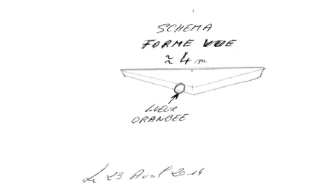
A photograph was taken during the event. Although the image itself is not conclusive, it does show a luminous source that broadly corresponds to the witnesses' account.
This is totally off topic for this thread, however if an anecdote and a fuzzy photo is a "good example", can you provide the source for this so we can start a dedicated thread? There is no sense in debating the merits of this case, or others in this thread.
jarlrmai
Senior Member.
Once we know it, they won't be UFOsDeclaring a phenomenon permanently unknowable before even deploying the right sensors isn't just scientific in my opinion.
FatPhil
Senior Member.
Then you've misunderstood @jarlrmai's point and comitted a category error. He's not discussing individual cases to which light can be borne, he's discussing the class of all UAP reports: no matter how good a sensor is, there will always be a range beyond which it can't give you useful information, and that will be where the UAP reports will come from. This is pretty much definitionally true.Declaring a phenomenon permanently unknowable before even deploying the right sensors isn't just scientific in my opinion.
Fritzkquzerk
Senior Member
Then you've misunderstood @jarlrmai's point and comitted a category error. He's not discussing individual cases to which light can be borne, he's discussing the class of all UAP reports: no matter how good a sensor is, there will always be a range beyond which it can't give you useful information, and that will be where the UAP reports will come from. This is pretty much definitionally true.
I totally agree with you both, didn't mean to argue against that.Once we know it, they won't be UFOs
I completely understand your point: by definition, once a phenomenon is fully resolved by a sensor, it ceases to be a UAP and becomes a known object.
The reports inherently live on the edge of our sensing capabilities.
My only nuance was that while we agree these reports come from low information zones, scientific approach (like NASA's) is to try and shrink those zones with better tools to see what is noise and if any real signal is left. But on the definition of the term itself, we are on the exact same page.

MyMatesBrainwashed
Senior Member
Can anyone explain why UAP seems to mean aliens more than UFO ever did?
No one here seems to know what to use or what each one even means. I admit I'm in the same boat.
No one here seems to know what to use or what each one even means. I admit I'm in the same boat.
Fritzkquzerk
Senior Member
I think they are mostly unidentified stuff in the sky, I don't think they mean aliens more than "UFO" did when it was invented.Can anyone explain why UAP seems to mean aliens more than UFO ever did?
No one here seems to know what to use or what each one even means. I admit I'm in the same boat.

Todd Feinman
Senior Member
It is more than stuff in sky like UFOs; UAP is defined as an anomalous phenomenon encountered in any Earth environment, including oceans.Can anyone explain why UAP seems to mean aliens more than UFO ever did?
No one here seems to know what to use or what each one even means. I admit I'm in the same boat.

NoParty
Senior Member.
Person A: "America has an epidemic of (racial group X) assaulting & killing (racial group Y). Something must be done!"
Person B: "Based on what?"
Person A: "Here are 25 cases that absolutely prove it!!"
Person B: "Okay, it took a while, but all 25 cases have now been carefully examined. Not one is actually a genuine
instance of (a member of racial group X) assaulting & killing (a member of racial group Y)."
Person A: "But you're missing the big picture! I gave you 25 examples! That number alone proves there's got to be something there!"
Person B: "Based on what?"
Person A: "Here are 25 cases that absolutely prove it!!"
Person B: "Okay, it took a while, but all 25 cases have now been carefully examined. Not one is actually a genuine
instance of (a member of racial group X) assaulting & killing (a member of racial group Y)."
Person A: "But you're missing the big picture! I gave you 25 examples! That number alone proves there's got to be something there!"
JMartJr
Senior Member.
Absolutely. If my sensor can clearly resolve a balloon at 1 mile, and balloons at 1.1 miles can be detected but not resolved (and so become UAP), I can build a better sensor and resolve balloons at 2 miles -- at which point balloons at 2.1 miles are detected by not resolved.Could more cases be solved with better networks, probably, but likely more would emerge.
I suppose I could try to fix that by making a new sensor that can resolve a balloon at 3 miles... maybe that would work...
And at the same time the number of prosaic objects in the air at all ranges has, ahem, ballooned.And in reality we've been doing that for a pretty long time, sure mostly without the explicit goal, and nothing has emerged.
- More than 15,000 satellites in low earth orbit, including 10,400 Starlinks. (https://planet4589.org/space/stats/active.html)
- More than 44,000 flights per day in the United States alone. (https://www.faa.gov/air_traffic/by_the_numbers)
- More than 855,000 drones registered with the US FAA. (https://www.marketgrowthreports.com/market-reports/helium-filled-party-balloons-market-121314)
- Almost $700 million of helium-fillable balloons will be sold this year. (https://www.marketgrowthreports.com/market-reports/helium-filled-party-balloons-market-121314)
Exactly! Better instruments don't really help. It doesn't matter how great our cameras are; the "anomalous stuff" will still be just out of reach.Absolutely. If my sensor can clearly resolve a balloon at 1 mile, and balloons at 1.1 miles can be detected but not resolved (and so become UAP), I can build a better sensor and resolve balloons at 2 miles -- at which point balloons at 2.1 miles are detected by not resolved.
I suppose I could try to fix that by making a new sensor that can resolve a balloon at 3 miles... maybe that would work...

Mauro
Senior Member.
Never said is worth believing, just pointing out that it has been said.
You said:
I understand it as "it's worth believing one might be red".I get your example, but if there was one telling you "one might be red", then one MIGHT be.
A lot of things "have been said", including unicorns, fairies and leprechauns. Nothing is worth believing just because "it has been said".
Todd Feinman
Senior Member
You've seen a bit of what's been captured (some consider anomalous footage) and provided by the DoD, which is plausibly debunkable. And you've all done a good job with it. Folks who have seen more footage claim it is better than what's been released; hopefully it will, and if it is still debunkable, your theory will continue to hold regarding sensors, UAP, and the LIZ (all unambiguous close-up witness testimony, notwithstanding as absolutely unreliable).Exactly! Better instruments don't really help. It doesn't matter how great our cameras are; the "anomalous stuff" will still be just out of reach.
Last edited:
FatPhil
Senior Member.
The cherry on top is the irony that the LIZs are now geometrically larger[*], so more things can and will fall into them - the more we can know the more we won't know.Absolutely. If my sensor can clearly resolve a balloon at 1 mile, and balloons at 1.1 miles can be detected but not resolved (and so become UAP), I can build a better sensor and resolve balloons at 2 miles -- at which point balloons at 2.1 miles are detected by not resolved.
I suppose I could try to fix that by making a new sensor that can resolve a balloon at 3 miles... maybe that would work...
[* I'm reticent to suggest by which scaling factor. One could argue that it's cubic, because it's a volume, but one of the dimensions (altitude) is different from the others because we're a planet with a gravity vector and an atmosphere and we simply won't be seeing any more party balloons above a certain height, so it might be quadratic. If the LIZ remains the same "thickness" - your 0.1 miles above - rather than scaling proportionally - such as making the limit 2.2 miles above - then it could be only linear. But whatever it is, it's still definitely growing.]
Todd Feinman
Senior Member
But so many people are seeing the same kinds of leprechauns across decades. Now we have military and government folks talking about leprechauns. Have to address goblins and leprechauns wherever they pop up. Regardless of the reality of UFOs, it's important to get to the bottom of it, especially if things like autonomous weapons will be developed.But this bring you back to the realm of unicorns, fairies and leprechauns. They all have been said to exist.
Imagine all of the sociology and psychology papers that will be written about all of this! Tomorrow a bunch of folks are gathering at the Capitol, to plead for non-LIZ footage and data they claim to KNOW exists. Goblins.
Last edited:
Mauro
Senior Member.
But is that nuance warranted? Better sensors simply move the LIZ further away so it actually gets bigger (in area: imagine a sphere doubling its size), not smaller.The reports inherently live on the edge of our sensing capabilities.
My only nuance was that while we agree these reports come from low information zones, scientific approach (like NASA's) is to try and shrink those zones with better tools to see what is noise and if any real signal is left. But on the definition of the term itself, we are on the exact same page.

Ann K
Senior Member.
If a video reveals two blurry pixels in one frame, it's simply unknowable because the information is simply not there to be studied. "Deploying the right sensors" is not a thing that most sightings can do, if the thing is fleeting, or (as happens in almost all cases) the sighting is made by a civilian who has nothing more sophisticated than the phone in his pocket.Declaring a phenomenon permanently unknowable before even deploying the right sensors isn't just scientific in my opinion.
"Strange" things (which is the most charitable description of most of them) don't appear by magic at the convenient time and place where sophisticated imaging technology is available. They happen "wherever and whenever", and very frequently are fleeting occurrences. When we get releases of info that has been reported to the government, the images are, in many cases, not identifiable in any way. They are "anomalous" because there is so little to look at, and of course verbal descriptions are generally even worse.
The concept of academic studies of the evidence is, I think, a non-starter. Very few people would wish to dedicate their work lives to a discipline that, most probably, would never have them witness a live event, and that may be entirely built upon mythology and popular fiction. Certainly astronomy can be a rewarding field of study, but astronomers, unlike UFOlogists, know where to expect their subjects will be tomorrow night.
NorCal Dave
Senior Member.
There could be interesting data from a scientific point of view, but, it will often remain inaccessible because of security policy and actionable data that will likely never come out.
I guess I disagree a bit here. Yes, more data is always better and maybe there is something interesting, but the history of UFOs is largely a history of mostly explainable things. Misperception, faulty memory, bad photos, outright hoaxes and as mentioned above, things at the edge of some sensors capabilities.
While stuff obviously is classified, older stuff becomes declassified. When that happens it rarely reveals something that the previous system couldn't. Rather the UAP always remains at the edge of whatever technology was in use. If we go with some of Grusch's claims, UFO were crashing in 1933 Italy or possibly at the turn of the 20th century. There was no radar at the time, no FLIR, no digital devices, no satellites, no tracking systems. As all of these data gathering systems came on line in the ensuing 80+ years, often classified at first, they never explained UFOs. Or rather, there is always something unexplained.
There is always something beyond a system's capabilities that no amount of data will explain. At least until, a better system comes along which may explain one thing, while then creating another unexplained one.
We talked at length about the whole idea of studying UFOs in this thread, including many pages of "spirited" discussion:
https://www.metabunk.org/threads/can-ufo-uaps-be-studied-scientifically.13556/
Fritzkquzerk
Senior Member
But better sensors don't just increase the range (the sphere radius), they drastically increase the resolution and data quality within our airspace. Solving and eliminating 99% of low-information cases closer to us is exactly what the scientific method aims for, even if the absolute frontier moves further out.But is that nuance warranted? Better sensors simply move the LIZ further away so it actually gets bigger (in area: imagine a sphere doubling its size), not smaller.
I'll stick with NASA's methodology.
Ann K
Senior Member.
It is more than stuff in sky like UFOs; UAP is defined as an anomalous phenomenon encountered in any Earth environment, including oceans.
https://www.cbsnews.com/news/what-are-uaps-unexplained-aerial-phenomenon-ufos-new-name/External Quote:The acronym stood for "unidentified aerial phenomena" until December 2022
When new names become even newer names...
Fritzkquzerk
Senior Member
Fair! I just don't think studying the subject with better sensors and possibly with more accessible data is a total waste of time and money.I guess I disagree a bit here. Yes, more data is always better and maybe there is something interesting, but the history of UFOs is largely a history of mostly explainable things. Misperception, faulty memory, bad photos, outright hoaxes and as mentioned above, things at the edge of some sensors capabilities.
While stuff obviously is classified, older stuff becomes declassified. When that happens it rarely reveals something that the previous system couldn't. Rather the UAP always remains at the edge of whatever technology was in use. If we go with some of Grusch's claims, UFO were crashing in 1933 Italy or possibly at the turn of the 20th century. There was no radar at the time, no FLIR, no digital devices, no satellites, no tracking systems. As all of these data gathering systems came on line in the ensuing 80+ years, often classified at first, they never explained UFOs. Or rather, there is always something unexplained.
There is always something beyond a system's capabilities that no amount of data will explain. At least until, a better system comes along which may explain one thing, while then creating another unexplained one.
We talked at length about the whole idea of studying UFOs in this thread, including many pages of "spirited" discussion:
https://www.metabunk.org/threads/can-ufo-uaps-be-studied-scientifically.13556/
Fritzkquzerk
Senior Member
Look, If some academic scientists will start to do that in the most scientific way possible, I'm all for it.If a video reveals two blurry pixels in one frame, it's simply unknowable because the information is simply not there to be studied. "Deploying the right sensors" is not a thing that most sightings can do, if the thing is fleeting, or (as happens in almost all cases) the sighting is made by a civilian who has nothing more sophisticated than the phone in his pocket.
"Strange" things (which is the most charitable description of most of them) don't appear by magic at the convenient time and place where sophisticated imaging technology is available. They happen "wherever and whenever", and very frequently are fleeting occurrences. When we get releases of info that has been reported to the government, the images are, in many cases, not identifiable in any way. They are "anomalous" because there is so little to look at, and of course verbal descriptions are generally even worse.
The concept of academic studies of the evidence is, I think, a non-starter. Very few people would wish to dedicate their work lives to a discipline that, most probably, would never have them witness a live event, and that may be entirely built upon mythology and popular fiction. Certainly astronomy can be a rewarding field of study, but astronomers, unlike UFOlogists, know where to expect their subjects will be tomorrow night.
I don't care if they find more balloons, they could even find new ways of identifying space junk and birds.
- Status
- Not open for further replies.
Similar threads

- Replies
- 13
- Views
- 4K


- Replies
- 6
- Views
- 1K

- Replies
- 72
- Views
- 9K


- Replies
- 8
- Views
- 3K


Trending content
-
 Thread 'David Grusch Makes Wild Claims in Oct 2026 Appearance on Joe Rogan Podcast'
- MeowingMuon
Replies: 44 -
-
