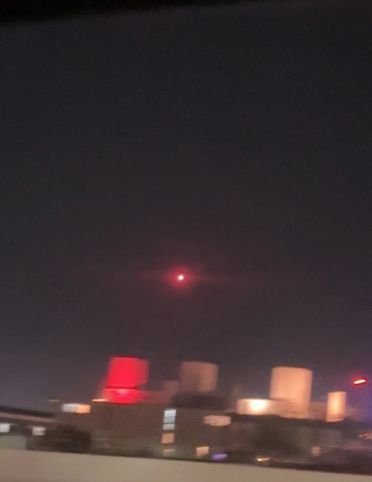
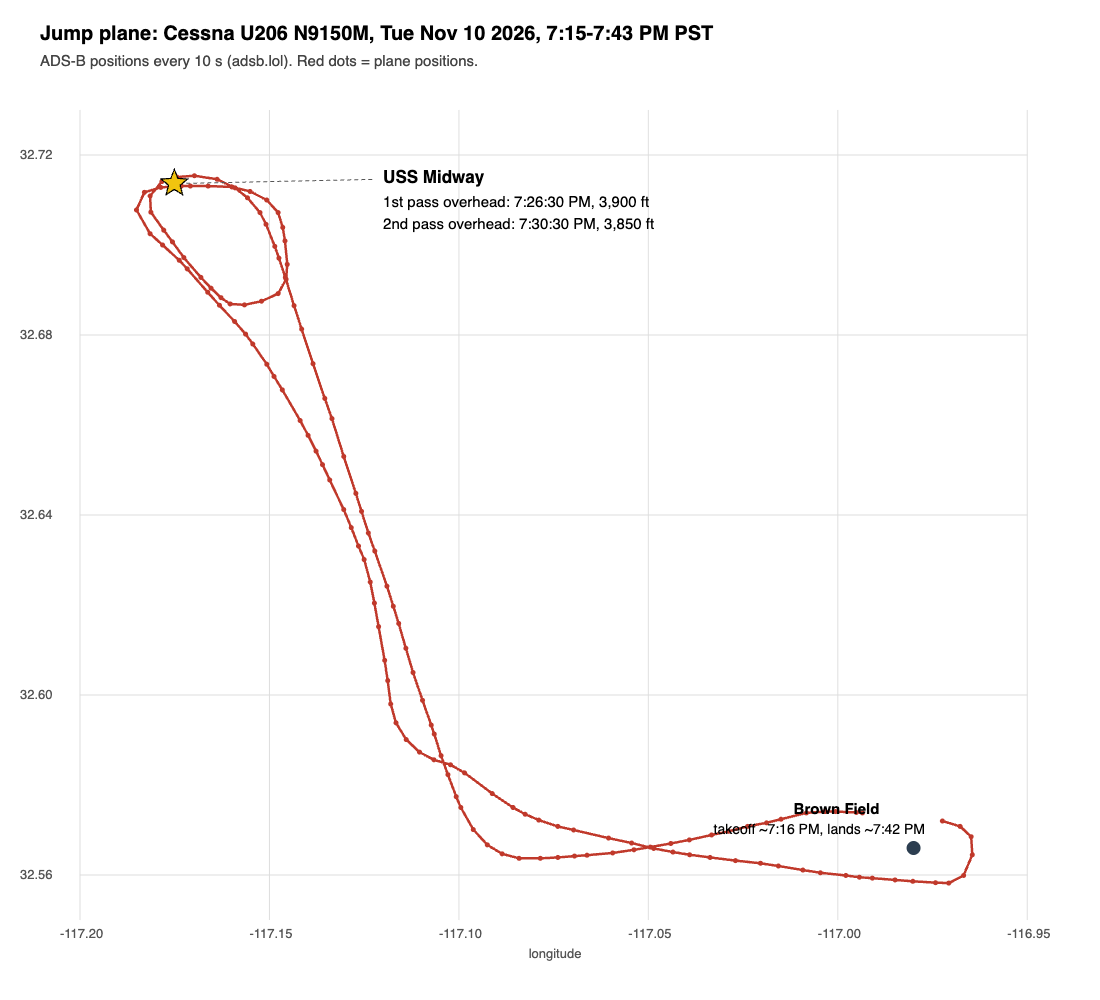
Following on from SkyAugur's original investigation, I downloaded the Flightradar24 flight track in KML format for the Cessna 206 (N9150M) and examined possible exit points for the parachutists.
The aircraft made two passes over the USS Midway at around 3,900 feet. Based on this I selected a possible exit point at just under 3,900 feet.
Cessna 206 (N9150M) flight path parachutists propose flight path and water landing location
Taking into account the earlier geolocation work and what I believe was the sequence of the original photographs generally north to south, I developed a possible flight path for the parachutists.
My assumption was that they initially travelled north, roughly parallel to the shoreline, before making a 180-degree turn and heading south. They then passed over the USS Midway before making a water landing approximately 250 metres west of the ship.
This is consistent with
SkyAugur's follow-up Reddit comment, in which he stated:
I emailed the team (Skydiving Innovations) and they confirmed it: "professional exhibition nighttime water jump for an audience on the USS Midway..."
For the reconstruction, I referred to the United States Parachute Association (USPA) guidance on opening altitudes, canopy performance and exhibition jumping.
The
USPA Basic Safety Requirements, Section 2-1.I, specify:
External Quote:
C- and D-license holders: 2,500 feet AGL (waiverable to no lower than 2,000 feet AGL)
The
USPA 2026 Instructional Rating Manual, page 116, describes the glide ratio as:
External Quote:
typically 2.5:1 on student canopies in no wind.
I therefore selected a 2.5:1 glide ratio as a reasonable starting assumption, representing approximately 2.5 feet of horizontal travel for every foot of altitude lost under canopy in still air.
Regarding the timing of the flares, the
USPA Exhibition Jumping guidance, Section 6-1, states:
External Quote:
The smoke canister is ignited after opening
I used this as a general guide for the reconstruction, assuming that the pyrotechnic devices were activated after the parachutes had deployed.
Using these assumptions, I created a reconstruction in SitRec, incorporating a 3D parachutist model, the proposed descent trajectory, and simulated pink-red ankle-mounted flares.
I then exported the simulated camera's Look View and imported it into DaVinci Resolve.
To reproduce the appearance of the lights in the original photographs, I added the pink halo and horizontal lens-flare streaks using image overlays. These were manually keyframed to follow the reconstructed light throughout the sequence.
Nevertheless, I think the resulting reconstruction is a plausible representation of what may have occurred that evening and could closely reproduce what was observed in the original photographs.
It doesn't establish the parachutists' exact movements, but I think it demonstrates how a nighttime parachute display with illuminated flares could account for the reported observations.
EDIT: got some weird text formatting