I had muted that conversation shortly after explaining that. Twitter isn't very good for extended discussions with multiple people where your 140 characters is reduced to about 60. All I could squeeze in were these three points:
External Quote:
What is the question? I see a cable map.
It's economic. Very long cable is expensive.
Hard to maintain in Antarctic ocean.
The basic clam is that if the Earth were a globe, then there would be cables between Australia, South Africa, and South America.
The reason there are not is that cables go where the people, the content, and the money is. The only reason why people in Chile would benefit from a direct internet cable to New Zealand would be if they were accessing servers in that country, or if they were doing some kind of peer-to-peer connection, like Skype or phone calls. All those things work fine (but slower) going the longer route via California & Hawaii, but really there does not seem to be any evidence of a need that would make commercial sense.
Most of the cable maps are schematic, here's a more realistic one showing the actual cable routes in detail:
And here's what it looks like on a hypothetical flat Earth:
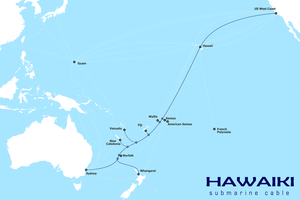
So why no cable from New Zealand to South America (6,000 miles)? Basically because it's not worth it. Hawaii is closer (4,000 miles), and adding a cable from NZ to Hawaii costs $400 Million.
http://www.nzherald.co.nz/northern-advocate/news/article.cfm?c_id=1503450&objectid=11480033
External Quote:
A $400 million undersea cable carrying huge amounts of electronic data from around the globe will come ashore in Northland, with an undisclosed Bream Bay site chosen as the landing point for the development.
Hawaiki Cable -- backed by its major New Zealand investor Sinclair Investments Group (SIL) -- confirmed yesterday it would forge ahead with the New Zealand link of its international submarine cable project landing in Whangarei.
Northland regional economic development agency Northland Inc says it is thrilled with the news. The cable could be operating by 2017 and will be the second fibre-optic cable network and third physical cable linking New Zealand with the rest of the world.
It will be able to carry vast quantities of electronic data between Australia, New Zealand, Hawaii and the west coast of the United States directly, but will open up connections globally.
There's simply no compelling economic reason to spend a billion dollars on a cable from New Zealand to South America when the very limited internet traffic between the two regions can get there via other means. It's similar to the reasons why we choose to build bridges and tunnels where we do.
I say a billion because construction and maintenance costs will be much higher in that remote region of the world.
Of course its quite possible that such cables WILL be built in the future, when there's a compelling economic reason to do so, for example the the SAex cable is currently under construction, edging south a bit.
https://en.wikipedia.org/wiki/SAex
Most Internet traffic is server based - it's generally streaming do and from a large datacenter. The internet giants like Facebook, Youtube, Amazon Google, and Netflix have data centers that serve the local needs. People in New Zealand don't access data centers in Chile. They use the fastest one, which is generally the closest.
For example, Amazon has several major data centers around the world. Amazon has it's shopping business, but also has a huge business in renting out server space for cloud computing and site hosting, as well as their streaming video and music services. This map shows the eight largest data centers, with the red lines showing where that data center is fastest. Thus all of Africa uses the UK center, and most of South America uses the Sao Paulo data center.