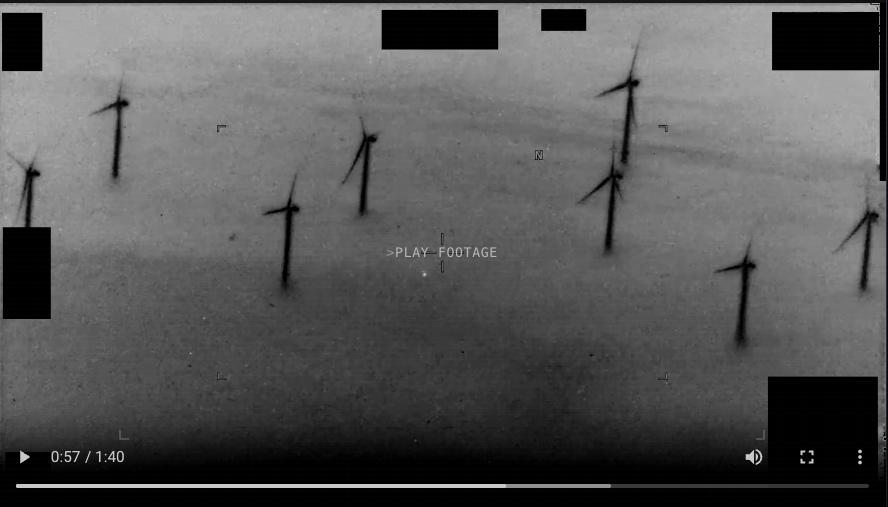
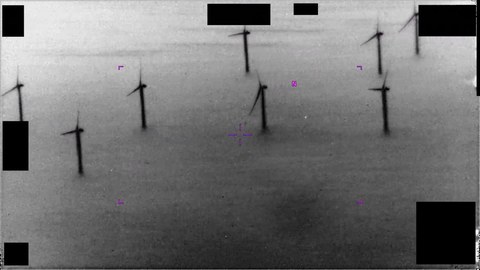
PR-48 INDOPACO, 2024 (Wind Farm + Dot Changing Apparent Direction)

Giddierone

Senior Member.
This one with the off-shore windmills looks easily geolocated at least.

DOW-UAP-PR48, Unresolved UAP Report, INDOPACOM, 2024

https://www.war.gov/UFO/#DOW-UAP-PR48-Unresolved-UAP-Report-INDOPACOM-2024

They tend to show up nicely on Sentinel 2 Satellite images.

Screenshot 2026-05-08 at 16.01.33.png


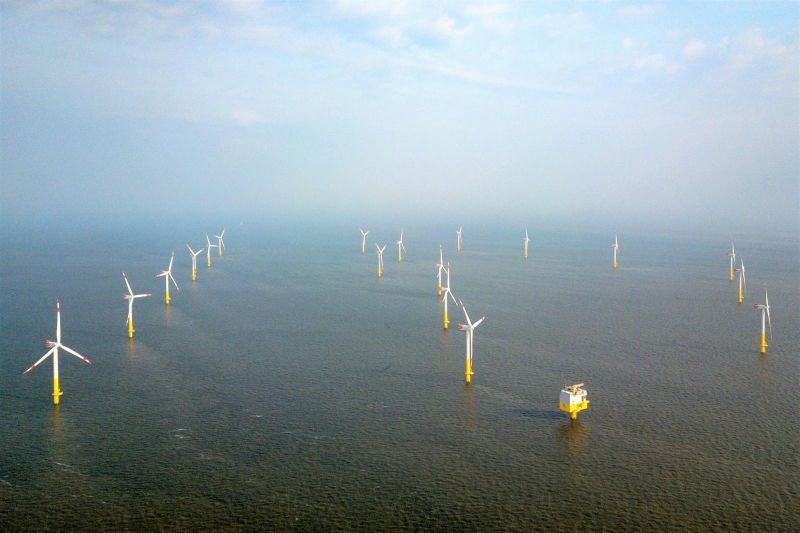
EDIT: here's a quick look at the shape of the windfarm.
DOW-UAP-PR48_Offshore.jpg
 
Last edited:
This one with the off-shore windmills looks easily geolocated at least.

DOW-UAP-PR48, Unresolved UAP Report, INDOPACOM, 2024

https://www.war.gov/UFO/#DOW-UAP-PR48-Unresolved-UAP-Report-INDOPACOM-2024

They tend to show up nicely on Sentinel 2 Satellite images.

View attachment 90177

World offshore windfarm map... not many in the INDOPAC region...

https://map.tgs4c.com/offshorewind/
Probably worth another thread just for the geolocation work on this one.
 
World offshore windfarm map... not many in the INDOPAC region...

Looking at the footage, DOW-UAP-PR48, Unresolved UAP Report, INDOPACOM, 2024
https://www.war.gov/UFO/#DOW-UAP-PR48-Unresolved-UAP-Report-INDOPACOM-2024
there appears to be at least two small features of increased brightness associated with the most noticeable one, perhaps most noticeable 40 to 42 seconds in:

sp1.jpg


Below, same screen detail, features highlighted in yellow (the brightest feature most obvious on watching the video is "c"):
sp2.jpg


These brighter details move in relation to each other,

sp3.jpg


There are several other small areas of increased brightness that seem to travel as the sensor head pans; two indicated in the screengrab below but there are others. Possibly many.
From a brief viewing, they don't move much (if at all) relative to each other or the crosshairs, and move as the camera pans. Perhaps they are on the lens (or "window" fixed in front of it if there is one).

sp4.jpg


The "UAP" ("c", and its friends "a" and "b" I guess) look like these but is a bit brighter and moves about more relative to the others and the crosshairs.

At approx. 1 min 21 secs into the video, the bright feature is moving left to right but the crosshairs stop moving (relative to the wind turbines).
The bright feature slows, and starts drifting downward.
At approx. 1 min 26 secs the crosshairs move downward and (it seems to me- could be wrong) the bright feature's path downward becomes a little faster, combined with movement to the left.

It made me think of floaters in the eye, and how they sometimes follow the direction of eye movement, and have a bit of momentum, gradually slowing, but capable of being "batted" into a new direction by a new eye movement.

At the moment, I'm thinking along the lines of the "UAP" being something on the surface of, but not fixed to, the surface of the lens, skating about a bit.
The other small bright (but not as bright) features are almost certainly on the lens/ window, perhaps they are less massive and more firmly "adhered" in position, less prone to being kicked around by movements of the sensor.

 
Last edited:
At the moment, I'm thinking along the lines of the "UAP" being something on the surface of, but not fixed to, the surface of the lens, skating about a bit.

Possible mechanism: tiny particles like pollen or dust on the camera's front window get coated in ice at altitude, and when the window's anti-icing heater cycles on, the ice flashes to vapor in uneven puffs that thrust the particle around the lens in jerky directions.

The window heater runs on a duty cycle, so ice forms during off-phases around any contamination on the glass. When it fires back up, different sides of the particle vent at different moments. Sub-millimeter specks weigh almost nothing, so even tiny vapor flows produce accelerations big enough to cross the field of view in a fraction of a second.

The variety of motion signatures (smooth streaks, oscillation, sharp 90-degree turns) is consistent with this: ice grows in a hexagonal crystal lattice and sublimates preferentially along specific faces, so thrust directions are quantized geometrically rather than smoothly random.

Visibility comes from emissivity contrast: organic matter is much more infrared-emissive than the germanium glass of the window. The escaping vapor is also briefly visible since water absorbs strongly at these wavelengths, which accounts for the apparent flight trails without needing actual propulsion.

Testable: appearances should correlate with the heater cycle. Heater status, window temperature, and IMU are all in the mission recorder.
 
This one with the off-shore windmills looks easily geolocated at least.

DOW-UAP-PR48, Unresolved UAP Report, INDOPACOM, 2024

https://www.war.gov/UFO/#DOW-UAP-PR48-Unresolved-UAP-Report-INDOPACOM-2024

They tend to show up nicely on Sentinel 2 Satellite images.

View attachment 90177

EDIT: here's a quick look at the shape of the windfarm.View attachment 90179
Nice stitch :)
But not a single frame in the entire video shows the dot moving behind the windmills - it's just dimmed because of the chanced background when moving past them.
 
PR-48 — INDOPACOM, 2024

AARO (INDOPACOM, IR sensor, 2024, 1m39s). Video Description:
00:00-01:39: The sensor tracks an area of contrast, maintaining its position generally within the center of the frame.
1778309682157.png


It is indeed possible that the object in the video is an inspection drone used by offshore wind farms, and from an engineering and maintenance perspective, this is currently a more reasonable explanation than a "high-speed anomalous craft." Modern offshore wind farms have long utilized drones equipped with infrared thermal imaging equipment for automated inspections of turbine blades, electrical systems, and towers. The video itself happens to be from an infrared perspective, and the target moves steadily between the turbines, which aligns perfectly with offshore wind drone operation scenarios. Based on estimates that modern offshore wind turbines are typically 200–250 meters tall with a spacing of about 0.8–1.5 kilometers, the size of the object in the video relative to the turbines actually resembles a small object within a few meters rather than a large aircraft. Furthermore, infrared long-focus gimbal videos are highly susceptible to the illusion of "high-speed lateral movement" caused by parallax and lens tracking; if the target is actually closer to the camera than the turbines, its true speed might only be a few dozen kilometers per hour, which is entirely consistent with the movement characteristics of a drone or a wind-drifted object. Meanwhile, the object in the video does not exhibit typical high-speed flight characteristics such as super-maneuverability, instantaneous acceleration, sharp turns, or high-heat exhaust plumes; therefore, the public video itself is currently insufficient to prove that it possesses anomalous flight performance.

An offshore project in 2026 has even achieved autonomous drone inspections while the wind turbines remain in continuous operation:

https://www.windtech-international....perating-wind-turbines?utm_source=chatgpt.com

Autonomous Path Planning Between Rotating Wind Turbines Using LiDAR UAVs:
https://arxiv.org/abs/2306.14637
 
At the moment, I'm thinking along the lines of the "UAP" being something on the surface of, but not fixed to, the surface of the lens, skating about a bit.
The other small bright (but not as bright) features are almost certainly on the lens/ window, perhaps they are less massive and more firmly "adhered" in position, less prone to being kicked around by movements of the sensor.

A particle on the lens/window of the camera will never create a light-point on the image.
 
A particle on the lens/window of the camera will never create a light-point on the image.

I guess focus would be a problem. In the video there's a number of other very small bright features that don't (appear to me to) move relative to the crosshairs, I'm guessing they're not "out there" physical objects flying in formation and anticipating where the camera pans.
 
I guess focus would be a problem. In the video there's a number of other very small bright features that don't (appear to me to) move relative to the crosshairs, I'm guessing they're not "out there" physical objects flying in formation and anticipating where the camera pans.
As jarlrmai mentioned, these are dead pixels.

Interesting video, this one.
 
The apparent horizontal slowing and re-acceleration of the object relative to the background also correspond with the visible rotation and flattening back out of the camera orientation in the video. I think this supports the idea of a bank being done by the filming aircraft, and that the change in direction of the object is purely parallax.

But not a single frame in the entire video shows the dot moving behind the windmills - it's just dimmed because of the chanced background when moving past them.
Agree.
 
Tim Gallaudet was on Jake Tapper's show on CNN yesterday and said this video was the most compelling in the data drop. (speaker in parentheses)
External Quote:
03:46.726 --> 03:53.970
(Tapper) I don't know how much time you've had to go over what was released today, but what was the most significant thing you saw that was released today?

03:55.784 --> 04:09.679
(Gallaudet) I looked at every single report, video, and image, Jake, and I think the one that stood out to me is this UAP UFO that is moving around a wind farm in the Indo-Pacific region.

04:10.000 --> 04:11.461
(Gallaudet) And it's absolutely remarkable.

04:12.642 --> 04:21.764
(Gallaudet) I'll ask your audience to pull it up, but this object is maneuvering around these wind turbines and it can't be explained. We don't have.

04:21.964 --> 04:26.105
(Gallaudet) It can't be explained by a drone or a helicopter.

04:26.285 --> 04:37.527
(Gallaudet) It adds to the body of evidence that is occurring now in terms of video data and imagery that has convinced me that we are not alone in the universe.
Timestamps from this video source:
x.com/_SolFoundation/status/2053140782584885570

Edit:
Another clip of Tim Gallaudet, on NewsNation with other guest Ryan Graves, saying similar things about the wind farm video:
x.com/UAPJames/status/2052982815680061805
 
Last edited:
How does IR work here? It seems much hotter/colder (don't know since everything is redacted) than the background, but it dims when it is in front of the windmills, which are darker than the sea.

If the windmills are warmer than the sea, the object would be cold, but do the dimming imply that it isn't that far off in temperature, only the coldest object in the image (or hottest if the sea is warmer than the windmills), or how does it work?
 
Quick explainer video of the parallax hypothesis.
I'm unaware of an mq-9 Reaper flying at 200 knots doing a 180 degree heading change in sub ten seconds.

Math says the Reaper needs to be banking at 73 degree angle with over 3gs.

The motion - original video to the Sitrec video - appears off.
 
Additionally, can someone explain the automatic gain control (AGC) behavior here?

I get that the dot dims noticeably when it moves near/past the turbines, but I would have expected AGC to make the target brighter to keep it visible, not dimmer.

To me it looks like the sensor is simply receiving less IR energy from that point source when it's in front of or near the turbine structure, which would naturally make it appear dimmer.

Wouldn't partial obscuring, or even flying very close in front of a blade, produce exactly this effect?
 
I'm unaware of an mq-9 Reaper flying at 200 knots doing a 180 degree heading change in sub ten seconds.
I think it's more like 15, but this isn't an exact recreation. We'd need the wind, and the actual track of the reaper for that, this was simply a proof of concept. I think the actual turning is a little more complicated

You can play around with the Physics/"Simple Flight Sim" menu here https://www.metabunk.org/sitrec/?custom=99999999/PR48 With Racetrack and towers/20260509_165333.js
 
I think it's more like 15,
I've taken a look into it, im getting around 15 degrees also, but looks like an orbit pattern, as opposed to straight line then bank, based on the angles. tilted when nose, tail on, level at 90 degree azimuth.

I'm thinking speed slower than 200 knots, closer to 160-180 knots.
 
I get that the dot dims noticeably when it moves near/past the turbines, but I would have expected AGC to make the target brighter to keep it visible, not dimmer.
It's not the target. As far as the camera knows, it's just another dot in the background.

To me it looks like the sensor is simply receiving less IR energy from that point source when it's in front of or near the turbine structure, which would naturally make it appear dimmer.
How would it get less energy?

Wouldn't partial obscuring, or even flying very close in front of a blade, produce exactly this effect?
2026-05-09_17-54-35.jpg

2026-05-09_18-02-01.jpg
2026-05-09_18-03-03.jpg


Here it's in the middle of the pole, so obviously in front, and clearly dimmer.

I think what we are seeing might be simpler than what I suggested. I think this is Black-Hot mode, so the hot pixel tend to spread a bit. So when it's over hot pixels, they spread into it.

Kind of a moot point though, regarding the mechanism, as it's obvious something is making it dimmer when it's in front of the turbine's pylon.
 
I think what we are seeing might be simpler than what I suggested. I think this is Black-Hot mode, so the hot pixel tend to spread a bit. So when it's over hot pixels, they spread into it.
Thats similar, to what I meant. The target (point light source) when over a "lighter background" the pixel resolution doesnt know when to start/ stop, as opposed to dark background, that allows for more definition.

Boundary is better defined, not automatic gain control. It looks dimmer/ smaller, but is actually more reflective of its actual size.
 
Last edited:
Has anyone definitely geolocated this wind farm? I notice there are two different kinds of turbines. Around 60 larger ones, then a gap and a field of smaller turbines (they have different shaped nacelles and shorter blades). I'd thought the field near Taiwan see #4
was a good candidate, it has a field of larger turbines next to smaller ones. However, there aren't enough of the larger turbines and the alignment seems wrong. Makes me wonder if INDOPACOM is a mislabeling.

Screenshot 2026-05-10 at 18.12.53.png
Screenshot 2026-05-10 at 18.03.30.png
 
Back
Top