he Blitz (from German, "lightning") was the sustained strategic bombing of the United Kingdom by Germany during the Second World War. Between 7 September 1940 and 21 May 1941 there were major raids (attacks in which more than 100 tonnes of high explosives were dropped) on 16 British cities. Over a period of 267 days (almost 37 weeks), London was attacked 71 times, Birmingham, Liverpool and Plymouth eight times, Bristol six, Glasgow five, Southampton four, Portsmouth three, and there was also at least one large raid on another eight cities.[1] This was a result of a rapid escalation starting on 24 August 1940, when night bombers aiming for RAF airfields drifted off course and accidentally destroyed several London homes, killing civilians, combined with Churchill's immediate response of bombing Berlin.
Starting on 7 September 1940, London was bombed by the Luftwaffe for 57 consecutive nights.[7] More than one million London houses were destroyed or damaged, and more than 40,000 civilians were killed, almost half of them in London....
Ultimately, Hitler was trapped within his own vision of bombing as a terror weapon, formed in the 1930s when he threatened smaller nations into accepting German rule rather than submit to air bombardment. This fact had important implications. It showed the extent to which Hitler personally mistook Allied strategy for one of morale breaking instead of one of economic warfare, with the collapse of morale as an additional bonus.[22] Hitler was much more attracted to the political aspects of bombing. Where the mere threat of it had produced diplomatic results in the 1930s, he expected that mere threat of German retaliation to persuade the Allies to adopt a policy of moderation and not to begin a policy of unrestricted bombing.
...
t was decided to focus on bombing Britain's industrial cities in daylight to begin with. The main focus of the bombing operations was against the city of London. The first major raid in this regard took place on 7 September. On 15 September, on a date known as the Battle of Britain Day, a large-scale raid was launched in daylight, but suffered significant loss for no lasting gain. Although there were a few large air battles fought in daylight later in the month and into October, the Luftwaffe switched its main effort to night attacks in order to reduce losses. This became official policy on 7 October. The air campaign soon got underway against London and other British cities.
...
Strategic or "terror" bombing
Although official German air doctrine did target civilian morale, it did not espouse the attacking of civilians directly. It hoped to destroy morale by destroying the enemy's factories and public utilities as well as its food stocks (by attacking shipping). Nevertheless, its official opposition to attacks on civilians became an increasingly moot point when large-scale raids were conducted in November and December 1940. Although not encouraged by official policy, the use of mines and incendiaries, for tactical expediency, came close to indiscriminate bombing. Locating targets in skies obscured by industrial haze meant they needed to be illuminated "without regard for the civilian population".[91]


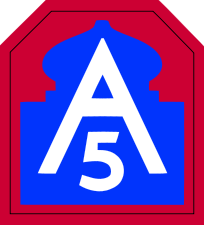

 I know the at a glance meaning of the symbol, the 'A' and '5' for the fifth army. This is obvious as that is their badge! Also I know a reasonable amount about masonry too, the guilds of old, stone and gold, the crafts, half of my paternal family are, literally, masons, in fact our family there goes by the name "The Masons" as they are multi-generational workers of the stone. I didn' t know about the 5th Army coming into existence to defend the royal family of Morocco. Interesting point but it just reaffirms the masonic link, the king is of the 33rd degree, the Moorish royals being steeped in masonry for centuries. In fact, surely, masonry starts in north Africa, Scottish houses are later day interpretations of the messianic cult of old in north Africa, Egypt.


