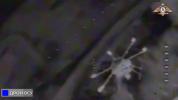
As noted in the thread, the footage was recorded by a small drone that can only fly for about 5 minutes, according to the Betaflight OSD information. Consequently, this specific drone model is better suited for a rapid reconnaissance of the surroundings than for offensive operations. It was fitted with a fixed IR camera, similar to the JS mini 640. More about this later.
The drone was likely launched from a Ukrainian defensive position, and flew generally straight up until it reached 800m. After a few minutes of flight, the battery died.
Based on the geolocation, the star-shaped figure was positioned between northeast and east:
At one point, the drone operator performs a 360° turn to look around their position. By constructing a panorama from the section of the footage where the 360° turn was recorded, it is possible to estimate the angular separation between the two objects. According to the panorama below, the objects were approximately 145° apart (347° - 202° = 145°):
If the star-shaped object was indeed just the Sun, the footage would have been recorded early in the morning, given the generally easterly direction of its position. The other bright object could potentially be the Moon.
If the location of the footage is entered into Stellarium, several candidate dates for the footage are revealed. Particularly, on 16th May 2025 early in the morning at around 05:30 local time, both the Sun and the Moon were low on the horizon at roughly 5° elevation. At that time, the Sun was between NE and E, and the angular separation between the Moon and the Sun was 144° (210° - 66° = 144°), matching the panorama. Other dates also fit, considering the uncertainty around the angular separation within the footage, as the panorama was not specifically adjusted for the camera's parameters and distortion, as they are unknown.
The Moon was in gibbous phase with 90% illumination on 16th May, and the terminator was at the drone's right-hand side. A comparison between Stellarium's prediction and a frame taken from the footage is provided:
One possible reason why the heat source looks like a star-shaped object, aside from it potentially being an artefact solely generated by a cheap IR camera under the right conditions, is that the drone operator may have not removed the transparent protective film from the lens of newly supplied drones before taking off. A transparent film in front of the lens can cause diffraction spikes.
Sergey Flash, who originally published the footage, warned operators to ensure they remove the protective film from thermal cameras before flying:
External Quote:
Просять звернути увагу, що на дронах не слід забувати знімати захисну плівку з тепловізійних камер.
Please note that when using drones, do not forget to remove the protective film from the thermal imaging cameras.
source:
t.me/serhii_flash/7277
The camera above closely resembles the Chinese-supplied JS Mini 640 thermal camera, which requires a custom-made protective casing and mounting bracket, as expected when assembling drones from off-the-shelf parts:
source1:
https://www.aliexpress.com/item/1005008040746098.html
source2:
https://ae-pic-a1.aliexpress-media....2bdb4bd5d7883e960b1F.jpg_960x960q75.jpg_.avif
The smoke seemingly emanating from the heat source looks more like rain falling from a cloud that just happens to be aligned with the Sun and the drone.
Now, viewing the drone footage with the rain cloud in mind, the cloud seems to surround the heat source and extend above it, which is what would be expected if by chance the Sun was apparently inside the cloud from the drone's perspective.
The perceived three-dimensional quality of the object appears to result, in part, from pareidolia.