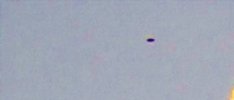
Unfortunately, at least as far as positively identifying the dot in this particular photo.
The "found in a photo later" type claim is particularly popular in the UFO world, likely because of the ambiguity they present. There is some sort of "object", often only a few pixels worth, that was only noticed later upon review of the photo. The person that took the photo doesn't remember anything unusual, which only adds to the mystery, or as in this case, the event is so long ago, most relevant details are lost.
While it may be difficult, or impossible, to identify this particular spot in this photo, you can see similar situations where the object is likely identified. A distant aircraft or even a balloon at the resolution limit of the camera can often just become a round or cigar shaped blob of a few pixels. Likewise, a close up small insect that is out of focus can appear similar. Either of these would likely never have been noticed at the time of the photograph.
You can still do some searching around, see what you find. For example, there are several Cao Dai temples in Tay Ninh Provence, but it looks like the one in your friends photo is referred to as the Holy See. Here is the best I could get with Google street view:
View attachment 90432
Compared to your photo:
View attachment 90433
I think this is roughly the same location, with the street view being closer to the building. That would suggest your friend was taking the photo looking in a roughly North-West direction:
View attachment 90434
If we expand the map, we find the Old Tay Ninh airfield roughly 5 miles to the west of the temple, circled in red:
View attachment 90435
And we find that the direction of the runway may intersect with he direction of the photo:
View attachment 90437
However as of now, the airfield is no longer used according to Wikipedia, though it's not clear when the PAVN stopped using that part of the facility:
External Quote:
The airfield is no longer in use but remains clearly visible on satellite images.
https://en.wikipedia.org/wiki/Tây_Ninh_Combat_Base
Was it used in 2006? I don't know. Is the object a possible aircraft climbing out of the old airfield? I don't know. But sometimes attacking these puzzles from different angles can lead somewhere.