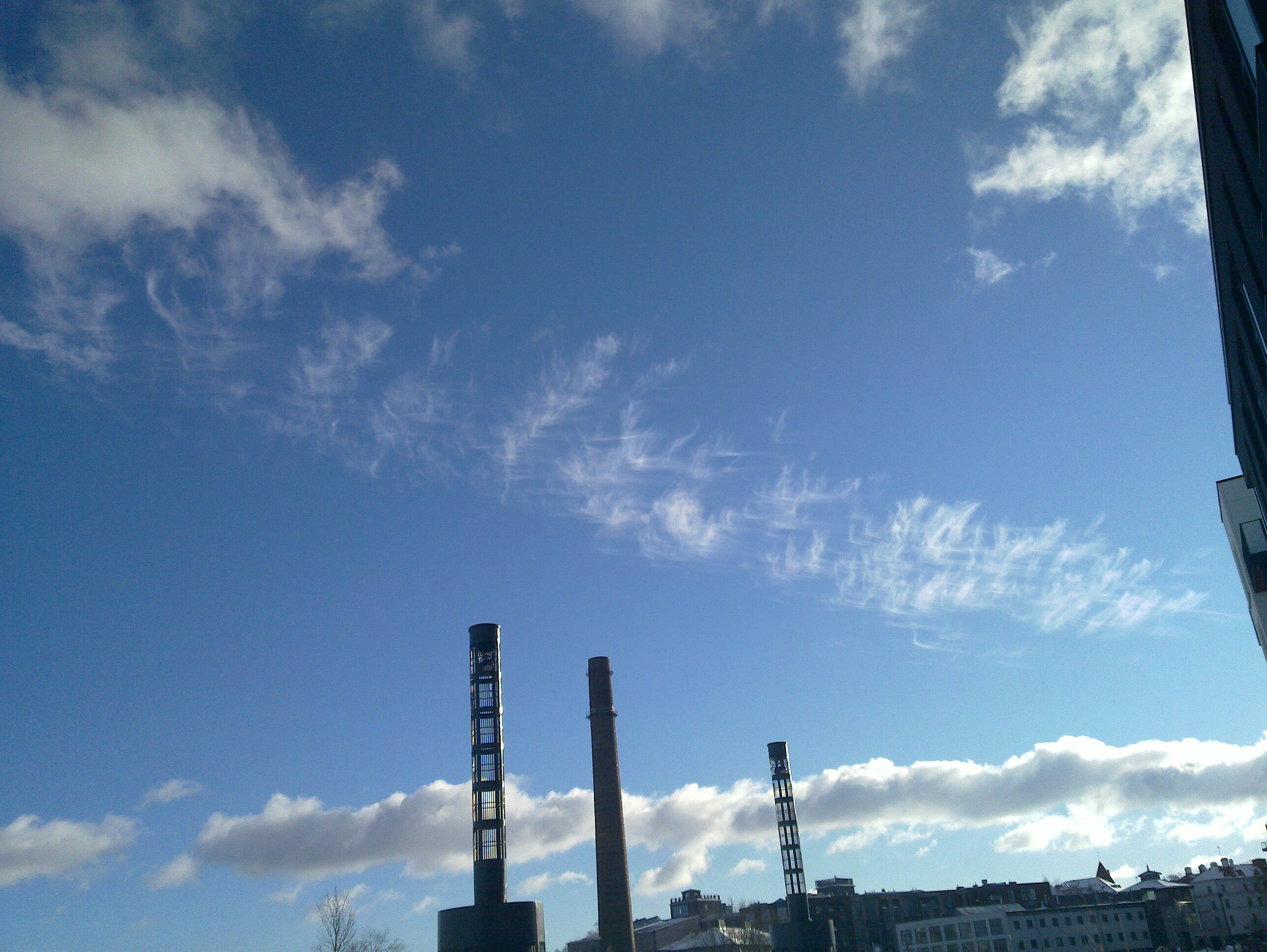
Photos of Clouds and Skies (That you took yourself)

Nice pics. Each pic is large enough that they won't fit on my screen all at once, and when the foreground stuff in the first pic is off the screen, my brain wants to make them into a shot seen from above (as from a plane) with pointy bits poking up, instead of from below with rounded bits pointing down. I've noticed the same thing with pictures of lunar craters, and now have discovered that the illusion seems to have a name -- in fact, three -- the Crater Illusion, the Dome illusion and (wait for it) the Crater-Dome Illusion.

Crater-illusion-Victoria-Crater-MRO-NASA-Photojournal-e1730383803440.jpg


Apparently it's to do with which way your brain decides the light is coming from. But I find I can make it switch back and forth with a bit of practice. With a bit more practice, I can see both of the above images as craters or domes simultaneously. Brains is weird.

So much for "I know what I saw..." ^_^
 
I don't know if it's a personal bias, after using Photoshop for many years (it's default for layer effects is that light is fromm the top left of an image), but seeing images like the ones above, I find it hard to force myself to see them other than a dome (on the left) and a crater (on the right).

I know that one of the images is just 180 degress rotation of the other, but my brain is saying, "nope... the one the left is a dome" regardless of how I internally try to massage my perception of them. I'd be curious to know if there is a cultural bias for this assumption of light direction. From above (top) is reasonable, as most of the time the dominant light source (the sun) is above the viewer, but are there any cultural assumptions of "light is from the left", or is that just a personal thing.

Visually illusions that have no lighting direction element (e.g. the "duck or rabbit" or "young woman or old crone" illusions) I can flip between at will, but shifting perception of lighting direction is something more difficult.
 
I don't know if it's a personal bias, after using Photoshop for many years (it's default for layer effects is that light is fromm the top left of an image), but seeing images like the ones above, I find it hard to force myself to see them other than a dome (on the left) and a crater (on the right).

I know that one of the images is just 180 degress rotation of the other, but my brain is saying, "nope... the one the left is a dome" regardless of how I internally try to massage my perception of them. I'd be curious to know if there is a cultural bias for this assumption of light direction. From above (top) is reasonable, as most of the time the dominant light source (the sun) is above the viewer, but are there any cultural assumptions of "light is from the left", or is that just a personal thing.
I'd be curious -- if you set up a situation where the light in the room is strongly from the top right or even from below, does that impact what you see.

At the moment, the Sun has moved from where it was when I first posted the crater pic, it is now off my right shoulder, sort of halfway between the direction of the Sun in the two pictures... they both look like domes now, at first glance. This morning, with room light from the upper left, there was a definite tendency to see a dome and a crater at first glance.
 
I don't know if it's a personal bias, after using Photoshop for many years (it's default for layer effects is that light is fromm the top left of an image), but seeing images like the ones above, I find it hard to force myself to see them other than a dome (on the left) and a crater (on the right).

I know that one of the images is just 180 degress rotation of the other, but my brain is saying, "nope... the one the left is a dome" regardless of how I internally try to massage my perception of them. I'd be curious to know if there is a cultural bias for this assumption of light direction. From above (top) is reasonable, as most of the time the dominant light source (the sun) is above the viewer, but are there any cultural assumptions of "light is from the left", or is that just a personal thing.

Visually illusions that have no lighting direction element (e.g. the "duck or rabbit" or "young woman or old crone" illusions) I can flip between at will, but shifting perception of lighting direction is something more difficult.
The Inverted Mask illusion has lighting as an important visual clue - the same directionality one as crater/hump - yet we're so attuned to what we think we're seeing that we ignore that, and almost always see "outie" rather than "innie".
 
Nice pics. Each pic is large enough that they won't fit on my screen all at once, and when the foreground stuff in the first pic is off the screen, my brain wants to make them into a shot seen from above (as from a plane) with pointy bits poking up, instead of from below with rounded bits pointing down. I've noticed the same thing with pictures of lunar craters, and now have discovered that the illusion seems to have a name -- in fact, three -- the Crater Illusion, the Dome illusion and (wait for it) the Crater-Dome Illusion.

I love the crater illusion. When I discovered it it astonished me so much that I had to show it to my friends too. I used a picture on my PC of a 'dome', then rotated it 180 degrees with Paint to turn it into a 'crater'. Well, one of my friends did not believe me: he thought I was doing some trick with the software. I had to physically rotate 180 degrees the monitor, a bulky CRT one, to have him say 'wow!'.
 
Last edited:
I'd be curious -- if you set up a situation where the light in the room is strongly from the top right or even from below, does that impact what you see.

At the moment, the Sun has moved from where it was when I first posted the crater pic, it is now off my right shoulder, sort of halfway between the direction of the Sun in the two pictures... they both look like domes now, at first glance. This morning, with room light from the upper left, there was a definite tendency to see a dome and a crater at first glance.
In a real world environment, in which I have freedome of movement and the ability to see the light souce, I've no problems correctly interpreting lighting and shadows of of surface features. However, those are known features, e.g. I put them there, or have a lot of experience of seeing them.

The kind of "stubborn perception" of light source position is only something I experience when seeing 2D images of features that I have no direct experience of, so don't know for certian where the light souce is, or that nothing other than areas of light and shadow, to inform my perception (e.g. no lense flare or glow form a light source).

My theory that Photoshop layer effect defaults might have bent my mind, seems like I was wrong. I just checked and top left isn't the default in the current version I used (which has it at center top). Possibly it was the default in the older Photoshop 5, that I used for about 2 decades (I make no apologies), that had a top left lighting angle default. However, I'm not even sure of that now (and can't summon the energy to install it right now to find out), as it may have just been my default behaviour to change it from top center, to top left.

I did a little looking around, to see if there are any conventions regarding lighting in art, that I might have picked up on over the years and built into my own perception and there seems to be one, in Western art at least, for light being from the top left.
designsynopsis.wordpress.com/2021/07/08/1070-top-left-lighting-conventions/
frontiersin.org/journals/psychology/articles/10.3389/fpsyg.2018.00454/full

This is the kind of thing I meant when I said in my previous post about "cultural assumptions of "light is from the left"

To complicate things just a little more, I did a little experimentation, after horiziontally flipping the pair of images at the top of your post my ability to flip my perception of lightng direction (so seeing a crater or dome), varies with the apparent lighting directions, available.

Here's the image I made, with all 4 flips in it.
Lighting Directions.jpg


Image 1 - At a glance this is a dome, and after a lot of effort I can see it as a crater.
Image 2 - At a glance this is a crater, I can flip this at will, roughly about once per second.
Image 3 - At a glance this is a dome and it takes huge effort (hardest of all 4 images) to see it as a crater. It takes a long time to see it as a dome and as soon as I do, it flips back to a dome, a moment later.
Image 4 - At a glance this is a crater and after staring at it for a few seconds I can start flipping between dome and crater, but not as quickly or as easily as Image 2.

As an extra tidbit of information, when I manage to change my perception of the hardest to flips ones (1 and 3), my right eye (the one with nearest to normal, uncorrected vision) gives me a "stop doing that" sensation... so I stop doing it. For the others, no sensation like that.

One thing that I noticed, is that to flip my perception of any of these, it's much easier if I "soft focus" at the center of each image, as if trying to take in the structure as a whole and not to stare at specific features, as doing that makes it much harder to flip.

It's all quite annoying really... dammit brain, do what I tell you :mad:
 
In a real world environment, in which I have freedome of movement and the ability to see the light souce, I've no problems correctly interpreting lighting and shadows of of surface features. However, those are known features, e.g. I put them there, or have a lot of experience of seeing them.

The kind of "stubborn perception" of light source position is only something I experience when seeing 2D images of features that I have no direct experience of, so don't know for certian where the light souce is, or that nothing other than areas of light and shadow, to inform my perception (e.g. no lense flare or glow form a light source).

My theory that Photoshop layer effect defaults might have bent my mind, seems like I was wrong. I just checked and top left isn't the default in the current version I used (which has it at center top). Possibly it was the default in the older Photoshop 5, that I used for about 2 decades (I make no apologies), that had a top left lighting angle default. However, I'm not even sure of that now (and can't summon the energy to install it right now to find out), as it may have just been my default behaviour to change it from top center, to top left.

I did a little looking around, to see if there are any conventions regarding lighting in art, that I might have picked up on over the years and built into my own perception and there seems to be one, in Western art at least, for light being from the top left.
designsynopsis.wordpress.com/2021/07/08/1070-top-left-lighting-conventions/
frontiersin.org/journals/psychology/articles/10.3389/fpsyg.2018.00454/full

This is the kind of thing I meant when I said in my previous post about "cultural assumptions of "light is from the left"

To complicate things just a little more, I did a little experimentation, after horiziontally flipping the pair of images at the top of your post my ability to flip my perception of lightng direction (so seeing a crater or dome), varies with the apparent lighting directions, available.

Here's the image I made, with all 4 flips in it.
View attachment 87266

Image 1 - At a glance this is a dome, and after a lot of effort I can see it as a crater.
Image 2 - At a glance this is a crater, I can flip this at will, roughly about once per second.
Image 3 - At a glance this is a dome and it takes huge effort (hardest of all 4 images) to see it as a crater. It takes a long time to see it as a dome and as soon as I do, it flips back to a dome, a moment later.
Image 4 - At a glance this is a crater and after staring at it for a few seconds I can start flipping between dome and crater, but not as quickly or as easily as Image 2.

As an extra tidbit of information, when I manage to change my perception of the hardest to flips ones (1 and 3), my right eye (the one with nearest to normal, uncorrected vision) gives me a "stop doing that" sensation... so I stop doing it. For the others, no sensation like that.

One thing that I noticed, is that to flip my perception of any of these, it's much easier if I "soft focus" at the center of each image, as if trying to take in the structure as a whole and not to stare at specific features, as doing that makes it much harder to flip.

It's all quite annoying really... dammit brain, do what I tell you :mad:

I love these kinds of optical illusions.

When I looked at the 2 versions that started this part of the discussion (3 and 4 above) I saw craters for both based on the dunes(?) in the center. I covered the dunes with my thumb and still saw craters. After reading and looking for a while, I then saw a dome for the leftmost picture (3 above). I could make either picture flip with a little concentration.

Then I got to this post. Here is what I saw
image 1 - crater
image 2 - dome
image 3 - dome
image 4 - crater

just the opposite from @purpleivan's first impression. For what it's worth, the sun was to my upper right slightly in front of me

I started trying to make the images flip between dome and crater. Moderate success with the pictures individually, except for #3. Got juuuust on the edge of seeing a crater. I'd had no problem with it in the 2-picture version, even knowing that I had originally seen it as a crater.

Then my eyes snapped instantly to wildly not focused and I got a migraine. Fooey. This is being posted a few hours later when I feel better.

The sun is now at my back right and I see the same crater dome impressions. A half-hearted attempt at flipping didn't result in success.
 
I started trying to make the images flip between dome and crater. Moderate success with the pictures individually, except for #3. Got juuuust on the edge of seeing a crater. I'd had no problem with it in the 2-picture version, even knowing that I had originally seen it as a crater.

Then my eyes snapped instantly to wildly not focused and I got a migraine. Fooey. This is being posted a few hours later when I feel better.
I'm not prone to migraines, so my discomfort was very short lived, but you seem to have had a similar "stop doing that" experience, to the one I had, when trying to "flip" number 3.
 
Earlier in the day there was a spectacular perihelic circle with and amazing bright signature when looking away from the sun. Sadly no picture. But it did have me waiting for the circumzenith arc in the afternoon.

Also, two days ago the altostratus deck was as vivid as I've ever seen it at sunset complete with Virga from canal and hole punch clouds. I need to take more pictures. Social media is loaded with sunset photos from Florida on 30 December but I have none of my own.
 
Given how this continued, but was rapidly being obscured by a low cloud, I'm pretty sure these were once a contrail:
contrail-whisps.jpg
 
Back
Top