(Mick, you should note your spell-check doesn't recognize 'hijab', and offers 'hijacker' as a correction...)
I believe that's browser specific. My (Chrome) spell-check recognizes it just fine, Firefox does not.

(Mick, you should note your spell-check doesn't recognize 'hijab', and offers 'hijacker' as a correction...)


See, I think that's what you're failing to do. I present you with footage of children in gargantuan sweatshops that are entirely commonplace there and a factory floor of a scale to put Limbo to shame, and you suggest I misjudge the situation based on the anecdotes of a well-off youth you spoke with on a field-trip, and how diverse his belief system was.Stop seeing the world through ONLY your eyes and experiences, try looking at it through others.
.....How about a livable, modern home and a decent paying job with active food-support from one's direct community? Maybe even just a self-sustaining cabin in a livable environment not flanked by factories and dump-heaps of a scale to boggle the mind? It's not like these things aren't, with work, will and a bit of luck/pre-determining factors, readily available to a majority of people in the west, though that's under increasing jeopardy for no good reason at all. Are you seriously going to tell me that great masses of young impoverished people, often children, paid pittances to slap on monocolored shirts and march ant-like about labor-mills for brutally long shifts while being housed in what look like industrial barns and according to many of them feel the same, is an issue of cultural choice...? That if offered a North-American lifestyle they wouldn't clutch to it in blessed relief?A small house with a smokey wood or dung fire for heating and cooking?, drawing and hauling water from a well or a river? long hours of backbreaking labor in the sun? Worrying if your crop will make?
My philosophy is that in the knowledge every person on the planet could be living in comfort right this moment, every instance a person is treated like less than one is an injustice. Crushing poverty, being entirely unnecessary in the modern world, is therefor abhorrent, as are those who exploit it, or worse maintain it to be exploited. I have no illusions about this sentiment winning out over the exceedingly well-armed minority opposing it, but its how I feel... and if it's wrong, you can keep your right.You are still placing YOUR philosophy onto others and that is NOT right.
I guess slavery wasn't so bad after all...? What are you trying to say here?In ancient Rome, some freeman would SELL their selves into slavery. For them it was an improvement over the life they had. A smart slave could then get access to education, and often after years of service, they would be freed and they could then become citizens. Many were valued and trusted. Now that Flies in the face of our impression of slavery.

Those are entirely familiar environments to me. I have worked in these and in many other environments. That is what MASS PRODUCTION has always meant. It will remain that way until dextrous robots replace people.INo one, and I mean no one, should have to live the way some of these laborers have to live.

"In ancient Rome, some freeman would SELL their selves into slavery. For them it was an improvement over the life they had. A smart slave could then get access to education, and often after years of service, they would be freed and they could then become citizens. Many were valued and trusted."
You don't have to go all the way to ancient Rome for that particular practice - this was one of the ways countless thousands of Irish people arrived to the American south to work the plantations.
There may well have been instances where slavery was better than freedom. But if that's the options you've got, then you are not living a great society. Stepping stone or no. People are often forced to chose one evil over another.
The Irish were having a hard time under the English occupation, what with the famine and all, so the American solution seemed quite appealing.
I didn't. I expressed my incredulity at what was said, and asked if you could explain your meaning. Big difference.Would you PLEASE stop changing what I said.
I thought you were saying you met this guy in China on a field-trip. Any English speaking Chinese person riding in a private car with American tourists would likely be rather well off compared to, say, the middle-child of an impoverished family who spends his days/nights assembling the switch-component of an electric iron over and over and over again. If that's true though, my question is this:By the way, that 'well off youth' was a REFUGE, his family had fled the mainland, then to Honk Kong, then to Taiwan, then to the US. They left China with NOTHING but the clothes on their backs.
I get that this is a personal attack of sorts, but I'm proud to admit I'm locked into the belief that people deserve to be treated like people, no matter where they are... and have no interest whatsoever in seeing the world from the perspective of those who feel otherwise.It seems that you are too isolated and locked into your belief system to try to look at things from another way.
http://www.amnesty.org.nz/files/SELECT-COMMITTEE-SUBMISSION-WITH-AMENDMENTS-MAY-08.pdfDo you have evidence of the large scale use of children in the Chinese factories? Please let us know.
13.
Amnesty International is concerned at the
use of child labour in China. Despite
China's ratification of the
Worst Forms of Child Labour Convention 1999 in 2002,
child labour continues. The Committee of Experts on the Application of
Conventions and Recommendati
ons' report published in 2007
5
on the above-
mentioned Convention reported that several procedures in the criminal justice system which deal with minors allow children to be sent to special 'work study'
schools, or to labour camp re-education programmes. The 'work study' schools
have become the basis of a form of school-run factories, allowing for the
exploitation of child labour. The labour camp re-education programmes take in
minors between 13 and 16 years with little avenue for appeals. China established
an interagency commission in 2002 to study
the issue of child labour. The failure
to make the activities of the commission public and the inadequate
implementation of the Convention are ongoing concerns.
6
A New York Times
article, published on 1 May 2008, has reporte
d that the authorities in Southern
China's Guangdong Province had made several arrests and had already 'rescued'
more than 100 children aged between 13
and 15 from factories. There were
reports that hundreds of other rural childre
n had been lured or forced captive, in
almost slave-like conditions for minimal pay.
7
I'm not unfamiliar with mass industrial settings, living in a major steel-town and with several family members having worked/still working the mills. But being familiar with settings similar to the one featured above, even given they hold no novelty for you, can you agree you wouldn't want to spend the rest of your forseeable life working at one, eating at one, and sleeping at one for pennies? Can you agree it's at least unfortunate people live that way, especially given that what they often produce are things that meet entirely manufactured needs?Those are entirely familiar environments to me. I have worked in these and in many other environments. That is what MASS PRODUCTION has always meant. It will remain that way until dextrous robots replace people.
I'm cynical and practical enough to understand I can't change it, and that expressing my opinion on the matter here has only a slightly greater impact than a fart in the wind. None the less I believe what I believe, and I'm not going to convince myself I feel otherwise just because it's easier.There's not much point railing against it. My heart bleeds for you. Move on.

"In ancient Rome, some freeman would SELL their selves into slavery. For them it was an improvement over the life they had. A smart slave could then get access to education, and often after years of service, they would be freed and they could then become citizens. Many were valued and trusted."
You don't have to go all the way to ancient Rome for that particular practice - this was one of the ways countless thousands of Irish people arrived to the American south to work the plantations.
External Quote:27 million people in slavery today. This means that there are more people in slavery today than at any other time in human history. Slavery has existed for thousands of years, but changes in the world's economy and societies over the past 50 years have enabled a resurgence of slavery
Yes, one evil over another.
The problem here is that by saying saying things like "slavery or indentured servitude was not as bad as...." it makes it sound like you are defending laissez-faire capitalism. Gets people all riled up.
You don't have to go all the way back to the 'Whole of Europe' potato famine either.

So oppression requires understanding? If someone is ignorant of their oppression, its not happening? Women who are raised to honestly believe their periods are indicative of an evil within them which only a man can hold in check aren't being oppressed?
I don't think it 'created' these archetypes, but it certainly seems to have cemented them. My question is, looking back on history and how these archetypes have played out over the centuries, can we really call them positive ideals? Unquestionably civilization as an environment has, in many cases, been conducive to marvelous technological, cultural, and moral advances... but it just as unquestionably and at the same time has been the single most powerful tool in manipulating, brutalizing, and generally degrading entire cultures and societies, while promoting the inordinate power of an individual/s. There's not a single civilization with ancient Egypt as an archetype that isn't deeply steeped in blood and oppression. The notion that this archetype is actually our 'nature' is something I also flatly reject. It's a dominant ideal that's so prevalent because it's so aggressive, and the ideals which oppose it, though I feel are of the majority, struggle to gain any real ground against it because they're largely rooted in pacifism. One shouting idiot with a sword/gun can easily drown out a thousand reasoned voices.The organization, coordination and administration involved in the building pyramids created the archetypes for which the large-scale, centrally directed, coherent political structures of civilization emerged. A strong government with an efficient civil service...an ideal that has been emulated throughout history.
I don't think it 'created' these archetypes, but it certainly seems to have cemented them. My question is, looking back on history and how these archetypes have played out over the centuries, can we really call them positive ideals? Unquestionably civilization as an environment has, in many cases, been conducive to marvelous technological, cultural, and moral advances... but it just as unquestionably and at the same time has been the single most powerful tool in manipulating, brutalizing, and generally degrading entire cultures and societies, while promoting the inordinate power of an individual/s. There's not a single civilization with ancient Egypt as an archetype that isn't deeply steeped in blood and oppression. The notion that this archetype is actually our 'nature' is something I also flatly reject. It's a dominant ideal that's so prevalent because it's so aggressive, and the ideals which oppose it, though I feel are of the majority, struggle to gain any real ground against it because they're largely rooted in pacifism. One shouting idiot with a sword/gun can easily drown out a thousand reasoned voices.
No, I don't think it's unfortunate.I'm not unfamiliar with mass industrial settings, living in a major steel-town and with several family members having worked/still working the mills. But being familiar with settings similar to the one featured above, even given they hold no novelty for you, can you agree you wouldn't want to spend the rest of your forseeable life working at one, eating at one, and sleeping at one for pennies? Can you agree it's at least unfortunate people live that way, especially given that what they often produce are things that meet entirely manufactured needs? I'm cynical and practical enough to understand I can't change it, and that expressing my opinion on the matter here has only a slightly greater impact than a fart in the wind. None the less I believe what I believe, and I'm not going to convince myself I feel otherwise just because it's easier.

It seems that you are dismissing the studies of the experts. Why do you HAVE to believe that the pyramids were built by slaves or near slaves?
They were being fed, and working in agriculture was no bed of roses either. I keep wondering if the pyramids doubled as 'work projects' to give folks a job. I would have to do more research on Egyptian history.
And today we build a different type of monument, the SPORTS stadium and then we blow it up, before it is even paid for.
Every age has had it's monuments, pyramids, temples, cathedrals, castles and on and on
External Quote:
- 6800 B.C. The world's first city grows up in Mesopotamia. With the ownership of land and the beginnings of technology comes warfare in which enemies are captured and forced to work: slavery.
- 2575 B.C. Egyptians send expeditions down the Nile River to capture slaves. Temple art celebrates the capture of slaves in battle.
[TD="bgcolor: #ded6c3"][/TD]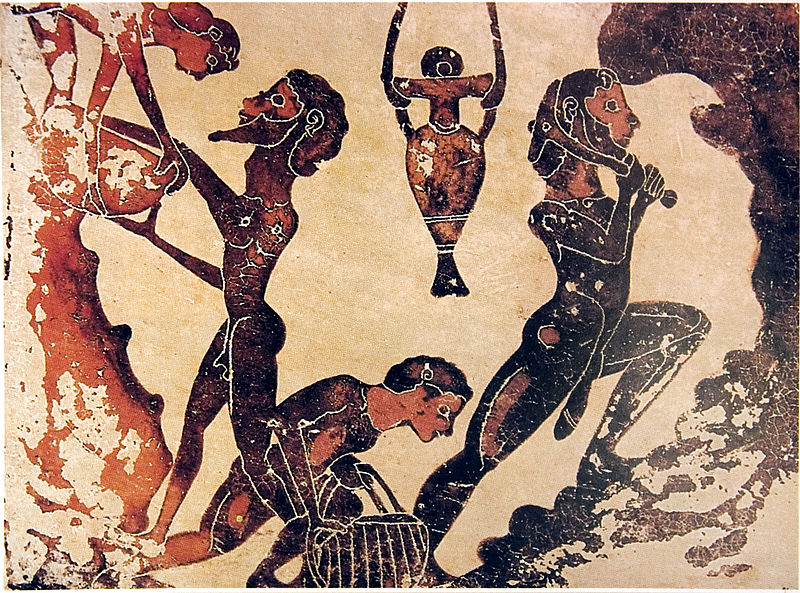
This painting on terra cotta depicts slaves in mines in ancient Greece, ca 5 B.C.
Image is in the public domain.
- 550 B.C. The mighty Greek city-state of Athens uses up to 30,000 slaves in the silver mines it controls.
- 120 Slaves are taken by the thousands in Roman military campaigns; some estimates put the population of Rome at more than half slave.

Tell me all about the Whole of Europe potato famine. As far as I know, the Highlands in Scotland endured something similar which caused under 2 million people to leave Scotland in a 12 year period. There was also a famine in Portugal that led to a revolt, but I'm not sure potatoes were at the root of it. So, I'm interested to hear about this Whole of Europe potato famine. Especially as I'd not mentioned the Irish famine in the post you were quoting.
oh sweet zombie jesus, are we really going to have to do pyramid-slave labor debate? it is SO debunked, by thousands of people. for over half a century. i wouldnt even call it debunked. common knowledge countless phd's, lives devoted to the study, thousands of digs and investigations and papers. id call the idea that they were built by slaves is nothing but religious propaganda. Have you no standards for reality?
yes most cultures owned slaves, now what slave meant is something unique in each of those cultures. Now unless you can show me atleast one good anthropological source for each of the cultures discussed, or are yourself an accomplished cultural anthropologist, i dont feel you have any place to pass judgement over what their conditions were or to compare them.
An anti-slavery site is NOT experts. It is folks with an agenda and I see several MAJOR errors and omissions in their time line.
I did NOT say that the ancients did NOT have slaves, I said that the pyramids were NOT built by them and that slavery was not the same as what we think of. Many slaves were war captives or criminals.
In early Irish law, if you killed a man, and you could not pay the 'blood price' (a figure that would compensate his family for his loss), then you would be given to his family as a slave. (these are the same laws where the fine for killing a cat was enough grain to cover the cat's body when it was held upright by it's tail. That is a nice amount of grain)
Google "prehistoric civil engineering". That should do it. I've seen a few trick videos about how simple the techniques were that were used in the past. Perhaps they're still there. Thank me later when you've made the effort.That's great, at least 4 or 5 posters know all about it. Can you point me to the definitive evidence so I don't have to read all through loads of blurb about 12 nicely buried skeletons proving that slaves didn't exist or were utilised in building the pyramids. I expect there is a great and succinct explanation of how they were built relatively easily as well, inc how they quarried, moved, cut and shaped them and sited them with great accuracy with little effort and in short time. Thanks.
That's great, at least 4 or 5 posters know all about it.
Can you point me to the definitive evidence so I don't have to read all through loads of blurb about 12 nicely buried skeletons proving that slaves didn't exist or were utilised in building the pyramids.
External Quote:We should contrast the evidence of the tombs and of medical treatment with the notion that pharaohs used slave labor to build the giant pyramids, an idea as old as Herodotus. The scenario of whip-drive slaves received support from the biblical account of Moses and the Exodus and the first-century A.D. historian Josephus. In our era, Cecil B. de Mille's galvanizing screen images reinforced this popular misconception. The pyramid builders were not slaves but peasants conscripted on a rotating part-time basis, working under the supervision of skilled artisans and craftsmen who not only built the pyramid complexes for the kings and nobility, but also designed and constructed their own, more modest tombs.
External Quote:Titles found in the tombs are of draftsmen, craftsmen, overseer of the workmen who move the stones, etc. The titles found and the location of the tombs so close to the pyramids, as well as their quality, indicate that the people buried there did, in fact, build the pyramids, and were most certainly not slaves. Slaves would not have been able to build their tombs so close to the tomb of their king. It is also clear that these people who built the pyramids were Egyptian, not from any lost civilization.
The layout of the cemetery of the pyramid builders further supports the idea that the workmen were divided into gangs, and that each gang had an overseer and a name. For example, the name of the gang "friends of Khufu" is recorded in the 5 relieving chambers above the king's burial chamber in the Great Pyramid.
We also know from the excavations in the area east of my work, that the workmen slaughtered about 11 cows and 33 goats every day, which could feed around 10,000 workmen a day. Herodotus recorded that there were 100,000 workmen who built the pyramids, but from estimates of how many people it would take to move the amount of stone needed to build the pyramids, and the amount of food available, 10,000 workmen is the best estimate.
On Monday, the press gathered at the site of Giza to ask me questions about who built the pyramids and what this new discovery says about them. They were especially interested in what this discovery tells us about who built the pyramids. The two topics I was asked the most questions about were slaves building the pyramids, and whether the pyramid builders were Egyptian or not. My answer to the first is that there is no way the builders of the pyramids were slaves. The location of these tombs near the pyramids proves this, as there is no way slaves would have been allowed to build their tombs so close to the king. Also, although slavery could build huge buildings, it could never construct something as genius as the pyramids. As to the second issue, it is clear that the pyramid builders were Egyptian from our new discoveries. The tombs are in Egyptian style, and we have examined the bones of the pyramid builders, they were definitely Egyptian.
External Quote:It was also essential to have willing workers with the necessary skills. Having visited the tombs of the workers and artisans at Giza -- those whose own statements, written in their tombs, bespeak the pride they felt working on the pyramids -- I find it inconceivable that slaves were involved. The tombs contain multiple generations. Father and son worked at Giza, and entire families were buried there. These people obviously took great pride in their work, and many of their tombs are smaller, pyramid-shaped versions of Khufu's tomb.
'What could motivate people to dedicate their lives to such a demanding project voluntarily? I believe the explanation lies in the fact that construction of the pharaoh's pyramid was an act of national pride, a monumental achievement that symbolized the strength and power of Egypt. I liken it to the Apollo Space Program, undertaken by the United States under the direction of President Kennedy. In a way, the goals were similar: to undertake an enormous challenge, something that had never been done before -- to reach out and touch the sky. As Jaromir Malek suggests, the large-scale building projects pushed by the pharaohs became a catalyst for change in Egyptian society.2 And the fundamental forces that drove the execution of this extraordinary undertaking were rooted in the ancient Egyptians' culture and religion.
The evidence is more than 12 skeletons- its tombs, writings, organizational details. A body of evidence that has been uncovered since 1990.
Perhaps you could provide definitive evidence to the contrary?
Is this the same Zahi Hawass? He seems easily convinced as well. Perhaps he has an agenda... a bit of PR for Egyptian human rights... not so off putting to the tourists? 'Oh yes, the people loved building these, in fact we have to constantly stop the local population from building more of them because they have little to do and they just love it so much'.External Quote:The modest 9ft deep shafts held a dozen skeletons of pyramid builders, perfectly preserved by dry sand along with jars of beer and bread for the afterlife.
The mud-brick tombs were uncovered last week near the Giza pyramids, stretching beyond a burial site first found in the 1990s and dating to the 4th dynasty (2575BC to 2467BC), on the fringes of the present-day capital, Cairo.
Graves of the builders were first found nearby in 1990 by a tourist. Egypt's chief archaeologist, Zahi Hawass, said the finds show the workers were paid labourers, rather than slaves.
I didn't know you could be convinced so easily. I'll bear that in mind.
So how many skeletons of the thousands of 'workers', are we actually talking about.
Is it possible they may be key figures such as architects, engineers and masons?
Might that account for their special burial privileges and working conditions?
http://www.guardian.co.uk/world/2010/jan/11/great-pyramid-tombs-slaves-egypt
Is this the same Zahi Hawass? He seems easily convinced as well. Perhaps he has an agenda... a bit of PR for Egyptian human rights... not so off putting to the tourists? 'Oh yes, the people loved building these, in fact we have to constantly stop the local population from building more of them because they have little to do and they just love it so much'.External Quote:The modest 9ft deep shafts held a dozen skeletons of pyramid builders, perfectly preserved by dry sand along with jars of beer and bread for the afterlife.
The mud-brick tombs were uncovered last week near the Giza pyramids, stretching beyond a burial site first found in the 1990s and dating to the 4th dynasty (2575BC to 2467BC), on the fringes of the present-day capital, Cairo.
Graves of the builders were first found nearby in 1990 by a tourist. Egypt's chief archaeologist, Zahi Hawass, said the finds show the workers were paid labourers, rather than slaves.
Can you provide any evidence to the contrary?External Quote:Dieter Wildung, a former director of Berlin's Egyptian Museum, said it is "common knowledge in serious Egyptology" that the pyramid builders were not slaves. "The myth of the slaves building pyramids is only the stuff of tabloids and Hollywood," Wildung said. "The world simply could not believe the pyramids were build without oppression and forced labour, but out of loyalty to the pharaohs."
Apparently is not just Hawass:
Can you provide any evidence to the contrary?External Quote:Dieter Wildung, a former director of Berlin's Egyptian Museum, said it is "common knowledge in serious Egyptology" that the pyramid builders were not slaves. "The myth of the slaves building pyramids is only the stuff of tabloids and Hollywood," Wildung said. "The world simply could not believe the pyramids were build without oppression and forced labour, but out of loyalty to the pharaohs."
Can he or you provide any 'reasonable', 'believable', 'substantive' evidence to back up his 'common knowledge'. Surely if it is that 'common', there must be lots of 'actual evidence' out there. Or maybe just a dozen or so skeletons is all it takes?

You keep pretending that the evidence is just 12 skeletons- when its the tombs built for them (slaves don't get tombs), its the inscriptions indicating labor division, its the lifestyle habits, medical treatment received, food consumption patterns....
Again- Do YOU have ANY 'reasonable', 'believable', 'substantive' evidence to contrary other than Cecil B DeMille?
(good ol JazzRoc!!! )
First there was NEVER any real evidence that slaves built them. Just some 'stories'. NONE of which came from contemporary sources.
The skeletons and mummys are not the ONLY thing. The way they were fed, the type of housing they had, the lack of pictures showing obvious slaves working. Even grave goods. There is overwhelming evidence that they were NOT slaves.
I really think the 'slave' idea came more from movies, than from anything else. Movies are an outstandingly BAD source of facts. Historical ones are very BAD. I have never been able to watch all of Braveheart. Some things I can ignore, but then the scene of the 'warriors in woad' shows up and I am driven out of the movie. Bright Blue clown makeup (woad is more the color of blue jeans) and woad on warriors of that time period. Woad was used by the early Picts, before there were Scots.
Well Jazzy and I can agree on something so that's good.
Perhaps the thread needs splitting off??? or can we close this down quickly with some 'actual evidence' that slaves were not used?
But you still offer no evidence other than a few people making grandiose statements that suit their agenda.
How many skeletons are we talking about here. I hear 12... you say more... how many.
Even if it were a hundred it would prove nothing as that would appear a reasonable number to have for Master Masons, Architects, Engineers and other professionals. I mean, in the scheme of things, slaves are not likely to be trained up as mathematicians, engineers, architects etc are they?
Google "prehistoric civil engineering". That should do it. I've seen a few trick videos about how simple the techniques were that were used in the past. Perhaps they're still there. Thank me later when you've made the effort.
Ah, caught it with "moving concrete blocks".
As opposed to YOU making grandiose statements to suite your agenda??
Are you purposefully ignoring what I wrote? its not just the skeletons- its the body of evidence including the skeletons- to which I have mentioned several times and you simply ignore.
Never mind that the people who are making the statements are the World's leading experts in the field of Egyptian pyramids...and base their statements off the evidence they have found and I have mentioned.
What exactly is this professor's agenda??:
http://www.ekt.bme.hu/CM-BSC-MSC/WhoBuiltThePyramids.pdf
I guess you would know better...
Again- Do YOU have ANY 'reasonable', 'believable', 'substantive' evidence to contrary other than Cecil B DeMille?
laughing out loud.