"It's Probably Just Starlink": Why That's Not Science – It's Evasion
Written by UAP Files - Jimmy
https://substack.com/@uapfiles
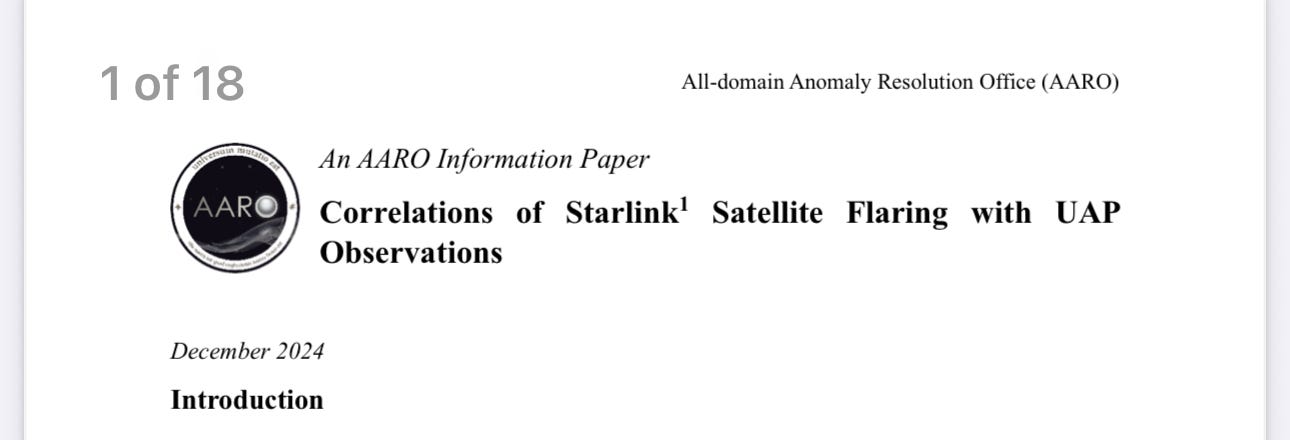
The All-domain Anomaly Resolution Office (AARO) released a detailed technical
paper in December 2024 explaining how Starlink satellite flares — glinting sunlight reflected off their mirrored surfaces — could account for many UAP/UFO sightings.
It's quite thorough. Diagrams. Equations. Azimuths and elevation angles. At one point, I believe I blacked out and woke up in a trigonometry lecture.
And yet — for all its detail — something feels off. Not wrong in the data, but wrong in the assumption that
explaining the light explains the experience.
Let me explain.
We already know sun reflects.
Let's start with the obvious. Yes, the sky has become increasingly cluttered. Yes, we now have over 16,000+ satellites up there including defunct, Starlink and all kinds of classified stuff, and yes, they reflect sunlight in dazzling, sometimes disorienting ways. We know. The astronomy community has been talking about light pollution for years. Nobody disputes that.
But here's the part where we part ways:
"The object zigzagged across the sky, pulsed with light, and responded as I focused my attention on it."
"Ah. Yes. Classic Starlink."
Really?

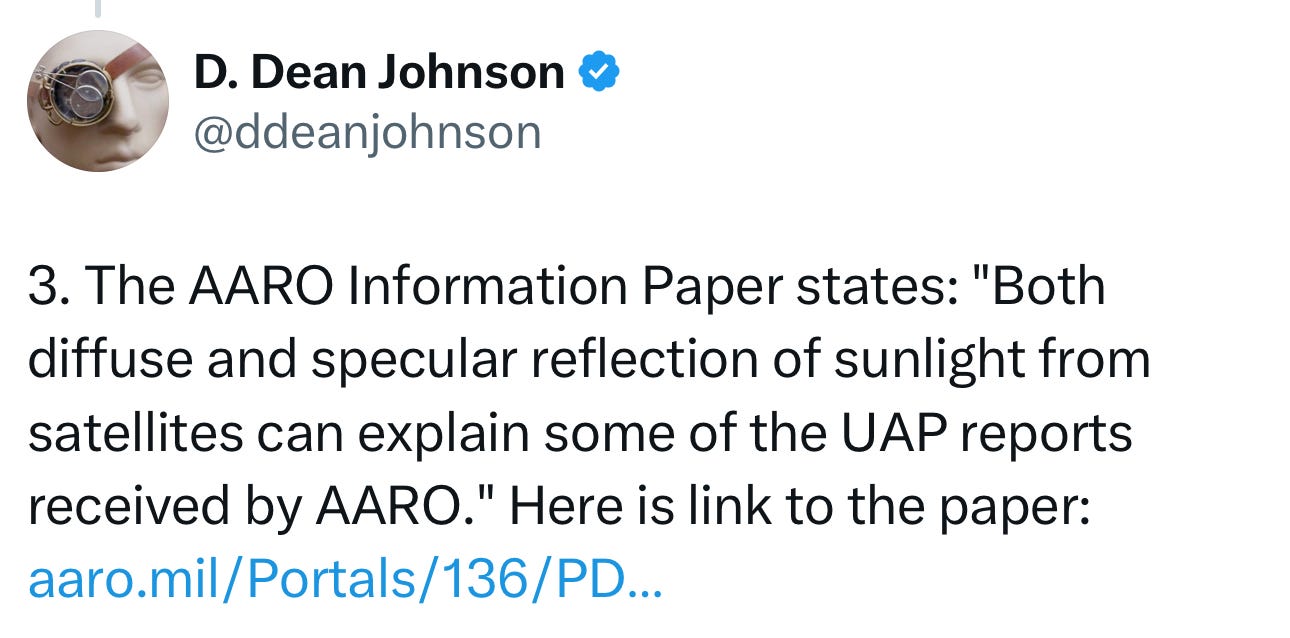
X Post from Douglas Dean Johnson a former political lobbyist turned UFO debunker.
The Flat Earth of UAP Explanations
This is the equivalent of someone describing a profound dream, and you responding:
"Well, dreams are caused by REM cycles and neurochemical shifts."
Yes, thank you — but you've explained the mechanism, not the meaning. You've flattened the human experience to fit a chart.
The AARO paper is impressive — don't get me wrong. It's necessary work. But when a pilot sees multiple lights moving in different directions, near a constellation, appearing to respond to attention or coordinate behaviour, the blanket response of
"just a satellite flare" is, quite frankly, scientific laziness masquerading as scepticism.
Let's entertain this for a moment in the language of "probability," which the AARO paper leans on heavily:
If someone reports a light in the sky, and there are Starlink satellites visible at that time, then the probability increases that the observation correlates with known space objects.
Fair enough.
But here is the thing…
"So… let me get this right. You saw a bright orb zigzagging, it flashed when you spoke to it, and you felt… what, a kind of connection?"[/center]
"Yes."
"And your first instinct was… Starlink?"
It would be funny if it weren't so patronising.

AARO report on Starlink Flaring.
The thing missing from this entire paper — and frankly, from much of the "UAP as optics" discourse — is
us.
The observer.
The witness.
The fact that people are having
profound, sometimes life-changing encounters — not with glints, but with moments that challenge their entire worldview. Something that pulses with intent, plays with geometry, or simply hovers with impossible stillness does not strike most people as a mirror on a stick.
I've interviewed people who have seen and experienced just this. Presented hours of
footage, archive reports connected to it and data that couldn't be debunked (and they tried).
And yet the standard response is:
"You were probably confused."
Let me be clear:
That is pseudoscience.
When you dismiss data (in this case, emotional, psychological, or phenomenological data) because it doesn't match your model, you're not doing science — you're doing selective storytelling with a lab coat on.
I'm not saying satellites can't cause misidentifications. They absolutely can and do. But if we are to treat this topic seriously — and I hope AARO intends to — we must look beyond what reflects, and into what reflects us back.
If thousands of credible people are seeing something they feel is
responding to them — something intelligent, even playful — and your response is, "Well, there was a Starlink nearby," then forgive me, but that sounds more like evasion than explanation.
And if one day, we discover that consciousness really does interact with reality in ways we don't yet understand, well — won't we look silly for calling it a glint?





 When people see a light in the sky and they think it is communicating with them - THAT is pseudoscience!


