In the past few days the US10144532B2 patent has cropped up in discussion in the
Claims of Advanced Tech Recovered from UFOs thread, other patents made by Salvatore Pais have been briefly mentioned.
The USN's Naval Air Warfare Center Aircraft Division, NAWCAD, sponsored Pais' research:
External Quote:
Timothy Boulay, Communications Director at NAWCAD, confirmed several points to
The War Zone by email:
– The High Energy Electromagnetic Field Generator testing occurred from October 2016 through September 2019;
– The cost was $508,000 over the course of three years. Around ninety percent of the total – $462,000 – was for salaries, while the rest was used for equipment, test preparation, testing and assessment.
– When NAWCAD concluded testing in September 2019, the "Pais Effect" could not be proven.
– No further research has been conducted, and the project has not transitioned to any other government or civilian organization.
"The Navy Finally Speaks Up About Its Bizarre "UFO Patent" Experiments",
The War Zone, 01 Feb 2021, Brett Tingley,
https://www.twz.com/39012/the-navy-finally-speaks-up-about-its-bizarre-ufo-patent-experiments
The fact that the project was not transitioned to any other organization is probably relevant, as the claims Pais made for this specific research are extraordinary.
That "the "Pais Effect" could not be proven", though not scientifically worded, is highly relevant- it was, after all, Pais doing the work, for an agency that apparently thought that his claims might be viable.
But, the research mentioned by NAWCAD's Tim Boulay wasn't research into patent US10144532B2, "Craft using an inertial mass reduction device",
https://patents.google.com/patent/US10144532B2/en, submitted April 2016, the triangular aerospace/ submarine craft.
"The High Energy Electromagnetic Field Generator testing" appears to refer to concepts in patent US10135366B2, "Electromagnetic field generator and method to generate an electromagnetic field", submitted 24 August 2015
https://patents.google.com/patent/US10135366B2/en
Like the flying craft patent, the field generator patent was filed by the US Navy. But both patents were submitted before the October 2016 - September 2019 timeframe identified by NAWCAD. It seems Pais worked for, or was at least known to, the USN before October 2016.
At least for the field generator (and I strongly suspect, for the other patents) the USN supported the patents
before experimental work had been conducted.
External Quote:
Beginning in 2015, Pais filed a series of patent applications on behalf of the U.S. Navy that attracted significant media attention. These patents, often referred to collectively as the "UFO patents," describe technologies that would, if feasible, represent dramatic advances beyond the current state of physics and engineering.
...No working prototype of any of the patented inventions was ever developed.
Wikipedia, Salvatore Pais
https://en.wikipedia.org/wiki/Salvatore_Pais
In the field generator patent (US10135366B2), Pais writes
External Quote:
It is a feature of the present invention to provide a method and apparatus for deflecting or destroying a large asteroid and preventing a possible collision with earth. The present invention may also deflect or destroy any other type of object.
It is a feature of the present invention to provide a method and apparatus for generating an impenetrable defensive shield to Sea and Land as well as Space-based military and civilian assets, protecting these assets from such threats as Anti-Ship Ballistic Missiles, Radar Evading Cruise Missiles, Top Attack for Main Battle Tanks (land and sea based systems), as well as counteracting the effects of solar-induced Coronal Mass Ejections...
The Unnecessary Capitalizations reminded me of TMBSPACESHIPS,
https://nitter.net/TMBSPACESHIPS/with_replies whose author claims to be a retired USAF PhD engineer. It was briefly (but not credibly) proposed that the author was William McCasland (
post #183, "Mysterious disappearance of UFO-linked Air Force general sparks search" thread; I had a few thoughts about TMBSPACESHIPS in
post #183. I doubt Pais / TMB are connected, but I think it's interesting that these independent thinkers, covering some similar topics, both have this trait.
Patent US10135366B2 is for an electromagnetic field generator that can raise an "impenetrable defensive shield" against anything from large asteroids and coronal mass ejections to man-portable anti-tank missiles.
It can destroy any object.
These claims are in the patent, submitted by the USN/ Pais before NAWCAD started practical research in October 2016.
Presumably the USN thought the patent was, at least in part, credible. To me it reads more Marvel than Lockheed or MIT.
A casual observer might be forgiven for thinking that significant resources and funding would be made available for such an astonishing technology.
Thinking about the money involved, I did some (very) rough and ready calculations.
$462,000 went on salaries, $46,000 on "equipment, test preparation, testing and assessment."
Pais' NAWCAD research seems to have lasted 35 or 36 months, let's say 35, approx. 152 weeks.
Spending on salaries was $462,000. 152/462,000 = $3039.47 per week.
The average US weekly wage, 4th quarter 2016, was $1,067 (US Bureau of Labor Statistics
https://www.bls.gov/opub/ted/2017/a...est-in-mississippi-in-fourth-quarter-2016.htm)
We don't know the wages of people involved, but if they were (averaged out) near the US average wage, there might have been 3 people involved. I guess it's possible the salary was for Pais alone, but would that be a bit generous for a DoD research scientist?
Whatever, it's a small number of people- Pais and maybe 1, 2 or 3 assistants/ technicians. The more assistants, the lower their salaries and perhaps experience/ qualifications.
Not every day would be a working day, but $46,000 for "equipment, test preparation, testing and assessment" works out over 152 weeks (1064 days) as
$43.23 per day.
The entire equipment/ experimental budget over 35 months is a bit less than the average cost of a new full-size pickup truck in September 2016, $47,004 (Kelley Blue Book
https://mediaroom.kbb.com/2016-10-0...-September-2016-According-To-Kelley-Blue-Book).
Let's suppose the Navy thought
only the most modest claim in Pais' patent might work, that the field generator might protect a main battle tank from a top attack munition (e.g. infantry weapons like NLAW,
https://en.wikipedia.org/wiki/NLAW, which has destroyed main battle tanks in Ukraine).
The only US main battle tank in service now, as in 2015-16, is the M1 Abrams, baseline cost approx. $10 million.
Even if the Pais generator saved
only one M1 (and its 4 crewmen)
ever, a development budget twenty times the size of NAWCAD's investment would have been recouped.
The evidence strongly suggests, after nearly 3 years of Pais getting to conduct practical research into his own proposal, he could not demonstrate to the USN that even this most modest goal was achievable, or that further research was justified.
Pais patents filed by the US Navy include (don't know if there are others):
"
Electromagnetic field generator and method to generate an electromagnetic field", discussed above
US10135366B2, filed 24 August 2015
https://patents.google.com/patent/US10135366B2/en, patent status "Expired - Fee Related"
Would add,
External Quote:
The fission reactor which provides the thermal power to the thermoelectric generator 400 is a pebble bed reactor (PBR) 300 which uses small tennis size uranium balls (9 grams of U238 per pebble)
Maybe Pais means tennis
ball size. Tennis balls are 56-59.4g; a table tennis ball approx. 2.7g. Uranium is
much denser than either.
U238 can't sustain a chain reaction. It isn't a fission reactor fuel.
"
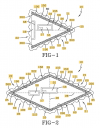
Craft using an inertial mass reduction device", the flying triangle
US10144532B2, filed 28 April 2016
https://patents.google.com/patent/US10144532B2/en, patent status "Expired - Fee Related"
Although there is no reason to believe this could fly at all, Pais discusses a way of making it fly faster than light. In fact he thinks there might be more than one way to make it fly faster than light.
External Quote:
The author discusses the possibility of using exotic matter (negative mass/negative energy density) to bring about this effect. This may not have to be the only alternative.
The craft could also be a submarine,
External Quote:
This hybrid craft would move with great ease through the air/space/water mediums, by being enclosed in a vacuum plasma bubble/sheath...
Vacuum plasma is plasma in a vacuum, not water. As a term, "vacuum plasma" is mainly used in connection with spraying/ coating processes.
"
High frequency gravitational wave generator",
US10322827B2, filed 14 February 2017
https://patents.google.com/patent/US10322827B2/en patent status "Expired - Fee Related"
External Quote:
It is a feature of the present invention to provide a high frequency gravitational wave generator that can be used for advanced propulsion, asteroid disruption and/or deflection, and communications through solid objects.
It's a spacecraft drive (hang on, hasn't Pais already done this?), it's an asteroid destroyer/ deflector (hang on, hasn't Pais...) it's a communications device (ah, something new).
External Quote:
On Feb. 11, 2016 the National Science Foundation publicly announced that the Laser Interferometry Gravitational Wave Observatory (LIGO) finally detected gravitational waves, thereby, showing that gravitational waves exist, further strengthening General Relativity (GR) theory predictions.
In 2016, the NSF, using a 4 kilometre-long instrument, detected gravity waves from two approx. 30 solar mass black holes merging.
One year later, Pais has a design for something that can not only generate detectable gravity waves, it can use them to destroy asteroids.
"
Plasma Compression Fusion Device",
appears to be for a fusion reactor, although Pais doesn't use the term for this design (that I could see),
US20190295733A1, filed 22 March 2018
https://patents.google.com/patent/US20190295733A1/en, patent status "Abandoned"
External Quote:
It is a feature of the present invention to provide a plasma compression fusion device that can produce power in the gigawatt to terawatt range (and higher), with input power in the kilowatt to megawatt range.
It has 3 fairly simple line-drawings, showing us fusion reactor designs don't have to be complex.
"
Piezoelectricity-induced High Temperature Superconductor", wobble a wire conducting pulses of current, it becomes a superconductor.
US20190348597A1, filed 23 August 2019
https://patents.google.com/patent/US20190348597A1/en, patent status "Abandoned"
First 3 lines of application,
External Quote:
The present invention is a high temperature superconductor comprising of a wire, which comprises of an insulator core and a metal coating. The metal coating is disposed around the insulator core, and the metal is coating deposited on the core. When a pulsed current is passed through the wire, while the wire is vibrated, high temperature superconductivity is induced.
Note that the first 2 lines say essentially the same thing three times. It is strange.
How a non-conductive core completely coated by a conducting surface is an insulator isn't explained. It's not insulating anything.
I'm pretty confident I read the phrase "
intergalactic craft" (or intergalactic spacecraft) somewhere in one of the patents, but I can't remember which, and I don't feel like going through them again at the moment.
I think Pais' patents give us three possibilities (although I'm open to other suggestions):
(1) Salvatore Pais is, by a very wide margin, the most important physicist to have ever lived, and the greatest inventor in history.
His ideas pave the way for superluminal flight (using perhaps more than one method). He has
two technologies that can deflect Earth-bound asteroids. An invention that can raise an impenetrable shield and also destroy any object. He has shown us how sustainable nuclear fusion can be achieved with a mechanism so elegant it can be illustrated with 3 simple drawings. And the room-temperature superconductor.
All this was done in four years or so.
(2) Many key claims in the patents are mistaken, but Pais doesn't know this. He believes he has invented, amongst other things, an impenetrable defensive barrier, a means to destroy any object, a simple fusion reactor, a flying craft based on a microwave resonant cavity that might fly faster than light etc. etc.
(3) Many key claims in the patents are mistaken, and Pais knows this but for some reason feels unable to retract/ doesn't want to.
Anyway, all the patents are interesting to some degree or another. I think it's profoundly unlikely that they represent anything useful.
The most interesting thing about them might be why the USN backed them.
I'm becoming less convinced that they might have been deliberate disinformation.