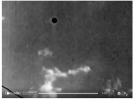
Reddit: First Disc-shaped UAP caught on photographic film; 1950 Louisville, KY

jarlrmai

Senior Member.

Source: https://www.reddit.com/r/UFOs/comments/1lw6p0f/first_discshaped_uap_caught_on_photographic_film/


This video shows a black disc in the sky, the disc does not change much and is completely black with a white glow

But it comes with some fairly specific information for a case from the 1950's

"1950. June 27, 1950. 4:15 p.m. Al Hixenbaugh, a photographer for the Louisville Times, is at the corner of Longest and Everett avenues in Louisville, Kentucky, when he hears the sound of a DC-3 airplane overhead. He looks up and sees the plane as well as a large disc with a slight corona around it. He shoots 50 feet of film with his 16mm movie camera as the object remains motionless for 10 seconds before it starts getting smaller and disappears to the west."

A reddit user suggest that the disc is the possibly the sun, but doesn't provide any followup or justification


Source: https://www.reddit.com/r/UFOs/comments/1lw6p0f/first_discshaped_uap_caught_on_photographic_film/n2bya8b/


However there is an effect called Solarisation

https://en.wikipedia.org/wiki/Solarization_(photography)

"The sun, instead of being the whitest spot in the image, turned black or grey."

It's possible the film was solarised although the exposure time for film is less there are similar effects that are intentional or accidental during the development process like this:

https://en.wikipedia.org/wiki/Sabattier_effect

Can this effect occur in a motion film?
 

Attachments

  • 1752144929326.png
    1752144929326.png
    515.7 KB · Views: 90
It's described as having a "dancing" motion relative to the background. That's the kind of thing you'd see if it were much closer than the background clouds and you were filming it with the inherent small motions of a hand-held camera.

The comments on Reddit also include mention of the complete change of clouds. In other words, it can't be just a single continuous view.
 
The comments on Reddit also include mention of the complete change of clouds. In other words, it can't be just a single continuous view.

Yes, very evident in the video, and not compatible with the claim that the film was shot over approx. 10 seconds.

The clip and description is taken from "The Flying Saucer Mystery", 1952, viewable on YouTube (posted by user TheUfoVideoChannel in 2011). Here it is; I'm not suggesting that watching it is particularly useful:

Source: https://www.youtube.com/watch?v=w-gobjVfFiQ

One of the "stars" is Donald E. Keyhoe, who IMDB lists as "Self - Flying Saucer Advocate (uncredited)", https://www.imdb.com/title/tt0188624/

The Reddit post has a link to a Fandom page with a claimed USAF memo about the film, https://completely-kentucky.fandom.com/wiki/Flying_Disk_Over_Louisville

This is the claimed memo:
Courrier_Journal_Flying_Disk.webp


I have no idea if it is authentic, but it is interesting.

It benefits from careful reading: Essentially, a number of USAF officers had read or heard of a Louisville, Kentucky Courier Journal story about the filming of a flying disc. They wanted to acquire (or at least access) the film and question the cameraman.

It seems to have fallen upon (or been decided by) Lt. Col. O'Connell to contact the Inspector General's Office of the USAF Office of Special Investigations, OSI [not to be confused with the CIA's Office of Scientific Intelligence].
O'Connell was district commander of the 5th OSI District; I first read this as "CSI" which confused me but some other capital "O"s in the memo look like "C"s, e.g.
a.JPG


O'Connell was suggesting that the USAF ask the FBI to take the necessary actions, as he didn't want a USAF interest in the film to be apparent. Why the USAF would want to hide any interest in UFOs is not clear (although it seems to be an item of faith among UFO enthusiasts). The idea of asking the FBI to conduct this particular investigation on behalf of the USAF is bizarre- on what grounds would the FBI be involved? The Louisville Courier Journal withholding evidence of flying saucers not complying with Federally mandated aviation laws?

The response is clear-
External Quote:
4. I have discussed the above matter with Major Nold and he subsequently informed me that he had talked to a representative of the Office of the Director of Intelligence, this headquarters, and that this representative had stated that OSI should not directly or indirectly (through the FBI) attempt to obtain the information indicated above.
(My emphasis). Also- perhaps a little tellingly-
External Quote:
5. Inasmuch as this is a matter under the cognizance of the Counter-Intelligence Division it is herewith referred for further action as necessary, including furnishing telephonic advice to Colonel O'Connell..."
In other words:
Some USAF Officers, including O'Connell (OSI): We want to get this film. We don't want our agents to ask for it. Can we ask the FBI?
OSI Inspector General's Office: No on both counts- you can't get it, and don't ask the FBI to get it.
Oh, and we've got some private advice for Lt. Col. O'Connell...

We don't know how seriously the OSI command took the Courier Journal story or the film.
Maybe they had no interest; if they had an interest they couldn't see a legitimate route to acquiring the film and were unhappy with O'Connell's suggested course of action.
 
However there is an effect called Solarisation

A couple of examples I found on photographer Harlan Erskine's blog, here.
slr 2.JPG


slr1.JPG

External Quote:
Minor White's photograph of a winter scene, The Black Sun 1955, was a result of the shutter of his camera freezing in the open position, producing severe overexposure.
https://en.wikipedia.org/wiki/Solarization_(photography)

Can this effect occur in a motion film?
I don't know, but at times the disc in the film appears to have a white "corona" like in the 1939 photo above.
 
off topic: interesting his name led me to a thorough report on the "1947 ufo flap". Hixenbaugh is part of case #683. Lucky indeed.

the wiki entries for the flap link at least 2 national papers that mention him. [add: i've found 5 national newspapers so far ] It's not really cool to discredit the "witness" but i'm thinking as a professional photographer he was having fun jumping on the UFO bandwagon.

At least he noted locations and times. (unlike most of todays ufo photos and vids). Too bad flight radars dont go back to 1947/1950.
hix 1947.jpg

https://www.academia.edu/10166049/Report_on_Uwave_of_1947_by_Ted_Bloecher?auto=download
 
Last edited:
One thing that I noticed, is that most of the film has black and white dust etc streaks pretty much all over it, but the black 'disc' part is seemingly never affected by dust, which may be an indication of it being something not real in the ie on the film.
 
It's not really cool to discredit the "witness" but i'm thinking as a professional photographer he was having fun jumping on the UFO bandwagon.


I also wonder where the line is drawn when judging a person's character and how it comes into play when assessing a claim.

In the submission statement for this Reddit post by the user Tamashii-Azul, they include multiple links to auxiliary news sources related to the filmed sighting and to the photographer.

One linked PDF contains photocopied articles dated some seven years after the sighting that describes Hixenbaugh's foray into performing as a hypnotist and magician.

https://www.nicap.org/docs/1950_06_26_US_KY_Louisville_Hixenbaugh_Background.pdf

To me that indicates a willingness to deceive in order to get attention and fame.

In my personal worldview not every person has that motivation. So for me it colors this sighting as coming from an unreliable source, making it a likely hoax in my eyes.
 
Note that the "UFO" is never between the camera and the cloud, but is always in a section of clear sky. To me that strongly suggests it's the Sun.

I was also struck by how often it is NOT centered in the frame. Wouldn't we expect that somebody filming a mysterious object would point the camera pretty directly at it?

Based on that, my hypothesis would be that the photographer was shooting cloudscapes, in some of the shots the Sun was present, when the film was developed the Sun looked like a mysterious black orb, so footage without the Sun (or in which the Sun looked like it's usual bright-light self, such as when it might have been dimmed by clouds in front of it) was excised and a UFO film was born. Not a planned hoax, but something the photographer would possibly have recognized as mundane when viewing the film, and for whatever reason decided to pass off as something mysterious.

An obvious objection would be that the "UFO" does not track perfectly with the clouds, it "dances" a bit. But those movements are always very small. I wonder if the black disk produced by solarization is a bit larger than the disc of the Sun and whether it is possible for it to not always be centered exactly on the Sun -- might the Sun be slightly off center depending on where the "UFO is in the frame, or on whether the fringe of clouds might dim it a bit on one side or another? Might this cause the slight jitter, or "dancing," mentioned above?
 
We can check whether it's the sun, or rather, whether the reported details are consistent with the sun.

There's rich information about the time and location of the film: June 27, 1950, 4:15 pm, Louisville, KY, corner of Longest and Everett Aves.

There's some uncertainty about the direction: the news article reprinted by NICAP says he "looked to the west of the plane, which was flying southwest toward Standiford Field - and saw the large disk." However, that's hard to reconcile with the film, where the dot appears slightly to the left of the DC-3, which is purportedly flying toward Standiford Field (now Louisville International Airport) approximately 5 miles south-southwest of his location. If the plane was flying SW or SSW and the dot was west of it, that would be closer to due west, which ought to be right of the plane. It's possible the approach to the runway at this distance would not be straight SW from his location, but it's very hard to reconcile the reported facts with the film.

But let's put it all together.

Google Maps film location (Longest & Everett Aves) and airport direction
IMG_0945.jpeg


Screenshot of plane & black dot
IMG_0938.jpeg


Sun's position on June 27, 1950, 4:15 pm: azimuth 267 degrees, elevation 43 degrees (the sun is almost due west and almost halfway up the sky)
IMG_0942.jpeg


(In case you're wondering, the weather in Louisville around that time was clear with intermittent clouds — so that at least is consistent.)

I don't see any way to reconcile the claimed 1) time, 2) location, and 3) direction with the position of the sun. At the given time and location, for it to be the sun (43 degrees up, nearly due west), the plane's direction would have to be slightly north of due west.

If it was the sun, and the plane's direction as seen from this location really was approaching the airport, the sun's position would be closer to due south, with a quite low elevation, which isn't at all consistent with the reported date in the summer.

So either 1) it is not the sun, or 2) it was not filmed at the place or timed claimed, or both. We know from the widely differing background clouds that this can't have all been filmed in a couple of minutes, so it seems likely that we should doubt at least the time. (Also, consider the credibility of the photographer who had already claimed one flying saucer sighting in 1947, per NICAP, happening to film another one that nobody else saw a couple blocks from his house? "Lucky" indeed.)

Another way to check this might be to look at the shadows in the clouds, to see where the sun actually should be, but I don't know if that's possible.
 
the wiki entries for the flap link at least 2 national papers that mention him. [add: i've found 5 national newspapers so far ] It's not really cool to discredit the "witness" but i'm thinking as a professional photographer he was having fun jumping on the UFO bandwagon.
Yeah, I think your suspicions might be right.

One linked PDF contains photocopied articles dated some seven years after the sighting that describes Hixenbaugh's foray into performing as a hypnotist and magician.
Thanks for the link, an interesting read.

The first article, "HIX-ING The Magic Act" was written by Alan Levy, a Courier-Journal staff writer.
Levy is partly reporting Hixenbaugh's new hypnotism/ magic show, but it is clear he has known him- or at least known of him- for some time (although it isn't clear to me if H. is still working for the Courier-Journal ).
Levy's write-up gives me the impression of being strongly tongue-in-cheek (i.e. implying the subject is not to be taken too seriously)- perhaps there's a hint of sarcasm.

External Quote:

Alfred "Doctor Al" Hixenbaugh is neither a hoax nor a walking typographical error. Al Hixenbaugh is for real. Strictly for real.
Half of Louisville probably has met him already in one of his many capacities- as a full-time photographer for the The Courier-Journal and The Louisville Times for almost 15 years... occasional lecturer (on photography)... and hypochondriac (alternatively beset by migratin' headaches and ulcers).
That last line doesn't strike me as being overly friendly or respectful.

External Quote:
Being strictly for real, he was just himself- the same personality that leaves his friends and co-workers shaking their heads to the tune of: "He must be kidding!"
... ...
Why all this about Al Hixenbaugh? Not because Al's act is particularly exceptional. But many Louisvillians have met Hix -and few will forget the experience. They know they have come in contact with a legend.
Levy writes,
External Quote:
...while he was covering a labor-management dispute that reportedly involved roofing nails scattered on a driveway inside the plant's gate, the only flat tire reported was on the car of Al Hixenbaugh.
...Which might be interpreted as Levy subtly suggesting that Hixenbaugh sometimes misinterpreted events- or had the good luck of, ahem, finding evidence for a juicy story...

Hixenbaugh:
External Quote:
As a photographer, I have always been interested in science, mental telegraphy, outer space, and the power of the subconscious mind. And photography, of course.
So he had the most amazing luck in getting to photograph flying fireballs in 1947 and a flying saucer in 1950.
 
Might this cause the slight jitter, or "dancing," mentioned above?
is it dancing or is the corona dancing, making us think the black is dancing? my question was would the black be that big being the sun.

ironically a freeze frame produced what might be one of those sun/light image things (forget their name now, sorry)... would this show the black should be smaller if the sun? of course the black also shrunk down in this freeze frame.


1752262296880.png
 
The clouds look as if the source of illumination is above and to the right. If the disk were really a "black sun" phenomenon, it's hard to see how the shadows would appear, especially here (red arrow, image from 20 seconds into the video), as that bit of cloud (and others) should receive unobstructed sunlight.
IMG_3291.jpeg
 
The clouds look as if the source of illumination is above and to the right. If the disk were really a "black sun" phenomenon, it's hard to see how the shadows would appear, especially here (red arrow, image from 20 seconds into the video), as that bit of cloud (and others) should receive unobstructed sunlight.
View attachment 82409
Perhaps it is, but is a thinner wisp of cloud and so not bouncing as much light around but is letting more through?
 
The difference in the cloud shapes between jumps in the footage demonstrates clearly the film is not from one continuous take.

It must be very unlikely (relatively slow cloud movement/ shape changes in each clip) that the 6 short clips, combined here into 1 minute 5 seconds of footage, were all taken in a short space of time (e.g. a couple of minutes).

Very approximately, the individual pieces of footage run from 0-4 seconds, 4-18 seconds, 18-24 seconds, 24-33 seconds, 33-46 seconds, 46-65 seconds.

1.JPG

r.png


In some of the clips, you can see an overhead cable at the lower left of the frame.

In the first clip, with the plane, we can see treetops- these are not seen in the other clips (lower edge of frame below) when they should be visible, as the disc was said to be motionless.
d.JPG

Hixenbaugh's account of filming the black disc is not correct; there are several clips probably taken at different times and locations.

But Hixenbaugh only reports seeing and filming the disc once. His account was unreliable, and likely deliberately false.

Whether by exploiting solarization, or by manually interfering with each frame of film- a no-doubt tedious task, but perhaps within his competencies- Hixenbaugh's film is almost certainly a hoax, and not a very convincing one.

The 1952 article by Alan Levy in the Courier-Journal strongly indicates that even those who knew (and maybe worked alongside) Hixenbaugh didn't take his claims particularly seriously re. flying saucers, and perhaps were sceptical about some of his claims regarding some non-esoteric subjects.
 
its only 2000 frames he would have to manipulate by hand :)

If each clip was filmed separately, maybe he altered them at different times, divided the work up a bit.

Roll a frame onto his editing block, use an improvised frame or support to guide a tool for making a small circular impression on the film in the same place each time, make his mark, wind on the next frame and repeat. Boring but doable.

Capture.JPG

(Posted above by @deirdre)

Hixenbaugh's footage with the disc(s) lasts approx. 65 seconds.
To use 50 feet of 16mm cine film in 65 seconds, his camera must have been working at over 30 FPS:

k.JPG


-screen capture from "Film Calculator", Kodak Motion Picture website https://www.kodak.com/en/motion/page/film-calculator/
(The calculator wouldn't accept 30.769 as an input for FPS, which allows a time of 1 minute 5 seconds.)

This seems a little high to me, though I know almost nothing about the subject.

Of course Hixenbaugh might not have used exactly 50 ft of film, but 1 minute 5 seconds at 24 FPS (a common speed for hobbyist 16mm cameras as far as I understand) only uses 39 feet of film:
k2.JPG
 
On looking around a bit, my concerns re. the likely FPS of Hixenbaugh's film aren't well-founded, particularly as the claim of 50 foot of film used may well be be an approximation.

The Bolex H-16, from all the way back in 1935, has a variety of speeds
External Quote:
VARIABLE SPEED: 8, 16, 24, 32 and 64 frames per second with the ability to change speeds while the camera is running.
Bolex Collector website, http://bolexcollector.com/cameras/h16.html (note website not secure).
The Bolex H-16 could carry 50 or 100 foot of film.

I guess there would have been equivalent cameras from other manufacturers.

Again; 65 seconds of footage at 24 FPS only uses 39 feet of film, but 52 feet at 32 FPS will run for 65 seconds (2080 frames), https://www.kodak.com/en/motion/page/film-calculator/

That said, it must be likely that the 65 second film is a splice of 6 separate clips, (the rapid changes in cloud patterns, the disappearing treetops), so Hixenbaugh's account remains extremely questionable- I think dismissible.
 
In none of the 6 apparently separate clips- totalling approx. 65 seconds- does the disc appear to move much relative to the 'nearby' clouds, which itself contradicts Hixenbaugh's claim that the disc was motionless for 10 seconds: It appears to have been motionless for very roughly 4, 14, 6, 11, 13 and 18 seconds respectively!

The treetops/ foliage visible in the first few seconds of footage, but not later, undermine Hixenbaugh's claim just as much as the rapid changes of cloud pattern with each jump-cut:

Capture.JPG


H.jpg


Where have the trees gone?
I guess it could be argued that Hixenbaugh might have zoomed in on the object, but the modest changes of the disc's size and the inclusion of overhead cables at the lower left of the scene in some clips, but not in the first, indicate this isn't so.
 
How this could be done by a low level pro-photographer with limited resources but a lot of patience and motivation. I haven't read other explanations yet, so this is solely my take. Everything is based on known, vintage techniques.

Things to notice:

-The spot remains in the same position relative to clouds, even as it wanders through the frame due to camera movement
-The spot is featureless
-Spot is a hexagon
-It has a halo
-It's a bit jittery; meaning it changes position relative to the clouds slightly.


Hand Painting
Paint the POSITIVE print frame by frame with ink, water color or some kind of dye. Most likely India ink. I obnoxiously put the word positive in all caps in order to avoid confusion. The film in the camera would be the negative. A positive print is produced to put in the projector. That's the one you would paint on.

Then another negative would be made with that altered positive print. Then another positive print, or prints, would be made from that negative.

How to explain the "halo" - India ink is mostly water. Water has surface tension. Even a thin layer of India ink on the film will tend to be thickest in the middle and thinner toward the edges. The center of the splotch is solid but the edges get more and more translucent.

Jittery effect: Self evident. This is done by hand. Can't be expected to be perfect.

Hexagon shape: Maybe a stencil was produced and used to produce a consistent shape while brushing on the ink. The most straight forward way to make the stencil would be cutting a hole in card stock or whatever with a razor blade. Straight edges are easier to cut than a round hole. (May make halo even more evident as the ink might bleed under the edges of the stencil and produce a super thin layer.

You would use the clouds as a reference as to where to put the splotch in each frame.


Animation Stand
Thing to note is that the splotch would be tiny in each frame of 16mm film. A more advanced method would be to produce paper prints of each frame to a good size. Produce paper prints, each with a black spot, and use an animation stand to produce a new in-camera negative. This is the method used to make animated cartoons.

Hobbyists at the time messed around with animation stands... for fun. Including simple home made versions.

unnamed (1).jpg


Halo: Shape on each print was done by masking the print with a hexagonal hole. First you expose the print as normal. Then place the mask over the print that has a single hexagonal hole in it, and "burn in" a black spot through the hole. There's a bit of light bleed around the edges.

Jitter: Each print is hand made. Can't expect perfect results.


Single Large Print
Make a single large print for each scene - with spot - and wave a hand held movie camera over it. Clouds don't move noticeably during the short clip so who's to know the difference?

Doesn't fit because of the jitter.


Emulsion Scratch
Scratch the emulsion away from the camera negative with a razor/blade. That leaves a hole in the negative and naturally that hole is going to let the maximum amount of light through during the printing process and will produce a black spot on the positive print. This was a very common method of "improving" prints in the days of glass negatives. Hard to do on roll film, and again we have to consider the tiny size on a frame of 16mm film... but possible. I rate this as very unlikely.

It is interesting however that the spot is in the form of a hexagon. It's easier to scratch the spot with straight edges.

Halo: Diffraction effects around the edges of the hole in the emulsion.


Under Table Suspect: In-camera matte techniques

This technique was used in the 1933 version of The Invisible Man.

Very hard to do with limited resources. And why produce a featureless spot? If you went to the trouble of using this technique, why not produce a film with a detailed model?

Halo and jitter: This technique can produce these effects.


None of these are really likely. Needlessly difficult and laborious.

 
Last edited:
Most Likely Suspect: Our old friend, the black paper cutout on a sheet of glass. (Or electrical tape, or paint, or whatever.) This black object is more of a silhouette than an image of the thing producing the silhouette.

Halo: Internal reflections in the sheet of glass. The sky is bright and I think direct sunlight is hitting the glass either on the camera side or the far side. Lots of light bouncing between the inner surfaces of the glass. Because the light path is slightly longer with each bounce and the light spreads out, the silhouette of the cutout is surrounded by ghost images which are larger than the cutout. This would be true if the cutout were either on the top surface of the glass or the bottom surface.

But I'm guessing that the cutout was on the camera side. The ghost image was produced by the Sun's rays illuminating the top surface of the cutout - the surface that's stuck to the glass. That light bounces up to the inner surface of the far side of the glass sheet and back toward the camera. Because the light path is longer, and the light has spread out a bit, the cutout is surrounded by a ghost image that's slightly bigger than itself. There could be more than one ghost image. Each fainter and larger. The silhouette thus appears to be surrounded by a halo of light.

That's a simple scenario. It could have been much more complex... but you get the idea. And note that the halo is more or less noticeable across different shots.

Jitter: Due to parallax effect. As the handheld camera wanders around there's a parallax effect between the nearby cutout and the distant clouds.

Jitter effect is enhanced by the changing internal reflections/ghost images.

This is by far the simplest method. Well known to a pro-photographer at the time.

An experienced photographer would have been able to hold the camera steady. I think the unsteady-cam was part of the trick.

The parallax effect was probably meant to be a feature rather than a bug. By waving the camera around, the resultant parallax effect was meant to give the impression that the flying saucer was moving about. His mistake was in using a static sheet of glass. Adamski did this much better, years later, by moving the camera and the glass at the same time.

That there are obvious cuts was also meant to be a feature. This was meant to imply that the saucer was moving slowly to the west. A 16 mm movie camera of this type only had a few minutes worth of film. If you were conserving the film - as the saucer moved slowly and undramatically - you'd want to film it intermittently rather than continuously. What if you used up your reel and then it started to do something dramatic?

The changes in the scene were caused by different set ups. Another not very convincing trick. Particularly unconvincing because it's the same size and same shape the whole time. This is same problem you'd have with a flat disk shaped Moon, if you remember that.

https://www.metabunk.org/threads/fl...ing-by-the-moons-appearance.7358/#post-181053
A flat moon would look like an oval from most spots on earth at any one time. The farther away it was the more oval it would be. Anyone should have an intuitive feeling for that from life experience.
37103446d99b63dd72be4ea50d275bbb.jpg

If this thing were a flat hexagon, okay it would look like a hexagon when you look straight up at it. But as it moved away it wouldn't look like that anymore, would it?


But it was early days. Cut him some slack. It was good enough to get in the news.
 
Last edited:
I wondered if Hixenbaugh had inadvertently filmed the lower edge of a sheet of glass at 60 seconds (second picture below), but comparing it with the footage immediately before and after, I think it's some sort of flaw or damage to just one frame (or a small number of adjacent frames). Not sure though.

Capture 1.JPG


Capture 2.JPG

Capture 3.JPG
 
If it was the sun, and the plane's direction as seen from this location really was approaching the airport, the sun's position would be closer to due south, with a quite low elevation, which isn't at all consistent with the reported date in the summer.
your post must have been stuck in the approval queue, glad i saw it eventually!!

if these trees were smaller ..couldnt the sun be here? i suck at degrees but it looks like half way up the sky.

1752528704006.png


of course i cant reconcile where he was to get the phone lines to match up. guessing they were in the same area as they were on that side in 1920 too. (i also suck at direction spatially..so if he was facing west and the plane..would not be SW?? << just asking about the sun height really for now.

1.jpg


edit add.
duh. i guess he could have been facing this way and the phone lines would be ok (told you i suck at spatial postioning!)
sun.jpg
 
Last edited:
I've read the comments about solarization - better term would be emulsion burnout or overexposure burnout.

This is not credible because the spot shows well defined edges - a hexagonal shape - and the shape is consistent across frames. Emulsion burnout involves halation and each frame would produce a blob of different shapes. That's as far as you need to go without listing the other problems.

I briefly fantasized about emulsion burnout due to a super bright lens flare with the hexagonal shape caused by the aperture. But does not compute.
 
Last edited:
I've read the comments about solarization - better term would be emulsion burnout or overexposure burnout.

This is not credible because the spot shows well defined edges - a hexagonal shape - and the shape is consistent across frames. Emulsion burnout involves halation and each frame would produce a blob of different shapes. That's as far as you need to go without listing the other problems.

I briefly fantasized about emulsion burnout due to a super bright lens flare with the hexagonal shape caused by the aperture. But does not compute.
Could the spot be done on the negatives with an ice pick or a needle?
 
Back
Top